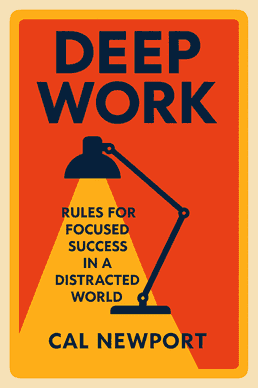
Deep Work: The Superpower of Focus
Constant interruptions are eroding our ability to do meaningful work. Learn how to reclaim your attention and master the rare skill of intense focus.

Melhor citação de Deep Work: The Superpower of Focus
The ability to focus intensely is becoming more valuable at the exact same time it is becoming more rare. If you can cultivate this capacity for depth, you will have a massive competitive advantage in an economy that rewards the elite and punishes the shallow.
Generated with BeFreed
An audio lesson about the book Deep Work, covering its key ideas and takeaways.


Perguntas frequentes
Deep Work is the ability to focus without distraction on a cognitively demanding task. In the twenty-first century, it has become a superpower because the capacity for intense concentration is becoming increasingly rare at the exact same time that its economic value is rising. While most people are losing their ability to go deep due to constant digital interruptions, those who cultivate this skill gain a massive competitive advantage by being able to master hard things quickly and produce elite-level results in both quality and speed.
Focusing intensely triggers a biological process called myelination. During this process, the brain builds fatty tissue called myelin around neurons, which allows electrical signals to travel faster and more efficiently. This neural growth is essential for learning complex skills and performing at an elite level. Conversely, constant distraction prevents this growth, essentially leaving the individual with a "leaky" brain that struggles to retain or process difficult information.
Attention residue occurs when you switch from a deep, cognitively demanding task to a quick distraction, such as checking an email or a message. Even after you return to your original work, a part of your brain remains stuck on the previous distraction. This residue significantly lowers your performance and cognitive capacity on the hard task. To avoid this, high achievers often batch their work into intense blocks to ensure they are giving their full intensity of focus to one thing at a time.
There are four primary strategies for scheduling deep work depending on an individual's professional needs. The monastic philosophy involves cutting oneself off from the world almost entirely. The bimodal philosophy involves splitting time between periods of deep isolation and periods of normal activity. The rhythmic philosophy focuses on creating a consistent daily habit or routine of deep work. Finally, the journalistic philosophy involves switching into a deep work state at any moment whenever a free block of time arises in an unpredictable schedule.
Downtime is not just rest; it is a requirement for peak cognitive performance. According to Unconscious Thought Theory, the unconscious mind continues to work on complex problems while the conscious mind is resting, often leading to breakthroughs that focused thought couldn't achieve. Additionally, "directed attention" is a finite resource that must be recharged. Implementing a strict "shutdown ritual" at the end of the workday helps eliminate the Zeigarnik effect—the brain's tendency to worry about unfinished tasks—allowing for the true mental recovery necessary for deep work the following day.
Criado por ex-alunos da Universidade de Columbia em San Francisco
"Instead of endless scrolling, I just hit play on BeFreed. It saves me so much time."


"I never knew where to start with nonfiction—BeFreed’s book lists turned into podcasts gave me a clear path."


"Perfect balance between learning and entertainment. Finished ‘Thinking, Fast and Slow’ on my commute this week."
"Crazy how much I learned while walking the dog. BeFreed = small habits → big gains."
"Reading used to feel like a chore. Now it’s just part of my lifestyle."

"Feels effortless compared to reading. I’ve finished 6 books this month already."
"BeFreed turned my guilty doomscrolling into something that feels productive and inspiring."

"BeFreed turned my commute into learning time. 20-min podcasts are perfect for finishing books I never had time for."
"BeFreed replaced my podcast queue. Imagine Spotify for books — that’s it. 🙌"

"It is great for me to learn something from the book without reading it."
"The themed book list podcasts help me connect ideas across authors—like a guided audio journey."
"Makes me feel smarter every time before going to work"
Criado por ex-alunos da Universidade de Columbia em San Francisco
"Instead of endless scrolling, I just hit play on BeFreed. It saves me so much time."
"I never knew where to start with nonfiction—BeFreed’s book lists turned into podcasts gave me a clear path."
"Perfect balance between learning and entertainment. Finished ‘Thinking, Fast and Slow’ on my commute this week."
"Crazy how much I learned while walking the dog. BeFreed = small habits → big gains."
"Reading used to feel like a chore. Now it’s just part of my lifestyle."
"Feels effortless compared to reading. I’ve finished 6 books this month already."
"BeFreed turned my guilty doomscrolling into something that feels productive and inspiring."
"BeFreed turned my commute into learning time. 20-min podcasts are perfect for finishing books I never had time for."
"BeFreed replaced my podcast queue. Imagine Spotify for books — that’s it. 🙌"
"It is great for me to learn something from the book without reading it."
"The themed book list podcasts help me connect ideas across authors—like a guided audio journey."
"Makes me feel smarter every time before going to work"
"Instead of endless scrolling, I just hit play on BeFreed. It saves me so much time."
"I never knew where to start with nonfiction—BeFreed’s book lists turned into podcasts gave me a clear path."
"Perfect balance between learning and entertainment. Finished ‘Thinking, Fast and Slow’ on my commute this week."
"Crazy how much I learned while walking the dog. BeFreed = small habits → big gains."
"Reading used to feel like a chore. Now it’s just part of my lifestyle."
"Feels effortless compared to reading. I’ve finished 6 books this month already."
"BeFreed turned my guilty doomscrolling into something that feels productive and inspiring."
"BeFreed turned my commute into learning time. 20-min podcasts are perfect for finishing books I never had time for."
"BeFreed replaced my podcast queue. Imagine Spotify for books — that’s it. 🙌"
"It is great for me to learn something from the book without reading it."
"The themed book list podcasts help me connect ideas across authors—like a guided audio journey."
"Makes me feel smarter every time before going to work"
"Instead of endless scrolling, I just hit play on BeFreed. It saves me so much time."
"I never knew where to start with nonfiction—BeFreed’s book lists turned into podcasts gave me a clear path."
"Perfect balance between learning and entertainment. Finished ‘Thinking, Fast and Slow’ on my commute this week."
"Crazy how much I learned while walking the dog. BeFreed = small habits → big gains."
"Reading used to feel like a chore. Now it’s just part of my lifestyle."
"Feels effortless compared to reading. I’ve finished 6 books this month already."
"BeFreed turned my guilty doomscrolling into something that feels productive and inspiring."
"BeFreed turned my commute into learning time. 20-min podcasts are perfect for finishing books I never had time for."
"BeFreed replaced my podcast queue. Imagine Spotify for books — that’s it. 🙌"
"It is great for me to learn something from the book without reading it."
"The themed book list podcasts help me connect ideas across authors—like a guided audio journey."
"Makes me feel smarter every time before going to work"




![Deep Work: Meaning, Benefits, and 7 Ways to Focus Today [2025] • Asana](/_next/image?url=https%3A%2F%2Fd1y2du6z1jfm9e.cloudfront.net%2Fassets%2Fpodcast%2Fyellow.png&w=1024&q=50)