AI and the Cure for Baumol’s Cost Disease | Podcast
Explore how artificial intelligence may solve Baumol’s Cost Disease, a theory by William Baumol and William Bowen regarding rising costs in stagnant labor sectors.
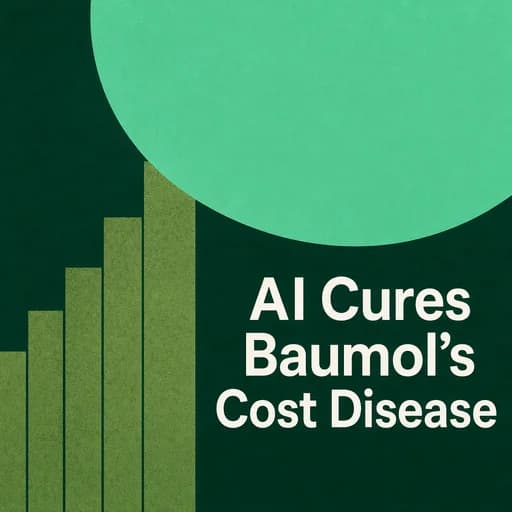
Melhor citação de AI and the Cure for Baumol’s Cost Disease | Podcast
Growth in an economy is often constrained not by what we are good at, but by what is essential and yet hard to improve. If professional judgment remains hard to improve, it becomes the bottleneck for the entire economy.
Generated by Yasmeena Faycurry
William Baumol's cost disease theory, specifically focusing on how AI impacts this phenomenon within knowledge services and professional labor.






Perguntas frequentes
Baumol’s Cost Disease is an economic theory introduced by William Baumol and William Bowen in 1966. It describes a paradox where costs in labor-intensive sectors, such as the arts, education, and healthcare, rise faster than the rest of the economy. This happens because these sectors rely on human labor as the product itself, making it difficult to increase productivity compared to manufacturing or shipping.
The string quartet example shows that some tasks require a fixed amount of labor and time regardless of technological progress. A Mozart piece performed in 1826 required four musicians and forty minutes, and it requires the exact same resources in 2026. Because the productivity of these performers hasn't changed in two centuries, these services become relatively more expensive as other parts of the economy become more efficient.
Historically, knowledge work and professional services were considered stagnant sectors because human judgment and intuition were difficult to mechanize. However, artificial intelligence is now challenging the assumption that these fields are destined to become less efficient over time. AI is shifting from a simple tool to a technology that could potentially cure Baumol’s Cost Disease by increasing productivity in professional services and labor-heavy industries.
Criado por ex-alunos da Universidade de Columbia em San Francisco
"Instead of endless scrolling, I just hit play on BeFreed. It saves me so much time."


"I never knew where to start with nonfiction—BeFreed’s book lists turned into podcasts gave me a clear path."


"Perfect balance between learning and entertainment. Finished ‘Thinking, Fast and Slow’ on my commute this week."
"Crazy how much I learned while walking the dog. BeFreed = small habits → big gains."
"Reading used to feel like a chore. Now it’s just part of my lifestyle."

"Feels effortless compared to reading. I’ve finished 6 books this month already."
"BeFreed turned my guilty doomscrolling into something that feels productive and inspiring."

"BeFreed turned my commute into learning time. 20-min podcasts are perfect for finishing books I never had time for."
"BeFreed replaced my podcast queue. Imagine Spotify for books — that’s it. 🙌"

"It is great for me to learn something from the book without reading it."
"The themed book list podcasts help me connect ideas across authors—like a guided audio journey."
"Makes me feel smarter every time before going to work"
Criado por ex-alunos da Universidade de Columbia em San Francisco
"Instead of endless scrolling, I just hit play on BeFreed. It saves me so much time."
"I never knew where to start with nonfiction—BeFreed’s book lists turned into podcasts gave me a clear path."
"Perfect balance between learning and entertainment. Finished ‘Thinking, Fast and Slow’ on my commute this week."
"Crazy how much I learned while walking the dog. BeFreed = small habits → big gains."
"Reading used to feel like a chore. Now it’s just part of my lifestyle."
"Feels effortless compared to reading. I’ve finished 6 books this month already."
"BeFreed turned my guilty doomscrolling into something that feels productive and inspiring."
"BeFreed turned my commute into learning time. 20-min podcasts are perfect for finishing books I never had time for."
"BeFreed replaced my podcast queue. Imagine Spotify for books — that’s it. 🙌"
"It is great for me to learn something from the book without reading it."
"The themed book list podcasts help me connect ideas across authors—like a guided audio journey."
"Makes me feel smarter every time before going to work"
"Instead of endless scrolling, I just hit play on BeFreed. It saves me so much time."
"I never knew where to start with nonfiction—BeFreed’s book lists turned into podcasts gave me a clear path."
"Perfect balance between learning and entertainment. Finished ‘Thinking, Fast and Slow’ on my commute this week."
"Crazy how much I learned while walking the dog. BeFreed = small habits → big gains."
"Reading used to feel like a chore. Now it’s just part of my lifestyle."
"Feels effortless compared to reading. I’ve finished 6 books this month already."
"BeFreed turned my guilty doomscrolling into something that feels productive and inspiring."
"BeFreed turned my commute into learning time. 20-min podcasts are perfect for finishing books I never had time for."
"BeFreed replaced my podcast queue. Imagine Spotify for books — that’s it. 🙌"
"It is great for me to learn something from the book without reading it."
"The themed book list podcasts help me connect ideas across authors—like a guided audio journey."
"Makes me feel smarter every time before going to work"
"Instead of endless scrolling, I just hit play on BeFreed. It saves me so much time."
"I never knew where to start with nonfiction—BeFreed’s book lists turned into podcasts gave me a clear path."
"Perfect balance between learning and entertainment. Finished ‘Thinking, Fast and Slow’ on my commute this week."
"Crazy how much I learned while walking the dog. BeFreed = small habits → big gains."
"Reading used to feel like a chore. Now it’s just part of my lifestyle."
"Feels effortless compared to reading. I’ve finished 6 books this month already."
"BeFreed turned my guilty doomscrolling into something that feels productive and inspiring."
"BeFreed turned my commute into learning time. 20-min podcasts are perfect for finishing books I never had time for."
"BeFreed replaced my podcast queue. Imagine Spotify for books — that’s it. 🙌"
"It is great for me to learn something from the book without reading it."
"The themed book list podcasts help me connect ideas across authors—like a guided audio journey."
"Makes me feel smarter every time before going to work"

![[0e0b5e2c-a4ef-488b-93bd-68ee55cf8209:c0000] Why SaaS freemium playbooks don’t work in AI, and what to do instead p1-1](/_next/image?url=https%3A%2F%2Fd1y2du6z1jfm9e.cloudfront.net%2Fassets%2Fpodcast%2Fpurple.png&w=1024&q=50)
![[0e0b5e2c-a4ef-488b-93bd-68ee55cf8209:c0001] Why SaaS freemium playbooks don’t work in AI, and what to do instead p1-1](/_next/image?url=https%3A%2F%2Fd1y2du6z1jfm9e.cloudfront.net%2Fassets%2Fpodcast%2Fgreen.png&w=1024&q=50)

![[47b6da3b-a464-4316-8b82-af70cb9bf146:c0001] Rays, >> raise >> Paris. Paris, Paris, Paris. Paris is be… p1-1](/_next/image?url=https%3A%2F%2Fd1y2du6z1jfm9e.cloudfront.net%2Fassets%2Fpodcast%2Fyellow.png&w=1024&q=50)