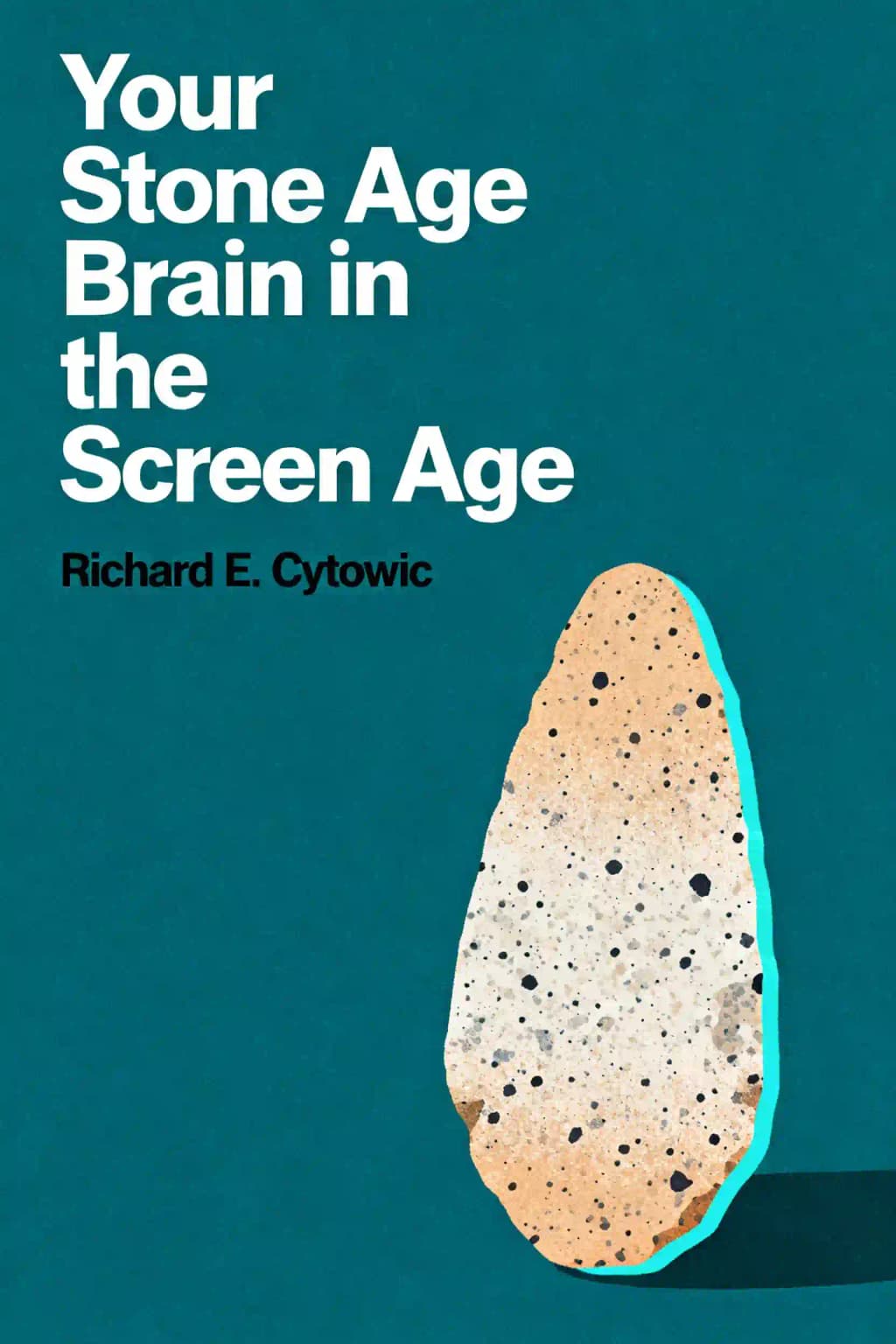
In "Your Stone Age Brain in the Screen Age," neurologist Richard Cytowic reveals why our prehistoric minds struggle with digital overload. Oliver Sacks praised how Cytowic "changed the way we think of the human brain." Can your ancient neural wiring ever adapt to endless notifications?
Richard E. Cytowic, neurologist and pioneering synesthesia researcher, explores digital distraction in Your Stone Age Brain in the Screen Age, merging neuroscience with modern sensory challenges.
A professor at George Washington University School of Medicine, Cytowic reignited scientific interest in synesthesia through bestselling works like The Man Who Tasted Shapes and Wednesday Is Indigo Blue (co-authored with David Eagleman), which won the Montaigne Medal and was praised by Oliver Sacks as "a unique and indispensable guide."
His writing spans academic textbooks, New York Times Magazine features—including a Pulitzer-nominated cover story—and essays blending medical insight with cultural commentary.
Cytowic’s expertise has been featured in TIME, BBC documentaries, and talks at NASA and the Smithsonian. His MIT Press publications establish authority in perception studies, while his latest book addresses how ancient neural wiring collides with today’s digital overload. Over 1.2 million copies of his works have circulated globally, translated into 18 languages.
Your Stone Age Brain in the Screen Age explores how evolutionary biology clashes with modern technology, explaining why our brains—optimized for survival in prehistoric environments—struggle with digital distraction and sensory overload. Richard Cytowic, a neurologist, details mechanisms like dopamine-driven reward systems and the orienting reflex, showing how tech companies exploit these neural pathways. The book offers science-backed strategies to regain focus and reduce screen dependency.
This book is essential for parents, educators, and professionals grappling with digital overstimulation. It’s particularly valuable for those seeking to understand how screens rewire attention spans, harm young developing brains, and undermine learning. Cytowic’s insights also appeal to neuroscience enthusiasts interested in the intersection of biology and technology.
Yes—Cytowic combines rigorous neuroscience with actionable advice, making it a standout guide for navigating screen addiction. Praised for its clarity, the book translates complex concepts like neurotransmitter functions into relatable takeaways. Its blend of evolutionary biology and modern tech criticism offers fresh perspective, earning endorsements from academics and general readers alike.
Key ideas include:
Cytowic recommends:
The book warns that screens condition children to seek instant gratification, impairing patience and deep learning. Developing brains are especially vulnerable to dopamine-driven feedback loops, which may stunt emotional regulation and critical thinking. Cytowic urges limits on screen time and more unstructured play to protect cognitive development.
Some readers may find its neurobiological focus too technical, though Cytowic avoids jargon. Others might desire more policy-level solutions beyond individual strategies. However, its evidence-based approach and practical frameworks are widely praised for bridging science and self-help.
While both address tech overuse, Cytowic’s book emphasizes the why of addiction (Stone Age brain wiring) rather than the how of habit change. It offers a stronger neuroscientific foundation but fewer step-by-step productivity hacks, making it a complementary read to Newport’s tactical guides.
As AI and immersive tech escalate screen time, Cytowic’s warnings about attention erosion and sensory overload grow more urgent. The book’s framework helps readers navigate emerging tools like VR and generative AI without losing cognitive autonomy, making it a timely resource.
Cytowic’s 40+ years in neurology, including pioneering work on synesthesia, grounds the book in clinical expertise. His TED-style storytelling makes complex science accessible, while his critiques of tech draw on firsthand observations of patient struggles with screen addiction.
For further reading, try:
Sinta o livro através da voz do autor
Transforme conhecimento em insights envolventes e ricos em exemplos
Capture ideias-chave em um instante para aprendizado rápido
Aproveite o livro de uma forma divertida e envolvente
Our ancient reward circuits have been hijacked by modern technology.
Attention shifting is metabolically expensive.
The human brain faces fundamental biological limitations.
Media multitasking has particularly concerning implications.
Divida as ideias-chave de Your Stone Age Brain in the Screen Age em pontos fáceis de entender para compreender como equipes inovadoras criam, colaboram e crescem.
Destile Your Stone Age Brain in the Screen Age em dicas de memória rápidas que destacam os princípios-chave de franqueza, trabalho em equipe e resiliência criativa.

Experimente Your Stone Age Brain in the Screen Age através de narrativas vívidas que transformam lições de inovação em momentos que você lembrará e aplicará.
Pergunte qualquer coisa, escolha a voz e co-crie insights que realmente ressoem com você.

Criado por ex-alunos da Universidade de Columbia em San Francisco
"Instead of endless scrolling, I just hit play on BeFreed. It saves me so much time."
"I never knew where to start with nonfiction—BeFreed’s book lists turned into podcasts gave me a clear path."
"Perfect balance between learning and entertainment. Finished ‘Thinking, Fast and Slow’ on my commute this week."
"Crazy how much I learned while walking the dog. BeFreed = small habits → big gains."
"Reading used to feel like a chore. Now it’s just part of my lifestyle."
"Feels effortless compared to reading. I’ve finished 6 books this month already."
"BeFreed turned my guilty doomscrolling into something that feels productive and inspiring."
"BeFreed turned my commute into learning time. 20-min podcasts are perfect for finishing books I never had time for."
"BeFreed replaced my podcast queue. Imagine Spotify for books — that’s it. 🙌"
"It is great for me to learn something from the book without reading it."
"The themed book list podcasts help me connect ideas across authors—like a guided audio journey."
"Makes me feel smarter every time before going to work"
Criado por ex-alunos da Universidade de Columbia em San Francisco

Obtenha o resumo de Your Stone Age Brain in the Screen Age como PDF ou EPUB gratuito. Imprima ou leia offline a qualquer momento.
Imagine picking up your phone 40,000 times a year-that's not science fiction, it's your reality. While tech executives strictly limit their own children's screen time, they've engineered products that keep the rest of us perpetually tethered to our devices. This isn't accidental. Our Stone Age brains-exquisitely tuned through 200,000 years of evolution to detect change and respond to rewards-have met their match in modern technology. That rustling bush that might have signaled danger to our ancestors has been replaced by the ping of a notification, triggering the same ancient survival circuits. The mismatch between our evolutionary programming and digital environments creates a perfect storm for attention capture and addiction-what former Google ethicist Tristan Harris calls "a race to the bottom of the brain stem." The brain's reward system didn't evolve for happiness but survival, driving us to constantly seek more through powerful dopamine pathways. While a smaller endorphin system provides brief satisfaction, the wanting never truly ends. This biological reality explains our compulsive phone-checking despite diminishing returns. Each notification triggers the same dopamine response that once rewarded finding food or avoiding danger. Social media platforms particularly exploit this mechanism through variable reward schedules-you never know which scroll will yield the dopamine-triggering "like," just as our ancestors never knew which berry bush would yield fruit.