Capítulo 4
The Profound Reality of Oneness
The universe-"uni-verse"-means "one song." Despite our strong belief in separateness, we are all part of this harmonious whole. Making this shift in consciousness requires suspending beliefs from our narrow personal perspectives and instead seeing ourselves in relationship to all humanity-past, present and future.
Einstein understood oneness deeply, describing humans as "part of the whole called by us 'Universe'" and our sense of separation as "a kind of optical delusion of consciousness." He saw this delusion as a prison restricting us to personal desires and limited affection. Our task, he believed, must be to free ourselves by widening our circle of compassion to embrace all living creatures and nature's beauty.
To grasp this concept, look inward at your own body-you are literally "an I that is we," teeming with life-forms working in harmony. Just as microorganisms in your toenails never contact those in your eyes yet form part of your whole being, we too are separate yet united parts of the universal whole.
My grandmother gave me my first glimpse of oneness. In her final days at ninety-four, I watched my mother care for her-feeding her mushed banana, changing her clothes, rocking her like a baby. The revelation struck me: who was mother and who was child? Hadn't my now-helpless grandmother once done the same for my mother? I saw life as one big circle, with each of us born into the larger being called Human Being.
My understanding deepened when I encountered the "hundredth monkey" theory-how behavior changes in one group of a species can spontaneously appear in physically disconnected groups once a critical mass is reached. This collective consciousness principle suggests that if enough humans think and act harmoniously, we can transform our entire species.
We can embrace the magnificence of oneness without sacrificing our individuality. Each of us is both a whole composed of countless life particles and simultaneously part of something larger. Looking inward through a metaphorical microscope, I find that a single cell contains everything needed to reproduce my entire being. Yet something invisible-what I call love-holds each cell together. As Teilhard de Chardin noted, "Love is the agent of universal synthesis."
When a cell lacks internal harmony or "ease," it becomes "dis-eased," losing reference to the whole and destroying everything in its path-exactly how cancer operates. Similarly, when we as individuals lose our reference to humanity's wholeness, we act destructively toward others.
To cultivate oneness in daily life, suspend thoughts of separateness for one hour daily, seeing everyone as invisibly connected to you. Examine the limiting labels you apply to yourself-nationality, age, politics-recognizing they create artificial boundaries. Remember you are not your form but the consciousness within. With family, visualize the invisible force connecting you when conflicts arise. Consider your "enemies" as part of the same humanity-you needn't accept geographical or political divisions as reasons for hatred.
Capítulo 5
Embracing Abundance in an Unlimited Universe
Abundance is about endlessness-the infinite potential within a single seed that can produce countless apples. Though we as human forms seem finite, we are connected to the boundless universe through our formless thought nature. Abundance is the universe's response to our belief in scarcity.
The first step to transcend scarcity consciousness is giving genuine thanks for everything you are and have. Focus on what you possess rather than what's missing. Nothing is truly missing in a perfect universe. By appreciating all gifts-water, sun, air, friends, family, possessions-you shift energy to your miraculous existence. While focusing on gratitude, you cannot simultaneously focus on lack.
Whatever occupies your thoughts will grow in your life. Focus on your assets rather than debts, and your assets will expand. Concentrate on wellness rather than illness, and wellness grows. Our thoughts literally become our daily experience.
You are already whole and complete. If you can't enjoy life with what you currently have, new possessions won't bring happiness. Fulfillment comes from how we process life internally, not from externals. The quality of life stems from our choice to feel complete based on our thinking and self-perception.
Abundance isn't acquired but tuned into. The universe contains infinite energy, and everything-including our possessions-is essentially energy. Our emitted energy reflects how we process our world. Needing to own things reveals belief in scarcity. In reality, we can't truly own anything-we merely have temporary possession of objects during our brief lifetime.
To experience abundance, you must transform yourself to be doing what you love and loving what you do-not someday, but now. This is crucial because our days are the precious currency of our lives. When we spend a third of our life in unsatisfying work just to pay bills, we constantly focus on what we dislike, which expands that negativity.
Whether employed or not, your daily activities can be experiences of either abundance or scarcity. Enlightenment has little to do with your daily activities and everything to do with how you view them. You'll still "chop wood and carry water," but with a different perspective-hate is a choice that comes from hateful thoughts, not from circumstances.
Six key reasons explain resistance to abundance consciousness: First, cultural conditioning emphasizes scarcity with beliefs like "there's only so much to go around." Second, people avoid taking responsibility for their scarcity, preferring to blame circumstances. Third, maintaining scarcity consciousness can feel easier than embracing abundance. Fourth, scarcity stories elicit sympathy. Fifth, the "I don't deserve it" pattern convinces people they're unworthy of abundance. Finally, some become so comfortable with scarcity they wouldn't know what to do with abundance.
Capítulo 6
The Freedom of Detachment
In our land of plenty, where we consume vast resources and enjoy unprecedented material wealth, we paradoxically experience profound unhappiness. The more materialistic we become, the less we trust each other. As possessions accumulate, our focus shifts from human connection to ownership, breeding loneliness and even violence.
Detachment offers a solution-not rejecting wealth, but releasing our desperate grip on it. Detachment doesn't mean abandoning success or possessions; ironically, it often brings greater abundance. It's about understanding that our essence exists in thought, not form, allowing us to flow with life rather than fight against it.
Your body operates as an exquisitely perfect energy system requiring no conscious direction from you. Consider eating lettuce: you don't control your salivation, peristaltic muscles, or digestive processes-they happen automatically. The nutrients travel precisely where needed without your intervention. Your heart beats thousands of times daily without your conscious effort.
Just as your body systems function harmoniously without your micromanagement, so too does the universe operate as a system of systems, guided by principles beyond our control. Like the lettuce delivering nutrients throughout your body, you are energy flowing within larger energy systems. Every attachment you form, every possession you cling to, creates resistance in this flow.
In elementary school, I silently pined for Earlene Rentz, never mustering the courage to express my feelings. Years later when we reconnected, she remembered me primarily for my generosity and lack of concern with possessions. This trait followed me through life-while teenage friends obsessed over fancy cars, I contentedly drove my rusty 1950 Plymouth.
Today, I own few luxury items that typically decorate wealthy lives, yet paradoxically, I have access to anything I could desire. The less I concern myself with acquisitions, the more they flow into my life for use and recirculation. The difference between attachment and enjoyment is simple: can you remain undisturbed if something you value disappears?
Our suffering always manifests in form and stems from attachments to externals. I've identified seven common attachments that lead to suffering: stuff (possessions), other people (control rather than loving connections), the past and traditions, your physical form, ideas and being right, money, and winning.
True detachment in relationships means loving others enough to allow them their choices without judgment, while maintaining your own emotional stability. This doesn't mean not caring; rather, it means caring so deeply that you suspend judgment and relate from a position of love rather than control. The paradox is that the less you try to own and control someone, the closer you become.
Capítulo 7
The Mysterious Web of Synchronicity
Synchronicity requires suspending our old ideas about coincidence, mistakes, and imperfection to accept that every event and person is connected in a perfectly operating universe. Carl Jung first described synchronicity as "the simultaneous occurrence of two meaningfully but not causally connected events," suggesting a collaboration between people and events that involves fate.
The fundamental belief is that every life has a purpose and deeper meaning, with an exquisitely perfect intelligence working behind all form in a synchronized fashion. When you trust this principle, you'll recognize its evidence daily and understand there are no accidents.
Synchronicity is a universal human experience-thinking of someone just before they call, experiencing deja vu, or being mysteriously guided to exactly what you need. The more we loosen up and flow with the universe's energy, the more frequently we encounter these phenomena, eventually accepting them as part of existence's mysterious perfection.
I once experienced this when, feeling stuck about my next book, I felt inexplicably compelled to drive to a mall I normally avoided. At the bookstore, one volume was literally falling off the shelf-Abraham Maslow's "The Farther Reaches of Human Nature." Reading it immediately clarified my direction for writing "The Sky's the Limit."
To understand synchronicity, consider the connections we already believe in. The easiest connections are those we directly perceive with our senses-a child pulling a toy with a string. Slightly more challenging are connections we know exist but cannot directly see-the wires inside walls connecting light switches to fixtures.
More mysterious are connections with no physical form at all, like using a remote control to change television channels. Even more fascinating is the ordinary act of conversation-sound waves traveling between mouth and ear, allowing instantaneous communication. Every movement of your body demonstrates the mysterious connection between thought and physical action.
More mysterious still are connections between one person's thoughts and another's physical experience. A mother suddenly knows her baby is crying though she couldn't possibly hear it. A nursing mother's milk comes in precisely when her distant infant is hungry.
The culmination of our understanding of connections is the invisible link between one person's thoughts and another's. Thoughts are formless and dimensionless, impossible to contain physically. This raises profound questions about memory-how can formless thoughts be stored in the physical brain? Perhaps thought exists in a dimension beyond physical form, a spiritual realm without beginnings or endings.
If thoughts exist outside our brains, then synchronicity becomes possible-thoughts meeting thoughts across the universe. We are both the source of thoughts and part of universal thought, allowing us to create connections that appear as "coincidences" but are actually manifestations of our divine connection to the invisible world.
Capítulo 8
The Healing Power of Forgiveness
To achieve true forgiveness, we must rid ourselves of three destructive practices: blame, revenge, and judgment. When we eliminate these, forgiveness becomes unnecessary as we naturally live without needing it.
Blame runs rampant in our culture, as evidenced by the lawsuit explosion. Taking total responsibility for everything in our lives is the antidote. We must recognize that everyone who entered our life was a teacher, and there are no accidents in this perfect universe. Our hatred belongs to us alone-we carry it, own it, become it. The absurdity of blame is that it gives others continued control over our inner life long after their actions. Forgiveness means saying, "I no longer give you power to control who I am."
We live in a world endorsing anger and revenge, constantly at war despite claiming to respect spiritual teachings about forgiveness. Revenge is blame acted out in physical form. Even when revenge is achieved, victims continue feeling pain and hatred, poisoning their souls. When we fill ourselves with love even toward those who harm us and accept the world as it is rather than how we wish it to be, we no longer need anger or revenge.
While blame and revenge can be eliminated completely, judgment can only be reduced, as virtually every thought contains some judgment. The key is reducing negative judgments, remembering they don't alter anything in the universe. When you judge another, you don't define them-you define yourself. Your judgments reveal your own likes and preferences.
True forgiveness embodies the understanding that those who harm others "know not what they do." People inflicting harm act from their own anger and hatred, unable to see our interconnectedness. Like cancer cells with no reference to the whole body, they send out disharmony because that's all they have to give. While victimizers must be held accountable, compassion becomes possible when we recognize our connection to all humans.
At my father's grave in 1974, I experienced a transformative forgiveness that freed me to create a life of abundance and love. Years later, facing an unjust lawsuit, I initially slipped into anger and vengeance that physically and emotionally destroyed me. After two years of legal battles, I remembered the power of forgiveness. The moment I switched from anger to love-sending flowers and books to those suing me-the case was dropped within days.
Giving is the answer to "Why am I here?" Since we can't truly own anything, and attachments block abundance, our purpose is to give of ourselves and keep energy flowing. When your primary objective is giving rather than getting, bitterness and hatred cannot take root. Ironically, the less obsessed you are with getting and the more willing to give, the more you receive.
Living these principles makes you gentler with yourself-this is self-forgiveness. When you accept yourself completely, self-acceptance transforms into self-love, which becomes what you have to give away. Everything you've done is over, and every experience was necessary to bring you to this exact moment. You needed it all to be here now.
Surrendering doesn't mean giving control to others, but trusting in the universal principles that govern our perfect universe. Forgiveness becomes easier with surrender-accepting that everyone is on their own path, doing what they know at the moment. You recognize that every person and experience entered your life for a reason, even those who caused pain.
Capítulo 9
The Miracle of Conscious Living
When we integrate these principles-transformation, thought, oneness, abundance, detachment, synchronicity, and forgiveness-we experience a profound shift in consciousness that transforms our entire experience of life. We begin to see the world not as a series of random events happening to us, but as a perfectly orchestrated symphony responding to our deepest beliefs and thoughts.
This integration doesn't happen overnight. It requires consistent practice, gentle self-correction, and a willingness to release old patterns of thinking. But with each small step, we move closer to experiencing the miracle of conscious living-where we create our reality through our beliefs rather than merely responding to circumstances.
The beauty of this journey is that it's available to everyone. You don't need special credentials, expensive workshops, or years of spiritual training. You simply need the willingness to question your current beliefs and the courage to embrace new possibilities.
Begin by practicing these principles in small ways. When faced with challenges, ask yourself: "What am I believing that's creating this experience?" "How can I shift my perspective to see the perfection in this moment?" "What would love do here?" These questions activate your creative power and connect you to the universal intelligence that orchestrates all life.
As you consistently apply these principles, you'll notice synchronicities increasing, relationships improving, abundance flowing, and a profound sense of peace emerging from within. The world hasn't changed-you have. And in changing yourself, you've changed your entire experience of the world.
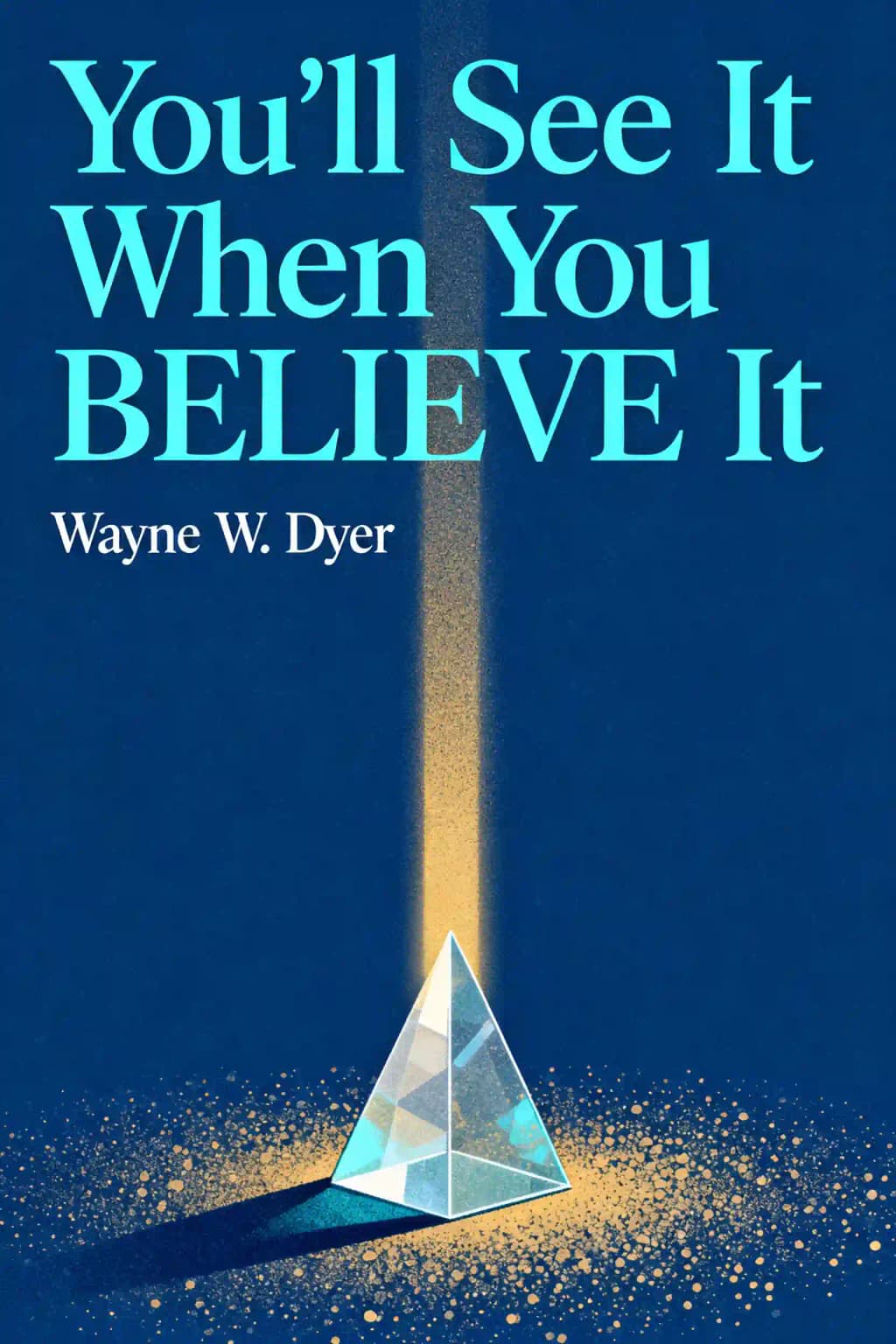
Remember, you'll see it when you believe it. The miracles you seek aren't waiting for you in some distant future-they're available right now, the moment you choose to believe in their possibility. Your life is your masterpiece, painted with the brushstrokes of your beliefs. What magnificent creation will you choose to believe into existence today?