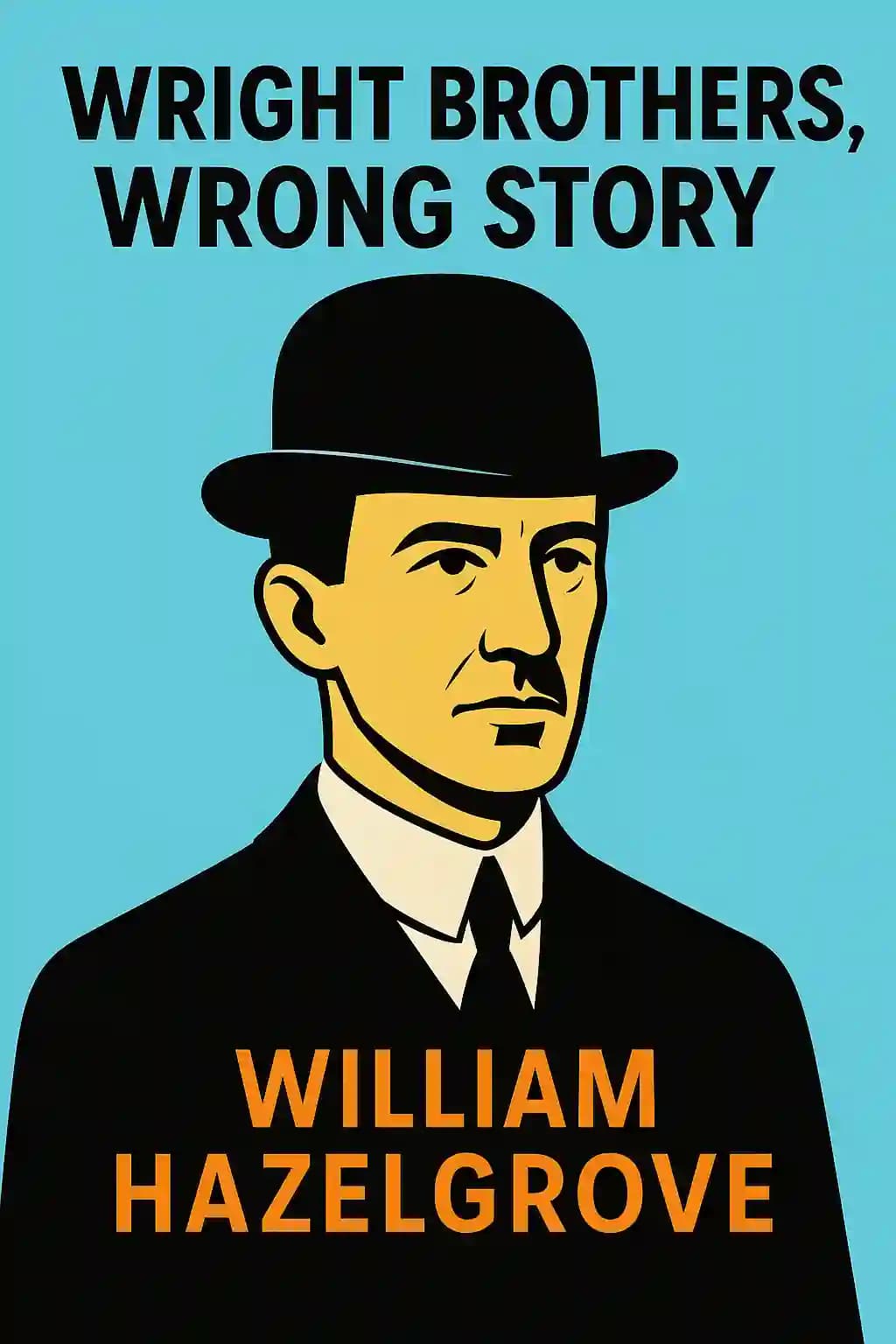
History's greatest aviation myth unraveled: Wilbur Wright was the true genius behind flight, while Orville crafted their legacy after his brother's death. Hazelgrove's controversial research challenges everything we thought we knew - sparking fierce debates among historians about individual genius versus collaborative mythology.
William Elliott Hazelgrove, bestselling author of Wright Brothers, Wrong Story: How Wilbur Wright Solved the Problem of Manned Flight, is a historian and award-winning writer specializing in reevaluating American historical narratives. With a master’s degree in history and 14 nonfiction titles to his credit, Hazelgrove combines rigorous archival research with compelling storytelling to challenge myths, as seen in his deconstruction of the Wright brothers’ partnership.
His works, including Madam President: The Secret Presidency of Edith Wilson and Forging a President: How the Wild West Created Teddy Roosevelt, frequently explore pivotal figures and events that shaped national identity.
Hazelgrove’s books have earned starred reviews in Publishers Weekly and Booklist, along with accolades like the Ohioanna Literary Award finalist designation for Wright Brothers, Wrong Story. A frequent media commentator, his insights have been featured on NPR’s All Things Considered, C-SPAN’s American History TV, and in The New York Times.
As the Ernest Hemingway Writer-in-Residence, he wrote from Hemingway’s attic birthplace, blending literary craftsmanship with historical analysis. His upcoming projects include screen adaptations of Madam President and The Pitcher, underscoring his cross-disciplinary influence.
Wright Brothers, Wrong Story reexamines aviation history, arguing that Wilbur Wright, not his brother Orville, was the true genius behind the first powered flight. William Hazelgrove challenges the traditional narrative, highlighting Wilbur’s technical brilliance and leadership while exploring the brothers' complex family dynamics and rivalry with contemporaries like Samuel Langley and Glenn Curtiss.
History enthusiasts, aviation buffs, and readers interested in biographical reinterpretations will find this book compelling. It appeals to those curious about early 20th-century innovation, patent battles, and the human stories behind historical milestones.
Yes, for its controversial thesis and deep dive into primary sources. While some criticize repetitive prose, the book offers fresh insights into the Wright brothers' lives, their feud with the Smithsonian, and the myth-making around their achievements.
Hazelgrove cites Wilbur’s detailed engineering notebooks, his leadership in patent disputes, and accounts of Orville’s mechanical execution of Wilbur’s designs. The book also analyzes the brothers’ correspondence and their later estrangement over credit for the invention.
It reveals their unconventional household, where neither brother married, and both lived with their father and sister Katharine. Hazelgrove explores how this insular environment fueled their collaboration and later conflicts.
Curtiss, a motorcycle innovator turned aviator, became their rival after modifying their patents. The book details his legal battles with the Wrights and the Smithsonian’s controversial support for Curtiss’s aerodrome.
Yes, it critiques the Smithsonian’s attempt to credit Samuel Langley’s failed aerodrome as the first viable aircraft, a move orchestrated to undermine the Wrights’ legacy. Hazelgrove exposes this institutional bias and its impact on historical narratives.
Critics note occasional factual errors and redundant passages. However, most agree the book’s research and challenge to the “lone inventor” myth outweigh these flaws.
Unlike traditional accounts, Hazelgrove’s work prioritizes Wilbur’s contributions and contextualizes the brothers’ achievements within early 20th-century technological rivalries. It contrasts with David McCullough’s The Wright Brothers, which portrays them as equal partners.
Orville is depicted as a skilled mechanic who executed Wilbur’s visions but struggled with credit-sharing after Wilbur’s death. The book suggests Orville’s later efforts to control their narrative obscured Wilbur’s centrality.
It underscores how historical narratives are shaped by bias and institutional power—a timely theme in an era of reevaluating legacy and credit in innovation. The book also resonates with debates over intellectual property in modern tech.
The author draws on the Wrights’ personal letters, patent documents, and court records, alongside newspapers and Smithsonian archives. Notable is his analysis of Wilbur’s technical journals, which reveal his problem-solving process.
Sinta o livro através da voz do autor
Transforme conhecimento em insights envolventes e ricos em exemplos
Capture ideias-chave em um instante para aprendizado rápido
Aproveite o livro de uma forma divertida e envolvente
Business felt like another prison.
Human flight is possible and practical.
An enthusiast, but not a crank.
The flying problem was left over to the 20th century.
Divida as ideias-chave de Wright brothers, wrong story em pontos fáceis de entender para compreender como equipes inovadoras criam, colaboram e crescem.
Destile Wright brothers, wrong story em dicas de memória rápidas que destacam os princípios-chave de franqueza, trabalho em equipe e resiliência criativa.

Experimente Wright brothers, wrong story através de narrativas vívidas que transformam lições de inovação em momentos que você lembrará e aplicará.
Pergunte qualquer coisa, escolha a voz e co-crie insights que realmente ressoem com você.

Criado por ex-alunos da Universidade de Columbia em San Francisco
"Instead of endless scrolling, I just hit play on BeFreed. It saves me so much time."
"I never knew where to start with nonfiction—BeFreed’s book lists turned into podcasts gave me a clear path."
"Perfect balance between learning and entertainment. Finished ‘Thinking, Fast and Slow’ on my commute this week."
"Crazy how much I learned while walking the dog. BeFreed = small habits → big gains."
"Reading used to feel like a chore. Now it’s just part of my lifestyle."
"Feels effortless compared to reading. I’ve finished 6 books this month already."
"BeFreed turned my guilty doomscrolling into something that feels productive and inspiring."
"BeFreed turned my commute into learning time. 20-min podcasts are perfect for finishing books I never had time for."
"BeFreed replaced my podcast queue. Imagine Spotify for books — that’s it. 🙌"
"It is great for me to learn something from the book without reading it."
"The themed book list podcasts help me connect ideas across authors—like a guided audio journey."
"Makes me feel smarter every time before going to work"
Criado por ex-alunos da Universidade de Columbia em San Francisco

Obtenha o resumo de Wright brothers, wrong story como PDF ou EPUB gratuito. Imprima ou leia offline a qualquer momento.
We've all heard the story: two bicycle mechanics from Dayton, Ohio changed history through sheer determination. But what if everything we thought we knew about the Wright brothers was wrong? The truth is far more complex and fascinating. Wilbur Wright was the true visionary behind human flight, while Orville, though talented, played a supporting role in his brother's quest. This isn't just about invention, but about how history is shaped by those who survive to tell it. In 1884, an eighteen-year-old Wilbur was struck in the face with a hockey stick during a game on a frozen pond. This seemingly minor incident altered the course of aviation history, knocking out several teeth and plunging him into a three-year depression, forcing him to abandon his Yale plans and remain confined to his Dayton home. During this period of isolation, Wilbur underwent a profound intellectual transformation. He immersed himself in his father's extensive library, systematically educating himself across multiple disciplines while caring for his dying mother. Though officially a high school dropout, he developed an extraordinary analytical mind that would later tackle problems that had defeated the greatest engineers of his time. Imagine how different history might have been if that hockey stick had missed its mark. His years of solitary study created an autodidact whose approach to problems was unencumbered by conventional thinking-precisely what was needed to solve the seemingly impossible challenge of human flight.