Capítulo 1
The Life-Changing Wisdom That Will Transform Your Days
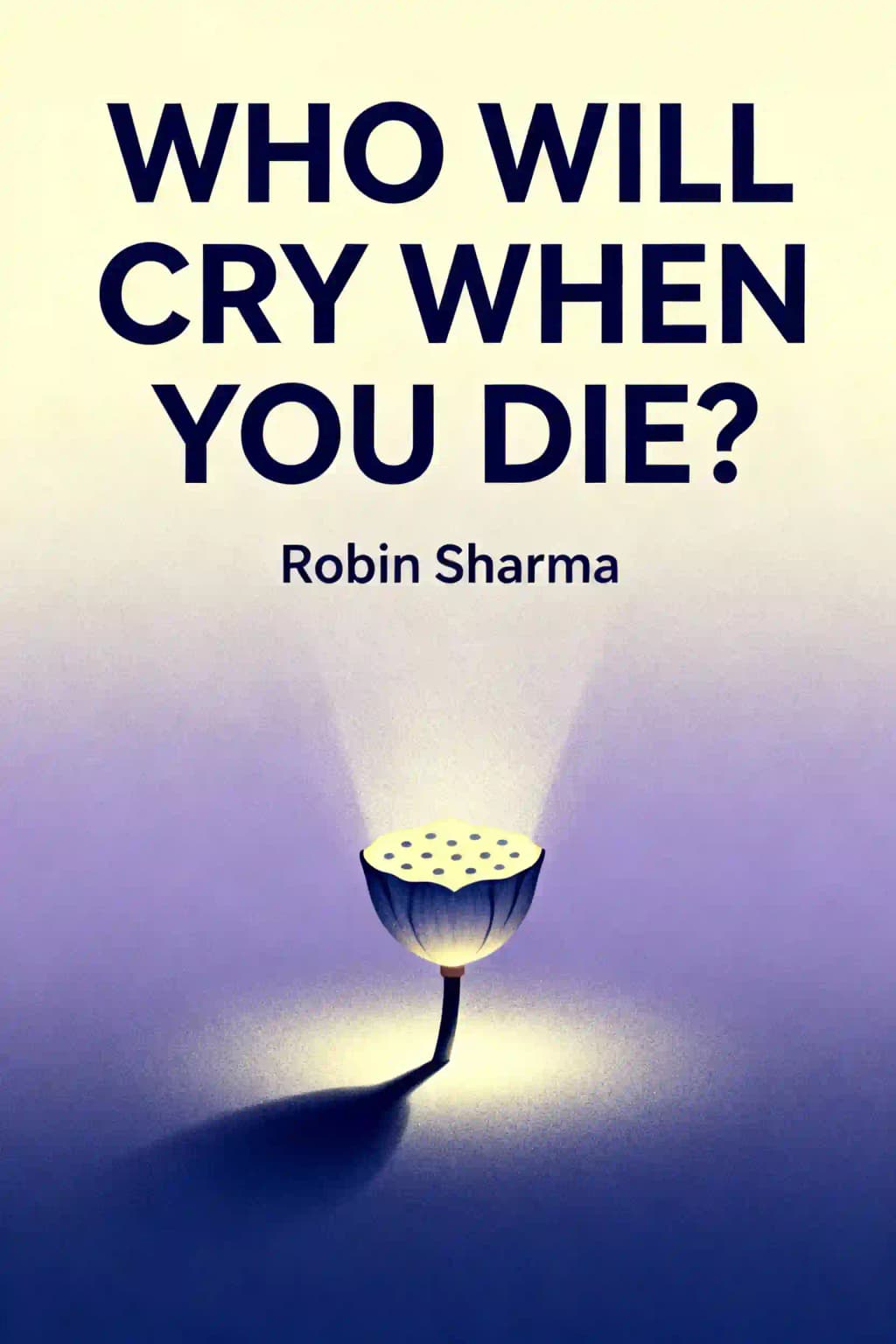
Robin Sharma's "Who Will Cry When You Die?" isn't just another self-help book-it's a cultural phenomenon that has transformed millions of lives worldwide. This international bestseller has been embraced by celebrities, business leaders, and everyday readers seeking more meaningful lives. What makes this book particularly powerful is Sharma's ability to distill profound wisdom into practical, actionable advice that resonates across cultures. Drawing from his unique background as a former high-powered lawyer who walked away from it all to pursue deeper meaning, Sharma offers a roadmap for anyone feeling stuck in life's hamster wheel. With over 15 million copies of his books sold in 96 countries, Sharma has become one of the most influential voices in personal development-yet his message remains refreshingly humble: the most extraordinary life comes from mastering the ordinary moments.
Capítulo 2
Discovering Your Life's Purpose Through Daily Actions
When Robin Sharma was growing up, his father shared a profound truth that would shape his life philosophy: "Son, when you were born, you cried while the world rejoiced. Live your life so that when you die, the world cries while you rejoice." This wisdom cuts to the heart of our existence-what legacy will we leave? Who will mourn our passing because we touched their lives meaningfully?
In our hyper-connected yet emotionally disconnected world, we've lost touch with what truly matters. We can instantly communicate with someone across the globe yet struggle to know our neighbors. We have remarkable technology but diminished human connection. The fundamental question remains: what impact will your life have?
The path to a meaningful life begins with discovering your calling-those special talents waiting for worthy pursuit. This doesn't necessarily mean abandoning your current job or making dramatic life changes. Instead, it means bringing more of yourself into whatever you do, focusing on what you do best, and finding purpose in your daily actions.
Consider how you might practice kindness to strangers each day. When you make just one person smile or brighten one stranger's mood, your day becomes worthwhile. Kindness is, as Sharma puts it, "the rent we pay for occupying space on this planet." These small acts-paying the toll for the car behind you, offering your seat on public transportation, or being the first to say hello-accumulate into something truly significant over time.
Maintaining perspective during life's challenges is equally important. When facing difficulties, ask yourself: "Is there a wiser way of looking at this seemingly negative situation?" As Stephen Hawking noted, we live on a minor planet of an average star in one of a hundred thousand million galaxies. Given this cosmic perspective, are our troubles really that significant? We walk this planet briefly-mere blips on eternity's canvas. The wisdom lies in enjoying the journey and savoring the process rather than becoming consumed by temporary setbacks.
The golden thread running through a highly successful and meaningful life is self-discipline-what Sharma calls "Tough Love." By being stricter with yourself, you'll live more deliberately rather than drifting aimlessly. The tougher you are on yourself, the easier life becomes. When you consistently flex your willpower by making right choices rather than easy ones, you reclaim control of your life and build the foundation for lasting fulfillment.
Capítulo 3
Cultivating Self-Awareness Through Reflection and Honesty
One of the most powerful personal growth initiatives you can undertake is maintaining a daily journal. This simple practice transforms your relationship with yourself by creating space for regular one-on-one conversations that force deeper thinking in a world where such reflection is increasingly rare.
Unlike a diary that merely records events, a journal analyzes them. It encourages you to consider what you do, why you do it, and what you've learned. This process promotes personal growth by giving you a forum to study and leverage your past for future success. Medical researchers have even found that writing in a private journal for just 15 minutes daily improves health, immune function, and overall attitude.
The journal becomes a central place to record insights, note success strategies, and commit to important achievements across your professional, personal, and spiritual life. It gives you a private space to flex your imagination and define dreams. Remember, if your life is worth thinking about, it's worth writing about.
Alongside journaling, developing an honesty philosophy strengthens your integrity and relationships. We live in a world of broken promises where people treat their words lightly. We tell friends we'll call next week knowing we won't, promise to lend books we never share, and commit to personal changes without real intention to follow through. Saying things we don't mean becomes habitual with practice.
The real problem is that when you don't keep your word, you lose credibility. When credibility is lost, trust bonds break. And broken trust ultimately leads to broken relationships. To develop an honesty philosophy, monitor how many small untruths you tell over a week. Go on a "truth fast" for seven days, vowing complete honesty in all dealings with others and yourself. Every time you fail to do right, you fuel the habit of doing wrong. Every untruth feeds the habit of dishonesty.
When you promise something, deliver it. Be a person of action rather than just talk. As Mother Teresa wisely said, "there should be less talk; a preaching point is not a meeting point. What do you do then? Take a broom and clean someone's house. That says enough."
Honoring your past is equally important for self-awareness. Every second dwelling on past mistakes steals from your future. Every minute focusing on problems takes away from finding solutions. Thinking about unwanted past events blocks desired things from entering your life. Instead, use lessons learned to rise to new awareness. Life's greatest setbacks reveal its biggest opportunities, and failing more than others likely means you're living more completely by taking more chances.
Capítulo 4
Mastering Your Daily Rhythms for Optimal Living
The way you begin your day determines how you'll live it. Those first thirty minutes after waking-what Sharma calls "The Platinum 30"-are truly the most valuable moments with profound influence on every minute that follows. With wisdom and self-discipline to think only the purest thoughts and take the finest actions during this key period, your days will consistently unfold marvelously.
An effective morning ritual might include fifteen minutes in silent contemplation, focusing on good things and envisioning your day. Next, read wisdom literature rich with timeless truths of successful living-works like Marcus Aurelius' Meditations, Benjamin Franklin's Autobiography, or Thoreau's Walden. These lessons center you on what truly counts and launch your day properly.
Learning to say no gracefully complements this morning discipline. Without clear priorities, others' agendas easily dictate your actions. The most effective people concentrate on their "areas of excellence"-what they do best and high-impact activities advancing their lifework. Being consumed by important things makes saying no to distractions easier.
To balance the intensity of focused work, plan a weekly period of peace-a weekly sabbatical-to return to life's simpler pleasures. Your weekly sabbatical doesn't need to last a full day-just a few hours alone when you can spend time doing things you love most, like visiting a favorite bookstore, watching the sunrise, taking a solitary beach walk, or writing in your journal.
Managing your internal dialogue is equally crucial for daily wellbeing. Try applying a 5,000-year-old strategy that can change your life: selecting a phrase (mantra) to train your mind to focus on throughout the day until it reshapes who you are. If seeking inner peace, your mantra might be "I am grateful that I am serene and tranquil." For confidence: "I am delighted that I am full of confidence and boundless courage."
Repeat your mantra softly while walking to work, waiting in line, or washing dishes-filling unproductive times with powerful improvement energy. Say your phrase at least 200 times daily for four weeks. The results will be profound as you find peace, prosperity, and purpose.
For those struggling with worry, scheduling specific "worry breaks"-perhaps thirty minutes each evening when you can wallow in your problems-can be transformative. After that period ends, train yourself to leave troubles behind and do something productive. If worries arise during other times, jot them down for your next worry session. This powerful technique will gradually reduce worry time and eventually eliminate the habit forever.
Capítulo 5
Reconnecting with Childlike Wonder and Simplicity
Taking my four-year-old son Colby to an Italian restaurant taught me an unexpected lesson in living. When served bread, rather than eating it whole as adults do, he scooped out the warm, soft part and left the crust intact-instinctively focusing on the best part and leaving the rest.
As grown-ups, we spend too much time focusing on the "crust of life"-our work challenges, bills, and lack of time-rather than on all the good flowing through our days. Yet our thoughts form our world, and what we focus on determines our destiny.
Make time to connect with your playful side, your inner child. Study children's positive qualities and model their ability to stay energized, imaginative, and completely present regardless of surroundings. Children come to us more highly evolved than adults to teach us the lessons we need to learn.
This childlike perspective helps us remember that inspiration drives genius more than perspiration. While Thomas Edison famously stated, "Genius is 1 percent inspiration and 99 percent perspiration," being deeply inspired and committed to making a difference is even more important than hard work alone.
All great geniuses were driven by their desire to enrich others' lives-this desire became their obsession, consuming every cell of their minds. Edison was inspired to manifest his visions into reality. Jonas Salk was inspired to prevent polio suffering. Marie Curie was inspired to serve humanity through discovering radium.
How inspired are you? Do you jump out of bed Monday mornings or lie there feeling empty? If your inspiration is low, read a self-help book, listen to motivational audio, attend lectures by people you admire, study biographies of your heroes, or spend time with passionate people dedicated to making the best of life.
Caring for your physical "temple" is essential for maintaining this childlike energy and wonder. Our bodies must be treated like temples and considered sacred to live fully. Regular exercise improves health, clears thinking, boosts creativity, and manages stress. Research proves it adds life to your years and years to your life-one Harvard study of 18,000 alumni found every hour spent exercising added three hours to participants' lives.
Finding regular time for silence complements physical care by restoring your mental clarity. All great wisdom traditions reach the same conclusion: to reconnect with your true self and discover the glory within, you must find regular time for silence. Experiencing solitude, even briefly each day, keeps you centered on your highest priorities and helps avoid the neglect pervading many lives.
Capítulo 6
Embracing Risk and Authenticity on Your Journey
I promise you this: on your deathbed, you won't regret the risks you took but those you didn't take-the opportunities not seized and fears not faced. Remember, freedom lies on the other side of fear. Success is a numbers game-the more risks you take, the more rewards you'll receive.
To live fully, take more risks and do what you fear. Get comfortable being uncomfortable and stop walking the path of least resistance. You might stub your toes on the road less traveled, but that's the only way forward. As my mother says, "you cannot get to third base with one foot on second."
The secret to abundance is pursuing opportunity rather than security. You'll face failures living more deliberately and passionately, but failure is just learning how to win. Life is about choices. Fulfilled people make wiser choices than others. You can spend your days safely on shore or take chances, dive deep, and discover the pearls waiting for the courageous.
When asked about his career's ups and downs, Kevin Costner profoundly replied, "I'm living a life." Rather than judging events as good or bad, he adopted a neutral stance, accepting them as natural parts of his path. We all travel different roads to our destinations. Some paths are rockier than others, but everyone faces adversity. Rather than fighting it, accept it as life's way.
Remember, life has no real failures, only results; no true tragedies, only lessons; no problems, only opportunities waiting to be recognized as solutions by the wise. Detach from outcomes and fully experience every circumstance. Feel the pain and savor the happiness. Without visiting valleys, mountaintop views aren't as breathtaking.
Good films can help us maintain this perspective. "Life Is Beautiful" powerfully reminds us that living is a gift we must make the best of every day. A good movie can restore perspective, reconnect you to what you value most, and keep you enthusiastic about life. As Ralph Waldo Emerson said, "Nothing great was ever achieved without enthusiasm."
Blessing your money represents another way to embrace authenticity. When paying for groceries, silently bless those who helped bring the food to you-farmers, delivery people, and store clerks. When writing a check for your children's education, appreciate the teachers shaping your kids' minds. As the timeless truth says, "The hand that gives is the hand that gathers."
The secret to controlling your life is restoring focus to your days. As Confucius said, "The person who chases two rabbits catches neither." Marcus Aurelius advised keeping your occupations few for a tranquil life. And Peter Drucker wisely noted, "There is nothing so useless as doing efficiently that which should not be done at all."
Capítulo 7
Building Meaningful Connections Through Small Acts
The things easiest to do are also easiest not to do. As our lives speed up, simple gestures have profound consequences-like the lost art of writing thank-you notes. Everyone loves receiving mail-it satisfies our need to feel important. Even with daily business contacts, following up with sincere thank-you notes shows you care, are considerate, and human.
Mother Teresa said, "There are no great acts. There are only small acts done with great love." What small acts can you do today to deepen bonds with those you value most? Create a love account. Each day, make deposits in this special reserve by doing something small to add joy to someone's life. Buy your partner flowers for no reason, send your best friend your favorite book, or tell your children explicitly how you feel about them.
The little things are the big things. Those tiny, daily deposits into the love account will bring more happiness than any amount in your bank account. As Emerson said, "Without the rich heart, wealth is an ugly beggar."
One of our deepest human hungers is to be understood, cherished, and honored. Taking time to truly understand another's perspective shows you value what they say and care about them as a person. When you start "getting behind the eyeballs" of the speaker and see the world from their perspective, you connect deeply and build lasting, high-trust relationships.
We have two ears and one mouth for a reason: to listen twice as much as we speak. Being a better listener has another advantage-since you're not doing all the talking, you're doing all the learning, accessing information you'd miss during monologues.
To release mental clutter from your problems, list all worries on paper. They'll no longer fester in your mind and drain your energy. This exercise puts problems in perspective and helps tackle them in an orderly sequence. As Winston Churchill said, "It helps to write down half a dozen things which are worrying me. Two of them disappear; about two, nothing can be done, so it's no use worrying; and two perhaps can be settled."
David Starr Jordan observed, "Wisdom is knowing what to do next, skill is knowing how to do it, and virtue is doing it." Most of us know what we need for happier, healthier, more fulfilling lives. The problem is we don't do what we know. Knowledge is only potential power, transforming into actual power when you decisively act on it.
Strong character isn't doing what's fun or easy, but what you ought to do rather than what you feel like doing. Since action is a habit, more positive actions make you feel like taking more. Too often we wait for the ideal path to appear, forgetting that paths are made by walking, not waiting.
Capítulo 8
Nurturing Family and Finding Life's True Treasures
On Father's Day, my son Colby brought home a handmade card with his small handprint and these words: "Sometimes you get discouraged because I am so small And always leave my fingerprints on furniture and walls. But every day I'm growing-I'll be grown up someday And all those tiny handprints will surely fade away. So here's a final handprint, just so you can recall Exactly how my fingers looked, when I was very small."
Children grow incredibly quickly. It's easy to promise more time with kids "when things slow down at work" or "when I get that promotion" or "next year." But if you don't act on life, life acts on you. Weeks slip into months, months into years, and suddenly that little child is an adult with their own family.
The greatest gift for your children is your time, and one of your greatest gifts to yourself is enjoying your kids and seeing them as the small miracles they are. As Kahlil Gibran beautifully writes in The Prophet, "Your children are not your children. They are the sons and daughters of Life's longing for itself."
When people ask why they should set goals, they often say "Because getting what I want will make me happy." But this misses the deeper truth: the real value lies not in the rewards but in who you become through the journey. As Ralph Waldo Emerson observed, "The reward for a thing well done, is to have done it."
You can never eliminate a weakness you don't know about. The first step to changing a negative habit is becoming aware of it. Once you recognize your need to improve, you begin noticing relevant seminars, finding the right books, and meeting people who can coach you. So reflect on your weaknesses and transform them into strengths that will enrich your life.
It's ironic that so many people claim they'd do anything for more time yet squander what they already have. Time is life's great equalizer-we all get exactly twenty-four hours each day. What separates remarkable lives from ordinary ones is how these hours are used.
Most of us live as if we have infinite time, procrastinating our dreams while handling daily emergencies. This is a recipe for regret. As novelist Paul Bowles wrote: "Because we don't know when we will die, we get to think of life as an inexhaustible well. Yet everything happens only a certain number of times... How many more times will you remember a certain afternoon of your childhood? Perhaps four or five times more. Perhaps not even that. How many more times will you watch the full moon rise? Perhaps twenty. And yet it all seems limitless."
Capítulo 9
Creating a Legacy of Wisdom and Service
Companies recruit boards of directors to help make effective decisions during challenging times. By consulting wise advisors, they reduce mistakes and increase credibility. Who would you invite to your imaginary board? I'd include Ben Franklin for character guidance, Albert Schweitzer for service wisdom, Gandhi and Mandela for leadership, Bruce Lee for self-discipline, Marie Curie for innovation questions, and Viktor Frankl for adversity counsel.
To get the best from life, you must be completely present in every moment. As Albert Camus wrote, "Real generosity towards the future consists in giving all to what is present." Yet our minds typically scatter in ten different directions at once. By developing present-moment awareness and mental focus, you'll feel calmer while unlocking your mind's full potential.
A wise Chinese proverb states: "He who asks may be a fool for five minutes. He who doesn't is a fool for a lifetime." The more you ask, the more you get, but asking takes practice. Success is a numbers game. Exercise your "asking muscles" by requesting better tables at restaurants, free extras at shops, or complimentary upgrades on flights. Remember, the person who asks has at least a chance of getting what they want. The person who doesn't ask has no chance at all.
Xerox PARC guru John Seely Brown once said, "The job of leadership today is not just to make money, it's to make meaning." While previous generations were content with jobs that simply paid bills, we now crave fulfillment, creative challenge, growth, joy, and purpose beyond ourselves.
To find higher meaning in your work, use creative questioning to recognize your impact: Who ultimately benefits from my company's offerings? What difference do my daily efforts make? By finding meaning in your daily work, you transform routine tasks into purposeful contributions that energize the human spirit. Few things motivate us more than making a difference in others' lives.
Few things make me happier than meeting someone who, inspired by my work, goes on to read ten more life improvement books that transform them completely. In a world with too much to do, be selective in your reading. Spend time with what Thoreau called "The Heroic Books"-those containing "the noblest recorded thoughts of man." Even a few minutes daily with such works will keep you centered on life's essence and profoundly affect your character.
Norman Cousins observed, "The tragedy of life is not death, but what we let die inside of us while we live." Most people have lost sight of their innate gifts, resigning themselves to spending their best years watching television rather than fulfilling their potential. Are you using your best qualities to their fullest? If not, you're doing a disservice not only to yourself but to the world that could benefit from your unique talents.
In our age of limitless information, spending time alone in natural surroundings connects us to the larger universe and restores our spirit. Natural surroundings silence the endless mental chatter, liberating our true brilliance. When in nature, observe with deep concentration-study a flower's complexity or a stream's current. Remove your shoes and feel grass beneath your feet.
Albert Schweitzer said, "There is no higher religion than human service," while ancient Chinese wisdom notes that "fragrance always clings to the hand that gives roses." The greatest fulfillment comes from rising from chasing success to finding significance by asking, "How may I serve?" All great leaders and humanitarians have abandoned selfish lives for selfless ones, understanding that success cannot be pursued directly-it flows as the inevitable by-product of serving others and adding value to the world.
Most people discover life's meaning only as they approach death. Don't wait until your deathbed to realize life's meaning and your precious role within it. True happiness isn't a destination but a state you create through committing your talents to purposes larger than yourself. When life's clutter is stripped away, its meaning becomes clear: to live for something beyond yourself. As George Bernard Shaw eloquently stated, life is "no brief candle" but a "splendid torch" to hold high and make burn as brightly as possible before passing it to future generations.