Capítulo 1
The American Dream Hijacked: How Wealth and Power Left the Middle Class Behind
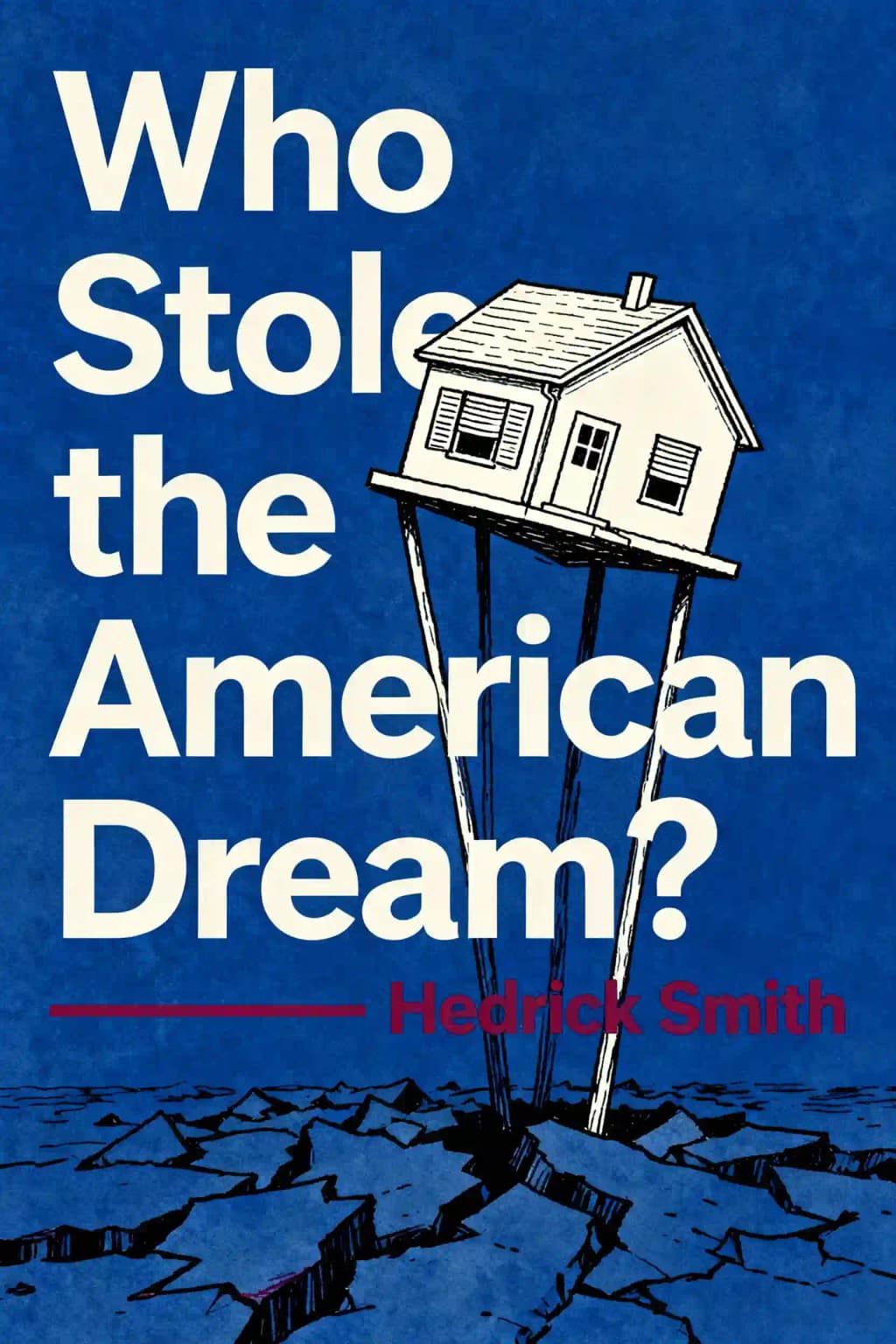
In 1971, a watershed moment in American history occurred with barely a whisper. Corporate attorney Lewis Powell penned a confidential memorandum that would ignite a business rebellion, forever altering the nation's power landscape. This document, written shortly before Powell's Supreme Court appointment, sparked sweeping transformations that reversed policies creating middle-class prosperity and propelled America into a New Economy tilted toward financial elites. The book "Who Stole the American Dream?" by Pulitzer Prize-winning journalist Hedrick Smith has become required reading in political science departments nationwide for its meticulous documentation of this pivotal shift. Former Secretary of Labor Robert Reich called it "the most comprehensive account yet of how the American Dream has been sabotaged," while The New York Times praised its "powerful narrative that connects the dots" between economic and political changes. Smith's work resonates particularly with readers disillusioned by growing inequality, offering both historical context and potential solutions for America's current predicament.
Capítulo 2
A Nation Divided: The Economic Fault Line
Over the past three decades, America has split into two distinct societies. We've lost the shared prosperity and political-economic power that united us after World War II. Instead, we're sharply divided by power, money, and ideology. Our politics have become rancorous and polarized, with leaders unable to solve basic problems. Constant conflict has replaced common purpose, creating deep, self-destructive fault lines across the nation.
Today's gravest challenge is America's gross inequality of income and wealth. Both liberal and conservative thinkers warn this divide threatens democracy itself. Conservative sociologist Charles Murray cautions that America is "coming apart at the seams" of class, forming separate groups unlike anything in our history. The past three decades have produced a new Gilded Age comparable to the 1890s and 1920s - both eras that ended in financial disaster.
In our New Economy, the super-rich have accumulated trillions while the middle class stagnates. During 2002-2007, the top 1% captured two-thirds of all economic gains; in 2010, they took 93%. This wealth chasm undermines equal opportunity and puts the entire economy at risk. Studies show concentrated wealth actually works against economic growth, with greater equality providing better conditions for sustained prosperity.
Since the late 1970s, the soaring wealth of the super-rich has coincided with the unraveling of the American Dream for the middle class - steady jobs with decent pay and benefits, rising living standards, home ownership, secure retirement, and better futures for one's children. America has declined from an era of widely shared prosperity to one of vast fortunes and mass economic insecurity. We've lost our status as "the land of opportunity," with economic mobility now higher in several Western European countries.
Politically, we've moved from the expansive democracy of the 1960s-70s to a narrow plutocracy. The high-visibility, grassroots power game of mass movements has been replaced by a low-visibility insider game dominated by elite lobbyists. Today's New Power Game in Washington is dominated by well-financed professional lobbyists, many former officials with insider connections, working for special interests. The imbalance is staggering - business has employed thirty times as many Washington lobbyists as trade unions and spent $28.6 billion on lobbying compared with $492 million for labor, nearly a 60-to-1 business advantage.
Capítulo 3
The Pivotal Power Shift: How Business Captured Washington
Contrary to popular belief, the power shift toward pro-business policies began not under Reagan and Republicans in the 1980s, but under Jimmy Carter with a Democratic-controlled Congress. Carter arrived in Washington with a middle-class reform agenda but was unprepared for Washington politics and faced the newly organized business lobby energized by the Powell memo.
The 1978 legislative session marked a critical turning point in modern American politics. Business forces defeated Ralph Nader's consumer protection agency through an unprecedented lobbying blitz that House Speaker Tip O'Neill called "the most extensive lobbying" he'd seen in 25 years. They then confronted their more formidable adversary - organized labor. The AFL-CIO had long sought to roll back anti-union provisions, and with Democrats controlling Washington, unions pushed three priorities: labor law reform, common situs picketing rights, and automatic minimum wage increases. Business interests, increasingly united against unions, mounted aggressive opposition. While labor's picketing bill died in the House, their reform legislation passed 257-163. However, in the Senate, a filibuster blocked the bill for five weeks. Despite compromises, labor fell two votes short of ending the filibuster, dealing a devastating blow to unions.
The corporate political rebellion moved beyond defense to offense in 1978, achieving a legislative agenda with profound long-term consequences for the middle class. Nearly every economic bill passed that year tilted in favor of business and the wealthy. Corporate lobbies successfully pushed Congress to deregulate trucking, railroad, and airline industries. The 1978 bankruptcy reform law dramatically shifted power to corporate management, enabling companies to shed debts and abrogate union contracts guaranteeing wages, health benefits, and pensions.
Perhaps most consequentially, Congress tucked into the 1978 tax bill a small provision with enormous implications - the 401(k). Originally introduced as a tax break for executives, the Reagan Treasury Department later expanded it to include rank-and-file employees. This financial upheaval effectively dismantled the corporate lifetime pension system, shifting retirement responsibility from companies to individuals.
Business interests ultimately challenged President Carter on taxes, defeating his attempt to close loopholes for the wealthy and corporations. Instead of implementing Carter's vision of tax reform, Congress rewrote his bill to favor business and the affluent, delivering $18.7 billion in tax cuts, including slashing the capital gains rate from 49% to 28%. This marked a watershed moment, reversing the traditional pattern of using taxes to redistribute income downward.
Capítulo 4
The Lost Era of Middle-Class Power
Before this political power shift, average Americans believed they could influence government policy through collective action. Unlike today's politically alienated citizenry, middle-class Americans in the 1960s and 1970s felt confident their voices mattered and acted accordingly, generating unprecedented citizen activism. Ordinary people won significant changes through the civil rights, women's, environmental, consumer, labor, and peace movements.
On August 28, 1963, an extraordinary demonstration of people power unfolded as 200,000 civil rights marchers converged on Washington. This "festival of democracy" embodied Martin Luther King Jr.'s call for "the fierce urgency of now" and demonstrated how ordinary Americans could break the congressional logjam on civil rights legislation.
King and the Southern Christian Leadership Conference strategically targeted Birmingham in 1963 because it remained "probably the most thoroughly segregated city" in America under the harsh enforcement of Bull Connor. Young understood that economic leverage-a black shopping boycott-would move the "Big Mules" to action. "Money is color-blind," he reasoned, as 100,000 Black citizens boycotted everything but food and medicine for ninety days. Combined with the negative publicity from police dogs attacking peaceful protesters, this economic pressure led merchants and the new mayor to agree to desegregation.
The environmental movement demonstrated unprecedented middle-class political power when twenty million Americans rallied on Earth Day 1970-the largest one-day grassroots demonstration in American history. Public anger at environmental degradation created a grassroots rebellion demanding action. Washington responded with remarkable speed, passing a torrent of environmental legislation: the Clean Air Act, Clean Water Act, EPA establishment, and numerous other protections.
The consumer movement, though less militant than environmentalism, gained significant traction in the mid-1960s. Ralph Nader became the movement's face with his 1965 book "Unsafe at Any Speed." His "Nader's Raiders" grew from five people in 1967 to two hundred by 1971, generating exposes on federal regulatory failures across industries. By 1974, U.S. News & World Report ranked Nader fourth in national influence.
Capítulo 5
The Virtuous Circle: How Shared Prosperity Built America
The post-war era of middle-class prosperity was guided by Henry Ford's economic philosophy of "the virtuous circle of growth." When Ford introduced the Model T and announced his revolutionary $5-a-day wage in 1914, he argued this wasn't just social justice but smart business. Ford understood that when wages are low, the economy suffers, but high, steady pay creates good customers who can eventually afford products like his Model T.
During the postwar era of shared prosperity (mid-1940s to mid-1970s), business leaders embraced a fundamentally different ethos than today's CEOs. They practiced "stakeholder capitalism," balancing the interests of all corporate stakeholders. Standard Oil chairman Frank Abrams articulated this philosophy: "The job of management is to maintain an equitable and working balance among the claims of the various directly affected interest groups... stockholders, employees, customers, and the public at large."
The American labor movement served as the anchor of middle-class power during this period, consistently advocating for average Americans and pushing corporations to share economic gains from rising productivity. Union power helped create the world's largest middle class, winning the eight-hour day, five-day week, child labor laws, and workplace safety regulations.
The landmark 1950 "Treaty of Detroit" between General Motors and the United Auto Workers established the social contract that defined the postwar era. After years of labor unrest, GM's chief executive "Engine" Charlie Wilson offered UAW leader Walter Reuther a grand bargain: shared prosperity for workers in exchange for labor peace. GM agreed to give autoworkers annual pay raises increasing their living standard by 20 percent over five years, pay half their health insurance costs, and provide pensions of $125 monthly to long-term employees.
In Washington, a bipartisan political consensus supported sharing America's wealth democratically. During the famous 1959 "kitchen debate" with Soviet premier Nikita Khrushchev, Vice President Richard Nixon proudly boasted about American middle-class prosperity, noting that three-quarters of America's 44 million families owned their homes, 56 million cars, 50 million televisions, and 143 million radios.
The postwar era featured the most level economic playing field in American history. Government policies, especially the tax code, kept incomes more evenly distributed by easing extremes at both ends. The minimum wage floor was set at nearly half the average hourly wage, enabling the poorest 20 percent of families to experience income growth as rapid as the richest 20 percent. High tax rates on the wealthy - 92 percent under Eisenhower and 77 percent under Kennedy (compared to 35 percent today) - didn't constrain economic growth.
Capítulo 6
Wedge Economics: How CEOs Broke the Social Contract
Al Dunlap exemplified the "predatory capitalism" that defined the New Economy of the 1990s. Unlike traditional CEOs who pursued efficiency through quality and viewed employees as assets, Dunlap made his fortune with a "cut-cut-cut" formula - slashing costs, plants, and jobs. By the mid-1990s, CEOs like Dunlap became the norm, as Wall Street demanded ever-higher profits. Milton Friedman's philosophy that corporations should focus solely on maximizing shareholder returns became the dominant business ideology, replacing the stakeholder model that had built middle-class prosperity.
Through the 1980s, the American CEO model transformed dramatically. Wall Street banks and investors pressured corporate leaders for ever-higher profit margins, resulting in deep cutbacks for average Americans. Anti-union strategies gained legitimacy from Barry Goldwater's anti-labor stance in 1964 and Reagan's breaking of the air controllers strike in 1981. By the 1990s, maximizing profits and share prices had replaced wealth-sharing as the measure of corporate success.
At Scott Paper, Dunlap chainsawed eleven thousand employees, fired senior managers, slashed R&D, and canceled charitable giving to focus on short-term profits. Within a year, Scott's stock doubled. After just eighteen months, Dunlap sold Scott to Kimberly-Clark for $9 billion, personally making $100 million from stock options-about $166,000 per day during his tenure.
The New Economy disrupted the virtuous circle of growth that had characterized the era of middle-class power. Wedge economics split CEO fortunes from employee fates and Wall Street from Main Street, dividing America into two separate economic realities. While corporate profits and CEO payoffs soared, the American Dream began unraveling for millions of average Americans.
Jack Welch, who headed General Electric from 1981 to 2001, personified the Darwinian New Economy CEO. BusinessWeek called him "the gold standard against which other CEOs are measured," and Fortune named him "the Ultimate Manager" of the twentieth century. Welch's hallmark was downsizing-slashing 130,000 jobs, 25% of GE's workforce, saving $6.5 billion. In 2000 alone, Welch collected $123 million in compensation plus roughly $2 million yearly in perks.
The payoffs for captains of U.S. industry from wedge economics have been enormous. In the 1970s, CEOs at major companies earned $1.2 million on average (inflation-adjusted), roughly 40 times an average worker's pay. By the early 2000s, CEO compensation topped $9 million annually-367 times the average worker's pay. At Wal-Mart, CEO Lee Scott earned $17.5 million in 2005, approximately 900 times the typical Wal-Mart worker's pay and benefits.
Capítulo 7
The Stolen Dream: Middle-Class Decline in Real Time
The economic world that greeted high school graduates in the early 1970s was vastly different from today's harsh reality. Pam Scholl from Chillicothe, Ohio exemplifies this contrast. After graduating in 1971, she immediately secured full-time work at the new RCA television tube plant in Circleville, earning $1.75 an hour in human relations. Within a year, she could afford a new Chevrolet Vega for $2,500 with monthly payments of just $50.
Circleville, Ohio, was a magnet for brand-name corporations like RCA, DuPont, GE, and others. Middle-class workers like Pam Scholl and Mike Hughes lived the American Dream there from the 1970s into the 2000s. Each bought homes, raised families, and moved up the ladder at RCA with steady pay, good benefits, five weeks of paid vacation, and company retirement plans.
The bottom fell out in 2004 when RCA sold the plant to French firm Thomson, which ultimately shut it down. Mike Hughes, in his early fifties, couldn't find steady work despite his technical experience and retraining. He ended up with two part-time jobs totaling $17,000 a year, with only his wife's public sector job keeping them above poverty. "They cut off the dream," he lamented.
Pam Scholl initially found work after RCA closed, but was downsized again in 2009. For eighteen months, she found only three months of census work, depleting her savings and accumulating credit card debt. "The hardest thing is not being wanted-not feeling worthy," she confessed. Despite completing over five hundred applications, she had only four interviews.
Pam and Mike represent "the New Poor"-middle-class Americans sliding downscale, the opposite of the American Dream. In six years, they fell from the middle 20 percent income bracket to the bottom 20 percent. Their stories reflect broader national trends: the worst decade in seventy years, with fewer jobs in 2011 than ten years earlier and middle-class family incomes lower than in the late 1990s.
America has evolved into a caste society, increasingly stratified by wealth and income, with people at the bottom frozen there generationally. Several Scandinavian and European countries now surpass the U.S. in social mobility. America is classified as "a low-mobility country in which about half of parental earnings advantages are passed onto sons."
Even those maintaining middle-class status have been stuck economically. From 1948-1973, worker productivity grew 96.8% and compensation rose 93.7%. But from 1973-2011, while productivity rose 80.1%, average wages increased only 4.2% and total compensation just 10%. Middle-class living standards fell behind a dozen European countries, as Americans worked longer hours for lower pay.
Capítulo 8
The Great Burden Shift: From Institutions to Individuals
Americans overwhelmingly viewed 2000-2009 as the worst decade in over half a century, describing it with terms like "downhill," "poor," "decline," "chaotic," and "disaster." The numbers validated these sentiments: in just the final quarter of 2008, American households lost $5.1 trillion in wealth-the largest quarterly loss in the 57 years the Federal Reserve had kept records.
Financial insecurity has become embedded in the New Economy's DNA. Not only have economic gains been distributed more unequally than during the era of middle-class prosperity, but Corporate America has fundamentally rewritten the social contract that once provided security for average Americans. The company welfare safety net enjoyed from the 1940s through the 1970s has been dramatically reduced, with costs shifted from employers to employees.
The largest financial burden shift from corporations to employees came through retirement benefits. While companies claimed they could no longer afford lifetime pensions, Wall Street Journal reporting revealed many pension plans were actually moneymakers for corporations. Companies like GE, Verizon, and IBM built up massive surpluses in the 1990s bull market. The shift from lifetime pensions to 401(k)s represented hundreds of billions in costs transferred to employees without offsetting pay increases.
Some political leaders defended this burden shift as promoting personal responsibility over dependency. George W. Bush championed an "ownership society" philosophy, arguing individuals should take complete financial responsibility for their economic destinies rather than relying on employer or government safety nets.
Even financial giant MetLife acknowledged that the burden shift had "turned the traditional definition of the American Dream on its ear." Their 2007 study found Americans believed economic security had deteriorated by a 3-to-1 margin, with two-thirds saying they hadn't achieved the American Dream.
The sharp rise in personal bankruptcies signals mounting middle-class distress in the New Economy. Bankruptcy filings soared sevenfold between 1984 and 2005, reaching over two million annually. As Harvard Law professor Elizabeth Warren noted, more Americans were filing for bankruptcy than suffering heart attacks, being diagnosed with cancer, or graduating from college.
Former RCA worker Pam Scholl exemplifies the middle-class bankruptcy spiral. After losing her job in 2009, her unemployment benefits couldn't cover expenses, forcing her to borrow on credit cards. Soon she was making $500 monthly minimum payments while her debt ballooned to $50,000. Her 2010 bankruptcy filing protected her house and retirement savings. Though she eventually found work as a payroll clerk, her new $12.25 hourly wage was about half her former RCA salary.
Capítulo 9
The Wealth Gap: America's New Plutocracy
Wall Street Journal reporter Robert Frank mapped America's wealth hierarchy as "Richistan": Lower Richistan (7.5 million families worth $1-10 million), Middle Richistan (2 million families worth $10-100 million), Upper Richistan (thousands of families worth over $100 million), and Billionaireville (the Forbes 400 plus). At the absolute pinnacle sits the Walton family, whose $90 billion fortune equals the combined assets of America's entire bottom 40% - some 120 million people.
The conventional explanation from business leaders and conservatives that wealth disparities stem from skill-based technological change doesn't match reality. While President Bush acknowledged rising income inequality, attributing it to an economy rewarding education, this explanation fails when comparing America to other advanced economies. Germany and other European countries experienced the same technological changes without America's extreme wealth concentration.
If education truly explained economic disparities, different people would constitute today's super-rich. Highly educated physicists, surgeons, and engineers earn only a fraction of what CEOs and Wall Street bankers make. Getting a college degree isn't a wealth ticket - a typical entry-level worker with a bachelor's degree earned only $1,000 more in 2006 than in 1980 (adjusted for inflation).
Two primary forces have created America's wealth concentration: corporate leaders taking larger shares of business earnings for themselves, and increasingly pro-rich policy shifts in Washington since the late 1970s. The tax code - "the most political law in the world" according to attorney Jonathan Blattmachr - has been repeatedly tilted to favor the super-rich. The capital gains tax cut from 48% in 1978 to 15% today particularly benefits the wealthy, with the top 0.1% garnering half of all capital gains.
Tax cuts since 1978, especially those under Presidents Reagan and Bush, have generated trillions for the super-rich. Reagan lowered the top income tax rate from 70% to 28%, providing roughly $1 trillion in the 1980s to the wealthiest 1%, with another trillion each decade after. Bush's tax cuts delivered another trillion-dollar windfall to the top 1%, while the middle class received modest breaks averaging $1,180 compared to $58,000 for the top 1% and $520,000 for those making over $3 million.
In the 1960s, CEO pay restraint was a core corporate ethic. Charles Wilson, GM's CEO in 1950, earned about $626,300 (roughly $5 million today) - a fraction of modern executive packages - and didn't receive massive stock options, which were then taboo. As economist John Kenneth Galbraith noted, "Management does not go out ruthlessly to reward itself." By the 1980s, this ethic was replaced by Gordon Gekko's "greed is good" philosophy, and CEO pay rocketed from 40 times the average worker's pay in 1980 to nearly 400 times by 2000.
Capítulo 10
The Washington-Wall Street Symbiosis: Captured Democracy
No sector of American business has amassed more political power or astronomical profits-or contributed more to America's economic divide and wealth concentration-than what Woodrow Wilson called "the money monopoly," Wall Street. Though Wall Street has boomed before during the Gilded Age and Roaring Twenties, the scale of its financial growth over the past two decades is unprecedented in American history.
Since the late 1980s, Finance has become the heart of the New Economy, exploding from $1.2 trillion in assets in 1978 to $11.8 trillion in 2007, overtaking manufacturing as the largest sector and growing from 17-18% of corporate profits to 46% by 2005. Wall Street has built its power and wealth on dangerous levels of debt - $36 trillion by 2007, plus $33 trillion in derivatives exposure, dwarfing the federal government's $15 trillion debt.
Despite causing widespread economic peril, Wall Street has escaped serious oversight through its extraordinary influence in Washington. Beyond spending $1.25 billion on lobbying and campaign contributions in 2009-10 alone, the financial sector has built a tight symbiotic relationship with government. Wall Street luminaries regularly flow into key policy positions - Alan Greenspan from J.P. Morgan to the Fed, Goldman Sachs executives Robert Rubin and Henry Paulson to Treasury, and numerous others into the Obama administration.
The Washington-Wall Street axis works as a two-way street, with Wall Street recruiting its lobbying army from government ranks. During the battle over 2010 financial regulations, the financial sector hired 1,447 former government officials as lobbyists, including 73 former members of Congress and 115 former banking committee staffers with intimate knowledge of regulatory law.
In 1998, Brooksley Born, head of the Commodity Futures Trading Commission, warned about the dangers of unregulated over-the-counter derivatives - what Warren Buffett later called "financial weapons of mass destruction." When she pushed for regulation and transparency, Rubin, Greenspan, and Summers tried to silence her. Despite her warnings being validated when Long Term Capital Management collapsed that September, the Wall Street-Washington axis responded by stripping her agency of regulatory authority over derivatives.
A pivotal victory for the Wall Street-Washington axis came in 1999 with the repeal of the Glass-Steagall Act, which had separated commercial and investment banking since the New Deal. Greenspan, who had served on J.P. Morgan's board and opposed Glass-Steagall, had been steadily weakening the law since 1987 by reinterpreting what constituted banks being "principally engaged in" investment banking.
For our democracy, the danger is the power shift away from the middle class to financial elites has left average Americans feeling powerless. In the 1960s, only 28% of Americans believed government was "run by a few big interests"; today that figure is 78%. Most Americans distrust lobbyists and want their power curtailed, but feel unable to change the system. We're sliding into an oligarchy where the wealthy use financial resources to buy political influence, then leverage that power to obtain policies multiplying their economic returns at average Americans' expense.
Capítulo 11
Reclaiming the American Dream: A Ten-Step Strategy
Reversing decades of political and economic tides requires a political metamorphosis - a populist renaissance with millions of Americans reengaging in direct citizen action. We need measures to restore a fairer economic playing field through action on jobs, homes, taxes, and fairness. Business leaders must share more profits with workers, and political leaders must invest in infrastructure, research, and worker retraining.
Corporate executives, economists and politicians across party lines recognize the need for a national economic strategy to revive American manufacturing and competitiveness. The Horizon Project advocates a domestic Marshall Plan-evoking America's post-WWII aid to Europe-through public-private partnership. Former Intel CEO Andy Grove argues that "job creation must be the number one objective" with government playing a strategic role.
Contrary to free market orthodoxy, American history is filled with government promotion of domestic industry. George Washington advocated for American manufacturing independence, especially for military supplies. Alexander Hamilton promoted tariffs and "buy American" policies. Throughout history, from the Erie Canal to the transcontinental railroad to the Apollo program to the Internet, government has backed industrial projects to enhance America's competitiveness before handing them to the private sector.
Even Ronald Reagan, despite his anti-government rhetoric, used government power to bolster U.S. industry. When Japanese firms threatened American computer chip makers, Reagan pressured Japan to guarantee U.S. firms market share and invested $1 billion in Sematech, a public-private partnership to keep America's high-tech industry competitive.
Germany offers valuable lessons in responding to globalization. Since the mid-1990s, Germany's economy has grown faster than America's, with average wages increasing nearly 30% compared to just 6% in the U.S. Germany generated $2 trillion in trade surpluses from 2000-2010 while America accumulated $6 trillion in deficits. Germany still employs 21% of its workforce in manufacturing versus America's 9%. The key is Germany's social contract-business, labor, and government working together for national benefit.
Rebuilding America's industrial base is perhaps the boldest step of all. GE's Jeffrey Immelt and Intel's Andy Grove reject the notion that America can prosper without manufacturing, calling it "dangerous nonsense." The evidence is clear in our jobless recovery-without an industrial base, consumer spending won't create jobs, trade deficits will grow, and military technology will depend on foreign sources.
Rebalancing the tax code means reducing its tilt toward the super-rich. The Reagan and Bush tax cuts generated over $1 trillion in savings for America's superclass every decade while offering modest benefits to the middle class. Polls show strong support for taxing the wealthy more by letting Bush tax cuts expire or implementing broader tax reform that lowers rates for 90% of families while eliminating loopholes for the wealthy.
To reclaim democracy, average Americans must counter the influence of money through direct personal engagement in politics. Public discontent over economic inequality has reached new highs, with two-thirds of Americans now seeing "strong" conflicts between rich and poor - a view shared across political lines. Confidence in government has plummeted to historic lows, with 70% believing special interests have too much influence and 85% saying ordinary people have too little.
The final step to reclaiming the American Dream requires average Americans to break their political inertia and forcefully reenter the political arena. Beyond structural reforms like open primaries and public financing, democracy needs actual citizen participation - a populist rebellion against political and economic inequalities coupled with renewed American idealism. Politicians fear mobilized voters, making physical involvement by millions of ordinary Americans essential as a counterweight to Washington influence peddlers.