Capítulo 1
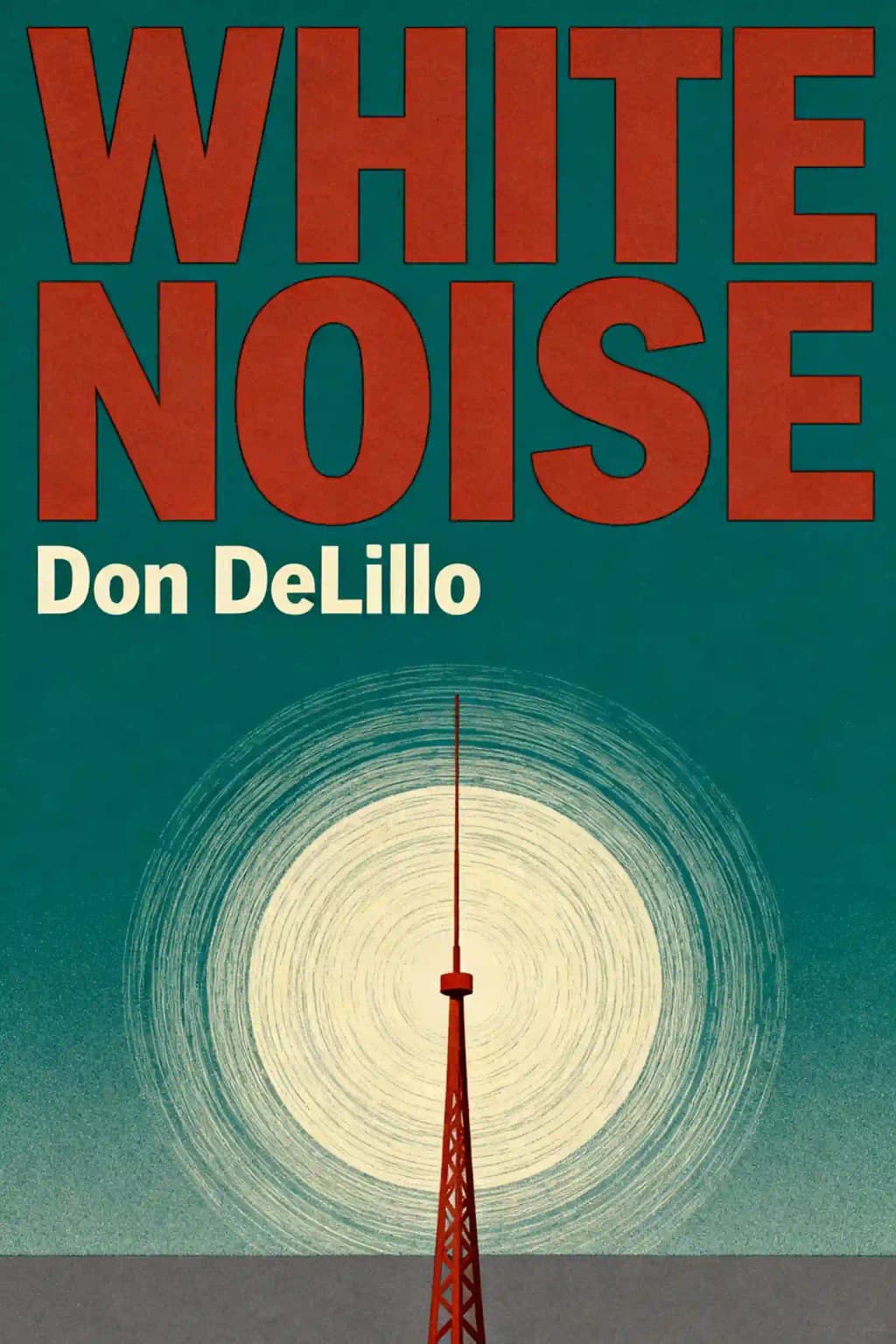
When Death Speaks in White Noise
Don DeLillo's "White Noise" burst onto the literary scene in 1985, immediately establishing itself as a defining novel of postmodern American fiction. This National Book Award winner has become required reading in university courses nationwide, praised for its darkly comic exploration of consumer culture, media saturation, and death anxiety in late 20th century America. Famously beloved by David Foster Wallace, who called it "an intellectual touchstone," the novel has recently gained renewed attention through Noah Baumbach's 2022 film adaptation starring Adam Driver. DeLillo's prescient examination of how information overload and consumer capitalism shape our perception of reality feels even more relevant today than when first published, making it a fascinating lens through which to examine our contemporary relationship with mortality, technology, and meaning.
Capítulo 2
The Gladney Family: Ordinary Lives in Extraordinary Times
At the center of "White Noise" is Jack Gladney, a middle-aged professor who invented Hitler Studies at the College-on-the-Hill in the fictional town of Blacksmith. Despite being the department chairman and foremost Hitler scholar in North America, Jack harbors a secret that could destroy his academic reputation: he doesn't speak German. This professional insecurity mirrors his personal anxieties about death, which haunt him throughout the novel.
Jack lives with his fourth wife, Babette, in a blended family that includes children from their various previous marriages: Heinrich (Jack's moody, intellectually precocious fourteen-year-old son), Denise (Babette's hard-nosed eleven-year-old daughter), Steffie (Jack's sensitive daughter from a previous marriage), and Wilder (Babette's toddler son). Their home functions as a microcosm of American consumer culture-cluttered with possessions accumulated from previous marriages, filled with the constant chatter of television and radio, and organized around rituals of shopping and consumption.
The family's dynamics reveal both the comforts and anxieties of contemporary American life. Their kitchen conversations range from playful debates about camels to serious discussions about environmental toxins. Denise monitors her mother's health habits with the vigilance of a miniature FDA agent. Heinrich challenges his father with relativistic theories about perception and reality. Through these interactions, DeLillo shows how even ordinary family life is permeated by information anxiety and existential uncertainty.
Jack and Babette share an overwhelming fear of death, frequently asking each other, "Who will die first?" This question becomes more than theoretical after Jack is exposed to a mysterious chemical during an environmental disaster. Their approaches to mortality-Jack's academic immersion in Hitler as a shield against death, Babette's secret participation in an experimental drug trial-reveal how deeply death anxiety shapes their identities and choices.
The Gladney family represents the modern condition: intelligent, self-aware people trying to navigate a world saturated with information yet starved for meaning, seeking security in consumption while haunted by the knowledge of their own mortality.
Capítulo 3
Consumerism as Religion: The Supermarket Cathedral
Throughout "White Noise," the supermarket emerges as a quasi-religious space-a temple of consumer abundance where the Gladneys and other characters seek meaning and reassurance. Jack describes shopping trips with an almost spiritual reverence: "It seemed to me that Babette and I, in the mass and variety of our purchases, in the sheer plenitude those crowded bags suggested... were creating a sense of replenishment... I began to grow in value and self-regard."
The supermarket offers what traditional religion once provided: community, ritual, and the promise of transcendence. Shoppers move through the aisles in a kind of secular communion, their carts filled with colorful packages that promise fulfillment. When Jack encounters his colleague Murray in the supermarket, Murray waxes philosophical about the space: "This place recharges us spiritually, it prepares us, it's a gateway or pathway. Look how bright. It's full of psychic data."
DeLillo contrasts the vibrant abundance of the supermarket with the characters' underlying anxieties. After the toxic chemical spill forces an evacuation, Jack finds comfort upon returning to the supermarket, which remains "musical and bright" while the town shows signs of decay. The consistency of the consumer experience provides reassurance that "everything was fine" despite evidence to the contrary.
The novel's treatment of consumerism is complex, neither simply condemning nor celebrating it. Shopping provides genuine comfort to the characters-the "sense of security and contentment" Jack feels when filling his cart with colorful products contrasts with Murray's experimental purchase of generic white-packaged foods, which he calls "the new austerity." Yet this comfort comes at a cost: a disconnection from authentic experience and an inability to confront mortality directly.
In one of the novel's most visceral scenes, the Gladney family eats fast food in their car, tearing into chicken parts with primal concentration, "half stunned by the dimensions of our pleasure." This moment of pure consumption-wordless, intense, almost animalistic-reveals both the power and the limitations of consumer culture as a source of meaning.
Capítulo 4
Media Saturation: Waves and Radiation
"White Noise" was remarkably prescient in its portrayal of media saturation and information overload. Written before the internet age, the novel nevertheless captures the disorienting effect of constant exposure to media-television, radio, tabloid headlines, and academic jargon all blend together to create the titular "white noise" that surrounds the characters.
Murray, a visiting lecturer studying American popular culture, theorizes that television has become "a primal force in the American home... like a myth being born right there in our living room." He sees TV as "close to mystical" while his students dismiss it as "the death throes of human consciousness." This tension between media as meaning-maker and media as destroyer runs throughout the novel.
The Gladney family's relationship with television is particularly revealing. Babette institutes mandatory family TV viewing on Friday nights to "de-glamorize the medium" for the children. Yet when the family discovers Babette herself on television teaching her posture class, they experience an existential disorientation-she is simultaneously present in the room and distant on screen, real and electronic. Only the toddler Wilder remains calm, touching her image while the others struggle with this technological separation of presence and absence.
Information in "White Noise" is both abundant and unreliable. The family generates misinformation in their dinner conversations, with Heinrich offering five dollars to anyone who can name Bolivia's population. Murray suggests this shared ignorance serves as protection against threatening facts. During the toxic chemical spill, information about symptoms and danger levels changes constantly, leaving the characters uncertain what to believe.
DeLillo shows how media shapes perception of events. When a plane nearly crashes, Bee (Jack's daughter) immediately asks where the media is to document the near-disaster. During the toxic event, a passionate man at the evacuation center demands to know why their suffering merits only "fifty-two words" of coverage: "Shouldn't the streets be crawling with cameramen and soundmen and reporters?" Without media attention, the disaster seems less real, less significant.
The novel suggests that in a media-saturated world, reality itself becomes mediated. When tourists visit "the most photographed barn in America," Murray observes they can't experience the barn directly: "We're not here to capture an image, we're here to maintain one... We can't get outside the aura."
Capítulo 5
The Airborne Toxic Event: Disaster as Spectacle
The central crisis of "White Noise" occurs when a chemical spill creates a toxic cloud-officially designated an "airborne toxic event"-that forces the evacuation of Blacksmith. This disaster serves as both literal danger and powerful metaphor, bringing the characters' abstract fears into concrete reality.
The evacuation scene is rendered with cinematic intensity. As the Gladney family joins the exodus, they witness scenes that seem simultaneously real and mediated: families wrapped in plastic moving with "fated determination," giving them "an epic quality" reminiscent of "a whole history of people trekking across wasted landscapes." A car accident illuminated by helicopter spotlights takes on "the eloquence of a formal composition." The toxic cloud itself appears "like some death ship in a Norse legend," escorted by military helicopters, inspiring "a sense of awe that bordered on the religious."
Heinrich, typically moody and withdrawn, becomes surprisingly animated during the crisis, describing every detail with "spirited enjoyment," his voice betraying "a craving for terrible things." His enthusiasm reveals how disaster can be perversely exciting, breaking through the numbing routines of everyday life.
The official response to the disaster highlights the novel's satirical edge. SIMUVAC (Simulated Evacuation) personnel use the real toxic event as practice for future simulations, inverting the expected relationship between preparation and reality. Later, they stage evacuation drills where volunteers perform "self-induced gagging and vomiting" for video analysis, while a technician announces through speakers that "the more we rehearse disaster, the safer we'll be from the real thing."
Information about the toxic cloud changes constantly. Initial reports list symptoms including sweaty palms, nausea, and deja vu. Later, the radio cheerfully adds "convulsions, coma, miscarriage." This shifting information creates both comedy and anxiety, as characters wonder whether they're experiencing genuine symptoms or merely responding suggestibly.
The airborne toxic event forces Jack to confront mortality directly when he's exposed to Nyodene D, the chemical in the cloud. A computer technician later informs him that the substance has created a "nebulous mass" in his body-a growth with "no definite shape, form or limits" that could potentially be fatal. This abstract death sentence intensifies Jack's existing fear, driving his increasingly desperate actions in the novel's final third.
Capítulo 6
Fear of Death: The White Noise Within
At its core, "White Noise" is about death anxiety-the persistent hum of mortality awareness that underlies contemporary life despite all attempts to suppress it. Jack and Babette's recurring question-"Who will die first?"-reveals how death haunts even their most intimate moments, seeming "woven into the texture of the bedroom, a natural part of the night thoughts, the selfless and expansive things that come to mind as you lie a foot apart."
Both characters develop elaborate strategies to manage this fear. Jack immerses himself in Hitler studies, using the dictator's overwhelming historical presence as a shield against his own mortality: "All plots tend to move deathward," he tells his students, revealing more about his own preoccupations than about Hitler. Babette secretly participates in an experimental drug trial for Dylar, a medication designed to eliminate the fear of death by targeting the brain's fear centers.
When Jack discovers Babette's secret, she confesses to having sex with the researcher (known only as "Mr. Gray" or "Willie Mink") in exchange for the medication. This revelation drives Jack toward violence in the novel's climax, as he plans to kill Mink and steal his supply of Dylar. Murray's philosophical justification-that there are "killers and diers" in the world, and killing transfers death to another person-provides Jack with intellectual cover for his murderous intentions.
The novel explores various approaches to mortality. Winnie Richards, a brilliant researcher at the college, suggests embracing death awareness: "I think it's a mistake to lose one's sense of death... Doesn't it give a precious texture to life?" She theorizes that fear is "self-awareness raised to a higher level." Murray proposes alternatives including embracing the afterlife as "a sweet and terribly touching idea" or surviving catastrophes where others die, which "can counteract the effect of any number of nebulous masses."
In one of the novel's most striking scenes, Jack visits a hospital run by atheist German nuns who maintain religious practices without belief. Sister Hermann Marie explains their philosophy: "The nonbelievers need the believers. They are desperate to have someone believe... Our pretense is a dedication." This performance of faith without conviction parallels Jack's own academic persona-the Hitler scholar who doesn't speak German-suggesting that modern life requires various forms of pretense to manage existential dread.
Capítulo 7
Technology and Toxicity: The Price of Progress
"White Noise" presents a world where technological progress has created new forms of danger and uncertainty. The novel's setting-a small college town surrounded by chemical plants, insane asylums, and toxic waste dumps-embodies this uneasy coexistence of everyday American life with invisible threats.
Heinrich, Jack's scientifically-minded son, articulates this concern most directly, declaring everyday radiation from household electronics the "real issue" compared to toxic spills. He cites disturbing claims about suicide rates near power lines and deformed babies from TV and radio exposure. When Jack asks if his son's receding hairline might be his fault-the result of raising him near chemical dumps or industrial waste-he reflects that "technology has complicated human guilt."
The airborne toxic event makes these abstract threats concrete. The cloud itself is described in almost supernatural terms, yet its origins are entirely man-made. After the evacuation, the town experiences unnaturally beautiful sunsets, a visible reminder of how the chemical disaster has altered their environment. People gather on an overpass to watch these spectacular skies with a mixture of wonder and dread, unsure whether they're witnessing beauty or danger.
Medical technology in the novel offers both reassurance and new anxieties. Jack undergoes a series of tests after his exposure to Nyodene D, but the results are communicated in cryptic, unsatisfying ways. Dr. Chakravarty speaks in riddles about "true elevations and false elevations" in Jack's potassium levels. A technician shows Jack computer-generated images of his body that reveal the presence of Nyodene D but cannot predict its effects with certainty.
Dylar, the experimental medication Babette takes, represents technology's promise to solve even existential problems. Designed to eliminate the fear of death by targeting specific brain receptors, it embodies the dream of technological transcendence. Yet its side effects-confusion between words and things, inability to distinguish between real threats and verbal descriptions-suggest the limitations of such approaches. When Jack confronts Willie Mink, the researcher is in a delusional state caused by Dylar, responding to random words as though they were physical realities.
The novel suggests that technological progress has created a new relationship with mortality-what Jack calls "the current generation of the dead, or death as we now know it." When an insane asylum burns, the acrid chemical smell drives onlookers away, making them confront "a synthetic kind of death alongside the natural one, complicating our sadness with thoughts of our own mortality."
Capítulo 8
Academic Satire: The College-on-the-Hill
DeLillo masterfully employs the academic setting of College-on-the-Hill to craft a biting satire of intellectual pretensions and the increasingly specialized nature of contemporary education. The institution houses an unlikely pairing: Jack's Department of Hitler Studies alongside the American Environments department, which focuses on popular culture studies. This jarring juxtaposition - between the profound historical gravity of Nazi Germany and the apparent triviality of studying Elvis Presley, breakfast cereals, and B-movie car crashes - serves as a central source of both humor and deeper commentary throughout the novel.
Jack's creation of Hitler Studies in 1968 exemplifies academic opportunism at its most calculating. He strategically established a field where he could reign as the sole authority, despite initially not speaking German - a fact he carefully conceals from his colleagues. His professional persona is meticulously crafted: the dark glasses suggesting gravitas, the academic robe lending authority, and the invented name "J.A.K. Gladney" providing scholarly legitimacy. When the chancellor advised him to "grow out into Hitler," suggesting he develop an air of "unhealthy excess" and "hulking massiveness," Jack dutifully gained weight and adopted an imposing presence to match his subject matter's historical weight.
Murray Jay Siskind arrives from New York with similar ambitions, hoping to replicate Jack's success by establishing Elvis Studies as a legitimate academic discipline. Their relationship culminates in one of the novel's most theatrical scenes, where they circle each other in a classroom, engaging in an intellectual dance that transforms into a meditation on crowds, death, and cultural power. Murray attempts to draw parallels between Hitler and Elvis through their ability to manipulate masses: "To become a crowd is to keep out death." This performative lecture allows Murray to temporarily share in Jack's academic prestige, "borrowing his aura of power and madness" while establishing his own scholarly territory.
The novel's satire of academic discourse reaches its peak in the pronouncements of Alfonse Stompanato, the bombastic chairman of American Environments. His declarations about understanding "the language of music" - reduced to "Buzz, buzz, buzz" - perfectly capture the often hollow nature of academic posturing. Department members excel at applying complex theoretical frameworks to the most mundane subjects, finding profound significance in everything from cereal box designs to television commercials, often speaking in dense jargon that serves more to obscure than illuminate.
Yet DeLillo's satire isn't merely dismissive. Beneath the comic surface, he suggests that academic study - even of seemingly trivial subjects - can represent a genuine attempt to make sense of an increasingly complex and mediated world. Jack's immersion in Hitler studies, though partially driven by career advancement, becomes a way to confront humanity's capacity for organized destruction. Similarly, Murray's analytical approach to consumer culture, while sometimes absurdly overreaching, offers valuable insights into the rituals and symbols that shape contemporary American life. The academic setting becomes a lens through which characters attempt to impose order on chaos, even as the novel questions the validity of such attempts.
Capítulo 9
The Absurd Sublime: DeLillo's Tragicomic Vision
"White Noise" achieves its distinctive tone through the juxtaposition of profound philosophical questions with absurd, often hilarious details of everyday life. DeLillo finds both comedy and transcendence in the mundane, creating what might be called an "absurd sublime"-moments where ordinary reality opens onto something larger and more mysterious.
The novel's dialogue exemplifies this approach. Family conversations veer from profound topics to trivial concerns and back again. When Jack and Babette discuss pleasing each other sexually, their circular, almost comical dialogue-"I want to do whatever's best for you"-reveals both the absurdity and tenderness of intimate relationships. Babette objects to phrases like "he entered her" in erotic literature because "We're not lobbies or elevators," a line that manages to be simultaneously funny and philosophically astute about language and embodiment.
Even in moments of crisis, comedy emerges. During the toxic event evacuation, Jack observes shoppers in a furniture store watching the exodus pass by and wonders, "Why were they content to shop for furniture while we sat panicky in slowpoke traffic in a snowstorm? They knew something we didn't." This deadpan observation captures both the absurdity of consumer behavior during disaster and the existential uncertainty of not knowing which response-panic or shopping-is more appropriate.
The novel finds beauty and meaning in unexpected places. Wilder's inexplicable seven-hour crying jag becomes almost transcendent: "I let it wash over me, like rain in sheets." When he finally stops, the family treats him with "reverent awe, as though he's returned from some holy place." Similarly, Jack's ATM transaction becomes a moment of spiritual connection: "The system was invisible, which made it all the more impressive, all the more disquieting to deal with. But we were in accord, at least for now... The system had blessed my life."
Even the toxic cloud itself inspires a kind of terrible beauty, with flares illuminating it against the night sky while helicopters escort it "like some death ship in a Norse legend." The spectacular sunsets that follow the disaster draw crowds who watch with a mixture of wonder and dread, unsure how to feel about this beautiful manifestation of environmental damage.
This combination of the absurd and the sublime extends to the novel's treatment of death. When Jack visits the old village cemetery, touching rough marble headstones with "great strong simple names," he reflects: "The power of the dead is that we think they see us all the time... Perhaps we are what they dream." This poetic meditation emerges from the same character who earlier bargained with himself about acceptable ages to die and worried about the "relative size of holes" his and Babette's deaths would leave in each other's lives.
Capítulo 10
The Persistence of Wonder in a Mediated World
Despite its satirical edge and dark themes, "White Noise" ultimately affirms the possibility of genuine experience and wonder in a world mediated by technology, consumerism, and academic jargon. Throughout the novel, moments of authentic connection and perception break through the titular white noise of modern life.
Children in the novel often serve as conduits for this unfiltered experience. Wilder, the toddler who barely speaks, represents a pre-linguistic relationship with reality. His epic tricycle journey across the expressway-cars swerving wildly around him as he pedals with determination-becomes a kind of heroic quest, culminating in his rescue by a passing motorist who holds him up "for the women to see" in a moment of almost religious significance.
Steffie provides another such moment when Jack watches her sleeping and hears her murmur "Toyota Celica"-a advertising phrase that becomes, in her unconscious utterance, "beautiful and mysterious, gold-shot with looming wonder." Jack finds himself "in the presence of some unspeakable truth" in this corporate name spoken by his sleeping child.
Even the much-maligned supermarket offers moments of genuine connection. When Jack encounters Murray studying the generic food section, their conversation about death and groceries achieves a kind of philosophical depth that transcends its setting. The novel's final scene returns to the supermarket, where shelves have been rearranged, causing confusion among shoppers. Yet even in this disorientation, the checkout scanners "decode the binary secret of every item"-"the language of waves and radiation, or how the dead speak to the living."
The novel's treatment of technology is similarly nuanced. While media saturation creates a barrier between people and direct experience, technology also enables new forms of perception and connection. The medical imaging that reveals Jack's "nebulous mass" represents both the anxiety of technological diagnosis and the wonder of seeing inside one's own body. The spectacular sunsets after the airborne toxic event, though caused by chemical contamination, nonetheless inspire genuine awe.
In its final moments, "White Noise" suggests that meaning persists despite-or perhaps because of-the conditions of postmodern life. The white noise of media, technology, and consumerism may distort our perception, but it cannot eliminate the human capacity for wonder, connection, and the confrontation with mortality that gives life its "precious texture."