Capítulo 1
The Remarkable Journey of Life's Transformation
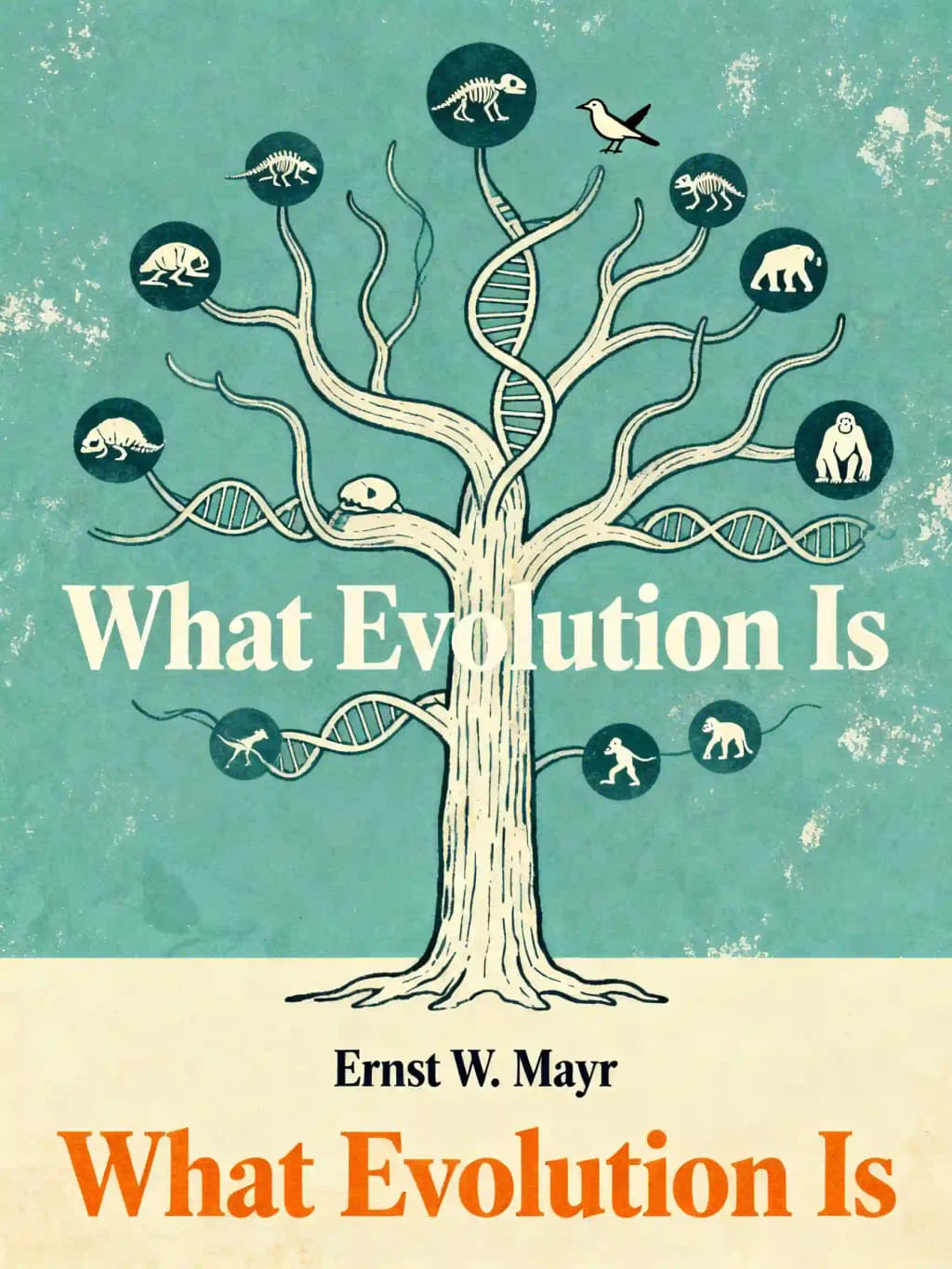
What if I told you that the book in your hands has been hailed as "the best book on evolution" by one of the world's most renowned scientists? Ernst Mayr's "What Evolution Is" stands as the definitive work on evolutionary theory by one of the greatest biologists of the 20th century. At 97 years old when he wrote this masterpiece, Mayr distilled his lifetime of knowledge into an accessible yet profound exploration of life's most fundamental process. This book has influenced countless scientists, including Richard Dawkins and Stephen Jay Gould, and remains a cornerstone text in university courses worldwide. Beyond academic circles, it has shaped how we understand ourselves as a species and our place in the natural world. When Jared Diamond, himself a celebrated scientist and author, declares "there will never be another book like it," we should pay attention. After all, we're about to explore not just any scientific theory, but the single most important concept in all of biology.
Capítulo 2
Evolution: The Shifting Worldview That Changed Everything
For most of human history, we've grappled with three competing explanations for our existence. The first, championed by Aristotle, proposed an eternal, unchanging universe of infinite duration. The second, rooted in biblical creationism, suggested a young Earth created just thousands of years ago. The third-evolution-represents a radical departure from both: a world of constant change, where species transform over vast periods of time.
The scientific revolution gradually undermined literal biblical interpretations, but the idea of an evolving world remained alien to Western thought until the 19th century. Early compromises like the Great Chain of Being (scala naturae) arranged all entities from rocks to humans in an ascending, unchanging ladder reflecting divine order. Yet mounting evidence from geology and paleontology made this position increasingly untenable.
When Charles Darwin published "On the Origin of Species" in 1859, he triggered mankind's greatest intellectual revolution. Born in 1809, Darwin developed as an ardent naturalist who studied at Cambridge before joining HMS Beagle's five-year voyage surveying South America. During this journey, he questioned everything about land history and biodiversity. His genius stemmed from superb observational skills and insatiable curiosity. He recognized evolution's dual aspects: anagenesis (gradual change within lineages) and cladogenesis (the splitting of lineages creating biodiversity).
Darwin's work challenged three fundamental beliefs: the world's constancy, the supernatural cause of organismal adaptation, and human uniqueness. Beyond presenting overwhelming evidence for evolution, he proposed natural explanations without supernatural forces, effectively secularizing science. While evolution itself was widely accepted by the 1860s, Darwin's explanatory mechanisms-particularly natural selection-faced prolonged opposition from those clinging to essentialist and teleological worldviews.
What makes Darwin's achievement so remarkable is that he had to overcome deeply entrenched philosophical ideas. He introduced four revolutionary concepts: population thinking (focusing on variable populations rather than fixed types), natural selection (differential survival driving adaptation), chance (random variation providing raw material), and historical perspective (recognizing past events shape current forms). These concepts eventually became the foundation of modern biological philosophy, but not without decades of resistance.
Capítulo 3
The Mountain of Evidence: Why Evolution Is Fact, Not Theory
The evidence for evolution has become so overwhelming that calling it "just a theory" reveals a fundamental misunderstanding of scientific terminology. Multiple branches of biology provide remarkably congruent conclusions that make sense only within an evolutionary framework.
Perhaps most convincing is the fossil record preserved in geological strata. These fossils document evolutionary transitions like Archaeopteryx from 145 million years ago, showing both reptilian features (teeth, long tail) and avian characteristics (brain, feathers, wings). Some fossil lineages are remarkably complete, such as the transition from therapsid reptiles to mammals, where intermediates are so balanced between reptilian and mammalian traits that classification becomes arbitrary.
What makes these fossil sequences particularly compelling is that each fossil appears exactly at the expected time level-modern mammals after the extinction event 65 million years ago, giraffes in mid-Tertiary (about 30 million years ago)-with no contradictory findings like modern mammals in 100-million-year-old strata. Modern radioactive dating techniques now allow extremely precise age determinations, providing virtually irrefutable documentation of evolution.
Beyond fossils, comparative anatomy reveals structures that are "the same organ in different animals under every variety of form and function," as Richard Owen defined homology. The mammalian forelimb demonstrates this perfectly, being modified for different functions-digging (mole), climbing (monkey), swimming (whale), and flying (bat)-while all sharing the same basic bone structure. This makes sense only if these structures evolved from common ancestors.
Embryology provides another window into evolutionary relationships. Early human embryos resemble not only other mammalian embryos but also those of reptiles, amphibians, and fishes. Even highly specialized adults like barnacles have free-swimming larvae similar to other crustaceans. While development necessarily moves from simple to complex, embryos always have characteristics peculiar to their phyletic lineage that reveal relationships.
Vestigial structures-like the human appendix, teeth in baleen whale embryos, and eyes in cave animals-provide further evidence. These remnants of fully functional structures in ancestors have been reduced due to changes in niche utilization. They create insurmountable difficulties for creationist explanations but align perfectly with evolution through common descent.
Biogeography-the study of species distribution-offers compelling evidence that Darwin found particularly convincing. The faunas of Europe and North America are relatively similar despite the North Atlantic separation, while those of Africa and South America are very different. Australia's fauna is strikingly different from all other continents, and oceanic islands typically lack mammals. These patterns result from organisms' dispersal history from their original points of origin, constrained by their ability to cross barriers.
Perhaps most surprisingly, molecular biology has provided the strongest confirmation of evolution. Closely related organisms have more similar molecules, with humans and chimpanzees sharing nearly identical proteins in many cases. Molecular studies have resolved many ambiguous relationships where morphological evidence was unclear and confirmed humans' close relationship to chimpanzees and other anthropoid apes.
Capítulo 4
Life's Remarkable Journey: From Simple Beginnings to Complex Forms
Life originated on Earth approximately 4.6 billion years ago and gradually evolved from simple prokaryotes to complex multicellular organisms. The earliest evidence of life dates back 3.5 billion years, with fossils showing bacteria remarkably similar to those still living today.
While Darwin explained evolution, the origin of life itself remained a challenge for decades. Modern theories began with Oparin and Haldane in the 1920s. Early life faced two major challenges: acquiring energy and developing replication. The first organisms likely thrived in an oxygen-free environment using solar and chemical energy. Before DNA-based life, an "RNA world" may have existed where RNA served enzymatic functions.
For the first billion years, Earth was dominated by prokaryotes-organisms without a nucleus, with DNA in gonophores rather than chromosomes, no sexual reproduction, simple cell division without mitosis, rotating flagella, small cell size, and no cellular organelles. Most remarkable about cyanobacteria (the earliest fossil prokaryotes) is their morphological stasis-about a third of early fossil species are indistinguishable from modern species.
After approximately one billion years of exclusively bacterial life, the most dramatic event in Earth's biological history occurred-the origin of eukaryotes. These organisms differ fundamentally from prokaryotes by possessing a membrane-bound nucleus containing chromosomes. The first eukaryote likely formed through symbiosis between an archaebacterium and a eubacterium, creating a chimeric organism. Subsequently, eukaryotes acquired various organelles like mitochondria (from alpha proteobacteria) and chloroplasts (from cyanobacteria) through symbiosis.
Multicellularity evolved repeatedly throughout evolutionary history. The path toward multicellularity typically begins with increased cell size in unicellular protists, followed by cell aggregation and division of labor among cells. Multicellularity reached its zenith in the three great kingdoms of Plants, Fungi, and Animals.
The apparent sudden appearance of most skeleton-bearing animal phyla in early Cambrian strata (543 million years ago) was long considered mysterious. However, this "Cambrian explosion" likely represents the acquisition of skeletons by already-existing soft-bodied animals, possibly triggered by atmospheric changes or the evolution of efficient predators. Molecular clock studies now suggest much earlier origins for animal phyla than the fossil record indicates-protostomes and deuterostomes diverged around 670 million years ago.
Capítulo 5
The Engine of Evolution: Variation and Natural Selection
Darwin's revolutionary insight was that species aren't fixed types but biopopulations of genetically unique individuals. This required an entirely new explanatory theory: variation and selection. For typologists, the type is real and variation illusory; for populationists, the average is merely statistical abstraction while variation alone is real.
Evolution in sexual organisms consists of generational genetic changes in populations. Recombination supplies an inexhaustible source of new genotypes, while selection eliminates all but the best-adapted individuals. This process favors new adaptations and evolutionary novelties, typically occurring gradually except for certain chromosomal processes.
The uniqueness of every individual-variation-is the indispensable prerequisite for evolution. Though individuals of a species might seem identical at first glance, closer examination reveals differences in size, proportions, color patterns, physiological traits, behaviors, ecological adaptations, and molecular patterns. This ubiquitous variability makes natural selection possible.
Natural selection operates through two distinct steps. The first step involves producing new variation through meiosis, gamete formation, and fertilization-processes ruled largely by chance. The second step involves testing the "goodness" of new individuals from embryonic stage through adulthood. Those most efficient at coping with environmental challenges have the best chance to survive and reproduce.
Unlike artificial selection where breeders actively choose superior individuals, natural selection has no agent doing the selecting. It's actually a process of elimination where individuals with favorable characteristics survive while others perish. Herbert Spencer's phrase "survival of the fittest" captures this accurately.
Darwin resolved the ancient philosophical debate between chance and necessity by showing that evolution results from both. While genetic variation arises randomly, the elimination process of natural selection is an antichance process. Complex structures like the eye aren't chance products but result from the favored survival of individuals with increasingly efficient visual structures over generations.
The individual is the principal target of selection, not genes themselves. A gene itself cannot be the object of selection as it's merely part of a genotype, while the phenotype of the whole individual faces selection pressures. The reductionist view that genes are selection's targets fails because genes don't act independently-they interact through epistatic interactions, where one gene may enhance, reduce, or enable the effects of others.
Capítulo 6
Adaptation: Nature's Ingenious Solutions
How can we explain why organisms are so remarkably adapted to their environments? The seeming perfection of structures like vertebrate eyes, bird migration precision, and social insect cooperation once prompted religious explanations. Natural theology, championed by scholars like William Paley, viewed adaptations as proof of a wise creator's design. Yet this view struggled to explain nature's brutality, waste, and apparent design flaws like the human appendix or the recurrent laryngeal nerve's circuitous route.
An adaptation is any trait-structural, physiological, or behavioral-that enhances an organism's fitness by contributing to its survival and reproductive success. What matters is the trait's current adaptive value, not its evolutionary history. For instance, bird feathers originally evolved for insulation and display before being co-opted for flight. Adaptation is a passive process-individuals with inferior adaptations are eliminated, but survivors don't actively contribute to becoming better adapted. This process operates through differential survival and reproduction rates rather than conscious effort.
Adaptations develop gradually, as demonstrated by numerous fossil records. Archaeopteryx, dating back 150 million years, displays an intermediate state between reptiles and birds with reptilian teeth and tail but avian feathers, wings, eyes, and brain. Similarly, whale fossils like Ambulocetus and Rodhocetus document intermediate adaptations to aquatic life, showing progressive changes in limb structure and skull position. Even complex structures like eyes evolved independently at least 40 times, with existing organisms showing every intermediate stage between simple light-sensitive spots and perfect eyes - from flatworms' eyespots to compound insect eyes to cephalopod camera eyes.
Convergent evolution produces remarkably similar adaptations when unrelated organisms colonize similar ecological niches. Australian marsupials evolved forms closely resembling placental mammals: the thylacine (marsupial wolf), sugar glider (marsupial flying squirrel), and numbat (marsupial anteater). Similar nectar-feeding birds evolved independently in different regions: honeyeaters (Australia), sunbirds (Africa/India), honeycreepers (Hawaii), and hummingbirds (Americas). Other striking examples include flightless ratites on different continents (ostriches, emus, kiwis), American and African porcupines, desert-adapted cacti and euphorbs, and the similar streamlined bodies of sharks, ichthyosaurs, and porpoises.
No individual is ever perfectly adapted, as Darwin emphasized in "Origin of Species." Genotypes represent compromises between genetic variability and stability in perpetually changing environments. A population adapted to drought conditions may be poorly suited for an oncoming wet period, demonstrating the constant tension between specialization and flexibility. Similarly, behavioral traits like boldness versus timidity reflect balances between conflicting demands - bold individuals may find more food but face higher predation risks. Modern examples include antibiotic resistance in bacteria, where resistant strains thrive under medication but may be less competitive when antibiotics are absent. This ongoing process of adaptation continues as organisms face new challenges like climate change, habitat fragmentation, and novel pathogens.
Capítulo 7
The Origin of Species: How Biodiversity Arises
Speciation refers specifically to the multiplication of species-the process by which one ancestral species gives rise to multiple descendant species-not the gradual transformation of a lineage over time. This distinction is crucial, as phyletic evolution doesn't increase biodiversity. While evolution can occur within a single lineage through adaptation and genetic drift, only speciation events contribute to the remarkable diversity of life forms we observe today.
Allopatric speciation occurs when populations become geographically isolated by barriers that prevent gene flow. These barriers can be physical (mountains, oceans, deserts), climatic (temperature zones, rainfall patterns), or ecological (habitat fragmentation). These isolated populations, called incipient species, evolve independently through various genetic processes: new mutations, gene loss through sampling accidents, novel recombinations, and adaptation to different selection pressures in their unique environments. For example, the Galapagos finches evolved from a single ancestral species into multiple species with different beak shapes adapted to various food sources, demonstrating how isolation leads to adaptive radiation.
Two major types of allopatric speciation exist. Dichopatric speciation occurs when a geographical barrier divides a previously continuous population, such as the flooding of the Bering Strait separating Siberian and Alaskan populations, leading to distinct brown bear populations in Asia and North America. Peripatric speciation involves the establishment of a small founder population beyond the periphery of a species' range. These genetically impoverished populations, often founded by just a few individuals, develop statistically different gene pools and face new selection pressures. The Hawaiian Drosophila flies represent a classic example, where founder events led to over 800 species evolving from a single ancestral species.
While Darwin initially proposed ecological divergence could lead to speciation without geographic isolation, careful studies of mammals, birds, butterflies, and beetles showed geographic isolation was the exclusive mechanism in these groups. However, other speciation mechanisms do occur in different organisms. Sympatric speciation occurs without geographic isolation, primarily in host-specific insects (like apple maggot flies switching between hawthorn and apple hosts) and freshwater fishes (like cichlids adapting to different lake depths). Instantaneous speciation through chromosomal processes like polyploidy is common in plants, where chromosome doubling can create new species in a single generation, as seen in wheat and cotton.
Understanding speciation requires studying the full spectrum of population differentiation-from local demes to geographical races to closely related species-to reconstruct the pathway of species formation. Ring species, such as the Ensatina salamanders of California, provide valuable insights into this process, showing how gradual geographic variation can lead to reproductive isolation. This process explains the apparent paradox in nature: continuous gradual change in populations through time and space contrasts with distinct gaps between species and higher taxa. Modern molecular techniques have further revealed the complexity of speciation, showing how genetic incompatibilities accumulate gradually and how hybridization can both promote and prevent species formation.
The study of speciation mechanisms continues to evolve with new technologies and discoveries, revealing that the formation of new species often involves multiple interacting factors rather than single, simple mechanisms. Understanding these processes is crucial for conservation biology and predicting how species might respond to environmental change.
Capítulo 8
Human Evolution: Our Place in Nature's Story
Humans have traditionally been considered entirely separate from the rest of creation-a view endorsed by religious texts and philosophers from Plato to Kant. Darwin's theory of common descent therefore shocked Victorian society by incorporating humans into the animal kingdom as primate descendants.
The evidence for human descent from primates, specifically apes, is overwhelming. Anatomically, humans share virtually all structural details with African apes, particularly chimpanzees, with differences being merely quantitative rather than qualitative. Fossil evidence, though lacking from the critical 5-8 mya period when humans and chimpanzees diverged, documents intermediate stages from 5 mya to present. Molecular evidence shows human macromolecules are more similar to chimpanzees than any other organism, with some proteins like hemoglobin being nearly identical.
Human evolution occurred through three major ecological shifts. The Rain Forest Stage featured apes moving by brachiation, eating soft fruits and plant material, with small brains and high sexual dimorphism, spending most time in trees. The Tree Savanna Stage began 5-8 million years ago when chimpanzee-like apes established populations in the savanna surrounding rainforests, developing bipedal locomotion for ground travel between trees.
Around 2.5 million years ago, Africa's climate deteriorated as the Northern Hemisphere ice age began. The tree savanna gradually transformed into bush savanna, eliminating the australopithecines' safety retreat. Those who survived adapted by developing defense mechanisms, likely using rocks, primitive weapons, and especially fire for protection. They became the first to make flaked stone tools and evolved into Homo. This ecological shift triggered the most fundamental change in hominid history, producing key Homo characteristics: doubled brain size, reduced sexual dimorphism, smaller teeth, shorter arms, longer legs, and likely the use of cooking.
After its initial evolutionary spurt, Homo erectus entered a period of stasis with only brain size continuing to increase during the transition to H. sapiens. While western erectus populations evolved into Neanderthals (flourishing 250,000-30,000 years ago), African erectus populations gave rise to H. sapiens around 150,000-200,000 years ago. This new species then spread rapidly across the world, reaching Australia 50,000-60,000 years ago and the Americas possibly as early as 50,000 years ago.
Despite our evolutionary relationship to apes, humans are indeed unique among animals. Most distinctly human characteristics relate to our extraordinary brain development and extended parental care. Unlike animal communication systems that merely exchange signals, human language incorporates syntax and grammar, allowing us to discuss past and future. The development of speech created selection pressure for brain enlargement, particularly memory centers, enabling art, literature, mathematics and science.
Capítulo 9
Evolution's Impact on Our Understanding of Life and Ourselves
Evolution isn't unexpected but inevitable given how organisms are structured. Every organism has a genome where each base pair occasionally mutates at a predictable rate - approximately one mutation per billion base pairs per generation. Different populations accumulate different mutations, and if isolated geographically or reproductively, they inevitably diverge over generations. This simplest scenario already constitutes evolution. Adding recombination through sexual reproduction and natural selection accelerates evolutionary change exponentially, as beneficial traits spread through populations while harmful ones are eliminated.
The term "evolutionary theory" has become questionable in scientific discourse. Evolution is now a fact so overwhelmingly established through multiple lines of evidence - including fossil records, comparative anatomy, molecular biology, and direct observation of evolutionary changes in bacteria and viruses - that calling it a theory is irrational. While specific evolutionary theories exist-common descent, origin of life, gradualism, speciation, natural selection-scientific debates about these mechanisms don't affect the basic conclusion that evolution occurs. The fossil record alone provides irrefutable evidence of species change over time, with countless transitional forms documented across various taxonomic groups.
Evolutionary thinking has become indispensable for addressing numerous human challenges. In medicine, understanding bacterial evolution is crucial for combating antibiotic resistance, as seen in the emergence of MRSA and other resistant strains. In agriculture, evolutionary principles guide the development of pest-resistant crops and the management of pesticide resistance. The control of disease vectors like mosquitoes requires understanding their evolutionary responses to interventions. During epidemics, tracking viral evolution helps predict disease spread and vaccine effectiveness, as demonstrated during the COVID-19 pandemic. Crop scientists apply evolutionary concepts to develop hardier, more productive varieties through both traditional breeding and genetic modification.
Perhaps most profoundly, evolution has transformed our understanding of ourselves. We now recognize that humans are not separate from nature but deeply embedded within it-the product of the same processes that shaped all life on Earth. Our superior brain has enabled remarkable inventions that make us increasingly independent of immediate environmental constraints, from climate-controlled buildings to modern medicine. Yet in the last 50 years, it's become evident we remain thoroughly dependent on the natural world's ecosystem services - from pollination to oxygen production to climate regulation.
Evolution teaches us humility by showing that we are not the pinnacle of creation but one branch on the vast tree of life, sharing common ancestors with all living things. It teaches us responsibility by revealing our unprecedented power to affect the future of that tree through habitat destruction, climate change, and species extinction. And it teaches us wonder by unveiling the extraordinary processes that, over billions of years, transformed simple prokaryotic cells into the rich tapestry of life we see today-including ourselves. The human genome itself tells this story, carrying ancient viral sequences and vestiges of our evolutionary past. In the words of Theodosius Dobzhansky, "Nothing in biology makes sense except in the light of evolution" - a statement that becomes more profound as our understanding of life's complexity deepens.