Capítulo 1
The Silent Language That Speaks Volumes
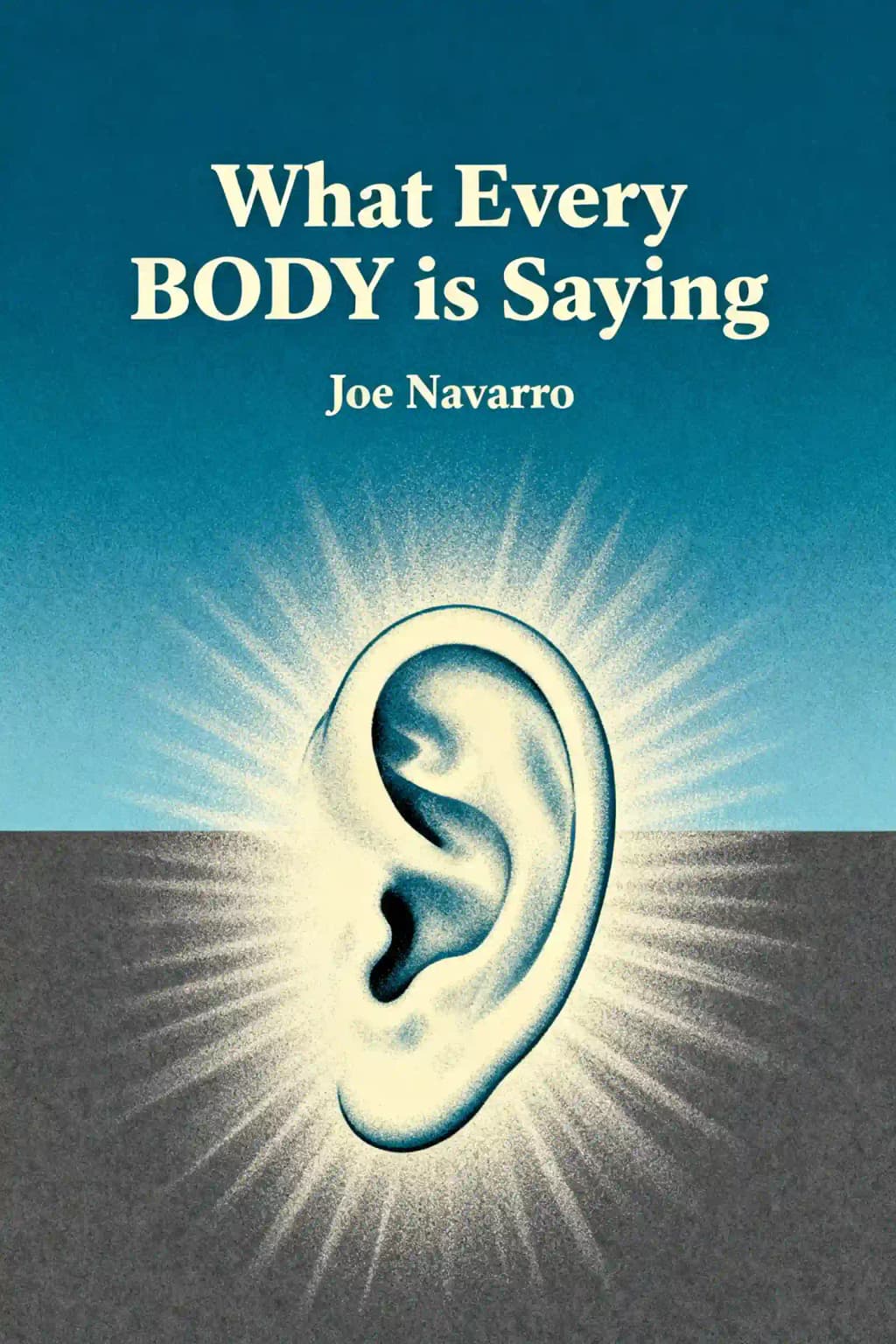
In a world dominated by verbal communication, we often overlook the most honest conversations happening right before our eyes. Joe Navarro's "What Every Body Is Saying" has become a cornerstone text for understanding nonverbal behavior, drawing on his 25 years as an FBI counterintelligence agent and behavioral analyst. This masterclass in reading body language has influenced everyone from business executives to poker champions, with celebrities like Will Smith and Emma Watson citing it as essential reading. The book's enduring popularity stems from its unique approach - rather than offering simplistic "tells" for catching liars, Navarro reveals how our bodies unconsciously broadcast our true thoughts and feelings through evolutionarily hardwired responses. What makes his insights so powerful is their foundation in both scientific research and real-world application in high-stakes FBI investigations. As you begin to understand the silent language of the body, you'll never experience human interaction the same way again.
Capítulo 2
The Limbic Brain: Our Honest Messenger
Our bodies communicate through an ancient, honest system that predates spoken language by millions of years. This communication originates in the limbic brain - our emotional center and survival mechanism that operates below conscious awareness. Unlike our thinking brain (neocortex), which can fabricate stories and tell lies, the limbic system reacts instantaneously and truthfully to our environment, producing genuine physical responses that manifest in our posture, gestures, and expressions.
This limbic honesty explains why nonverbal behavior comprises 60-65% of all interpersonal communication. When someone says they're happy while their body language shows tension, trust what the body says - it's speaking directly from the limbic brain, which cannot lie. The limbic system's primary directive is ensuring survival by avoiding danger and seeking safety, which it accomplishes through three distinct responses: freeze, flight, and fight.
The freeze response is our first line of defense - becoming motionless to avoid attracting predators' attention. In modern contexts, this appears when people suddenly hold still during questioning about troubling matters, exhibit shallow breathing during interviews, or display the "turtle effect" where they lower their head and raise shoulders to minimize exposure. Children who've experienced abuse often exhibit these behaviors by keeping arms dormant and avoiding eye contact - essentially hiding in plain sight.
When freezing fails, the limbic system activates the flight response. While running was practical for our ancestors, today this manifests as subtle distancing behaviors: turning away from undesirable people or conversations, blocking behaviors like closing eyes or placing hands in front of the face, leaning away from others, putting objects between ourselves and threats, and positioning feet toward exits.
The fight response emerges only when freezing and fleeing aren't options. Our ancestors developed the ability to transform fear into rage to fight off attackers, and in modern society, this appears as arguments, threatening postures, aggressive eye contact, chest-puffing, and personal space violations.
Following these limbic responses, we engage in pacifying behaviors (also called adapters) to calm ourselves down. Recognizing these self-soothing actions - from neck-touching to face-rubbing to leg-cleansing - provides remarkable insight into someone's emotional state, revealing precisely what topics or situations cause them distress.
Capítulo 3
The Truth Lies at Your Feet
If you want to know what someone is really thinking or feeling, start by looking at their feet. While most people observe body language from top to bottom, FBI agents are trained to work in reverse - beginning with the feet and legs, then moving upward. This counterintuitive approach works because our feet are the most honest parts of our body, furthest from our conscious awareness and control.
From childhood, we're taught to control our facial expressions ("Don't make that face!"), essentially training us to lie with our faces for social harmony. Meanwhile, few pay attention to their feet and legs, which honestly reveal nervousness, stress, fear, happiness, and confidence. This honesty stems from our evolutionary heritage - our limbic brains programmed our lower limbs to react instantaneously to threats without conscious thought.
Happy feet wiggle and bounce with joy when someone has heard or seen something positive that affects them. You don't need to look under the table - watch for subtle vibrations in their shirt or shoulders that reveal foot movement below. When feet suddenly shift direction, they signal genuine interest or disinterest. If someone turns both feet and torso to admit you to a conversation, the welcome is genuine; if they only swivel at the hips while keeping feet in place, they'd rather be left alone.
The knee clasp - placing both hands on knees while seated - signals someone wants to leave. This intention movement typically precedes a forward torso lean and shifting to the edge of the chair. When excited or feeling positive, we unconsciously defy gravity - rocking on the balls of our feet, walking with a bounce, or lifting our toes while seated. These limbic behaviors honestly reveal positive emotions in real time.
Territorial displays through leg splaying occur when humans feel stressed, threatened, or are attempting to intimidate others. When people shift from feet together to spread apart, it signals increasing displeasure and readiness to "deal with it." This stance establishes dominance and claims territory.
Leg crossing accurately reveals comfort levels around others. This position significantly reduces balance and escape ability, so our limbic brain only permits it when we feel safe and comfortable. When strangers enter an elevator, a person standing with crossed legs will immediately plant both feet firmly on the ground. Two colleagues with crossed legs signal mutual comfort through mirroring (isopraxism).
During courtship, our feet and legs mirror those of our companion and remain playful. Women often engage in "shoe-play" - dangling shoes from their toes when comfortable with a suitor. This behavior ceases immediately if discomfort arises. In intimate settings, couples often touch feet under tables because these areas feel private, and because feet contain numerous sensory receptors with neural pathways terminating near genital sensation centers in the brain.
The "foot freeze" - when someone who constantly wiggles their feet suddenly stops - signals stress, emotional change, or feeling threatened. This limbic-controlled survival response often occurs when a question is asked that might lead to revealing information the person wants to conceal. Similarly, when someone suddenly turns their toes inward or interlocks their feet, it indicates insecurity, anxiety, or feeling threatened.
Capítulo 4
The Torso's Protective Wisdom
Our torso houses vital organs like the heart, lungs, and liver, making it a priority for limbic protection when we feel threatened. The brain instinctively recruits the body to guard these areas in both subtle and obvious ways, creating nonverbal signals that reveal our true comfort level and intentions.
When standing near someone disliked or obnoxious, the torso will lean away. Since the torso carries significant weight, any reorientation requires energy and balance, making these reactions honest indicators of our feelings. We not only lean away from uncomfortable people but also "blade away" (turn slightly) from things we dislike. This happens even with images - museum visitors physically turn away from disturbing Holocaust exhibits as their brains say "I can't handle this."
Our ventral (front) side, containing vulnerable areas like eyes, mouth, chest, and genitals, is sensitive to things we like and dislike. "Ventral denial" occurs when we shift or turn away from people or topics we disfavor, as our limbic brain protects our vulnerable side. Conversely, "ventral fronting" happens when we expose our ventral sides to those we favor. This evolutionary response shows trust by exposing our most vulnerable parts.
When leaning away isn't practical or socially acceptable, we instinctively use arms or objects as barriers against discomfort. Businessmen may suddenly button jackets when uncomfortable, only to unbutton them when the conversation ends. Women often shield their torsos more than men, crossing arms over their stomachs or grabbing opposite elbows when feeling insecure. Students carry notebooks against their chests during the first days of class or before tests.
Bowing at the waist is a nearly universal sign of subservience, respect, or humility. When we automatically assume a kowtow position by bending the torso, we're demonstrating lower status or submission. For Westerners, this gesture doesn't come naturally, but learning to bow slightly when meeting elders from Eastern cultures can confer social advantages.
Our torsos function as billboards advertising our sentiments through clothing and accessories. What we wear significantly influences others' perceptions - from suits to casual clothes, even color choices matter. During courtship we dress to enchant; at work we dress for success. Our attire reveals social, economic, and occupational status, shows allegiance to groups, and communicates whether we're celebrating, mourning, conforming to norms, or belonging to a particular sect.
When physically and mentally well, we naturally groom ourselves appropriately. Conversely, poor grooming often signals illness or mental distress. Those suffering from schizophrenia or depression frequently neglect their appearance, with the depressed person physically stooping as if carrying the world's weight.
Humans, like many animals, puff out their chests when establishing territorial dominance. This seemingly comical behavior shouldn't be ignored - observation shows chest-puffing often precedes physical aggression. Schoolyard fights typically begin this way, as do professional boxing confrontations.
Under stress, the chest heaves as breathing becomes rapid and deep. The limbic system, preparing for potential fight-or-flight response, increases oxygen intake through deeper breathing or panting. This physiological response equips the body for sudden escape or confrontation.
Capítulo 5
The Arms: Powerful Communicators
Since humans began walking upright, our arms evolved for remarkable functions - carrying loads, casting blows, and providing first-line defense against threats. Their movements reveal our true sentiments far more honestly than our faces, making them reliable indicators of our thoughts, feelings, and intentions.
The freedom and extent of our arm movements accurately indicate our emotional state. When happy and content, our arms move freely and joyfully - we point, gesticulate, and wave without restraint. Excited people defy gravity, raising their arms high above their heads, while confident individuals swing their arms affirmatively when walking. Conversely, negative emotions physically bring us down - shoulders and arms sink upon hearing bad news, creating that "sinking feeling."
When upset or fearful, we instinctively withdraw our arms to our sides or across our chest as a protective survival tactic. Consider the worried mother watching her child play with rougher children - she'll cross her arms across her abdomen, restraining herself from intervening. During arguments, both parties may unconsciously engage in this self-restraint behavior, which has survival value by protecting the body while presenting a non-provocative stance.
Arm freeze, particularly in children, can indicate abuse. Abused children instinctively restrict arm movements around their abusers since predators orient toward movement. The child's limbic system self-regulates to avoid attracting attention. Observant adults should note this behavior as a potential warning sign, along with suspicious bruising patterns.
Certain arm behaviors clearly communicate "Don't come close to me; don't touch!" When people place their arms behind their backs, they signal higher status and create distance. This isn't merely a thinking pose - it's a deliberate barrier. The "regal stance" is used by royalty and authority figures to maintain distance. This isolation behavior affects everyone from children to pets, with potentially lasting psychological effects when used by parents.
Our arms serve as powerful tools for claiming and defending territory. From jockeying for armrest space on airplanes to dominating conference tables by spreading materials wide, territorial arm displays communicate power and status. Higher-status individuals typically claim more territory immediately upon sitting down, while those with lower confidence keep elbows against their waist with arms tucked between legs.
The arms akimbo posture - arms extended in a V pattern with hands on hips, thumbs backward - is a classic territorial display that projects authority and dominance. Common among police officers and military personnel, this stance doesn't translate well to civilian settings. For women executives, however, it can be a powerful tool to demonstrate confidence and unwillingness to be bullied in male-dominated environments.
Similar to how a cobra expands its hood to appear larger, the "hooding effect" occurs when someone leans back and interlaces hands behind the head with elbows out. This territorial display communicates "I am in charge here" and follows a clear pecking order - subordinates will abandon this posture when their superiors enter the room, as claiming territory is reserved for those of high status.
In courtship rituals, men often place an arm around their date or position themselves to pivot around her, creating a territorial barrier that signals to other males this person is claimed. The positioning of arms when seated together at a table also reveals relationship comfort levels - couples place arms near each other due to the sensory pleasure of potential contact, while discomfort or deteriorating relationships cause people to withdraw their arms.
Capítulo 6
Hands: Windows to Intention
Our human hands are uniquely expressive appendages with remarkable capabilities - from creating art and performing surgery to communicating complex thoughts. Despite the evolution of spoken language, our brains remain hardwired to engage our hands in communicating emotions and thoughts. Understanding hand behavior is crucial to decoding nonverbal communication, as nearly all hand movements are directed by the brain, either consciously or subconsciously.
The human brain gives disproportionate attention to hand movements, making them essential for persuasive speaking. Whether hand expressiveness comes naturally or requires training, effective hand communication significantly enhances how we convey ideas. Adolf Hitler, despite his evil nature, demonstrated the power of practiced hand gestures - initially a poor speaker with no stage presence, he meticulously practiced gestures in front of mirrors and on film to develop a dramatic speaking style that helped him rise to power.
People instinctively distrust those whose hands they cannot see during conversation. The brain depends on seeing hands as an integral part of communication, and hidden hands create discomfort and suspicion. In an informal classroom experiment, students interviewing others with hands hidden under a desk were perceived as uncomfortable, withdrawn, sneaky or deceptive, while those with visible hands appeared open and friendly.
A handshake creates the first physical connection between people and leaves a lasting impression. Cultural variations exist worldwide in handshake strength and duration - from the strong "Mormon handshake" to gentler Latin American greetings. While some use handshakes to establish dominance through manipulative techniques, these typically create negative impressions rather than respect.
Finger pointing ranks among the most universally offensive hand gestures, often triggering strong negative reactions and even physical confrontations in schools and prisons. When parents point at children while scolding them, the gesture itself can distract from the message being delivered. Jurors respond negatively to prosecutors who point at defendants before proving their case - an open palm gesture is more appropriate until closing arguments.
When the limbic brain is aroused during stress, surges of neurotransmitters and hormones cause uncontrollable hand trembling that telegraphs "I am under stress." This quivering is particularly noticeable when holding objects like pencils or paper, which magnify the trembling. People often try to control this shaking by clasping their hands, tucking them under their arms, or holding someone else's hand.
Steepling - touching spread fingertips together like a church steeple without interlocking - is perhaps the most powerful high-confidence tell. Women tend to steeple low (at waist level), making it less visible, while men typically steeple higher at chest level for more visible impact. This gesture signifies confidence in one's thoughts or position and is commonly used by high-status professionals like lawyers, doctors, and judges.
The "thumbs up" gesture almost universally signals high confidence and high status. When individuals carry their thumbs high, it indicates they think highly of themselves or feel confident in their circumstances. This gravity-defying gesture typically signals comfort and assurance. Even when fingers are interlaced, extended thumbs transform the meaning to one of confidence.
When people wring their hands or interlace their fingers in response to significant events or environmental changes, it typically indicates stress or low confidence. This common pacifier, seen worldwide, resembles prayer. As hand-wringing intensifies, fingers may blanch as blood is forced away from tension points - a clear sign that matters are worsening.
Capítulo 7
The Face: A Canvas of Emotion and Deception
Our faces are the mind's canvas for emotions, with smiles, frowns, and countless nuances in between creating humanity's universal language across cultures. With muscles controlling every aspect of facial expression, humans can produce over ten thousand different expressions. While faces effectively communicate happiness, sadness, anger, fear and other emotions universally recognized worldwide, they don't always represent true feelings.
From childhood, we're taught to control our expressions - to hide disgust at food or fake smiles at people we dislike. This makes facial deception common, though meaningful insights can still be gained by looking for clusters of behaviors that complement each other rather than isolated expressions.
Our eyes truly are windows to the soul, providing accurate information about our feelings because we have limited control over them. When we like something, our pupils dilate; when we don't, they constrict. These automatic responses make the eyes particularly honest indicators of our thoughts.
When we encounter something negative, our pupils quickly constrict to focus more precisely, similar to a camera aperture creating clearer focus. If this isn't sufficient, we squint to further reduce the aperture while protecting the eye. These reactions happen unconsciously and reveal our true feelings - as demonstrated in an FBI case where a spy's pupil constriction when seeing certain names helped identify his co-conspirators.
Eye blocking is a limbic survival mechanism where we subconsciously attempt to censor incoming negative information. This ancient, hardwired behavior manifests in various ways - closing eyelids when hearing bad news, covering eyes with hands, or using objects to block the face. Even blind children instinctively cover their eyes when hearing something unpleasant.
Positive emotions display through dilated pupils - the brain saying "I like what I see; let me see it better!" When genuinely pleased, people not only dilate their pupils but also arch their eyebrows, widening the eye area. Some dramatically expand their eyes into "flashbulb eyes" - the wide-eyed look associated with pleasant surprise.
Blink rates increase with arousal, nervousness or concern, returning to normal when relaxed. Rapid eye blinks or eyelid flutter reveal an inner struggle - whether with performance anxiety or difficulty processing information. This nonverbal signal accurately pinpoints the moment when a conversation becomes troubling.
Humans display two distinct smiles: genuine ones reserved for people and events we truly care about, and fake ones used as social obligations. A real smile engages both the zygomaticus major muscle (stretching from mouth corner to cheekbone) and the orbicularis oculi (surrounding the eye), drawing the mouth upward and creating crow's feet. The fake smile uses only the risorius muscle, which stretches the lips sideways without lifting them.
When stressed, our lips literally disappear as we press them together - as if the limbic brain is instructing us to shut down while dealing with serious issues. Lip compression reliably indicates negative sentiment in real time. The progression culminates in the corners turning downward in an upside-down U shape, signaling extreme distress.
Lip pursing - when lips protrude slightly - signals disagreement or consideration of alternative viewpoints. This reliable indicator appears precisely when someone encounters information they reject or question. By monitoring when lip pursing occurs, you can identify exactly which statements or proposals trigger disagreement, making it an invaluable tool for reading true sentiments during negotiations.
The sneer, like eye-rolling, universally communicates contempt. When we sneer, the buccinator muscles contract to draw lip corners sideward, creating distinctive cheek dimples. Even when flashed momentarily, this expression reveals profound disrespect. Researcher John Gottman discovered that sneering between married couples serves as a "potent signal" predicting relationship dissolution - once contempt enters the relationship, it's often troubled or terminal.
Capítulo 8
The Deception Challenge
Detecting deception is extraordinarily difficult, despite popular misconceptions. As a career FBI agent with extensive behavioral analysis experience, Navarro cautions that most people - professionals included - struggle to accurately identify lies. This realistic assessment contradicts many books that oversimplify deception detection. Misinterpreting stress responses as deception has led to false confessions and ruined lives, as in the New York Central Park jogger case.
The sobering reality is that most people - including professionals like judges, attorneys, FBI agents, and teachers - perform no better than chance (fifty-fifty) at detecting deception. Even those truly gifted at spotting lies (less than 1% of the population) rarely exceed 60% accuracy. Most behaviors mistaken for deception are actually manifestations of stress, not lies. There is no single behavior that definitively indicates deception - not one.
We become skilled liars through lifelong practice. From childhood, we hear phrases like "Tell them we're not home" or "Put on a party smile," training us in social deception. As social creatures, we lie not just for ourselves but for each other's benefit. Lying serves as a "tool for social survival" - avoiding lengthy explanations, escaping punishment, or simply being polite.
Navarro's research at the FBI led to a "Four-Domain Model of Detecting Deception" based on the comfort/discomfort domain. This approach recognizes that truthful people with nothing to hide tend to appear more comfortable than those who are lying or concealing "guilty knowledge." Liars carry the cognitive burden of their deception, making comfort difficult to achieve. They must fabricate answers to otherwise simple questions, creating noticeable tension.
When detecting deception, focus on nonverbal behaviors involving synchrony and emphasis. Synchrony between verbal and nonverbal communication is crucial for assessing truthfulness. When answering affirmatively, head movements should immediately support what's said, not be delayed. Asynchrony appears when someone says "I did not do it" while nodding yes, or when asked "Would you lie about this?" gives a slight nod while answering "No."
When speaking genuinely, we naturally use our bodies - eyebrows, head, hands, arms, torso, legs, and feet - to emphasize emotional points. This emphasis is universal in honest communication, as the limbic brain contributes to showing how strongly we feel. Liars, however, rarely emphasize appropriately because they're focused on crafting deception with their cognitive brain, not on presentation. Their emphasis appears unnatural, delayed, or absent on important matters.
Research over the past twenty years is unequivocal: no single nonverbal behavior definitively indicates deception. As Dr. Mark G. Frank notes, "There is no 'Pinocchio effect' when it comes to deception." Our only realistic approach is to rely on behaviors indicating comfort/discomfort, synchrony, and emphasis as guides. Someone who appears uncomfortable, fails to emphasize appropriately, and communicates out of synchrony may simply be communicating poorly - or possibly being deceptive.
Capítulo 9
Seeing What Was Always There
Imagine getting lost in a city because you're looking for street signs mounted on poles when they're actually six-inch weathered stone blocks placed on the ground. Once you know what to look for and where, the previously invisible signs become "obvious and unmistakable." This perfectly parallels the purpose of understanding nonverbal communication - teaching you to recognize signals that have always been present but often overlooked.
While we're all trained to identify verbal signs (the equivalent of pole-mounted street markers), nonverbal cues (ground-level markers) require different awareness. Through understanding nonverbal behavior, you can achieve a deeper view of human experience - hearing and seeing both spoken and silent languages that together create the full tapestry of human interaction.
The knowledge you now possess is powerful. You understand that our feet and legs, furthest from our conscious control, reveal our true intentions and comfort levels. You recognize how our torsos protect vital organs by distancing from threats and how our arms establish territory and express emotions through their freedom of movement. You appreciate how our hands signal confidence through steepling or betray anxiety through trembling. And you've learned that while our faces are masters of deception, they still leak truth through pupil dilation, eye blocking, and microexpressions.
Most importantly, you understand that no single gesture or expression definitively indicates deception or reveals a person's thoughts. Instead, it's clusters of behaviors, changes from baseline, and the synchrony between verbal and nonverbal signals that provide meaningful insights into what others are truly thinking and feeling.
This awareness transforms everyday interactions. You'll notice the subtle foot shift of a colleague who wants to end a conversation, recognize when a friend's compressed lips reveal discomfort with a topic, and understand when a child's restricted arm movements might signal something more concerning than shyness. You'll become more attuned to others' needs and emotions, more effective in your communications, and more insightful in your relationships.
The silent language of nonverbal behavior has always been speaking to you. Now you can finally hear what every body is saying.