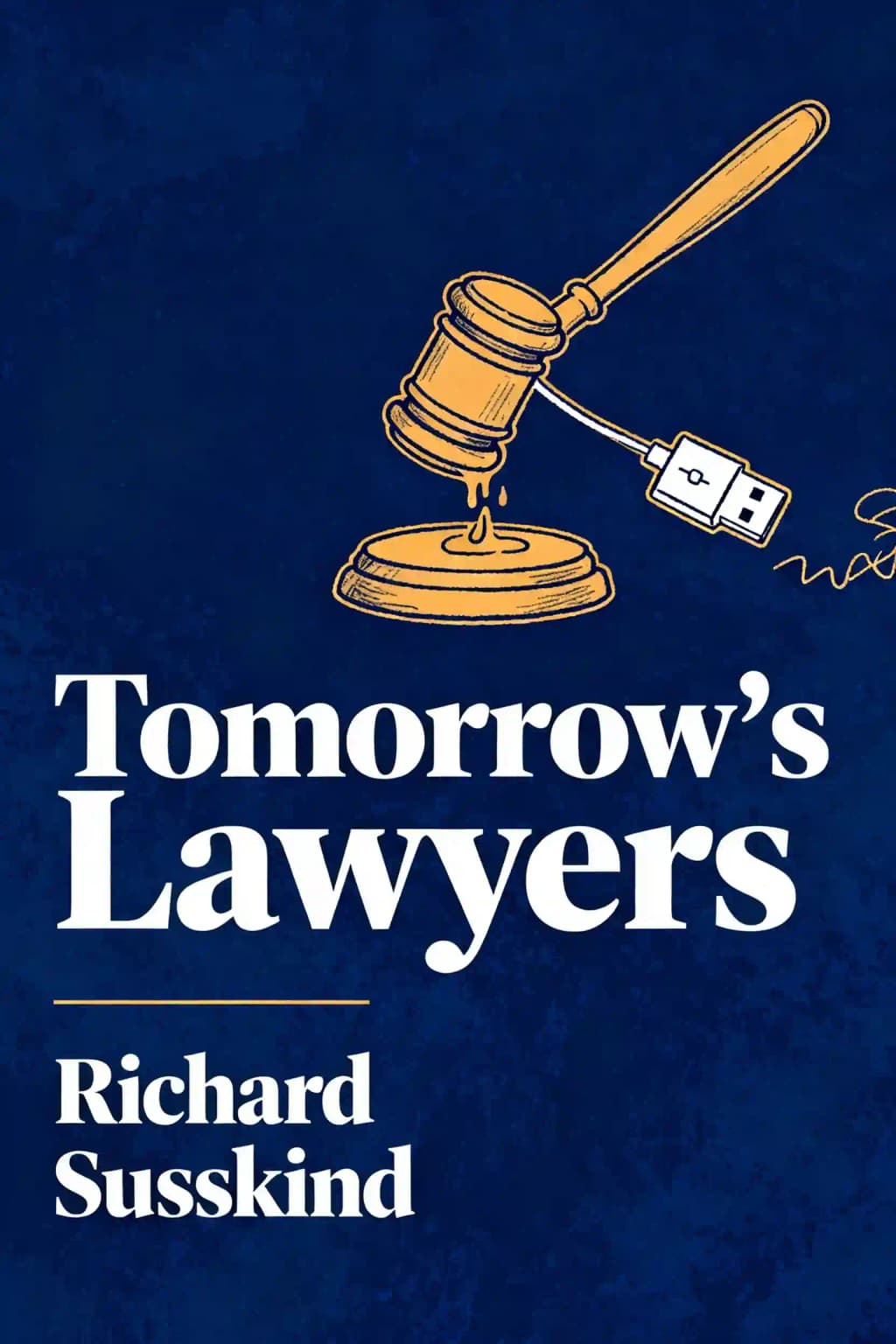
Susskind's legal prophecy reveals how technology and AI will transform law practice forever. Oxford professor's bestselling guide - endorsed by top legal minds - challenges traditional models while offering a blueprint for survival in an era where lawyers must adapt or become obsolete.
Richard Eric Susskind, OBE KC (Hon), is a pioneering legal futurist and author of Tomorrow’s Lawyers, renowned for his groundbreaking work on technology’s transformative impact on the legal profession. A British authority born in 1961, Susskind has served as IT adviser to England’s Lord Chief Justice since 1998 and holds professorships at Oxford University and Gresham College.
His 40-year career exploring legal technology began with his Oxford doctorate on artificial intelligence, positioning him as a global thought leader through books like The Future of Law and The End of Lawyers?—both essential reads for understanding modern legal innovation.
As president of the Society for Computers and Law and columnist for The Times (150+ articles), Susskind bridges academic rigor with practical insights. His collaborative work with son Daniel Susskind, The Future of the Professions, expands these themes to all knowledge-based fields.
Translated into 12 languages, Susskind’s works are mandatory reading in law schools worldwide and inform policy debates across 60+ countries. The third edition of Tomorrow’s Lawyers continues his mission to prepare practitioners for AI-driven legal systems while advocating for accessible justice through technology.
Tomorrow's Lawyers explores how technology, client demands, and market liberalization are transforming legal services. Richard Susskind predicts a shift from traditional "bespoke" legal work to commoditized services via automation, outsourcing, and online platforms. He outlines strategies for law firms to adapt, discusses virtual courts, and emphasizes preparing young lawyers for emerging roles in this evolving landscape.
Aspiring lawyers, legal educators, and current legal professionals (both firm-based and in-house) will benefit most. The book equips readers to navigate career shifts caused by AI, legal tech, and new service models. It’s also valuable for policymakers addressing access-to-justice gaps through online legal solutions.
Key ideas include:
Susskind argues traditional firms must embrace efficiency (via AI tools) and collaboration (through legal process outsourcing) to survive. He predicts a "more for less" client demand will force firms to abandon hourly billing and adopt flat fees, while top-tier firms focus on high-stakes advisory roles.
The book positions AI as a catalyst for automating document analysis, contract review, and legal research. Susskind stresses that lawyers who leverage these tools will outperform those relying on manual methods, but warns against underestimating client expectations for tech-enabled efficiency.
Susskind advocates for virtual courts to improve access to justice, reduce costs, and expedite resolutions. He envisions online dispute resolution platforms handling routine cases, freeing traditional courts for complex matters. This aligns with his work on England’s adopted online court policies.
The book urges young lawyers to:
While The Future of the Professions (co-authored with Daniel Susskind) critiques all traditional professions, Tomorrow's Lawyers focuses specifically on legal services. The latter provides actionable strategies for law firms and detailed predictions about virtual courts, AI tools, and career pathways.
Some critics argue Susskind overestimates the pace of tech adoption in risk-averse legal sectors. Others note the book’s predictions lean heavily on corporate law, with less analysis of criminal or family law impacts. However, its framework for assessing market shifts remains widely cited.
With AI tools like GPT-4 now handling basic legal drafting and online courts expanding globally, Susskind’s 2013 predictions about commoditization and tech-driven efficiency remain prescient. The book helps readers contextualize current trends like blockchain contracts and regulatory AI.
"NewLaw" refers to alternative legal service providers (e.g., legal tech startups, freelance lawyer platforms) challenging traditional firms. These entities focus on scalability, transparent pricing, and tech-driven solutions for tasks like e-discovery and compliance checks.
Sinta o livro através da voz do autor
Transforme conhecimento em insights envolventes e ricos em exemplos
Capture ideias-chave em um instante para aprendizado rápido
Aproveite o livro de uma forma divertida e envolvente
Prepare not for the legal market as it once was, but as it will be.
The more-for-less challenge represents an existential crisis.
Pricing differently isn't enough; lawyers must work differently.
The binary distinction between bespoke and commoditized legal work is fundamentally misleading.
The notion that legal work is entirely bespoke is often an unhelpful fiction.
Divida as ideias-chave de Tomorrow's Lawyers em pontos fáceis de entender para compreender como equipes inovadoras criam, colaboram e crescem.
Destile Tomorrow's Lawyers em dicas de memória rápidas que destacam os princípios-chave de franqueza, trabalho em equipe e resiliência criativa.

Experimente Tomorrow's Lawyers através de narrativas vívidas que transformam lições de inovação em momentos que você lembrará e aplicará.
Pergunte qualquer coisa, escolha a voz e co-crie insights que realmente ressoem com você.

Criado por ex-alunos da Universidade de Columbia em San Francisco
"Instead of endless scrolling, I just hit play on BeFreed. It saves me so much time."
"I never knew where to start with nonfiction—BeFreed’s book lists turned into podcasts gave me a clear path."
"Perfect balance between learning and entertainment. Finished ‘Thinking, Fast and Slow’ on my commute this week."
"Crazy how much I learned while walking the dog. BeFreed = small habits → big gains."
"Reading used to feel like a chore. Now it’s just part of my lifestyle."
"Feels effortless compared to reading. I’ve finished 6 books this month already."
"BeFreed turned my guilty doomscrolling into something that feels productive and inspiring."
"BeFreed turned my commute into learning time. 20-min podcasts are perfect for finishing books I never had time for."
"BeFreed replaced my podcast queue. Imagine Spotify for books — that’s it. 🙌"
"It is great for me to learn something from the book without reading it."
"The themed book list podcasts help me connect ideas across authors—like a guided audio journey."
"Makes me feel smarter every time before going to work"
Criado por ex-alunos da Universidade de Columbia em San Francisco

Obtenha o resumo de Tomorrow's Lawyers como PDF ou EPUB gratuito. Imprima ou leia offline a qualquer momento.
The legal profession stands frozen in time while technology transforms every other industry around it. In "Tomorrow's Lawyers," Richard Susskind delivers a wake-up call that has become required reading at Harvard Law School: the legal world will transform more radically in the next two decades than it has in the past two centuries. While most lawyers seek comfort in continuity, the future promises discontinuity - a fundamentally alien legal landscape where traditional models collapse and new opportunities emerge. For aspiring lawyers, the message echoes hockey legend Wayne Gretzky's advice: "Skate where the puck's going, not where it's been." The comfortable, traditional legal career path is vanishing, replaced by something both more challenging and more exciting. Are you prepared to practice law in a world that doesn't yet exist?