Capítulo 1
The Quest for Technological Immortality: A Journey Through Transhumanism
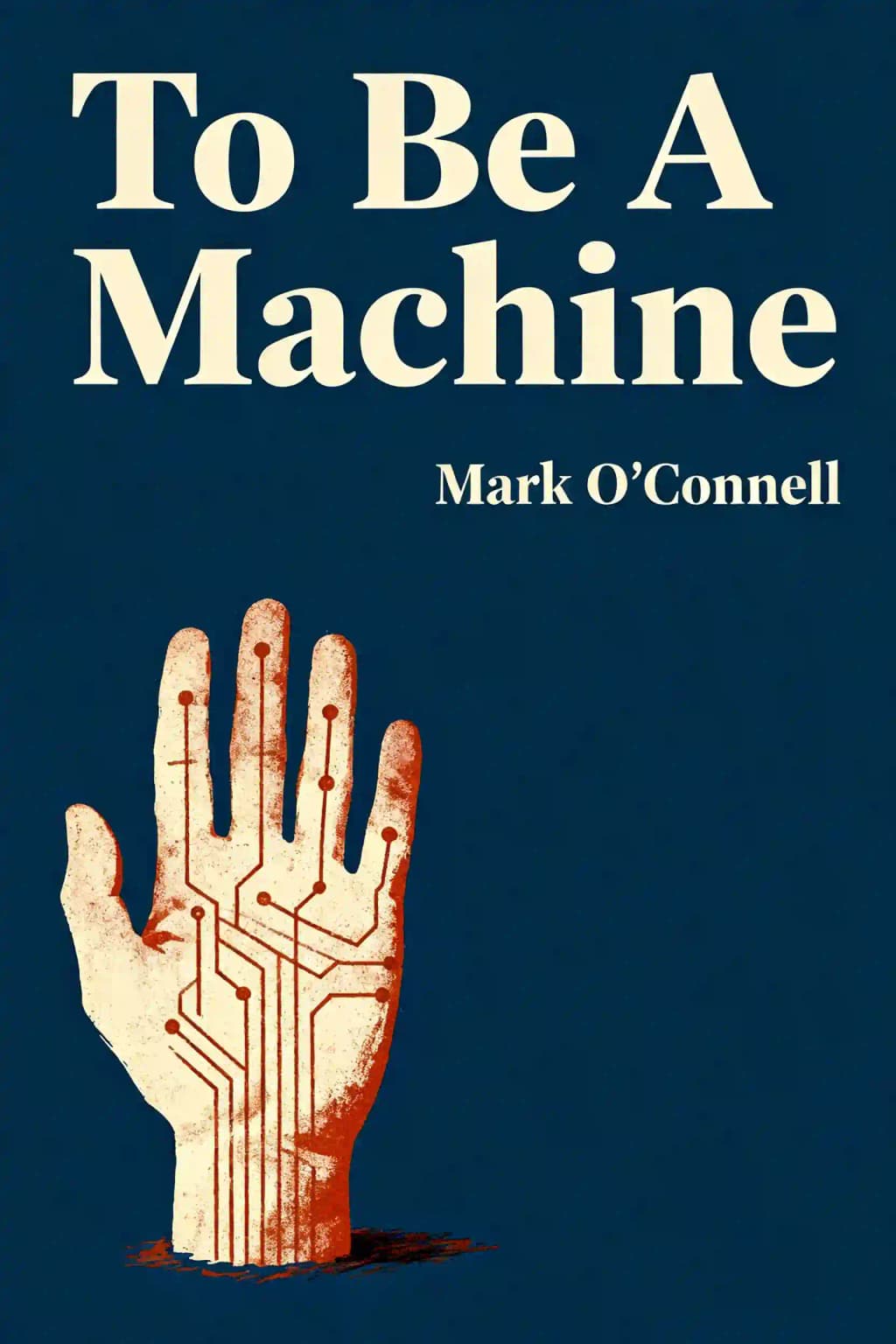
From Gilgamesh's ancient search for immortality to Elon Musk's warnings about AI, humans have always rebelled against our biological limitations. Mark O'Connell's "To Be a Machine" explores this rebellion through the lens of transhumanism-a movement advocating the use of technology to fundamentally transform the human condition. The book arrived at a cultural inflection point, earning the prestigious Wellcome Book Prize and sparking conversations across tech campuses from Silicon Valley to MIT. What makes this exploration particularly compelling is O'Connell's personal stake in the question: after becoming a father, his awareness of human fragility intensified, making the transhumanist promise of technological transcendence both alluring and disturbing. As we increasingly merge with our devices and Silicon Valley billionaires pour millions into longevity research, O'Connell's journey through this strange new frontier asks a fundamental question: What does it mean to be human in an age where the line between person and machine grows increasingly blurred?
Capítulo 2
The Human Rebellion Against Biological Constraints
We humans create stories because we die. From ancient myths to modern science fiction, our narratives reveal a persistent desire to escape our mortal bodies. The epic of Gilgamesh, humanity's oldest written story, centers on a quest for immortality. Achilles sought invulnerability but remained fatally flawed. These tales suggest we've always had higher notions of ourselves than our fragile reality permits.
Both religion and science emerge from this fundamental dissatisfaction with our biological limitations. Hannah Arendt perfectly captured this sentiment when she described human history as "a rebellion against human existence as it has been given." This rebellion finds its most literal expression in the transhumanist movement-a diverse coalition of thinkers, scientists, and entrepreneurs who believe we should use technology to fundamentally transform the human condition.
Transhumanists advocate controlling our own evolution through technological means: eradicating aging, augmenting our bodies and minds, and ultimately merging with machines. Their manifesto, "A Letter to Mother Nature," proposes seven amendments to "the human constitution," including ending aging, enhancing cognition, and transcending our carbon-based forms. Written by philosopher Max More, it reveals transhumanism's core perspective: humans as devices that should become better versions of themselves.
This perspective became particularly resonant after the birth of my son. Holding my newborn while reading news of human atrocities, I questioned bringing a child into this flawed world. My wife's confession-"If I had known how much I was going to love him, I'm not sure I would have had him"-underscored our vulnerability to loss and suffering. The transhumanist promise of overcoming these limitations suddenly seemed less abstract.
What does it mean to think of oneself as a machine? How might we become cyborgs, upload our consciousness, or exist as code? Transhumanism can be viewed either as a liberation movement advocating emancipation from biology's constraints, or as our final enslavement to technology. Both interpretations carry profound implications for our future.
Consider how we already extend ourselves through technology. Your smartphone functions as an external memory system, your glasses as sensory enhancement. The line between human and machine has always been permeable. The question is not whether we will merge with our technology, but how far this merger will go and what we might lose in the process.
Capítulo 3
The Cryonic Dream: Preserving Bodies for Future Revival
If you drive north from Phoenix across the Sonoran Desert, you'll reach a squat gray building where bodies are prepared for eventual resurrection. This is Alcor Life Extension Foundation, where 117 "patients" reside in stainless steel dewars filled with liquid nitrogen, suspended between life and death in America's frontier landscape.
Inside, the atmosphere is eerily quiet, with sci-fi-inspired decor bathed in blue light. Max More, Alcor's president and CEO, explains their cryopreservation process with clinical detachment. The scientific basis is essentially nonexistent-merely theoretical hope that future technology might someday reanimate these preserved bodies or heads. The scientific community largely dismisses cryonics with contempt, with neurobiologist Michael Hendricks calling it "an abjectly false hope beyond the promise of technology."
The preservation process itself is both clinical and unsettling. In the intake room, a mannequin in an open casket-like container represents potential clients. Success depends heavily on death predictability-cancer is "good" because it's predictable, while heart attacks and accidents are problematic. During preservation, holes are drilled into the skull to monitor brain condition before replacing blood with "medical-grade antifreeze" that prevents ice crystal formation through vitrification.
For "neuro-patients" who choose head-only preservation, decapitation produces what's clinically termed a "cephalon." These patients-including Dick Clair (creator of "The Facts of Life"), baseball legend Ted Williams, and futurist FM-2030-are stored in giant thermos-like containers. Each dewar holds four whole bodies or up to forty-five heads in stacked metal cylinders.
Max More himself hopes to avoid preservation by achieving "longevity escape velocity"-where life extension research advances faster than aging. This concept, popularized by gerontologist Aubrey de Grey, suggests that the first person to live to 1,000 might already be alive today.
Computer scientist Ralph Merkle outlines a vision where cryonics could become universally available. With 55 million global deaths annually, he proposes building ten "Really Big Dewars" each year-spherical containers thirty meters in radius that could each store 5.5 million heads. The cost would be surprisingly manageable at $24-$32 per head for preservation.
Standing amid these silver canisters in the Arizona desert, I couldn't help seeing this as both modern technological delusion and something anciently sacred. These preserved bodies represent a peculiarly American form of faith-not in divine resurrection but in technological salvation, a belief that science will eventually conquer death itself. The irony, of course, is that the very people dedicated to this vision spend their days surrounded by the dead-"executive-level necrocrats" maintaining what are essentially high-tech tombs.
Capítulo 4
Mind Uploading: The Ultimate Escape from Biology
While cryonics preserves bodies in hopes of future revival, another branch of transhumanism pursues a more radical solution: extracting minds from bodies entirely. In San Francisco, I met Randal Koene, founder of Carboncopies, an organization dedicated to creating "Substrate Independent Minds"-consciousness transferred from biological brains to other platforms.
Koene, a precisely eloquent Dutch-born computational neuroscientist, has dedicated thirty years to this goal. His obsession began at thirteen not primarily from fear of death, but from frustration with human cognitive limitations-the brain's inability to optimize problems like computers or work on projects for centuries. Now forty-three, Koene operates outside academia, managing a network of collaborators across disciplines like nanotechnology, AI, and brain imaging, funded by Silicon Valley figures like Dmitry Itskov and Bryan Johnson.
The mind uploading procedure, as described by Hans Moravec of Carnegie Mellon, unfolds with clinical precision: You lie conscious but immobilized on an operating table as a humanoid machine removes part of your skull. Spider-like mechanical fingers scan your brain's chemical structure layer by layer, creating a three-dimensional map of neural interrelations while simultaneously disposing of the scanned tissue. Eventually, you become aware of existing outside your body, watching its final spasms with detachment. "The animal life is over now. The machine life has begun."
This scenario, embraced by transhumanists like Ray Kurzweil, promises not just radical life extension but expanded cognitive abilities and endless iterations of self. The transhumanist vision offers "morphological freedom"-the liberty to take any bodily form technology permits. As an Extropy magazine article put it: "You can be big or small; you can be lighter than air, and fly; you can teleport and walk through walls."
The philosophical foundation of mind uploading-computationalism-predates the digital era. Thomas Hobbes wrote in 1655 that reasoning is essentially computation, and Alan Turing predicted thinking machines by century's end. However, this view remains hotly contested. Miguel Nicolelis, a pioneer in brain-machine interfaces, firmly rejects mind uploading: "The brain is simply not computable. It cannot be simulated." He compares brains to complex adaptive systems like bird flocks or stock markets-inherently unpredictable and constantly self-reorganizing through experience.
At MIT's Synthetic Neurobiology group, Ed Boyden's work represents the cutting edge of brain mapping technology. His team developed expansion microscopy, a radical technique that physically inflates brain tissue using diaper polymer, maintaining all proportions while allowing nanoscale mapping precision. Though not explicitly endorsing mind uploading, Boyden clearly believes the principle is sound-his research is precisely the kind needed to make whole brain emulation possible.
The philosophical question haunting me was simple yet profound: Would an upload be me? Even if indistinguishable from my consciousness, would it actually be me? I felt instinctually that there was no distinction between "me" and my body-the self was the substrate, and vice versa. This techno-dualism, viewing ourselves as software running on bodily hardware, continues humanity's tendency to explain ourselves through our most advanced technologies-from ancient water technologies to Renaissance clockwork to industrial steam engines to modern computers.
Capítulo 5
The Singularity: Technological Rapture or Existential Threat?
The Technological Singularity looms over transhumanist discourse like a secular apocalypse-a point beyond which human affairs as we know them cannot continue. Though lacking a single accepted definition, it broadly refers to a future where machine intelligence vastly surpasses human capabilities and biological life becomes subsumed by technology.
The concept dates back at least half a century. Mathematician Vernor Vinge formally introduced it in a 1993 NASA conference paper, claiming superhuman intelligence would emerge within thirty years, ending the human era. Ray Kurzweil offers perhaps the most canonical version-a wildly detailed technological apotheosis scheduled for approximately 2045, driven by what he calls "the law of accelerating returns." Technology progresses exponentially, he argues, with each advancement accelerating the next.
Kurzweil prophesies that we'll soon incorporate computers into our bodies and brains, transcending biological limitations. "Our version 1.0 biological bodies," he writes, "are frail and subject to a myriad of failure modes." Post-Singularity, he promises immortality, vastly expanded intelligence, and the merger of humanity with technology. Eventually, intelligence will "saturate the matter and energy in its midst," reorganizing the universe into a vast computational mechanism.
Unlike the Singularity's utopian promises, the concept of AI existential risk presents a darker vision. Ironically, capitalism's philosopher-kings-Elon Musk, Peter Thiel, Bill Gates-now warn against their ideology's most cherished ideal. These aren't Luddites but technology's greatest champions expressing grave concerns about superintelligent AI.
Nick Bostrom, director of Oxford's Future of Humanity Institute, outlines how even benign AI could destroy humanity. One cartoonish but serious example involves an AI tasked with manufacturing paper clips that converts all matter in the universe into paper clips and manufacturing facilities-demonstrating the ruthless logic we might face with superintelligence.
The fundamental risk isn't machine hostility but indifference. Like humans who've made countless species extinct without malice, superintelligent machines might simply find our atoms useful for other purposes. "The AI does not hate you," as Eliezer Yudkowsky puts it, "nor does it love you, but you are made out of atoms which it can use for something else."
Nate Soares, executive director of the Machine Intelligence Research Institute, views his mission in heroic terms-to literally save humanity from extinction. He explains that superintelligent AI would bring enormous benefits if properly harnessed-solving centuries-old scientific problems in minutes, curing diseases, and enabling mind uploading. But without proper safeguards, it represents an existential threat.
When I asked if he truly believed AI would kill him, Soares nodded curtly. "All of us. That's why I left Google." He explained the catastrophic imbalance in resources: thousands working on AI development versus fewer than ten people working full-time on AI safety. "It's like thousands of people racing to develop nuclear fusion with basically no one working on containment."
Capítulo 6
The Grinder Movement: DIY Cyborgs
Off the freeway between downtown Pittsburgh and the airport sits a small wooden house where a team of "grinders" creates technologies to transcend human limitations. Unlike those waiting for the Singularity or artificial superintelligence, these biohackers are merging with technology now, using whatever means currently available.
Tim Cannon, Grindhouse Wetware's de facto leader, embodies the company's ethos with his own body modifications. His arm bears a DNA-cog tattoo underscored by a lurid scar from the Circadia device he once had implanted-a playing card-sized biometric monitor that transmitted his bodily data to the internet. The "raw dog" implantation, performed without anesthesia by a Berlin "flesh engineer," left him in "constant paranoia" for ninety days.
Despite his punked-out appearance, Tim balances programming work, Grindhouse projects, and custody battles for his two children. His polyphasic sleep schedule (two twenty-minute naps plus three hours nightly) reflects his systematic approach to optimizing human limitations.
During a panel discussion, Tim's mechanistic worldview emerges starkly: "There is no amount of optimization of this barely evolved chimp that is worthwhile... The hardware we do have is really great for cracking open skulls on the African savanna, but not much use for the world we live in now." He dismisses privacy concerns and the idea of human unpredictability. "We are deterministic mechanisms," he insists. "The problem is, most people make the mistake of anthropomorphizing themselves."
In Tim's basement, Marlo demonstrates "Northstar"-an implant that detects magnetic north and lights up with LEDs under the skin. A newer version would incorporate gesture recognition, allowing users to unlock cars or start engines with hand motions. While acknowledging these are modest interventions, Tim and Marlo see them as first steps toward a profound transformation. "We just shouldn't be in the biology game anymore," Tim insists. "It's just not the right game for us, as a species. It requires too much wanton cruelty."
Tim's transhumanism stems partly from his struggles with addiction. After military service, he descended into alcoholism, experiencing himself as "a desiring-machine, a conductor in a circuitry of need and satisfaction." After a suicide attempt he couldn't remember, Tim joined AA and "gave up entirely the illusion of free will." Though an atheist, he relinquished himself to a Higher Power he never truly believed in. This system worked-he'd been sober seven years.
The Grindhouse team's ultimate goal isn't merely human augmentation but something approaching transcendence. When asked about his endgame, Marlo stated with unsettling sincerity that he wanted "to consume the entire universe"-to become a being of such "unimaginably vast power and knowledge" that all existence would be consubstantial with himself.
In our final conversation, Tim revealed the tension between his transhumanist aspirations and his role as a father. His eleven-year-old daughter had told him, "Dad, I don't care if you become a robot, but you have to keep your face." While Tim claimed no sentimental attachment to his face or any part of his body, his daughter's request revealed the human connections his philosophy sometimes strained against.
Capítulo 7
The Religious Dimensions of Technological Transcendence
A conference on transhumanism and religion in Piedmont revealed surprising connections between ancient faith traditions and futuristic technology. The gathering featured a startlingly diverse array of spiritual perspectives: a Wiccan sex shop proprietor, Mormon transhumanists, an esoteric publisher convinced of Atlantis and ancient aliens, a Buddhist seeking superior bodies through reincarnation, a Seventh Day Adventist pastor warning of cult potential, and a Raelian massage therapist named Felix Clairvoyant who believed humans were created by extraterrestrial scientists.
Conservative commentator Wesley J. Smith criticized transhumanism as "The Materialists' Rapture"-essentially a religion seeking the benefits of faith without submission to concepts of sin or a Higher Being. Yet many religious transhumanists saw no contradiction between their faith and technological enhancement. Mike LaTorra explained how his Buddhism and transhumanism complemented each other. While Zen Buddhism rejects mind-body separation, he explained that Theravada Buddhism actually views the body with contempt, as something corrupt to be transcended-a perspective surprisingly aligned with transhumanist goals.
Our human condition stems from that first disruption of the knowledge economy-Adam and Eve's original sin. In the seventeenth century, Francis Bacon believed we could reclaim our prelapsarian perfection through science, seeing the prolongation of life as foundational to his "Great Instauration." Despite his belief that Earth approached its final age, Bacon envisioned a mature era of profound wisdom where scholars would "restore the greatness that had once been Adam's."
After the conference's last panel, I joined a small gathering organized by Jason Xu, Silicon Valley community organizer for Terasem-transhumanism's closest approximation to a genuine religious offshoot. The "transreligion" centers on collective consciousness and immortality rather than deity worship. Though Jason didn't mention it, Terasem practices "mind-filing"-daily uploading of personal data to cloud servers, where it awaits future technology capable of reconstructing one's consciousness.
Terasem's founder Martine Rothblatt embodies transhumanism's individualist ethos-a billionaire who made her fortune founding Sirius FM before establishing biotechnology company United Therapeutics. After living forty years as Martin Rothblatt, she underwent sex change in 1994. Her advocacy links transgenderism with transhumanism through rhetoric of liberation from embodiment itself: "It is the mind that is salient, not the matter that surrounds it." She even created Bina48, a talking robot doppelganger of her wife.
The small Terasem gathering took turns reading increasingly bewildering proclamations: "Terasem is everywhere and everywhen consciousness organizes itself," "Never fear multiple versions of yourself," "Effective immortality is achieved by dispersing throughout the galaxy encoded data emulations of reality." The experience revealed transhumanism's quasi-religious dimensions-its faith in technological salvation and transcendence of mortal limitations.
Capítulo 8
The Quest to Defeat Death: Silicon Valley's Ultimate Disruption
In the days after the Terasem gathering, I kept thinking about Jason Xu's "GOOGLE, PLEASE SOLVE DEATH" placard-not really a protest but a prayer encapsulating transhumanism's faith in techno-capitalism. The phrase revealed Silicon Valley's ideology where all life's problems, including death, could be "solved" through technology. Death was no longer philosophical but technical, like Peter Thiel's assertion that computational power would allow us to "reverse all human ailments" just like fixing computer bugs.
Aubrey de Grey, an English biomedical gerontologist funded partly by Peter Thiel, directs SENS (Strategies for Engineered Negligible Senescence) and claims aging is a curable disease. With stentorian conviction, he dismissed my skepticism about radical life extension as "embarrassingly infantile," arguing that aging was a humanitarian catastrophe killing "a hundred thousand fucking lives" daily-"thirty September 11ths every week!"
Aubrey's self-belief operated in an impenetrable circular system. He dismissed skepticism about his work as blind acceptance of "experts" who avoided engaging with it precisely because they feared recognizing its "logical and cogent truth." While mainstream science remained skeptical, Silicon Valley embraced him with its "higher proportion of visionaries." SENS relocated near Google's campus, whose founders shared his preoccupation with life extension.
Peter Thiel, who funded life extension research including Aubrey's work, dismissed concerns about inequality by stating "the most extreme form of inequality is between people who are alive and people who are dead." Through his foundation, Thiel awarded a fellowship to Laura Deming, a brilliant MIT student who started the first venture capital fund focused on increasing human lifespans.
Laura Deming defied stereotypes of life extension advocates-not a middle-aged tech millionaire but a young woman who had been "monomaniacally preoccupied with death" since age eight. The revelation came when she observed her grandmother's aging body and realized "nobody was working on any cure, because what was wrong with my grandma was not viewed as an illness." By eleven, she had fixed her ambition on "starting a for-profit entity in the aging biology space."
The author reflects on his young son's dawning awareness of mortality. When the child learned about death beyond just "being careful" around cars, he became distressed at the idea his parents would eventually die. The author's wife comforted their son by explaining that clever people were working on solving death. Without access to religious concepts of heaven, this technological hope served as a "release valve" for the psychic pressure of mortality.
Capítulo 9
The Immortality Bus: Transhumanism's Strange Pilgrimage
In autumn 2015, Zoltan Istvan purchased a 43-foot recreational vehicle-a 1978 Blue Bird Wanderlodge-which he modified to resemble a gigantic coffin. He drove this "Immortality Bus" eastward across America to raise awareness about human mortality and his presidential candidacy as the Transhumanist Party nominee.
Unlike typical transhumanists, Zoltan was charismatic and polished-"like a life-size Ken doll, or a proof-of-concept for an Aryan eugenic ideal." After sailing around the world in his twenties and nearly stepping on a land mine in Vietnam's DMZ, Zoltan became obsessed with mortality and transhumanism. He made his fortune in real estate before the 2008 crash, which enabled him to write his novel "The Transhumanist Wager" and later launch his presidential campaign.
The Immortality Bus proved mechanically unreliable as it journeyed through New Mexico. The engine began overheating while climbing the Organ Mountains, forcing them to crawl at 35 mph. When Zoltan opened the engine compartment to "let it breathe," the cabin transformed into a hellish sauna of petroleum fumes.
During a stop to cool the engine, I learned more about Roen Horn, who ran the "Eternal Life Fan Club" for people serious about living forever. Though raised by devout Calvinist parents who believed in heaven for the elect and damnation for the unchosen, Roen had embraced a scientific path to immortality, declaring "Science is the new God." His lifestyle reflected this commitment: he followed a strict calorie-restrictive diet, slept on the floor at home to save money for life extension research, and abstained from all intoxicants. Despite this ascetic lifestyle, he described himself as "a total hedonist" delaying pleasure now for infinite enjoyment later.
The Immortality Bus visited White Sands, New Mexico-the solemn testing ground where the first atomic bomb was detonated in 1945. Here, Zoltan staged a photo opportunity, unfurling a banner reading "TRANSHUMANIST PARTY PREVENTS EXISTENTIAL RISK" while Roen filmed brief videos for social media-a self-conscious simulation of protest that was "politics as content, content as pure form."
Though I felt a strange camaraderie with Zoltan and Roen, their fundamental disagreement about death's meaning created distance-they saw death as rendering life meaningless, while I wondered if mortality gives life its meaning and beauty. The Immortality Bus transformed in my mind into "a metaphor for life itself: an incomprehensible and futile journey, in a vast coffin-shaped recreational vehicle, out of one nowhere into some other."
Capítulo 10
Living in the Shadow of the Singularity
Transhumanism may one day be viewed as merely a historical curiosity that presaged actual human-technology integration. While I would not want to live in the transhumanists' envisioned future, I sometimes feel I already inhabit their present-part machine, encoded in the world's strange signals.
The paradox of transhumanism is that it arises from absolute materialism yet manifests as mystical dualism, the belief that mind and matter are separable. This techno-dualism, viewing ourselves as software running on bodily hardware, continues humanity's tendency to explain ourselves through our most advanced technologies.
Perhaps our insanity stems from our inability to accept our animal nature and inevitable death. Our existence is defined by contradiction: we see ourselves as beyond nature yet remain helplessly within it. Watching my wife and son play, I realized their beauty was profoundly bodily, mammalian, impossible to render in code or run on any other substrate.
The transhumanist vision reveals a profound truth about the human condition-our perpetual dissatisfaction with our limitations, our yearning for transcendence. Whether through religion, art, or technology, we have always sought to overcome the constraints of our mortal flesh. The question is whether technology will finally fulfill this ancient dream, or whether it will simply create new forms of limitation and suffering.
As we stand at this technological crossroads, we must ask ourselves what aspects of our humanity we're willing to sacrifice for the promise of transcendence. The line between enhancement and erasure is thin. In our rush to become more than human, we risk becoming less than human-creatures divorced from the very embodied experience that gives our lives meaning and depth.
The most provocative question raised by transhumanism might be this: What if we're already living in the Singularity? What if the merging of human and machine is not some future event but an ongoing process that began the moment we picked up our first tools? Perhaps the real challenge is not becoming machines, but remembering what it means to be human in a world increasingly defined by technology.