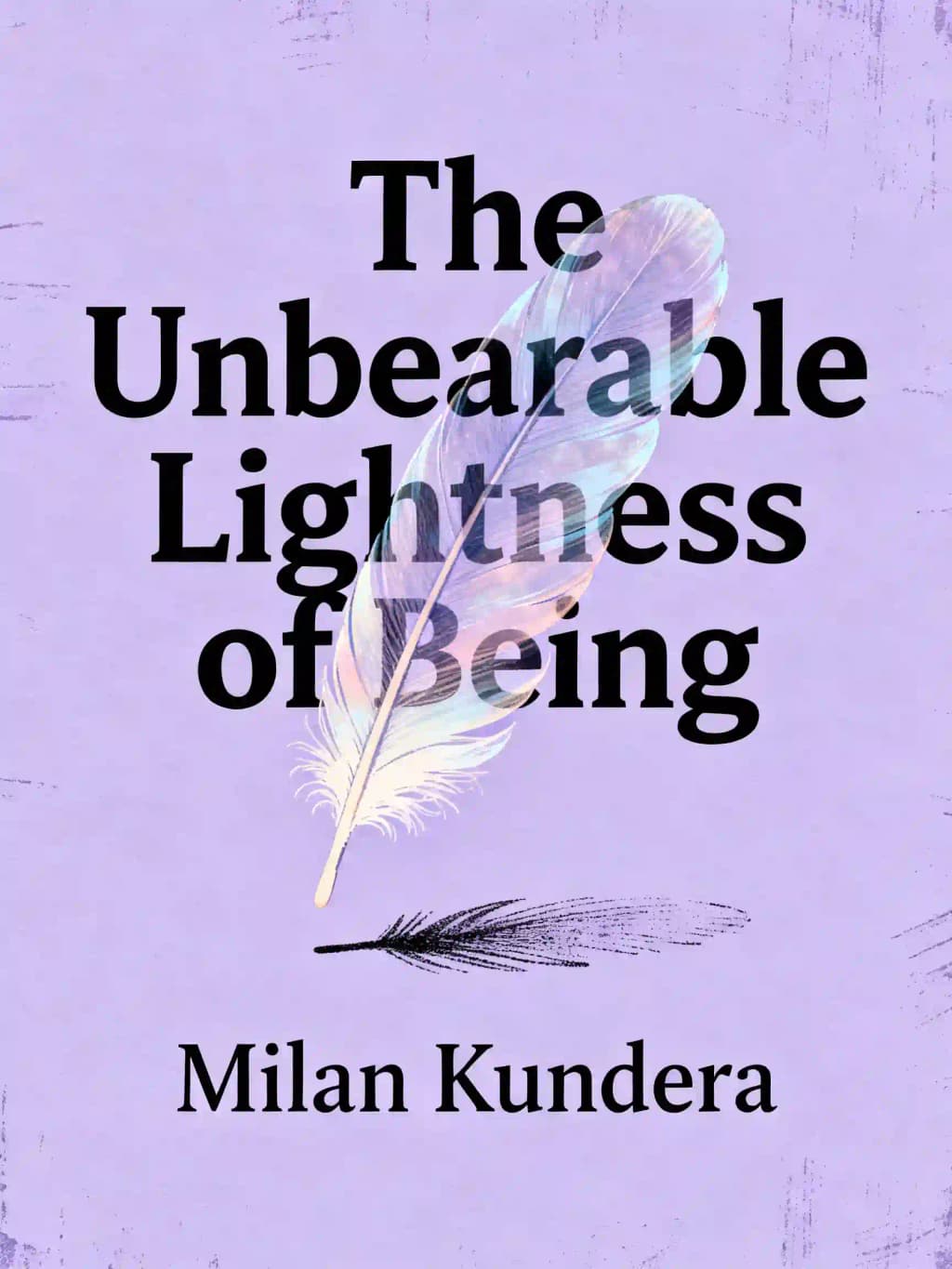
Banned until 1989, Kundera's philosophical masterpiece explores love and politics against Soviet-occupied Czechoslovakia. This critically acclaimed work - inspiring an Oscar-nominated film - challenges readers with its provocative question: Is it better to live weightlessly free or anchored by meaningful commitment?
Milan Kundera (1929–2023) was a Czech-French novelist and master of existential fiction, best known for authoring The Unbearable Lightness of Being, a seminal exploration of love, political turmoil, and philosophical paradox. Born in Brno, Czechoslovakia, Kundera’s works intertwine his experiences under Communist rule with incisive critiques of ideology, memory, and human impermanence.
After his exile to France in 1975, Kundera's writing gained global acclaim, particularly his 1984 novel, which dissects the Prague Spring’s aftermath through the entangled lives of its protagonists.
Kundera’s influential oeuvre includes The Joke (1967), a dark satire of authoritarianism; The Book of Laughter and Forgetting (1979), a fragmented meditation on historical erasure; and Immortality (1990), a meta-fictional examination of identity. Awarded the Jerusalem Prize (1985) and Austrian State Prize for European Literature (1987), his novels blend irony, eroticism, and political allegory.
The Unbearable Lightness of Being was adapted into a 1988 film starring Daniel Day-Lewis and Juliette Binoche, amplifying its reach. Translated into over 40 languages, Kundera’s works remain pillars of 20th-century literature, celebrated for their unflinching interrogation of freedom and moral ambiguity.
Milan Kundera’s The Unbearable Lightness of Being explores existential duality through the intertwined lives of four characters in 1968 Czechoslovakia. The novel contrasts philosophical concepts of lightness (freedom, ephemerality) and heaviness (responsibility, meaning) against the backdrop of Soviet repression. Themes like love, betrayal, political dissent, and identity unfold through fragmented narratives, blending fiction with metaphysical musings.
Readers of philosophical fiction, fans of postmodern narrative styles, and those interested in Cold War-era Eastern European history will find this novel compelling. Its exploration of existential themes and interpersonal dynamics appeals to anyone grappling with questions of freedom, authenticity, and the weight of human choices.
Key themes include:
The 1968 Soviet invasion of Czechoslovakia serves as both historical context and metaphor. Characters like Tomas and Tereza navigate political disillusionment, mirroring the nation’s struggle between communist ideology and individual freedom. The event underscores themes of resistance, exile, and the weight of collective trauma.
It encapsulates the paradox of human existence: without eternal recurrence (Nietzsche’s concept), life’s singular nature renders choices weightless. This “lightness” becomes unbearable because it denies definitive meaning, forcing characters to confront existential freedom and its isolating consequences.
Tomas’s womanizing embodies his pursuit of lightness—avoiding emotional attachment to maintain freedom. However, his relationship with Tereza forces him to confront the weight of love, revealing the impossibility of true detachment.
The novel interweaves essay-like digressions on Nietzsche, Parmenides, and existentialism with character-driven plots. This metafictional approach prompts readers to reflect on storytelling itself, as Kundera directly addresses themes and dissects his characters’ motivations.
Some critiques highlight its dense philosophical passages as overly abstract, potentially distancing readers from emotional engagement. Others argue female characters like Tereza and Sabina are overly symbolic, serving male protagonists’ existential journeys.
Through characters’ reactions to totalitarianism, Kundera examines compliance versus rebellion. Tomas’s career downfall after refusing to recant an anti-communist article illustrates the personal cost of resisting ideological heaviness, while Sabina’s exile represents radical freedom.
Its themes of individual vs. societal expectations, the search for authenticity, and the politics of power resonate in modern discussions about identity, cancel culture, and authoritarianism. The existential questions it poses remain universal.
Fragmented timelines, authorial intrusions, and shifting perspectives mirror the characters’ disjointed search for meaning. This nonlinear structure reinforces the idea that life—like the narrative—lacks a predetermined arc, embracing ambiguity over resolution.
Sinta o livro através da voz do autor
Transforme conhecimento em insights envolventes e ricos em exemplos
Capture ideias-chave em um instante para aprendizado rápido
Aproveite o livro de uma forma divertida e envolvente
Is commitment freedom or burden?
Is meaning found in commitment and attachment, or in freedom and detachment?
Compassion becomes both blessing and burden.
Haven't we all experienced this tension between freedom and connection?
The journey becomes a profound statement about what gives life weight and significance.
Divida as ideias-chave de The Unbearable Lightness of Being em pontos fáceis de entender para compreender como equipes inovadoras criam, colaboram e crescem.
Destile The Unbearable Lightness of Being em dicas de memória rápidas que destacam os princípios-chave de franqueza, trabalho em equipe e resiliência criativa.

Experimente The Unbearable Lightness of Being através de narrativas vívidas que transformam lições de inovação em momentos que você lembrará e aplicará.
Pergunte qualquer coisa, escolha a voz e co-crie insights que realmente ressoem com você.

Criado por ex-alunos da Universidade de Columbia em San Francisco
"Instead of endless scrolling, I just hit play on BeFreed. It saves me so much time."
"I never knew where to start with nonfiction—BeFreed’s book lists turned into podcasts gave me a clear path."
"Perfect balance between learning and entertainment. Finished ‘Thinking, Fast and Slow’ on my commute this week."
"Crazy how much I learned while walking the dog. BeFreed = small habits → big gains."
"Reading used to feel like a chore. Now it’s just part of my lifestyle."
"Feels effortless compared to reading. I’ve finished 6 books this month already."
"BeFreed turned my guilty doomscrolling into something that feels productive and inspiring."
"BeFreed turned my commute into learning time. 20-min podcasts are perfect for finishing books I never had time for."
"BeFreed replaced my podcast queue. Imagine Spotify for books — that’s it. 🙌"
"It is great for me to learn something from the book without reading it."
"The themed book list podcasts help me connect ideas across authors—like a guided audio journey."
"Makes me feel smarter every time before going to work"
Criado por ex-alunos da Universidade de Columbia em San Francisco

Obtenha o resumo de The Unbearable Lightness of Being como PDF ou EPUB gratuito. Imprima ou leia offline a qualquer momento.
What if our lives happen only once, never to be repeated? Would our choices matter more, or less? Milan Kundera's masterpiece explores this haunting question through four intertwined lives against the backdrop of Soviet-occupied Czechoslovakia. The novel's central philosophical dilemma comes from Nietzsche's concept of eternal return: without repetition, do our actions lose their weight? In a world without return, even monumental events like revolutions diminish in importance, fading into the lightness of non-being. Yet paradoxically, our one-time choices become unbearably significant precisely because we have only one chance. Standing at his window, surgeon Tomas contemplates this paradox when Tereza arrives at his door with a suitcase-symbolically offering her entire existence to him. Against his principles of emotional detachment, he welcomes her in, making the first of many choices between lightness (freedom) and weight (commitment).