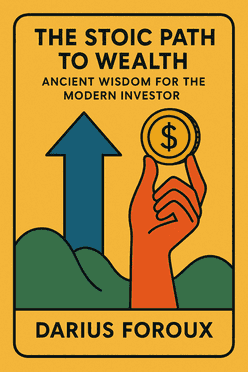
Discover how ancient Stoic wisdom creates lasting wealth in today's volatile markets. Ranked #20 in 2024's top psychology books, Morgan Housel praises Foroux's rare gift for turning complex ideas into simple, actionable strategies that build both financial and emotional resilience.
Darius Foroux, bestselling author of The Stoic Path to Wealth, is a productivity expert and entrepreneur whose work bridges ancient philosophy and modern wealth-building strategies.
A University of Groningen graduate with a finance specialization, Foroux transitioned from co-founding a manufacturing business and advising at ING to becoming a full-time writer and educator.
His blog, DariusForoux.com, has reached over 30 million readers since 2015, offering actionable insights on productivity, career growth, and financial responsibility—themes central to his eight books, including Do It Today and Think Straight.
Foroux’s ideas have been featured in TIME, NBC, and Fast Company, and his 140,000 newsletter subscribers and six online courses reflect his authority in merging Stoic principles with practical wealth creation. The Stoic Path to Wealth distills his decade of research and personal experience into a system embraced by professionals seeking enduring financial clarity.
The Stoic Path to Wealth merges ancient Stoic philosophy with modern investing strategies to teach emotional control, disciplined financial habits, and long-term wealth building. Darius Foroux emphasizes managing reactions to market volatility, avoiding greed, and focusing on sustainable practices like index fund investing and skill development. The book blends practical finance advice with timeless Stoic principles like acceptance and self-mastery.
This book suits investors seeking emotional resilience, beginners interested in Stoicism-backed financial strategies, and anyone overwhelmed by market uncertainty. It’s particularly valuable for readers who want actionable steps to build wealth while maintaining mental clarity.
Yes, for its unique fusion of Stoic mindfulness and finance. While some sections use technical investing terminology, the book provides clear frameworks for decision-making, stress-tested strategies from historical investors, and exercises to cultivate discipline. Reviews praise its structured approach but note it leans more toward finance than philosophy.
Core principles include:
Unlike purely technical guides, Foroux’s approach prioritizes psychological resilience. It avoids get-rich-quick schemes, instead teaching readers to build “enduring prosperity” through consistent habits, low-cost index funds, and emotional discipline rooted in Stoic practices.
Foroux advocates:
Yes, but some chapters (e.g., portfolio rebalancing) assume basic financial literacy. Foroux clarifies complex terms through analogies and historical examples, making it accessible to motivated newcomers.
Critics note the Stoic-philosophy integration feels secondary in later chapters, and the finance-focused sections may overwhelm readers seeking purely philosophical insights. However, most praise its actionable blend of mindset and strategy.
Foroux argues that Stoicism’s emphasis on adaptability helps investors navigate 2025’s AI disruptions, geopolitical shifts, and market unpredictability. Techniques like journaling and pre-loss acceptance prepare readers for volatility.
Unlike his productivity-focused titles (e.g., Do It Today), this book applies Stoicism specifically to finance. It shares his signature clarity but delves deeper into technical investing concepts.
Yes, including:
Sinta o livro através da voz do autor
Transforme conhecimento em insights envolventes e ricos em exemplos
Capture ideias-chave em um instante para aprendizado rápido
Aproveite o livro de uma forma divertida e envolvente
Avoiding investing is financial suicide in a world where inflation steadily erodes cash value.
True wealth isn't just about getting rich at all costs-it's about prospering financially while maintaining peace of mind.
Skills remain when money may disappear.
If you can make money remaining honest, trustworthy, and dignified, by all means do it.
Divida as ideias-chave de The Stoic Path to Wealth em pontos fáceis de entender para compreender como equipes inovadoras criam, colaboram e crescem.
Destile The Stoic Path to Wealth em dicas de memória rápidas que destacam os princípios-chave de franqueza, trabalho em equipe e resiliência criativa.

Experimente The Stoic Path to Wealth através de narrativas vívidas que transformam lições de inovação em momentos que você lembrará e aplicará.
Pergunte qualquer coisa, escolha a voz e co-crie insights que realmente ressoem com você.

Criado por ex-alunos da Universidade de Columbia em San Francisco
"Instead of endless scrolling, I just hit play on BeFreed. It saves me so much time."
"I never knew where to start with nonfiction—BeFreed’s book lists turned into podcasts gave me a clear path."
"Perfect balance between learning and entertainment. Finished ‘Thinking, Fast and Slow’ on my commute this week."
"Crazy how much I learned while walking the dog. BeFreed = small habits → big gains."
"Reading used to feel like a chore. Now it’s just part of my lifestyle."
"Feels effortless compared to reading. I’ve finished 6 books this month already."
"BeFreed turned my guilty doomscrolling into something that feels productive and inspiring."
"BeFreed turned my commute into learning time. 20-min podcasts are perfect for finishing books I never had time for."
"BeFreed replaced my podcast queue. Imagine Spotify for books — that’s it. 🙌"
"It is great for me to learn something from the book without reading it."
"The themed book list podcasts help me connect ideas across authors—like a guided audio journey."
"Makes me feel smarter every time before going to work"
Criado por ex-alunos da Universidade de Columbia em San Francisco

Obtenha o resumo de The Stoic Path to Wealth como PDF ou EPUB gratuito. Imprima ou leia offline a qualquer momento.
Warren Buffett once said, "Be fearful when others are greedy, and greedy when others are fearful." So why do most of us do exactly the opposite? Why do we panic-sell during crashes and chase stocks at their peaks? The answer lies not in spreadsheets or market analysis, but in something far more fundamental: our inability to master our own emotions. What if the secret to building lasting wealth wasn't hidden in complex financial models, but in wisdom developed over 2,000 years ago by philosophers who never heard of the stock market? Picture fleeing war-torn Tehran with nothing, landing in the Netherlands where every dinner conversation revolves around money you don't have. That desperation fueled a journey from business school to ING bank, where the 2008 crisis delivered a brutal lesson: watching 60% of your savings evaporate when you panic-sell ING shares at $11 after buying at $27. That pain creates a fork in the road-some people avoid investing forever, slowly watching inflation devour their cash like termites in a wooden house. Since 1980, inflation has quietly stolen 76% of every dollar's purchasing power. Meanwhile, the S&P 500 has averaged 10% annual returns, turning $1,000 into nearly $30,000. Today's investors face unprecedented volatility-in 2022, the S&P 500 swung at least 1% daily on 87% of trading days. Add decision paralysis from 59,000 publicly traded companies and countless investment vehicles, and you understand why 97-99% of active traders lose money. This fusion of Stoic philosophy and modern investing offers something more valuable than hot stock tips-it teaches us how to become psychologically bulletproof in a world designed to make us anxious, impulsive, and broke.