Capítulo 1
The Tyranny of Hurry: Finding Peace in a Frantic World
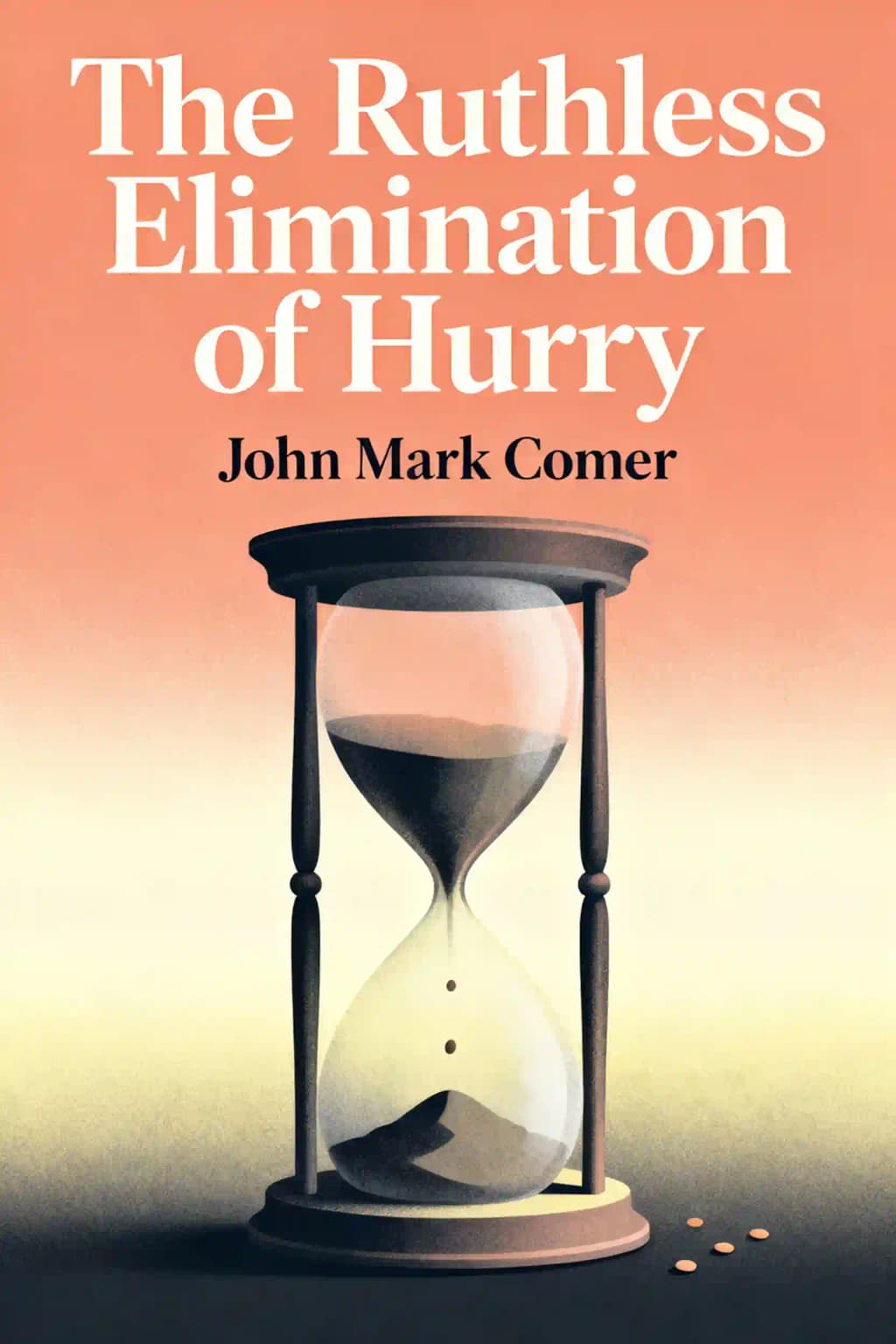
In a world that seems to move at an ever-accelerating pace, John Mark Comer's "The Ruthless Elimination of Hurry" arrives like a cool breeze on a sweltering day. This book has become something of a modern spiritual classic, resonating deeply with burned-out professionals, overwhelmed parents, and anyone feeling the crushing weight of our hyperconnected age. When Oprah featured it in her reading list, she called it "a life-changing manifesto," while Tim Ferriss credited it with helping him restructure his entire approach to work. The book's cultural impact extends beyond celebrity endorsements-it has sparked a movement of "digital minimalists" and "Sabbath-keepers" across diverse communities, offering a counternarrative to our society's worship of productivity. What makes Comer's message so powerful is its simplicity: the greatest threat to our spiritual and emotional wellbeing isn't external circumstances but the relentless pace at which we're attempting to live our lives.
Capítulo 2
The Great Enemy of Spiritual Life
"Hurry is not of the devil; hurry is the devil." This striking statement from psychologist Carl Jung captures the central premise of Comer's argument. While many of us might identify other challenges to spiritual life-theological disagreements, cultural shifts, or moral temptations-hurry is the root problem beneath much of what poisons our souls. The modern world's obsession with speed and efficiency has created an environment where contemplation and spiritual depth are increasingly rare.
Satan doesn't typically appear with a pitchfork and horns; he's more likely to show up as constant notifications on your phone, endless Netflix binges, or the perpetual state of having too many commitments. These seemingly innocent distractions disconnect us from God, others, and our own souls more effectively than obvious vices. The average person checks their phone 96 times per day, receives over 120 emails, and spends nearly three hours on social media - each interruption fragmenting our attention and spiritual focus.
The problem isn't having much to do-Jesus himself was busy-but having too much to do, requiring us to constantly rush. A global survey of Christians identified busyness as their major spiritual distraction, creating a vicious cycle: Christians assimilate to a culture of hurry, marginalize God in their lives, damage their relationship with Him, become vulnerable to secular assumptions, and further conform to busyness. This cycle manifests in shortened prayer times, skipped church services, and neglected spiritual disciplines.
Hurry is fundamentally anti-Christ because it makes love impossible. In Christ's kingdom, love has the highest value, but love takes time. All our worst moments as parents, spouses, friends, and colleagues happen when we're hurried. There's a reason we "walk" with God rather than "run"-because God moves at the speed of love. Consider how Jesus, despite urgent demands, never rushed: He took time with children, stopped for the bleeding woman, and lingered with His disciples.
In our culture, "slow" is negative, but in Jesus' upside-down kingdom, hurry is demonic while slowness aligns with Jesus. The triumvirate of Jesus' kingdom-love, joy, and peace-are all incompatible with hurry. If there's a secret to happiness, it's presence in the moment, which hurry destroys. Studies show that people who practice mindfulness and maintain slower daily rhythms report higher levels of life satisfaction and spiritual well-being.
As John Ortberg wisely observed: "I cannot live in the kingdom of God with a hurried soul." Nobody can. Hurry not only keeps us from love, joy, and peace-the core of what humans crave-but also from God himself by stealing our attention. The ancient practice of Sabbath, regular periods of contemplative prayer, and intentional slow living aren't luxury add-ons to spiritual life; they're essential practices for cultivating a deep relationship with God. Every spiritual giant throughout history has emphasized the importance of unhurried time with God, from Desert Fathers to modern mystics.
Capítulo 3
How We Got Here: A Brief History of Speed
Our frenetic pace hasn't always been the norm. The acceleration of Western society began with simple timekeeping devices but has evolved into something far more demanding and soul-crushing.
As early as 200 BC, the Roman playwright Plautus was already lamenting the sundial's invention, cursing "the man who first found out how to distinguish hours" for cutting his days "into small portions." By the 12th century, monks had invented mechanical clocks to coordinate their prayer times, but the real turning point came in 1370 with the first public clock tower in Cologne, Germany.
Before this innovation, time was natural-linked to earth's rotation and seasons. People rose with the sun and slept with the moon, with days naturally longer in summer and shorter in winter. Life followed "agrarian rhythms, free of haste, careless of exactitude, unconcerned by productivity." The clock created artificial time-the rigid nine-to-five schedule year-round. We stopped listening to our bodies and started obeying machines, gaining efficiency but losing humanity.
Edison's 1879 light bulb further accelerated this shift by enabling activity after sunset. Before Edison, the average person slept eleven hours nightly-compared to our current seven hours. The early risers of Christian history weren't necessarily more spiritual; they simply went to bed at seven after nine hours of sleep!
The 20th century brought "labor-saving devices" that promised more leisure. Yet despite our smartphones, dishwashers, and cars, most feel we have less time, not more. Why? Because we filled saved time with more activities. In the 1960s, futurists predicted Americans would work just 22 hours weekly by 1985. Instead, Americans now work nearly four more weeks annually than in 1979.
Everything culminated in 2007 with the iPhone's release-an inflection point comparable to Gutenberg's printing press. This launched the digital age, placing the internet in our pockets and fundamentally altering how we process information. The average iPhone user touches their phone 2,617 times daily, spending over two and a half hours across seventy-six sessions. Studies show that merely having phones in the same room reduces working memory and problem-solving skills-they literally make us dumber by "silently shouting your name at your brain."
Tech insiders are sounding alarms. Tristan Harris, a former Google design ethicist, compares smartphones to slot machines-addictive by design. Sean Parker, Facebook's first president, admits social media was intentionally designed to exploit "vulnerability in human psychology" through "social-validation feedback loops." Our attention span has dropped from twelve seconds in 2000 to eight seconds today-worse than a goldfish's nine seconds.
Capítulo 4
The Secret of the Easy Yoke
Jesus offers a profound invitation to all who are weary and burdened: "Come to me... and I will give you rest." This isn't merely comforting rhetoric or a temporary respite-it's a comprehensive invitation to apprentice under him, to fundamentally reorganize one's entire life around being with Jesus, becoming like Jesus, and doing what he would do in every situation we encounter.
The "secret of the easy yoke" embodies a principle both simple yet profound: if you want to experience the life of Jesus, you must intentionally adopt the lifestyle of Jesus. Most Christians today focus intensely on theological understanding or ethical behavior while neglecting Jesus' actual patterns of daily living. Just as athletes develop specific training routines to achieve peak physical fitness - from careful nutrition to sleep schedules to workout regimens - followers of Jesus need concrete practices that shape their souls and transform their daily rhythms.
Every system, whether in nature, technology, or human life, is perfectly designed to get the results it gets. If your life consistently produces anxiety, depression, or burnout, it signals that something in your lifestyle is fundamentally out of alignment with Jesus' way. Jesus offers not an escape from life's inevitable burdens but rather an "easy yoke" - sacred equipment to carry them differently, moving at his characteristically unhurried pace. This yoke represents a new way of engaging with life's demands while remaining rooted in God's presence.
Jesus demonstrated a striking absence of hurry, even when confronted with what others perceived as emergencies - whether Lazarus's fatal illness or Jairus's dying daughter. He consistently maintained healthy margins between his load and limits, regularly rising early for extended solitude with the Father, faithfully practicing weekly Sabbath rest, savoring unhurried meals with friends and strangers alike, and embracing simple living. This wasn't mere coincidence or circumstance but rather an intentionally crafted rhythm of life.
What contemporary followers of Jesus need is a thoughtful rule of life - not a rigid set of legalistic regulations but rather a life-giving trellis that supports the vine of our relationship with God. Like a trellis provides essential structure for a growing vine to flourish and bear fruit, this framework organizes our entire life around abiding in God's presence. This includes intentional practices of prayer, rest, community, service, and simplicity that create space for spiritual growth and sustainable ministry.
The invitation remains open: learning to live as Jesus lived involves both unlearning our culture's addiction to hurry and embracing new patterns that foster deep connection with God and others. This transformation doesn't happen overnight but through patient, persistent reorientation of our daily choices and habits around Jesus' rhythms of grace.
Capítulo 5
Silence and Solitude: The Foundation of Spiritual Life
The clutter in our minds creates a mental prison, trapping us in toxic thought patterns. While external noise is easy to quiet by turning off devices or finding a quiet space, internal noise-the wild beast of our thoughts-has no off switch. True silence requires silencing both.
Solitude is being alone with God and your own soul-not isolation, which is escape and danger. Solitude is engagement, safety, and nourishment for your soul, while isolation is what you crave when you neglect solitude. As Richard Foster wrote, "Loneliness is inner emptiness. Solitude is inner fulfillment." In solitude, we're not alone but most connected to God.
The spiritual malaise many experience-feeling separated from God and rarely experiencing his presence-might be solved through silence and solitude. If the problem is our distraction rather than God's disconnection, the solution is creating an environment for attention and connection.
Throughout church history, silence and solitude have been considered the most important spiritual disciplines. Henri Nouwen stated bluntly: "Without solitude it is virtually impossible to live a spiritual life... We do not take the spiritual life seriously if we do not set aside some time to be with God and listen to him." Like any relationship, our connection with God requires time alone together.
When we neglect this practice, we experience consequences: feeling distant from God and ourselves, persistent anxiety, exhaustion, turning to unhealthy escapes, becoming vulnerable to temptation, and emotional reactivity. Conversely, when we practice silence and solitude, we find quiet places to decompress, slow down, breathe, process our emotions, hear God's voice, and experience freedom from others' opinions and our own failures and successes.
The practice of silence and solitude-what secular society now calls "mindfulness"-has been part of Christian tradition for millennia. As Andrew Sullivan noted, "If the churches came to understand that the greatest threat to faith today is not hedonism but distraction, perhaps they might begin to appeal anew to a frazzled digital generation."
Capítulo 6
Sabbath: God's Gift for Our Restlessness
I wake up each morning driven by desire-wanting to watch the sunrise with coffee, spend time with God before my children wake, meet my writing deadlines, and provide for my family. While desire motivates us to get out of bed, it becomes dangerous when it controls our lives rather than the reverse, because desire is never truly satisfied.
Thomas Aquinas concluded we would need to experience literally everything to feel satisfied-every restaurant, country, natural wonder, relationship, achievement, and possession-yet time and space make this impossible. Karl Rahner described this as "the torment of the insufficiency of everything attainable," where "ultimately in this world there is no finished symphony."
This is our human condition: infinite desire minus our finite souls equals restlessness. The Jesus tradition teaches that our desire is infinite because we were made to live with God forever, and nothing less will satisfy. As Augustine wrote, "You have made us for yourself, and our heart is restless until it rests in you."
Sabbath comes from the Hebrew Shabbat, meaning "to stop." It's simply a day to stop working, wanting, and worrying. Ironically, the lifestyle images that advertising sells us-people lounging in bed with coffee, having perfect picnics, or playing guitar while watching rain fall-are all images of Sabbath, of stopping. But we don't need expensive products to experience this; we just need to take a day to slow down.
The Sabbath rhythm goes back to creation itself: "By the seventh day God had finished the work he had been doing; so on the seventh day he rested." God himself rested, building a rhythm into the DNA of creation. When we fight this work-six-days, rest-one-day pattern, we go against the grain of the universe.
God commands Sabbath in the Ten Commandments-the only spiritual discipline that makes the list, taking up over 30% of the content. "Remember the Sabbath day by keeping it holy." The command is simple: rest and worship. The Sabbath isn't just a day off-what Eugene Peterson called a "bastard Sabbath." On a day off, we still work: running errands, catching up on bills, making IKEA runs. But on Sabbath, we do nothing but rest and worship.
Sabbath is also resistance against empire. Slaves don't get Sabbaths-they work until they die. We live in a modern Egypt, a culture of more: more food, more devices, more square footage. Like Egypt, our empire is built on oppression. When we practice Sabbath, we're drawing a line in the sand and saying "I have enough" to break our addiction to accomplishment and accumulation.
Capítulo 7
Simplicity: Freedom from the Burden of More
Jesus made several statements about possessions and wealth that many of us secretly disagree with or find uncomfortable. He warned against greed, saying "life does not consist in an abundance of possessions." He instructed followers to "sell your possessions and give to the poor"-seemingly impractical advice in our retirement-focused culture.
Jesus described wealth as inherently "deceitful" with a suffocating effect on our spiritual lives. Perhaps most shocking, he claimed it's "easier for a camel to go through the eye of a needle than for someone who is rich to enter the kingdom of God."
Our culture promotes a "gospel of America" that directly contradicts Jesus' teachings: the more you have, the happier you'll be. This belief system wasn't always dominant. Just a century ago, 90% of Americans were farmers living simply, but today only 2% work in agriculture.
After World War II, business leaders, politicians, and advertisers deliberately reshaped America's economy around consumerism. As one Wall Street banker stated, "We must shift America from a needs to a desires culture." Modern advertising evolved from wartime propaganda techniques, using Freudian psychology to manipulate our unconscious drives.
A landmark Princeton study by Nobel Prize-winning psychologist Dr. Daniel Kahneman and economist Dr. Angus Deaton analyzed 450,000 Gallup surveys and reached a surprising conclusion: emotional well-being increases with income, but only up to $75,000 annually. Beyond that threshold, additional money doesn't improve happiness and may even cause decline.
As oil tycoon John Rockefeller famously answered when asked how much money is "enough": "Just a little bit more." This captures the endless pursuit that never satisfies.
Materialism has accelerated Western society to an unsustainable pace even as happiness declines despite economic growth. As Alan Fadling insightfully noted, "The drive to possess is an engine for hurry." Everything we purchase costs not just money but time-to earn, maintain, clean, fix, and use. That motorcycle payment isn't just $250 monthly; it's the hours worked to afford it, the maintenance time, and the hurry required to fit everything else into your remaining hours.
Simplicity-also called simple living, frugality, or minimalism-offers escape from soul-draining Western materialism. It's not about joyless deprivation but about greater freedom. As Joshua Becker defines it, simplicity is the "intentional promotion of things we most value and removal of everything that distracts."
Capítulo 8
Slowing: Practical Steps to an Unhurried Life
I'm a rule-lover-a high J on Myers-Briggs who finds safety in structure. While some mock this approach, I've noticed that anti-rule people often live reactively rather than proactively, bouncing from one urgent matter to another without a clear direction. We achieve inner peace when our schedules align with our values, and if our values center on life with Jesus and growing in love, joy and peace, then our schedules and practices constitute our "rules of life." These aren't rigid constraints but rather gentle guardrails guiding us toward our desired destination.
Could such rules be fun? The self-help concept of "gamification" turns personal growth into enjoyable games, transforming what might feel like restrictions into engaging challenges. So I've developed quirky, creative "rules" to slow down my nearly-hurried life. The core idea: slow down your body to slow down your life. We're not just brains on legs but whole, embodied creatures. By slowing both our thinking and physical movement, we can decelerate our souls. This mind-body connection is crucial - our physical pace often dictates our mental state.
Some practical steps include driving exactly the speed limit (which surprisingly reduces stress and road rage), getting into the slow lane (using drive time for reflection rather than racing), coming to a full stop at stop signs (practicing mindfulness in small moments), showing up ten minutes early for appointments without your phone (creating buffer zones of peace), and choosing the longest checkout line at the grocery store (turning waiting into meditation). With technology, consider turning your smartphone into a dumbphone by removing social media apps, email, and disabling notifications. Set your phone to grayscale mode to reduce dopamine hits, and establish boundaries like putting your phone "to bed" before you go to sleep and not checking it until after your morning quiet time. These digital boundaries protect our mental space and prevent technology from hijacking our attention.
Other practices include setting specific times for email (perhaps 10am and 4pm) rather than checking it constantly, limiting social media to scheduled times (maybe 30 minutes total per day), reducing TV consumption to selective, meaningful viewing, single-tasking instead of multitasking (giving full attention to one activity), walking slower (noticing your surroundings), taking regular days alone for silence and solitude (monthly if possible), journaling (processing thoughts without digital interference), practicing mindfulness (being fully present in ordinary moments), taking long vacations (disconnecting completely), and cooking meals at home (turning food preparation into a meditative practice).
None of these practices come from a place of religious guilt or uptight obligation-they're life-giving and fun, designed to create space for joy and presence. There's more to life than increasing speed, and often the richest moments come when we slow down enough to notice them. Life is right under our noses, waiting to be enjoyed, in the small moments we often rush past. We must ruthlessly eliminate hurry, and that's best done playfully, treating it as an adventure rather than a burden. The goal isn't to become inactive but to move at a pace that allows us to fully engage with life and the people around us.
Capítulo 9
A Quiet Life: The Radical Alternative
Five years after quitting my job and getting off the hurry-train, I'm in a completely different life with no desire to return. I've reorganized my life around three simple goals: slow down, simplify my life around the practices of Jesus, and live from a center of abiding. This transformation wasn't immediate or easy - it required intentional restructuring of daily routines, relationships, and priorities. Where I once measured days by accomplishments, I now measure them by moments of presence and peace.
When I slip back into hurry, I repeat a mantra: "Slow down. Breathe. Come back to the moment. Receive the good as gift. Accept the hard as a pathway to peace. Abide." This practice has become my anchor in turbulent times, especially during morning commutes, deadline pressures, or family obligations. The world hasn't changed, but I have. I no longer experience life the same way, though I still fail multiple times daily. These failures have become teachers rather than sources of shame.
My manifesto has become Paul's words: "Make it your ambition to lead a quiet life." The juxtaposition strikes me-ambition aimed at quietness. This paradox challenges our cultural assumptions about success and achievement. To live this way requires fighting against the status quo, dying to who I could have been, and accepting who I am. It means saying no to good opportunities, limiting social media exposure, and often being misunderstood by others who still operate in hurry mode.
The easy yoke of Jesus isn't about an easy life but carrying life's burdens with Jesus. This truth manifests in practical ways: choosing to walk instead of drive when possible, maintaining margin in my schedule for unexpected needs, and practicing contemplative prayer during ordinary moments. As our world speeds from fast to faster, we must decide daily: will we follow the tired story of hurry, or off-ramp onto the narrow path? When we fail, we begin again-slowly, with grace and patience for ourselves.
In a world that worships productivity, efficiency, and constant connectivity, choosing to live an unhurried life is perhaps the most countercultural decision we can make. It means resisting the pressure to be constantly available, setting healthy boundaries with technology, and creating sacred spaces for silence and solitude. It's also the path to finding what we're all desperately searching for-love, joy, and peace. These treasures aren't found in the frantic rush of modern life but in the quiet spaces we create when we ruthlessly eliminate hurry. This might mean regular digital sabbaths, intentional meal times without screens, or scheduled periods of complete unavailability for deep work or rest.
The quiet life isn't passive or unproductive - rather, it's marked by purposeful engagement with what matters most. It's about quality over quantity, depth over breadth, and presence over performance. This alternative way of living creates space for genuine relationships, meaningful work, and spiritual growth that hurry always threatens to crowd out.