Capítulo 1
The Social Contract Unraveled: How Power Shifted in the 21st Century
When you sip your morning coffee, scroll through social media, or commute to work, you're participating in an invisible web of cooperation between citizens, businesses, and governments. This "everyday magic" is the social contract in action-the fundamental agreement defining rights and responsibilities that makes modern society possible. But something has gone terribly wrong. Infrastructure crumbles while corporate profits soar. Public services struggle while offshore accounts bulge with untaxed wealth. The social contract that powered post-WWII prosperity has fractured, producing the rage that defines our current era.
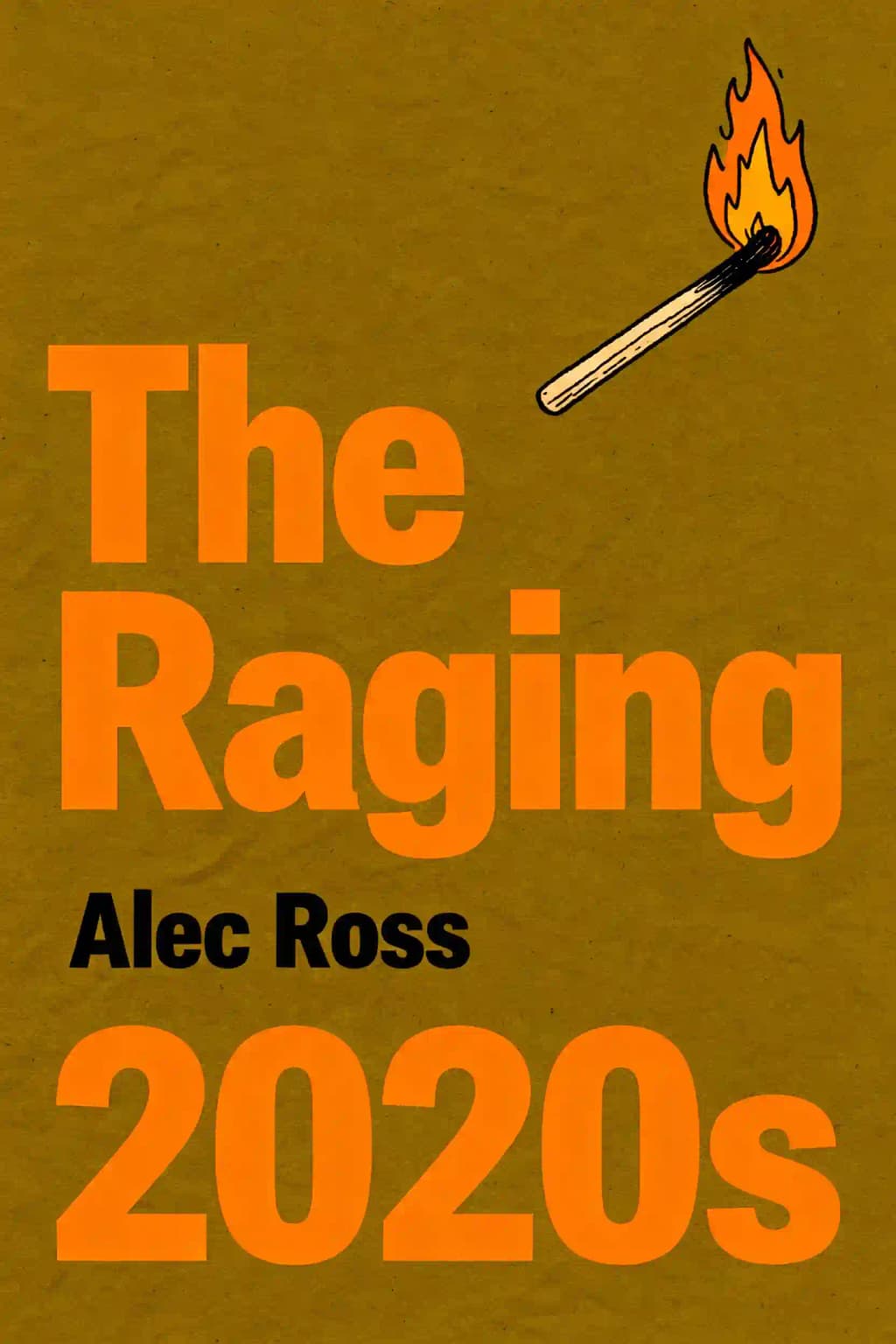
Alec Ross's "The Raging 2020s" has become required reading in boardrooms and policy circles precisely because it diagnoses this breakdown with surgical precision. The book has earned praise from figures ranging from LinkedIn co-founder Reid Hoffman to former Secretary of State Madeleine Albright, who called it "a masterful analysis of how the social contract has broken down and how we can repair it." Its timing couldn't be more relevant-as societies emerge from a pandemic that exposed the fragility of our systems, Ross offers a roadmap for rebuilding the foundations of a functioning society.
Capítulo 2
When Balance Breaks: The Origins of Our Social Contract Crisis
The social contract-civilization's fundamental balancing act between individuals, governments, and businesses-has never been static. Throughout history, it has evolved from simple prohibitions against murder and theft in early human societies to complex arrangements governing modern nation-states and multinational corporations. These contracts undergo significant revision during periods of massive change, as demonstrated by the divergent paths taken by Western democracies during the Great Depression - from America's New Deal to Europe's experiments with fascism and socialism. Each crisis has forced societies to fundamentally reconsider the relationship between citizens and their institutions.
The Industrial Revolution triggered one such dramatic rewriting. As populations shifted from rural to urban settings and agricultural work gave way to manufacturing, the early industrial period (known as "Engels' Pause") brought unprecedented inequality and squalor despite rapid technological advancement. Charles Dickens captured the misery of this transition in novels depicting children working sixteen-hour days in dangerous factories while living in filthy tenements. In Manchester, life expectancy dropped to just 17 years for factory workers. This upheaval spawned ideological movements like Marxism and waves of revolution across Europe, from the Paris Commune to the 1848 uprisings that shook multiple countries.
Over decades, industrial societies completely rewrote their social contracts, introducing innovations we now take for granted: worker pensions, public education, minimum wage laws, antitrust protections, income taxes, child labor prohibitions, and environmental standards. The Progressive Era in America saw the creation of the FDA, Interstate Commerce Commission, and Sherman Antitrust Act. In Europe, Bismarck's social insurance programs became a model for modern welfare states. These changes allowed industrialization's benefits to extend beyond factory owners to the broader population, creating the middle class and unprecedented prosperity.
Today, we find ourselves in a similar transition period-an "Engels' Pause" for the digital age. The equilibrium established during industrialization has broken down as digital revolution, globalization, deregulation, and climate crisis have fundamentally altered the relationships between citizens, governments, and corporations without corresponding updates to our social contracts. While early political theorists like Locke and Rousseau worried primarily about unchecked state power, today's concern is increasingly corporate power, as global companies rival countries in size and influence. Tech giants like Amazon employ more people than many nations' entire workforces, while companies like Facebook shape democratic discourse for billions. The gig economy has created a new class of workers outside traditional labor protections, while automation threatens to displace millions of jobs. Climate change poses existential risks that transcend national boundaries, challenging our existing frameworks for collective action and responsibility.
Capítulo 3
Shareholder Capitalism: When Profit Trumps Everything
Since the 1970s, shareholder capitalism has given free rein to capitalism's most destructive aspects by prioritizing stock prices and dividends above all else. This shift began with Milton Friedman's influential 1970 essay arguing that a corporation's sole responsibility is to increase profits for shareholders. Despite skyrocketing corporate power and profits, these gains haven't benefited most employees, communities, or stakeholders. The minimum wage perfectly illustrates this problem-had it kept pace with productivity since 1960, it would exceed $24 today, yet it remains at $7.25, unchanged since 2009. This growing disconnect between productivity and wages has resulted in the largest wealth gap since the Great Depression.
When Walmart CEO Doug McMillon called on Congress to raise the minimum wage, his reasoning was revealing. If Walmart unilaterally raised wages while competitors didn't, Wall Street would punish their stock. But if Congress mandated higher wages for all companies simultaneously, Walmart would benefit from customers with more spending power without facing competitive disadvantage. This demonstrates how even well-intentioned executives are constrained by market pressures. Our current incentives pull toward a dystopian form of capitalism that drives companies toward share buybacks instead of investments in workers, equipment, and R&D. Companies like Amazon and Apple regularly announce multi-billion dollar buyback programs while facing criticism over working conditions and wage levels.
The evidence suggests stakeholder capitalism-where companies take responsibility for their environmental impact and the well-being of employees, customers, and communities-actually produces better financial returns over time. Studies show that companies with strong environmental, social, and governance (ESG) practices outperform their peers by up to 4.8% annually. Companies like Patagonia, Ben & Jerry's, and Costco demonstrate that prioritizing stakeholders can create sustainable business success. Yet without concrete metrics and realigned incentives, stakeholder capitalism remains more public relations than boardroom priority.
Consider how stock buybacks have transformed corporate priorities. In the decade following the 2008 financial crisis, America's largest airlines spent 96% of their free cash flow on buybacks, enriching executives and shareholders while leaving little for emergencies or investments. American Airlines alone spent $12.9 billion on buybacks between 2014 and 2020. When COVID-19 hit, these same companies immediately sought government bailouts. Without the $50 billion in taxpayer assistance they received, most would have collapsed within months. Similar patterns played out across industries, from hospitality to retail.
Imagine if these companies had instead invested in worker training, equipment upgrades, or rainy-day funds. They might have weathered the pandemic without government intervention, while providing better service and more stable employment. Companies like Microsoft and Intel, which maintained significant cash reserves and continued investing in R&D through previous downturns, proved more resilient during crisis periods. This short-term optimization ensures worse long-term outcomes for everyone, as evidenced by the inequality and climate crises we already face. The growing calls for regulatory reform and stakeholder capitalism suggest a recognition that the current system is unsustainable.
Capítulo 4
When Government Fails: The Hollowing of Public Capacity
Hurricane Maria's devastating impact on Puerto Rico in September 2017 revealed the catastrophic failure of government response capabilities. Despite 150-mile-per-hour winds, thirty inches of rain, and 1.9 million American citizens left without drinking water, the federal government's reaction was disastrously slow. Food, water, and equipment took four days to arrive; senior officials waited five days to visit; and the president didn't attend response meetings until day six.
The government's failure in Puerto Rico revealed a stark contrast between bureaucratic inefficiency and nimble private response. While FEMA struggled, World Central Kitchen transformed San Juan's Choliseo arena into an operation producing 146,000 meals daily across sixteen kitchens, effectively tapping into local networks and businesses. This represents a troubling decline in government effectiveness. Once running the planet's most effective logistics network, the US government was outperformed by a chef-led nonprofit.
The consequences were deadly-with the official death toll at 2,975 (possibly as high as 8,000), most deaths resulting from inadequate healthcare, electricity, and water access following the storm. This weakening exemplifies a decades-long trend of declining governmental effectiveness coinciding with shareholder capitalism's rise.
Today, billions are governed more by companies than governments-from privacy and sustainability to workers' rights. Private actors increasingly fill the void where government seems unable to act, even on basic issues like minimum wage, which hasn't risen federally since 2009 while companies like Amazon responded to direct petitions by raising wages to $15.
Government dysfunction stems from four key factors: political polarization, institutional weakening, lack of imagination, and brain drain, with corporate influence being the most significant factor. The influence industry has evolved beyond registered lobbying to include "shadow lobbyists"-former government officials working as consultants without disclosure requirements. Despite declining numbers of registered lobbyists, lobbying expenditures remain constant, indicating a shift toward less transparent methods.
The 2010 Citizens United Supreme Court decision dramatically increased corporate political influence by allowing unlimited "independent political spending." Outside spending jumped from $680 million in the five cycles before the ruling to $4.4 billion in the five cycles after, with total election spending rising from $4 billion in 2000 to $14 billion in 2020. Just 225,000 people (less than 0.1% of American adults) contributed $3.1 billion in 2018, representing 55% of all campaign spending.
Capítulo 5
Labor's Decline: From Factory Floor to Gig Economy
The golden age of the American worker emerged from the 1936-37 GM sit-down strike in Flint, Michigan, when workers occupied factories demanding unionization, minimum wages, and improved conditions. Despite police violence and company pressure, the strike succeeded with government support, leading to a 300% wage increase and UAW membership explosion from 30,000 to 500,000. Within a decade, union membership nationwide tripled to nearly one-third of American workers.
The Great Depression had created the perfect conditions for labor organizing, with workers feeling they had little to lose and Roosevelt's New Deal policies supporting unionization. This represented a critical inflection point where America chose liberalism over the authoritarian paths taken by Germany and Italy. The social contract was revised to better protect workers, recognizing their indispensable role in building industrial America-similar to how the COVID pandemic highlighted essential frontline workers.
However, attitudes toward unions gradually soured over the next half-century. American union membership has plummeted from 35% in 1954 to just 10.3% in 2019 (only 6% in the private sector), leading to wage stagnation even as corporate profits soar. This decline stems from globalization, technology, shareholder capitalism, and eroding labor laws.
The consequences have been devastating for working families. Workers now receive less than six cents of every dollar they earn for employers-half what they received at the Cold War's end. A 2020 study by Larry Summers and Anna Stansbury identified declining worker bargaining power as the root cause of wage stagnation. Beyond union decline, shareholder capitalism pressured companies to cut labor costs and redirect profits to shareholders.
Traditional union organizing tactics are poorly suited for today's decentralized workforce. Brian Dolber, a self-described scholar-activist and adjunct professor earning less than $35,000 annually, joined Rideshare Drivers United (RDU) after driving for Uber between teaching assignments. Using Facebook ads to target rideshare drivers, RDU recruited thousands of members and mobilized a nationwide strike days before Uber's IPO. The company's share price dropped more than 7% on its first trading day-the worst IPO since 1975.
Unlike traditional strikes focused on halting production, modern collective action targets publicity, brand perception, and investor confidence. The gig economy presents a paradox: either compel benefits regardless of business viability, have government provide stronger safety nets, ban gig work entirely, or create new flexible benefit models.
Capítulo 6
The Tax Wormhole: How Trillions Disappear from Public Coffers
A simple online belt purchase illustrates the complex tax issues in our global digital economy. When Marco buys a 40 Italian leather belt from the Ascani family's website after clicking a Google ad, he participates in what seems like a routine transaction. But unlike pre-internet commerce, this transaction involves a powerful fourth party-Google.
The Ascani family pays Google approximately 0.11 per click, totaling about 3.96 (10% of the belt's cost) for the 36 clicks typically needed to generate a sale. This represents a form of "tax" that Google and other tech giants collect on virtually all digital commerce flowing through their platforms.
While both Marco (paying 41% income tax) and Ascani (paying 22% VAT) contribute significantly to Italian tax coffers, Google manages to pay just 0.7% in taxes despite its trillion-dollar valuation. Though Italian law requires 24% corporate tax, Google uses complex mechanisms to shift profits to Ireland and beyond.
The "Double Irish with Dutch Sandwich" tax strategy involves a complex flow of money designed to minimize taxes. When Marco clicked on the Ascani family's belt ad, his 3.96 payment went to Google Ireland Limited. From there, the money flowed through Dutch and Bermuda-based entities, allowing Google to pay only 0.0284 in taxes on 3.96 revenue-an effective tax rate of 0.7% instead of Italy's 24%.
This isn't merely a loophole but a "wormhole in the global economy" that has steadily eroded social contracts worldwide. When multiplied across billions of daily transactions, these practices result in governments losing over $500 billion annually to corporate tax avoidance, with additional losses from wealthy individuals using similar strategies.
The consequences are clear: corporate taxes fell from 32% of U.S. federal revenue in 1952 to less than 7% in 2019, while the burden on individual income and payroll taxes rose from 52% to 86%. Adjusted for inflation, American companies paid less tax in 2018 than in 1989, despite profits more than doubling during that period.
This shift wasn't intentional policy but resulted from global tax competition. Since 1980, average global corporate tax rates have fallen from 40.4% to 24.2%. Only six countries have increased corporate rates since 2000. When countries compete on tax rates, citizens lose control over their safety nets and wealth distribution.
Capítulo 7
Corporate Foreign Policy: When Companies Become Global Powers
Not all global problems can be solved by governments alone. While tax avoidance represents an issue where governments collectively lose out and could gain by cooperating, other challenges like weaponized AI and cyber warfare break along geopolitical lines, pitting major powers against each other.
Companies now occupy a unique position on the global stage. They can exploit geopolitical gaps (as with tax avoidance) or help fill them with their expertise and scale. Historically, companies were subordinate to the state, acting as tools of empire and national power. During WWII, American companies like GM and Ford built tanks instead of cars, while German firms like BMW and IG Farben supported the Nazi war machine.
Throughout the Cold War, Western multinational businesses worked in lockstep with democratic governments against communism. As GM's president Charles Wilson famously said, "What was good for our country was good for General Motors." But when the Cold War ended, these rules changed dramatically. Western democracies removed financial and legal guardrails while building infrastructure for a global economy.
Freed from constraints and with global markets now accessible, multinational companies grew exponentially. These companies can now effectively customize their social contracts, choosing which countries' laws to follow. After centuries of business subordination to government, large corporations now act as sovereign players on the global chessboard.
Chris Lynch's journey from tech entrepreneur to defense innovator illustrates the growing gap between America's military capabilities and digital warfare needs. While the US military dominates traditional domains, it faces significant challenges in cyberspace and AI development. With government lacking technical expertise, technology companies bear tremendous responsibility.
While Western democracies debate technology ethics, China has constructed a technological universe entirely removed from Western influence. The Chinese government and private sector function as one entity, with companies like Didi Chuxing, Alibaba, and Baidu operating as extensions of state power.
China has leveraged its technological prowess to construct an unprecedented surveillance apparatus-approximately one camera for every four citizens, with footage fed into AI systems identifying behaviors from murder to jaywalking to reading the Koran. This techno-authoritarian model is now being exported globally. Chinese companies sell surveillance technology at artificially low prices to countries like Zimbabwe, the Philippines, and Malaysia, collecting biometric data that further improves their algorithms while enabling authoritarians worldwide.
Capítulo 8
Competing Models: The Battle for Tomorrow's Social Contract
For over six thousand years, societies have balanced the rights and responsibilities of state, people, and business through social contracts that take different forms across time and place. Strong contracts reinforce themselves while weak ones collapse. However, this equilibrium has broken down in much of the world as companies assumed traditional state responsibilities while governments became less effective and responsive to citizens.
China represents the most powerful example of the controlled model-a social contract drafted, signed, and executed entirely by the state, with citizens having minimal input. While authoritarianism is history's oldest form of government, no country has more effectively adapted it for the 21st century than China.
China's transformation began in 1978 when Deng Xiaoping opened China for business after Mao's devastating reign. The government loosened control of agriculture, allowed private companies, and established special economic zones with tax breaks that attracted foreign investors. The results were extraordinary-9.5% annual growth for forty years, a 36-fold increase in GDP, and over 800 million people lifted from poverty.
Yet contrary to Western expectations, economic liberalization didn't lead to demands for political freedom. Most Chinese citizens view their prosperity as validation of Communist Party governance rather than Western ideals. This acceptance of surveillance and control stems partly from China's history of centralized authority and partly from prioritizing collective harmony over individual liberty.
The Chinese model isn't bulletproof, however. It depends entirely on continued economic growth, and there's no precedent for an economy that never falters. Without safety nets or independent labor unions, any economic downturn could threaten the entire social contract.
A society's crisis response reveals much about its social contract. During COVID-19, the United States created stimulus programs that prioritized capital over labor-keeping financial markets and large companies afloat while allowing unemployment to surge and small businesses to fail. Denmark took a different approach, effectively nationalizing private-sector payrolls by paying 75-90% of affected workers' salaries provided companies didn't fire them.
This exemplifies the Nordic model, where Denmark, Sweden, Norway, Finland, and Iceland use democratic governance to shield citizens from market harshness. Their social contract guarantees cradle-to-grave quality of life: free healthcare, subsidized childcare, tuition-free education, housing assistance, generous parental leave, unemployment benefits, job retraining, and secure pensions.
Capítulo 9
Charting a Path Forward: From Rage to Renewal
If nothing changes, rage will define the 2020s, but it doesn't have to be this way. Certain developments are inevitable-exploding urban populations, which are expected to add 2.5 billion people to cities by 2050, climate-driven migration affecting up to 200 million people by 2050, and advancing AI and surveillance technologies that will reshape work relationships across every industry. But our responses to these seismic shifts remain within our control.
Without change, we risk the global spread of the controlled political models of China and Russia, as inequality drives violent unrest that pushes more nations toward authoritarian social contracts. Countries facing internal instability increasingly look to China's model of digital authoritarianism, combining mass surveillance with AI-powered social control and aggressive crackdowns on dissent. This trend threatens to create a new global paradigm where individual rights are subordinated to state control, further increasing China's global influence while sidelining Western democracies.
But if we change course, democracies can maintain their appeal by implementing thoughtful regulation of AI and surveillance technologies, ensuring upward mobility through education and job training programs, and welcoming well-managed immigration that strengthens economies. We need an international push to address climate change through massive public and private investment in clean energy, targeting $3-4 trillion annually in green infrastructure. The world's elites must recognize that their long-term self-interest lies in repairing capitalism rather than decoupling from troubled societies through private security, exclusive communities, and offshore havens.
By enacting interlocking reforms-replacing shareholder capitalism with stakeholder capitalism that considers all constituencies, reforming international taxation to prevent profit shifting, expanding safety nets including universal basic income pilots, and transitioning to clean energy through carbon pricing-we can build a better contract for the whole planet. Each reform makes the others more attainable, creating a virtuous cycle that can lead us toward hope rather than rage.
The path forward requires concrete steps: treating multinationals as single entities for tax purposes to prevent artificial profit shifting, allowing countries to tax their fair share of profits based on actual economic activity, and automatically sharing information about cross-border banking to fight tax evasion. We need to create a "global financial register" to track ownership of all financial securities worldwide, allowing tax authorities to verify banks are reporting complete information and combat hidden wealth.
For companies to step up, corporate leadership must embrace stakeholder capitalism with transparency and metrics tracking impact on workers, communities, and the environment. Boards must provide oversight with worker input through labor representation, while lawmakers establish guardrails without abandoning antitrust measures needed to maintain competition. Today's successful CEOs must adopt the toolkit of world leaders-developing diplomatic skills to navigate geopolitics, intelligence capabilities to anticipate threats, cybersecurity defenses against state-sponsored attacks, and clear ethical principles for operating in a complex world.
The stakes couldn't be higher. The 2020s will determine whether we continue down a path of increasing rage and inequality that threatens democracy itself, or rebuild a social contract that serves the many rather than the few through concrete reforms and collective action. The choice is ours, but time is running short to change course.