Capítulo 1
The Logic Revolution: How Barbara Minto Changed Business Communication Forever
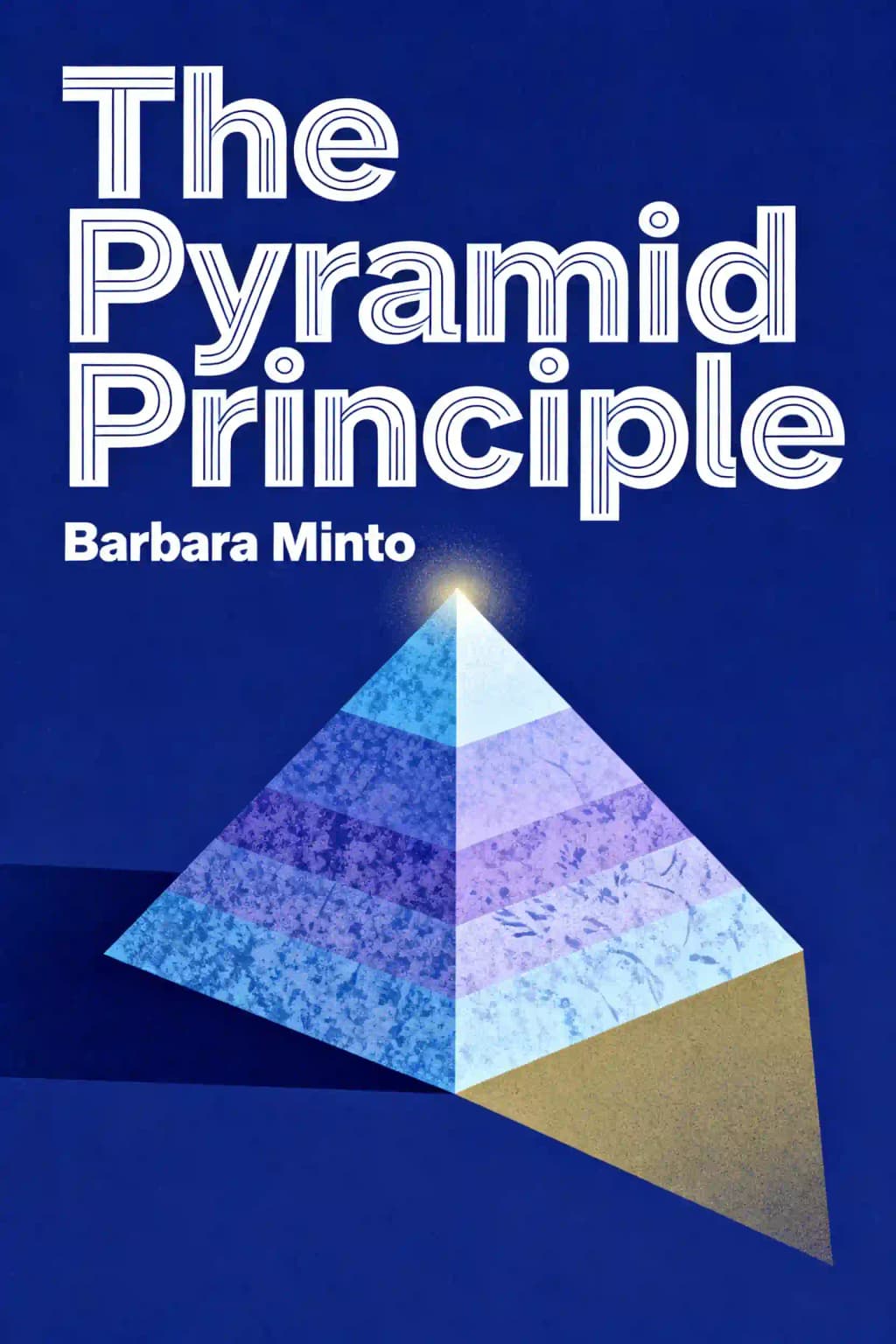
When McKinsey consultant Barbara Minto introduced the Pyramid Principle in the 1970s, she couldn't have predicted it would become the gold standard for business communication across Fortune 500 companies worldwide. What began as an internal guidance document for fellow consultants transformed into a revolutionary approach that fundamentally changed how professionals structure their thinking. Steve Jobs was known to demand presentations follow this structure, and management consultants at top firms like BCG and Bain consider it required reading. The brilliance of Minto's approach lies in its counterintuitive nature-starting with conclusions rather than building up to them-a method that mirrors how our brains naturally process information. In today's information-saturated world, this principle has become more valuable than ever. But what exactly makes this pyramid so powerful?
Capítulo 2
The Architecture of Clarity: Building the Pyramid Structure
Imagine walking into a maze versus viewing it from above. The difference is perspective-and this is exactly what the Pyramid Principle offers. At its core, this approach organizes ideas hierarchically beneath a single controlling thought. Rather than wandering through disconnected ideas, readers immediately grasp the main point and understand how supporting elements connect to it, much like seeing the entire layout of the maze from an elevated position.
The pyramid structure isn't merely aesthetic-it's deeply psychological. Our minds naturally seek order and relationships between concepts, constantly trying to create patterns and connections. When information is presented in a pyramid, with the main idea at the top supported by logically grouped ideas beneath it, comprehension happens almost effortlessly. Each level of the pyramid answers questions raised by the level above it, creating a natural flow of thought that mirrors how our brains process information.
Consider how differently we process these approaches:
• Traditional approach: "We conducted market research, analyzed competitors, evaluated our capabilities, and therefore recommend entering the Asian market."
• Pyramid approach: "We should enter the Asian market. Our research shows high demand, limited competition, and our company has the necessary capabilities to succeed there."
• Enhanced pyramid approach: "We should enter the Asian market immediately. Market research indicates a 40% growth in demand for our product category, only two major competitors hold less than 30% market share combined, and our existing infrastructure can support expansion with minimal additional investment."
The pyramid structure excels in three key dimensions:
1. Clarity of Thought: By forcing the writer to identify the main message first, it ensures crystal-clear communication
2. Logical Flow: Supporting ideas are grouped naturally, making connections obvious
3. Memory Retention: Readers remember structured information better, with recall rates improving by up to 40%
The pyramid isn't just about top-down organization. It's equally important that ideas at each level are grouped logically and presented in a sequence that makes sense-chronologically, spatially, or by order of importance. For example, when presenting a business case, you might structure supporting evidence in order of impact: financial benefits first, operational improvements second, and strategic advantages third. This careful structuring creates a roadmap that guides readers effortlessly through complex information landscapes, allowing them to navigate confidently rather than becoming lost in details.
When implemented correctly, the pyramid structure transforms even the most complex ideas into accessible, persuasive communication. Consider how major consulting firms use this approach to present findings to C-level executives: a clear recommendation upfront, followed by 3-4 key supporting arguments, each backed by specific data points and analysis. This structure has proven so effective that it's become the standard format for executive communications in many Fortune 500 companies.
The beauty of the pyramid structure lies not in simplifying content but in organizing it in a way that honors the natural thinking patterns of the human mind. It creates a framework where complex ideas can be understood, retained, and acted upon with remarkable efficiency.
Capítulo 3
Start With the Answer: The Revolutionary Approach to Conclusions
We've been taught since elementary school to build arguments step by step, leading readers through our reasoning before revealing conclusions. Barbara Minto turns this conventional wisdom on its head. The Pyramid Principle insists that effective communication begins with the conclusion-a radical departure from traditional approaches that has proven remarkably effective in business settings.
Why does this work? Because busy executives and decision-makers don't have time to follow your entire thinking process before understanding your point. By presenting your conclusion first, you create immediate clarity and context. This approach respects your audience's time and cognitive resources, allowing them to process supporting information with the end goal already in mind.
Consider this scenario: A team spends fifteen minutes detailing market research, competitor analysis, and internal capabilities before finally recommending a product launch in Europe. By the time they reach their conclusion, their audience has been forming their own conclusions or, worse, wondering where the presentation is heading. Contrast this with starting boldly: "We recommend launching in Europe by Q3. Here's why..." The audience immediately understands the destination and can evaluate the supporting evidence more effectively.
This "answer first" approach isn't just efficient-it's psychologically sound. When we know the conclusion, our brains more effectively process information that supports or challenges it. We become active participants rather than passive recipients of information.
However, this doesn't mean being abrupt or unsupported in your assertions. The conclusion serves as the top of your pyramid, with each layer beneath providing increasingly detailed support. You're not eliminating the reasoning process-you're reordering it to match how decisions are actually made in professional settings.
This approach requires confidence and clarity of thought. You must thoroughly understand your own reasoning before communicating it. The reward is communication that respects your audience's intelligence and time while dramatically increasing the likelihood that your message will be understood, remembered, and acted upon.
Capítulo 4
The MECE Principle: Creating Logical Groupings That Convince
One of the most powerful tools in the Pyramid Principle arsenal is the MECE approach-Mutually Exclusive, Collectively Exhaustive. This concept, though technical-sounding, addresses a fundamental challenge in communication: how to organize supporting points so they feel complete without redundancy.
Mutually exclusive means each idea stands alone without overlapping others. Collectively exhaustive means together, they cover all relevant possibilities. When your supporting points are MECE, your argument becomes airtight, leaving no gaps for objections and no confusion from repetition.
Consider analyzing a company's declining profits. A non-MECE approach might list: "decreasing sales, increasing costs, poor marketing, and operational inefficiencies." The problem? Marketing issues likely affect sales, and operational inefficiencies probably impact costs-these categories overlap, creating confusion. A MECE approach would restructure this as: "declining revenue (with subcategories including marketing issues) and increasing costs (with subcategories including operational inefficiencies)."
The power of MECE thinking extends beyond organizing existing ideas-it helps identify gaps in your reasoning. If you're evaluating market entry options and only consider Europe and Asia, you've missed other regions. Your analysis isn't collectively exhaustive. Similarly, if you're discussing "international markets" and "European markets" as separate categories, you've created overlapping groups that aren't mutually exclusive.
Applying MECE requires disciplined thinking. Ask yourself: "Do any of these points overlap?" and "Together, do these points cover all possibilities?" This approach forces clarity of thought before you even begin communicating.
The MECE principle creates a satisfying logical completeness that resonates with analytical audiences. When decision-makers sense that you've considered all angles without redundancy, they gain confidence in your recommendations. Your ideas appear thorough yet elegant, comprehensive yet clear.
While MECE thinking comes naturally to some, most of us must consciously practice it. The effort pays dividends not just in communication but in problem-solving itself. By organizing your thinking into clean, logical categories, you often discover insights that would have remained hidden in a more haphazard approach.
Capítulo 5
The Magical Rule of Three: Why Triads Persuade and Stick
"Life, liberty, and the pursuit of happiness." "Blood, sweat, and tears." "Location, location, location." What do these memorable phrases have in common? They leverage the power of three-a principle Barbara Minto incorporates into the Pyramid structure that dramatically enhances both comprehension and persuasiveness.
The human mind has a remarkable affinity for patterns, and three is the smallest number that creates a pattern while remaining manageable. Two points create a line, but three create a complete shape-a triangle that feels stable and complete. This isn't just poetic thinking; cognitive science confirms that information grouped in threes is more memorable, more persuasive, and perceived as more complete than other groupings.
Within the Pyramid Principle, grouping supporting ideas in threes whenever logical creates a natural rhythm that guides readers through your thinking. Consider how differently these approaches feel:
• "Our strategy will improve efficiency, enhance customer satisfaction, boost employee morale, increase market share, and reduce costs."
• "Our strategy delivers three key benefits: operational excellence (improving efficiency and reducing costs), customer delight (enhancing satisfaction and loyalty), and team empowerment (boosting morale and innovation)."
The second approach, using groups of three, feels more organized and digestible despite covering the same territory. The mind can hold these three categories comfortably while processing the details within each.
This principle extends beyond just grouping. When developing supporting points, aiming for three substantive arguments often creates the ideal balance between thoroughness and focus. One point feels incomplete, two creates a binary opposition, but three establishes a pattern that feels comprehensive without overwhelming.
Of course, the rule of three shouldn't override logical groupings. Sometimes two points or four points make more sense. But when possible, restructuring your thinking into triads often reveals more elegant ways to organize information.
The rule of three works because it balances our competing cognitive needs: we crave both simplicity and completeness. Three points are few enough to remember easily but numerous enough to suggest thorough analysis. This cognitive sweet spot makes your communication not just clearer, but significantly more persuasive and memorable.
Capítulo 6
Vertical Logic: Building Convincing Arguments Layer by Layer
The strength of any pyramid depends on how solidly each layer supports what's above it. In communication, this vertical relationship between ideas forms what Minto calls "vertical logic"-perhaps the most crucial element in creating compelling arguments.
Vertical logic addresses a fundamental question: How does each supporting point connect to and reinforce the idea above it? When this connection is strong, readers move effortlessly through your reasoning. When it's weak, even well-written content feels unconvincing.
The key to strong vertical logic lies in understanding that each level of the pyramid should answer questions raised by the level above it. Your main point naturally prompts the question "Why should I believe this?" Your supporting points answer this question. These supporting points, in turn, raise their own "why" questions, which the next level addresses.
Consider this example:
• Top point: "We should acquire Company X."
• Question raised: "Why should we acquire Company X?"
• Supporting points: "It would give us access to new markets, proprietary technology, and cost synergies."
• Questions raised by supporting points: "Which new markets?" "What technology?" "What specific synergies?"
• Next level answers these specific questions with evidence and examples.
This question-answer relationship creates a natural flow that pulls readers through your argument. Each point satisfies curiosity raised by the previous point while creating new, more specific curiosity that keeps engagement high.
Strong vertical logic requires disciplined thinking about causality and evidence. Ask yourself: "If my reader accepts my supporting points as true, would they necessarily accept my conclusion?" If not, you've identified a logical gap that needs addressing.
The pyramid structure visually reinforces these vertical relationships, making it easier to identify weak connections. When you map your thinking into a pyramid, gaps in reasoning become immediately apparent-supporting points that don't directly connect to their parent idea stand out, allowing you to strengthen or replace them.
By consciously building these vertical connections, you create arguments that feel inevitable rather than forced. Readers experience the satisfaction of seeing how each piece connects to form a coherent whole, making your communication not just clear but compelling.
Capítulo 7
Horizontal Logic: The Art of Sequencing Ideas for Maximum Impact
While vertical logic connects ideas between levels of your pyramid, horizontal logic governs how ideas at the same level relate to each other. This critical dimension of the Pyramid Principle addresses a question many communicators overlook: In what order should I present my supporting points?
The sequence of ideas significantly impacts how readers process information. Minto identifies three primary patterns for organizing ideas horizontally: time order (chronological), structural order (spatial or physical), and ranking order (importance). Choosing the right pattern depends on your content and purpose.
Time order works naturally for processes, histories, or cause-effect relationships. When explaining how a problem developed or how a solution will be implemented, chronological sequencing creates a narrative flow that's easy to follow. "First we'll analyze the market, then develop prototypes, and finally conduct testing."
Structural order organizes information based on physical or conceptual relationships. This might mean moving from east to west in a geographic analysis, from largest to smallest in a physical description, or from general to specific in a conceptual explanation. "We'll examine market conditions in North America, Europe, and Asia."
Ranking order arranges ideas by importance, typically either building toward the most important point (climactic order) or starting with it (anti-climactic order). When persuading, starting with your strongest point often works best. "Our most compelling advantage is proprietary technology, followed by our distribution network and cost structure."
The key insight about horizontal logic is that random sequencing creates cognitive friction. When points appear arbitrarily arranged, readers unconsciously expend mental energy trying to discern the pattern. By deliberately choosing a logical sequence, you reduce this cognitive load and make your communication more effortless to process.
Sometimes multiple sequencing options make sense. In these cases, consider your audience's needs and expectations. Technical audiences might prefer building from general principles to specific applications, while executive audiences often want the most important information first.
Effective horizontal logic also creates momentum. Each point should build on previous points, creating a sense of progression rather than a mere list of disconnected ideas. This momentum carries readers forward through your argument, making them more likely to reach-and accept-your conclusion.
Capítulo 8
Introductions That Work: Setting the Context for Your Pyramid
The pyramid structure begins with your conclusion, but this doesn't eliminate the need for an introduction. Rather, it transforms the introduction's purpose from gradually building toward a conclusion to establishing the context that makes your conclusion relevant and compelling.
Minto identifies a powerful four-part sequence for introductions that primes readers to be receptive to your main point:
1. Situation: Start with an objective statement of facts that your audience will readily accept. This establishes common ground and orients readers to the subject matter. "Our company has operated exclusively in domestic markets for 25 years."
2. Complication: Introduce the change, problem, or opportunity that disrupts the situation and creates a need for action. This generates tension that engages the reader's interest. "Recent tariff reductions have created unprecedented access to Asian markets, while domestic competition has intensified."
3. Question: Explicitly or implicitly raise the central question prompted by the complication. This focuses the reader's attention on exactly what your conclusion will address. "How should we respond to these changing market dynamics?"
4. Answer: Provide your conclusion-the top of your pyramid-which directly answers the question. "We should establish operations in Singapore by Q3 to serve as our Asian headquarters."
This situation-complication-question-answer sequence works because it mirrors how we naturally process problems. We recognize a change from the expected (complication), wonder what to do about it (question), and seek a resolution (answer). By following this pattern, you align your communication with your audience's cognitive processes.
The introduction shouldn't just present these elements but connect them logically. The complication should genuinely disrupt the situation, the question should naturally arise from this disruption, and your answer should directly address the question posed.
The length of your introduction should be proportional to how much context your audience needs. For familiar topics with knowledgeable audiences, a brief introduction suffices. For complex or unfamiliar subjects, a more detailed situation and complication may be necessary.
A well-crafted introduction using this structure doesn't just provide context-it creates anticipation. By the time you present your main point, readers aren't just ready to hear it; they're actively wanting it as the resolution to the tension you've established.
Capítulo 9
Mastering Deduction and Induction: The Twin Engines of Persuasion
At the heart of the Pyramid Principle lie two fundamental reasoning patterns that give your arguments their persuasive power: deductive and inductive reasoning. Understanding when and how to use each is essential for building compelling pyramids.
Deductive reasoning moves from general principles to specific conclusions. When using deduction, you present a major premise, a minor premise, and a conclusion that logically follows. For example: "All successful market entries require local partnerships (major premise). The Japanese market has particularly complex distribution systems (minor premise). Therefore, we must secure a local partner for our Japanese market entry (conclusion)."
Deductive reasoning creates a sense of logical inevitability. When your premises are accepted, the conclusion feels inescapable. This makes deduction particularly effective when your audience already accepts your general principles or when those principles are widely acknowledged.
Inductive reasoning moves in the opposite direction-from specific observations to general conclusions. You present multiple specific examples or data points, then identify the pattern or principle they suggest. "Our product succeeded in Germany after localizing the user interface. It also succeeded in Brazil after similar localization. In markets where we didn't localize, like Korea and India, we underperformed. This suggests that localization is a key success factor for international markets."
Induction builds credibility through evidence accumulation. Each example strengthens your case, creating a compelling pattern that points toward your conclusion. This approach works well when you have strong specific evidence or when your audience may be skeptical of general assertions.
The Pyramid Principle leverages both reasoning types, often in combination. The overall pyramid typically follows deductive structure-starting with the conclusion and supporting it with reasons. Within each supporting point, you might use induction by providing multiple examples or data points that support that specific reason.
The key is matching your reasoning approach to your content and audience. Technical or analytical audiences often respond well to deductive reasoning that explicitly lays out the logical steps. Narrative-oriented audiences might find inductive reasoning more engaging, as it builds toward insights through stories and examples.
By consciously choosing between deduction and induction at each level of your pyramid, you create arguments that feel both logically sound and evidentially supported-a powerful combination that makes your communication not just clear but convincing.
Capítulo 10
Putting It All Together: Implementing the Pyramid Principle in Real Life
Transforming your communication with the Pyramid Principle doesn't happen overnight. It requires practice, feedback, and a willingness to restructure deeply ingrained writing habits. But the payoff-dramatically more effective communication-makes the effort worthwhile.
Start small by applying the principle to everyday communications like emails. Before writing, identify your main point and the key reasons supporting it. Structure your message with the conclusion first, followed by supporting points in a logical sequence. This daily practice builds the mental muscles needed for pyramid thinking.
For more complex communication, begin with idea generation before structuring. Capture all relevant points without worrying about organization. Then step back and ask: "What's my single main point?" This becomes the top of your pyramid. Group remaining ideas into supporting points, ensuring they're MECE (Mutually Exclusive, Collectively Exhaustive). Arrange these points in a logical sequence, and ensure each has adequate support.
Visual mapping helps tremendously. Actually drawing your pyramid structure-with your main point at the top and supporting levels beneath it-makes logical gaps immediately apparent. Software tools like mind mapping applications can facilitate this process, though even simple index cards or sticky notes work well for physically arranging and rearranging ideas.
When reviewing your work, ask these diagnostic questions:
• Does my introduction establish a clear situation, complication, question, and answer?
• Is my main point truly the single controlling idea everything else supports?
• Are my supporting points MECE-covering everything important without overlap?
• Does each level of the pyramid answer questions raised by the level above it?
• Have I sequenced ideas at each level in a logical way?
Remember that the Pyramid Principle isn't rigid-it adapts to different communication contexts. In presentations, you might reveal your pyramid structure explicitly to help audiences follow your reasoning. In reports, section headings and executive summaries can reflect your pyramid structure. In conversations, you might start with your conclusion and then provide supporting points based on what questions arise.
The ultimate test of successful implementation isn't structural perfection but audience response. When people understand your point quickly, follow your reasoning easily, and remember your key messages, you've successfully applied the Pyramid Principle. When they ask fewer clarifying questions and move more quickly to substantive discussion, you know your pyramid is working.
With consistent practice, pyramid thinking becomes second nature-not just a communication technique but a way of organizing thought itself. The result is not just clearer communication but clearer thinking, as the discipline of the pyramid structure forces precision and logical rigor that benefits every aspect of professional life.