Capítulo 1
The Paradox of Human Folly: When Intelligence Meets Its Limits
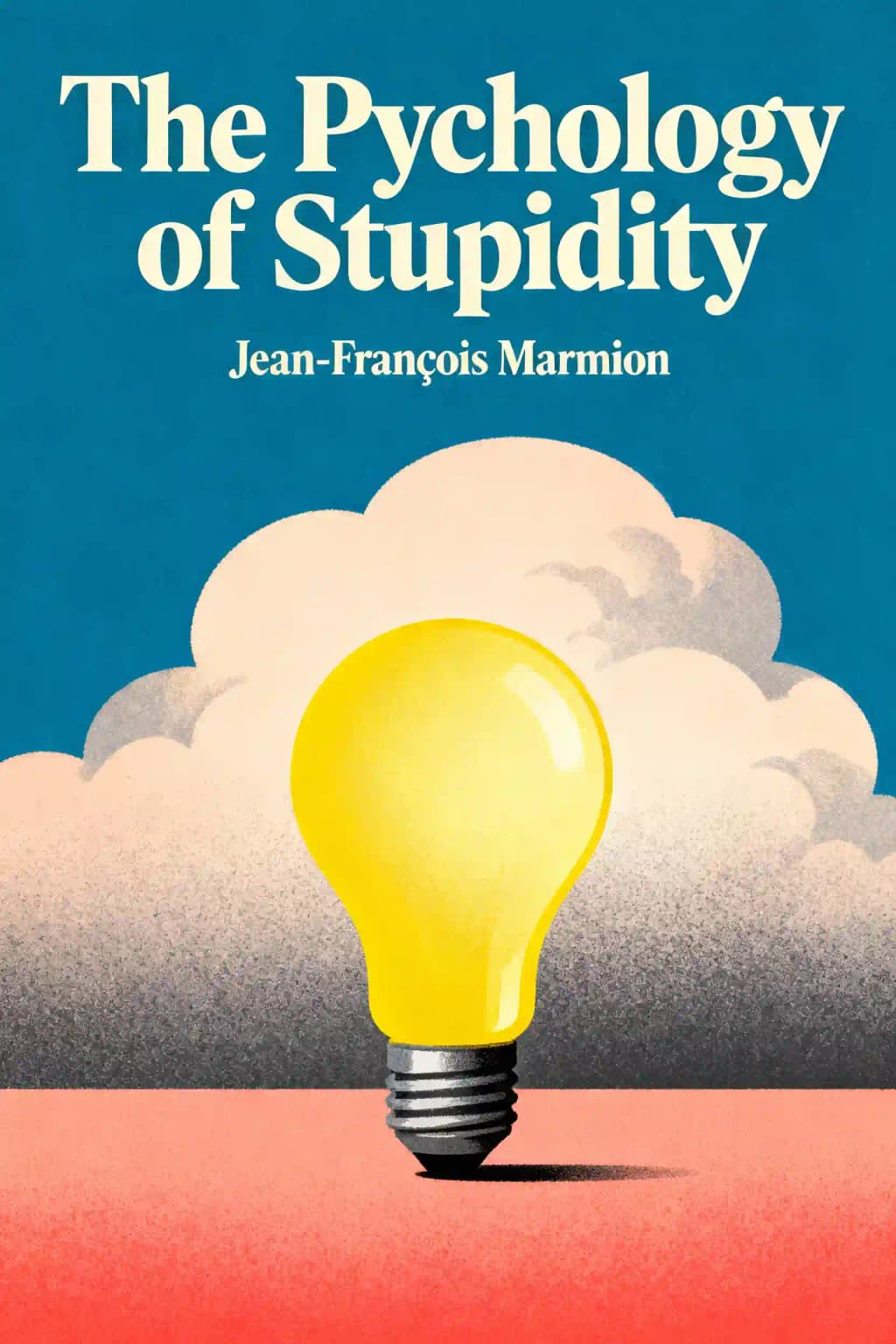
We encounter stupidity daily-in conversations, news headlines, social media, and occasionally in our own mirror. Jean-Francois Marmion's anthology "The Psychology of Stupidity" has become a cultural touchstone since its publication, selling over 100,000 copies in France alone before being translated into English. This collection brings together some of the world's leading psychologists, philosophers, and neuroscientists to examine why humans-even brilliant ones-so frequently abandon reason and logic.
What makes this book particularly compelling is its refusal to position stupidity as something that happens to "other people." As Nobel Prize winner Daniel Kahneman notes within these pages, we are all susceptible to cognitive biases that lead to poor decisions. The book's popularity reflects our collective fascination with understanding why smart people do dumb things-a question that has only grown more urgent in our era of "fake news" and "post-truth" politics.
Capítulo 2
The Anatomy of Everyday Idiocy
Stupidity surrounds us like air-invisible yet essential to the human experience. It manifests in various intensities: gentle lappings that cause minor irritations, nauseating swamps of institutional incompetence, and occasionally as devastating tidal waves that destroy everything in their path. The most dangerous manifestations come from what Marmion calls "assholes with a capital A"-those who prosper despite their wrongheadedness, eroding others' morale and dignity with their unjustified arrogance. These individuals often occupy positions of power in corporations, governments, and social institutions, making their impact particularly far-reaching.
What makes these individuals particularly toxic is their steadfast refusal to acknowledge limitations or consider alternative viewpoints. They represent an unkept promise of intelligence, betraying humanity's potential by dragging others down to their level through a combination of bullying, gaslighting, and institutional leverage. The worst part? They're sometimes quite intelligent in conventional terms, possessing degrees from prestigious institutions or demonstrated success in specific fields. However, they weaponize their knowledge rather than using it as a tool for understanding and growth, creating toxic environments wherever they go.
When confronting such individuals, attempting to reason with them backfires spectacularly. Logic, evidence, and rational discourse become futile exercises, as their ego-defense mechanisms are impenetrable. The moment you try to improve them or point out their errors, you become the idiot in their narrative. Your opposition only strengthens their conviction that they're heroic anticonformists fighting against the establishment, effectively turning one moron into two. This exponential power of stupidity explains why it has maintained such profound influence throughout human history, from ancient civilizations to modern societies.
Each era believes it lives in the golden age of idiocy-perhaps correctly, given how present stupidity always feels more acute than historical examples. What makes our current moment uniquely dangerous is the combination of widespread ignorance with unprecedented technological power. One idiot with access to nuclear weapons, artificial intelligence, or biological weapons could eradicate all stupidity along with humanity itself. Modern stupidity has never been more visible, unabashed, and peremptory, amplified by social media echo chambers and the rapid spread of misinformation. This phenomenon drives some to despair while inspiring others toward philosophical contemplation about the nature of human cognition and social behavior.
The paradox of contemporary stupidity lies in its coexistence with unprecedented access to information and education. Despite having libraries of knowledge at our fingertips, many choose willful ignorance, embracing conspiracy theories and rejecting expertise. This suggests that stupidity isn't merely about lack of information, but rather a complex psychological and social phenomenon that requires deeper understanding to address effectively.
Capítulo 3
The Science Behind Our Foolishness
Can idiots be studied scientifically? Psychologist Serge Ciccotti suggests such research is essentially the study of all mankind. Psychological literature has extensively investigated behaviors we might classify as idiotic, revealing why people sometimes act foolishly despite their intelligence.
We often operate without deeply analyzing our environment, relying instead on automatic behavioral scripts that reduce required attention. This explains why someone might check their watch twice in succession or ask inappropriate questions to a crying person. Research shows we're frequently blind to changes around us and susceptible to illusions of control-like frantically pressing an already-pressed elevator button.
The Dunning-Kruger effect reveals that incompetent people tend to overestimate their competence while failing to recognize expertise in others. This explains why fools give unsolicited advice on subjects they know nothing about, why clients tell professionals how to do their jobs, and why someone might confidently declare "It's easy to be a lawyer" despite having no legal training.
Our "negativity bias" makes us notice problems more than successes, while attribution bias leads us to blame character rather than circumstances for others' behavior-both mechanisms increasing our tendency to spot idiots everywhere. We're also prone to believing in a just world (leading to victim-blaming) and falling for illusions of control (explaining behaviors like throwing dice harder to get sixes).
These cognitive shortcomings aren't limited to the unintelligent. In fact, intelligence offers no protection against the biases that lead to poor decisions. As philosopher Harry Frankfurt notes, "bullshit" (indifference to truth) is worse than lying because liars at least acknowledge truth's importance by working to subvert it.
Capítulo 4
The Varieties of Human Stupidity
Different forms of stupidity exist just as there are multiple forms of intelligence. The vocabulary of stupidity is rich-backward, slow, ignorant, idiotic, imbecilic-reflecting subtle gradations in meaning. Each term carries its own nuanced implications: "backward" suggests a failure to progress, "slow" indicates processing difficulties, while "ignorant" points to a lack of knowledge that could be remedied. Fundamentally, stupidity is a relative concept; one is judged stupid from a position of presumed superiority, often within specific cultural or intellectual contexts.
The "universal idiot" who loudly proclaims "They're all morons!" while sitting at a bar exemplifies a particular type of fool. This sweeping judgment-encompassing politicians, voters, bureaucrats, and essentially everyone-reveals a lack of discernment and an arrogance that places oneself above humanity. Such individuals often display what psychologists call the Dunning-Kruger effect, where limited knowledge leads to inflated self-assessment. As Descartes noted, "The peculiar nature of error is that it does not recognize itself"-especially true of stupidity, which often manifests as a blind spot in self-awareness.
While collective intelligence can produce remarkable results through self-organization (like ant colonies building complex structures), groups sometimes make worse decisions than individuals-a phenomenon called collective stupidity. Solomon Asch's famous conformity studies showed that people will embrace manifestly false ideas simply due to social pressure, with subjects frequently choosing obviously incorrect answers when surrounded by confederates giving wrong responses. This tendency toward group-think appears in corporate boardrooms, political movements, and social media echo chambers. Similarly, research on brainstorming reveals that individuals working separately often produce more and better ideas than groups working together, challenging the common belief in the superiority of collective thinking.
Gullibility isn't necessarily a lack of logic but relates to systems of reference and trusted authorities. Even rational adults believe in scientifically verified phenomena they can't personally confirm, from quantum mechanics to historical events. This selective acceptance of information creates vulnerability to manipulation when trust is misplaced. The term "loon" refers to dreamy fools living in fantasy worlds-a step away from "weirdos" who do bizarre things, who themselves are close to "freaks" displaying eccentric behavior. These categories exist on a spectrum of social deviation, where the boundaries between eccentricity, peculiarity, and genuine cognitive impairment often blur.
Modern psychology recognizes various cognitive biases that contribute to stupid behavior: confirmation bias leads people to accept information that confirms their existing beliefs, while the bandwagon effect causes individuals to adopt beliefs simply because others hold them. These systematic errors in thinking affect even intelligent people, suggesting that stupidity isn't simply the opposite of intelligence but a complex phenomenon involving social, emotional, and cognitive factors.
Capítulo 5
The Asshole: A Philosophical Analysis
Philosophy professor Aaron James provides a rigorous academic analysis of what constitutes an asshole, defining them as individuals who systematically grant themselves special advantages in social life while maintaining an entrenched sense of immunity from criticism. The classic example is someone who cuts in line, believing their time is inherently more valuable than others', but this behavior manifests in numerous ways: taking up multiple parking spaces, talking loudly on phones in quiet spaces, or monopolizing conversations. When confronted, they typically either ignore the complaint entirely or respond with dismissive hostility-not because they actively despise others, but because they genuinely don't believe others deserve their consideration or respect.
Intelligence and education, contrary to what some might expect, don't prevent someone from being an asshole-in fact, these qualities can actually exacerbate the condition by reinforcing their sense of intellectual superiority. Many highly successful professionals, academics, and executives fall into this category, using their achievements to justify their special status. The core issue isn't necessarily malice but rather a fundamental failure to show genuine interest in others' perspectives, operating from the baseline assumption that everyone else should adjust to accommodate them. While simple awareness of one's assholery rarely leads to behavioral change, significant life events or existential crises might occasionally trigger meaningful self-reflection.
The prevalence of assholes varies significantly by culture and social context. James notes higher concentrations in individualistic societies like the United States compared to more collectivist cultures like Japan, where social harmony is prioritized. However, all functioning societies necessarily develop mechanisms to limit asshole behavior for collective survival. These mechanisms range from formal rules and regulations to subtle social sanctions. James advocates for addressing the problem through coordinated collective action-essentially marginalizing assholes through unified social responses-rather than attempting to change them individually. While assholes might experience momentary satisfaction when successfully imposing their will on others, they often suffer from underlying anxiety and insecurity, constantly needing to maintain their perceived superiority. This creates a cycle of behavioral reinforcement: the more they assert their specialness, the more isolated they become, further feeding their need to assert dominance.
Capítulo 6
From Simple Stupidity to Sophisticated Folly
Stupidity has many gradations, from brute dullness to sophisticated folly. Pascal Engel identifies a detailed hierarchy beginning with bestial stupidity (the dull-witted) through idiots and imbeciles, to fools who don't lack intelligence but deploy it badly, up to what Robert Musil calls "sophisticated stupidity"-intelligent people with ill-conceived plans and moral blindness. This sophisticated form often manifests in highly educated individuals who use their intelligence to construct elaborate but fundamentally flawed arguments or pursue misguided goals with technical precision.
At the highest level is "bullshit" or hogwash-discourse that systematically devalues truth itself. Unlike liars who respect truth's norms to subvert them, bullshitters simply don't care about truth. This "folly in the second degree" has become pandemic in our post-truth era, spreading through media and social networks as a political force. We see this in the proliferation of pseudo-expertise, where complex issues are reduced to oversimplified soundbites, and in the rise of social media influencers who prioritize engagement over accuracy.
Stupidity isn't merely an intellectual deficit but often involves excessive reasoning. As Nicolas Chamfort noted, "Three-fourths of folly is just stupidity." The fool loves to reason and often reasons too much-"Reasoning banishes reason," as Moliere wrote. Classical moralists like La Bruyere and Voltaire denounced this surfeit of reason, while Romantics rejected cold reason entirely. This paradox appears frequently in academic circles, where overthinking can lead to paralysis by analysis or the construction of elaborate theoretical frameworks that lose touch with practical reality.
Gustave Flaubert's bourgeois characters exemplify this phenomenon-they're extremely rational but take it too far, making reason ridiculous through tautologies, cliches, and truisms that reveal the self-satisfied vanity of fools. His character Bouvard and Pecuchet perfectly illustrate this tendency, as they apply scientific methods to absurd ends, creating a parody of rational inquiry. This mass stupidity creates a fundamental dilemma: if stupidity originates in reason's excesses, how can reason fight it? The challenge is particularly acute in our information age, where the tools of rational discourse are often weaponized to promote irrationality.
Modern examples of sophisticated folly abound in corporate culture, where complex metrics and analytics sometimes obscure simple truths, and in political discourse, where logical fallacies are dressed up in the language of expertise. The phenomenon of "smart stupid" appears in tech giants launching elaborate solutions to non-existent problems, or in financial markets where sophisticated mathematical models can lead to catastrophic miscalculations.
Capítulo 7
The Cognitive Science of Human Irrationality
Nobel Prize winner Daniel Kahneman's groundbreaking research illuminates how humans process information through two distinct but interconnected systems. System 1 operates automatically, intuitively, and rapidly - it's what allows us to recognize faces instantly, understand simple sentences, and react to sudden dangers. System 2, by contrast, engages in slow, methodical, and energy-intensive thinking required for complex calculations, logical analysis, and careful decision-making. While System 1 excels at pattern recognition and quick responses, it tends to oversimplify reality, leading to various cognitive biases and systematic errors in judgment.
The interplay between these systems shapes our daily experience in profound ways. Without System 1's automatic processes, we would be paralyzed by having to consciously think through every action, similar to how alcohol impairment disrupts our automatic responses. Conversely, without System 2's oversight, we would be at the mercy of our impulses and intuitions, making us highly susceptible to errors and manipulation. This dynamic becomes particularly evident in political decision-making, where System 1's emotional responses often override System 2's rational analysis. People typically form political beliefs through emotional resonance and trust in familiar sources rather than through careful evaluation of policy arguments.
Kahneman and Tversky's research revealed how our mental shortcuts (heuristics) serve as rough approximations of logical thinking. These shortcuts, while imperfect, proved evolutionarily advantageous. For instance, the availability heuristic - judging probability by how easily examples come to mind - helped our ancestors avoid dangerous situations without requiring complex probability calculations. The anchoring effect, where initial information disproportionately influences subsequent judgments, allowed for quick decision-making in uncertain situations.
This evolutionary perspective helps explain why modern democracy faces particular challenges with abstract threats. Climate change, for instance, doesn't trigger System 1's immediate emotional responses the way a visible predator would, making it harder for societies to mobilize appropriate responses. Similarly, complex economic policies often fail to engage System 1's intuitive understanding, leading to support for oversimplified but emotionally appealing solutions.
The debate over how to approach our cognitive limitations continues to evolve. Some experts, like Rolf Dobelli, advocate for systematic approaches to overcome our biases, suggesting we should actively resist our intuitive responses in important decisions. Others, including Kathryn Schulz, argue that our capacity for error is inextricably linked to our ability to learn and innovate. Herbert Simon's concept of "bounded rationality" suggests that our cognitive limitations aren't just flaws to overcome but are fundamental to how humans successfully navigate complex environments. This perspective suggests that rather than pursuing perfect rationality, we should focus on understanding and working within our cognitive constraints while developing systems and institutions that can compensate for our limitations.
Capítulo 8
The Neuroscience of Stupidity
Neurologist Pierre Lemarquis approaches the challenge of locating stupidity in the brain with humor and scientific curiosity, offering a fascinating exploration of our cognitive limitations. He notes that our neurological challenges begin even before birth-humans are born prematurely due to evolutionary pelvic constraints, requiring fifteen more months of development ideally. This early developmental stress likely marks us for life, creating a foundation for potential cognitive vulnerabilities that persist into adulthood.
Our brain's rapid evolutionary development has created significant internal conflicts that complicate decision-making processes. Its posterior section, including regions like the occipital and temporal lobes, processes complex sensory information and continuously compares it with stored memories and experiences. Meanwhile, the frontal lobe-our primary distinguishing feature from other animals-handles sophisticated executive functions that determine future actions, including planning, impulse control, and social behavior. However, we're far from purely rational beings: ancient brain circuits governing pleasure and reward, such as the nucleus accumbens and ventral tegmental area, can make even the most brilliant individuals succumb to destructive impulses, leading to career-ending decisions or self-sabotaging behaviors.
The brain's inherent duplicity stems from its two mismatched hemispheres, each with distinct characteristics and processing styles. The left hemisphere operates as a conservative accountant, calculating and speech-dominant, methodically exploring only the right visual field while seeking patterns and rational explanations for everything it encounters. It constantly attempts to restrain its counterpart, much like a stern parent monitoring an unruly child. The right hemisphere, in contrast, functions as a revolutionary poet-holistic, intuitive, and creative. It excels at recognizing faces, processing emotions, and appreciating the world's fullness, but struggles with linear tasks like budgeting or articulating words precisely.
This internal struggle creates what amounts to a government of extremists engaged in perpetual tug-of-war, significantly hampering clear decision-making processes. The frontal lobe, serving as our brain's executive police force, only fully develops in early adulthood-around age 25-leaving younger individuals particularly vulnerable to impulsive decisions. Moreover, those without active cultural and intellectual lives risk cerebral sclerosis, a gradual decline in cognitive flexibility and adaptability. Perhaps most humbling is the revelation that intelligence offers no guaranteed protection against stupidity-even Nobel laureates can fall prey to fundamental cognitive biases and irrational decisions, demonstrating that academic brilliance and practical wisdom don't always align. This phenomenon, known as "domain-specific intelligence," explains why experts in one field can make remarkably poor decisions in others.
Capítulo 9
When Smart People Do Stupid Things
Intelligence doesn't protect against belief in unfounded ideas. Though a meta-analysis of sixty-three studies suggests intelligent people are less inclined toward religious faith, even brilliant individuals can embrace bizarre theories. Critical thinking-requiring evidence, recognizing fallacies, and overcoming cognitive biases-is distinct from raw intelligence. Studies have shown that high IQ individuals can actually be more skilled at rationalizing and defending their irrational beliefs, using their intelligence to construct elaborate justifications for unfounded ideas.
Steve Jobs, nicknamed "iGod," demonstrated fatal irrationality when diagnosed with pancreatic cancer in 2003. Despite creating revolutionary products that made him a billionaire, when his tumor was operable, he refused surgery, instead pursuing alternative therapies like herbal capsules, fruit juice, and fasting. For nine crucial months, he explored acupuncture, dietary modifications, and hydrotherapy, consulting with psychics and naturalists while his condition worsened. Only when the cancer spread beyond his pancreas did he accept conventional treatment, but by then it was too late. His wife later revealed that he deeply regretted this decision, acknowledging that early surgery might have saved his life.
Some irrational beliefs endanger not just believers but others through influence and proselytizing. In 2010, a pseudoscientific conference called "Galileo Was Wrong: The Church Was Right" gathered self-proclaimed "experts" who attempted to prove geocentrism-that the sun revolves around Earth-despite centuries of scientific evidence to the contrary. Similar movements persist today, from flat Earth believers to anti-vaccination advocates, often led by educated professionals who use their credentials to lend false credibility to dangerous ideas. The Internet has amplified these voices, creating echo chambers where incorrect beliefs can flourish unchallenged.
Our vulnerability to dangerous beliefs stems from our need to find meaning in life, especially when explanations align with our worldview or intuitive expectations. This cognitive vulnerability appears regardless of education level or professional success. Throughout history, humans have believed bizarre things while others fought against such beliefs, creating an equilibrium that persists. Even brilliant minds like Einstein weren't immune-he attributed his wife's and son's illnesses to "well-deserved punishment" for marrying "a physically and morally inferior person." Nobel laureate Linus Pauling, despite his groundbreaking work in chemistry, became obsessed with vitamin C as a cure-all, making increasingly extreme claims unsupported by evidence. These examples demonstrate how compartmentalized thinking can allow rational and irrational beliefs to coexist in even the most accomplished minds.
The phenomenon of smart people holding irrational beliefs also manifests in contemporary issues like climate change denial and conspiracy theories. Research shows that higher education levels don't necessarily correlate with better judgment in areas outside one's expertise. In fact, intelligent people may be more susceptible to certain cognitive biases, like the tendency to seek information that confirms existing beliefs while dismissing contradictory evidence.
Capítulo 10
Finding Wisdom in Our Foolishness
Jean-Claude Carriere distinguishes between folly and stupidity: folly is arrogant while stupidity sometimes hesitates. He warns the worst stupidity is believing you're intelligent, as we're all capable of foolishness. In today's information-saturated world, Carriere notes the challenge of verifying truth: "We're now submerged in something scarce in centuries past: information... without verification or confirmation."
Stupidity is inevitable because we're human. Our stupid actions are our own creation-as are our reactions to them. Even the most absurd inanity, when not received as intended, becomes recognized as a mistake. Rarely are stupid actions knowingly committed. The challenge lies in accepting our imperfections, limitations, and inevitable stupidity.
Psychologist Albert Ellis advanced the concept of unconditional self-acceptance through his rational emotive behavior therapy, inspired by Stoic philosophers. Ellis observed that humans tend to accept themselves only when certain performance-related conditions are met, constructing identity entirely around actions. Yet "to do" doesn't mean "to be"-humans are neither "good" nor "bad"; they simply are.
When we accept that our actions don't define our identity, doing something stupid doesn't make us fools-it relates to experience, not identity. Kristin Neff identifies three components of self-compassion: mindfulness (being conscious of experiences without judgment), recognizing our common humanity (connecting with others who've experienced similar struggles), and showing ourselves kindness.
Tobie Nathan, emeritus professor of psychology, suggests stupidity serves as necessary background noise that allows wisdom to emerge, much as musical background enables melody to appear. Perhaps this is the ultimate wisdom about human folly-it provides the contrast against which intelligence can shine, reminding us that embracing our limitations may be the most intelligent thing we can do.