Capítulo 1
Spices, Sacrifice, and Second Chances
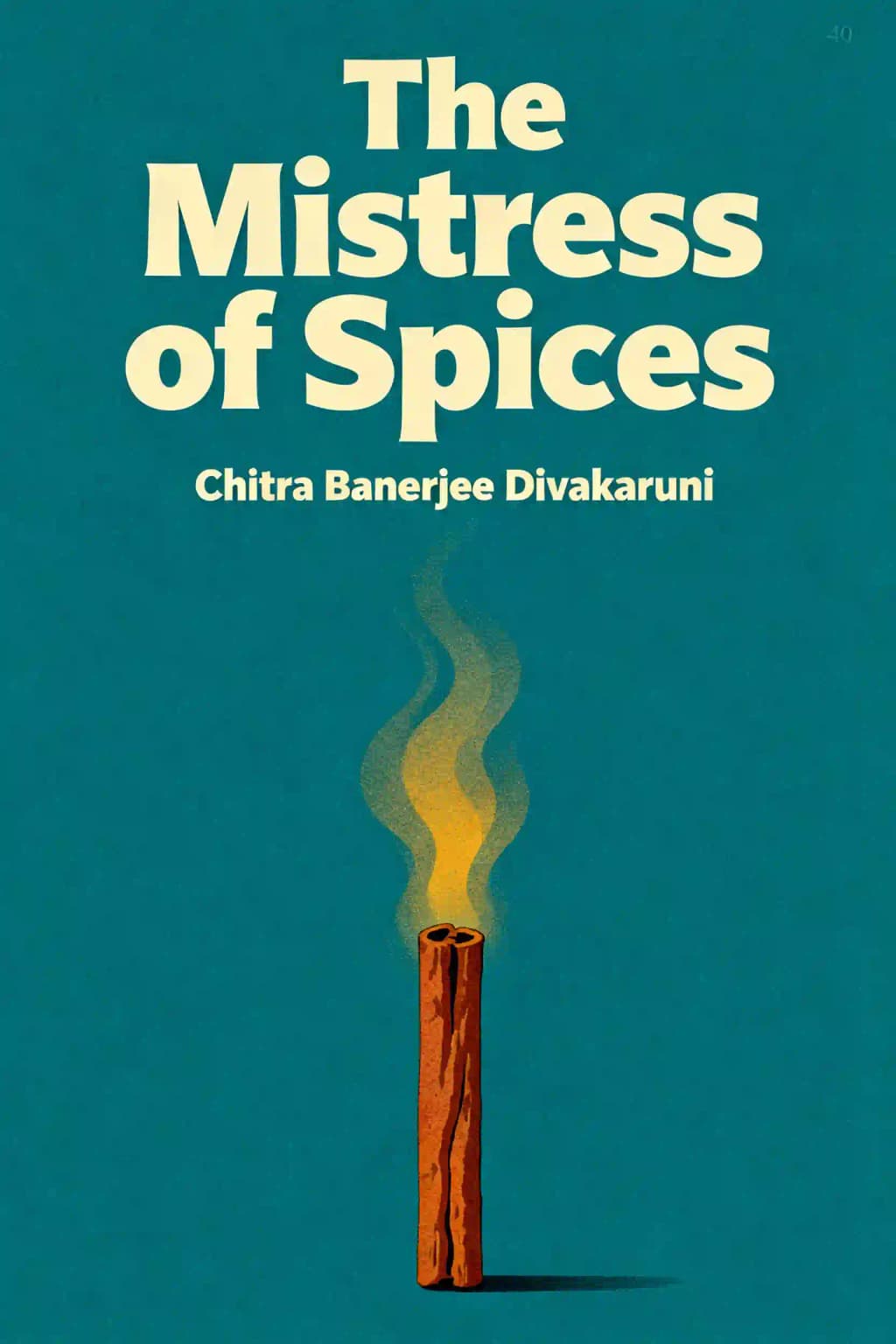
The scent of turmeric and cardamom hangs in the air as you step into the Spice Bazaar, a small Indian grocery store nestled between Rosa's Weekly Hotel and Lee Ying's Repair Shop in Oakland. What appears to be an ordinary ethnic market is actually a portal to ancient magic, presided over by a woman whose true identity remains hidden behind her elderly appearance. Chitra Banerjee Divakaruni's "The Mistress of Spices" takes readers on a sensory journey through the life of Tilo, a powerful sorceress who must choose between duty and desire. This international bestseller, which spent weeks on the San Francisco Chronicle's bestseller list before being adapted into a film starring Aishwarya Rai, explores themes of cultural displacement, forbidden love, and personal transformation. Beloved by celebrities like Oprah Winfrey, who featured it in her book club selections, the novel continues to resonate with readers seeking stories that blend magical realism with profound explorations of identity and belonging in immigrant communities.
Capítulo 2
The Calling and Transformation of Tilo
Born as Nayan Tara, "Star of the Eye," in a remote Indian village, Tilo was an unwanted dark-skinned girl with extraordinary powers. Her ability to find stolen buffalo, sense buried gold, and predict floods brought her fame and transformed her into a proud, willful child who treated her family with disdain. This pride attracted pirates who had heard tales of her powers from merchant sailors. When they raided her village, killing her father and plundering her home, they carried her away as their "Bhagyavati" - Bringer of Luck.
For years, Tilo lived as a pirate queen, carrying the secret guilt of having inadvertently summoned the pirates through what she would later learn was "the calling thought" - a power that can draw whoever you desire. Walking the decks alone at night, she promised herself never to forget the pain she had caused, unaware that "everything is forgotten. Someday."
Her life changed again when, weary of her existence, she summoned a great typhoon, intending to end her life. As she faced the storm's fury, she suddenly realized she wasn't ready to die. The world seemed "sweet, piercingly so." In that moment, sea serpents with mother-of-pearl skin and jeweled crests appeared, offering her a choice - join them as "Sarpa-kanya," snake maiden, or seek the island where an Old One taught the magic of spices. Though the serpents warned against choosing the spices, Tilo felt their call coursing through her veins. The oldest serpent, before disappearing, revealed the way to the island, becoming "the first among all the spices would take from me."
On the island, the Old One examined Tilo's hands - too light, too hot, too damp, freckled "like a golden plover," with palms where "midnight thorn-purple blood-wort would bloom." These "volcano hands, simmering with risk" should have disqualified her, but she possessed a unique quality: in her hands, "the spices sang back." After rigorous training in both mundane tasks and magical arts, Tilo entered Shampati's fire to be reborn as a Mistress of Spices. She awoke in America, transformed into an old woman, with a spice store that would be her new home and prison.
What drives someone to surrender youth, beauty, and freedom for power? Tilo's journey reflects our own struggles with identity and purpose. How many of us have transformed ourselves - perhaps less dramatically - to fulfill a calling or responsibility? Her sacrifice raises questions about the price of power and whether any gift is worth surrendering one's freedom.
Capítulo 3
The Spice Bazaar and Its Visitors
Tilo's store, the Spice Bazaar, appears unremarkable from outside - faded letters, cobwebbed walls, pictures of gods, metal bins of atta and rice, videomovies, and bolts of fabric. Yet it serves as a sanctuary for Oakland's Indian immigrant community. Her customers both love and hate her for understanding "their dangerous self-indulgence, their longing for what they left behind." They fear her when she asks questions revealing knowledge of their troubles but return after dark seeking help from her purest spices.
Each visitor carries unique struggles that Tilo attempts to address through her magical spices. Lalita, Ahuja's wife, comes weekly for the barest staples, always putting back luxuries she desires. Wearing dark glasses to hide bruises from her abusive, alcoholic husband, she longs most for a baby, believing it would "make everything right, even the brutal nights." Tilo slips turmeric wrapped in newspaper into her grocery sack - a healing charm for her bruised cheek and wounded spirit.
Haroun, a Kashmiri refugee who once rowed tourists in a shikara lined with red silk, carries memories of rebels with machine guns killing his father and grandfather. Working as a driver for the haughty Mrs. Kapadia, he maintains "that rueful amusement that says he's only playing at servitude temporarily." When Tilo sees a vision of him slumped against his taxi's steering wheel, "bruised and broken," she prepares kalo jire, "blueblack spice of planet Ketu," to protect him from the evil eye.
Ten-year-old Jagjit in his green turban stands partly behind his mother, fingers touching her dupatta. Mocked at school where bullies try to pull off his turban and laugh at his long hair, he lies awake at night staring at stars that remind him of his grandmother's kheti outside Jullunder. Tilo secretly tucks cinnamon in his turban - "friend-maker, warm-brown as skin" - hoping it will help him find acceptance.
The "bougainvillea girls" float through the store "like dragonflies," with hair "polished as ebony" and painted nails "like purple flowers." They don't truly see Tilo, speaking in "blackbird voices pitched as for the deaf." Though momentarily tempted by anger, Tilo blesses them instead, making them "irresistible" with fenugreek and elach.
These characters represent the diverse experiences of immigrants in America - from domestic abuse to workplace discrimination, from childhood bullying to cultural assimilation. Through their stories, we see how displacement creates unique vulnerabilities and how people seek connection to their homeland through food, spices, and shared cultural understanding. Isn't this why ethnic markets become community hubs in immigrant neighborhoods? They offer not just ingredients but a taste of home and belonging.
Capítulo 4
The Rules and Restrictions of a Mistress
The life of a Mistress of Spices comes with strict rules designed to maintain "the world's frail balance." Tilo must never leave her store, never touch her customers, never use her powers for herself, and never fall in love. She must remain focused solely on helping others through the spices, which have their own wills and personalities.
The Old One taught her apprentices: "You are not important. What matters is the store and the spices." A Mistress serves as a conduit for the spices' magic, "hollow reeds only for the wind's singing." She cannot read futures, as this skill is withheld "to keep us hoping and trusting the spices." She must not look at her reflection, a rule Tilo accepts knowing "how old and unbeautiful" she is.
These restrictions create a prison of duty. Tilo sleeps in the store, spreading her bedding "where the floor dips," surrounded by "flour buckets, oil casks, and salt sacks." Each night, she secures the store with locks, bars, and protective words to keep out "rats, mildew, and the angry boys who prowl the streets." The walls grow dim until invisible to outsiders, creating a magical barrier between her world and America.
The spices themselves enforce these rules, watching Tilo's every move with judgment. When she considers using lotus root and prishniparni to make a man return to her, or abhrak, amlaki and maharadwaj to transform her aged body, she remembers the Old One's warning about her "life-lust" and fear she would "shatter in America." The punishment for disobedience is severe - a Mistress who grows disobedient "tears through the delicate fabric of the balanced world," bringing chaos to all whom she has loved.
These restrictions mirror the constraints many immigrants face - caught between cultures, limited by language barriers or discrimination, sacrificing personal desires for family responsibilities. How many first-generation immigrants have surrendered their own dreams to provide opportunities for their children? How many have felt trapped between old-world values and new-world temptations? Tilo's magical prison symbolizes the very real cultural and psychological constraints that can make adaptation to a new country so challenging.
Capítulo 5
The Lonely American and Forbidden Desire
Tilo's carefully ordered existence unravels when a lonely American enters her store one Friday evening. Unlike other customers, she cannot read his desires through "the silk cloud of his mind." His "expensive black clothes, sharp jawline, and dark eyes with flickering lights" draw her inexplicably. When he touches her hand helping with a bin, "fire-sweet sensation" courses through her. Breaking Mistress rules, she explains spices to him: "coriander for clearing sight, amchur for healing taste buds." After he leaves with "a rhinestone smile promising return," she wanders aimlessly, "poisoned by dissatisfaction."
The American, who later reveals his name is Raven, returns frequently, deepening their connection with each visit. When he sucks blood from her cut finger, his touch sends "waves of desire" through her. He offers his wrist to read his pulse, and she feels them "swaying together like the sea." He places her hand on his chest, confessing "an ache in his heart." Though tempted by lotus root aphrodisiac, she gives him only churan for heartburn, promising "something else" next time.
Their relationship intensifies when Raven invites Tilo to spend a day with him in San Francisco. Despite her misgivings about her aged appearance, she accepts. During their outing, he brings her a beautiful white dress, insisting this body isn't the real her. They tour the city's landmarks before settling at a spot overlooking the Pacific, where Raven shares his past.
He tells of his Native American great-grandfather, a healer who offered him a spiritual inheritance. As a child, Raven stood between his resistant mother and his dying great-grandfather, who showed him visions of healers working with herbs and fire. Just as Raven nearly accepted this ancestral power, symbolized by a raven bird, his mother's fearful intervention broke the moment. The bird disappeared, leaving only a feather that melted into his palm, and his great-grandfather died. This lost opportunity haunted his relationship with his mother and shaped his identity.
Raven's story parallels Tilo's own journey of power and sacrifice. Both were offered magical gifts that required surrendering conventional lives. Raven's interrupted initiation left him searching for meaning and connection, while Tilo's completed transformation trapped her in service to the spices. Their attraction stems partly from this shared understanding of magic's potential and price.
Their relationship represents the forbidden fruit that many immigrants fear - assimilation through romantic love with someone outside their culture. Will loving an American mean losing one's identity? Will crossing cultural boundaries betray one's heritage? These questions haunt Tilo as she finds herself increasingly drawn to Raven despite the spices' disapproval.
Capítulo 6
Breaking Boundaries and Facing Consequences
As her feelings for Raven intensify, Tilo begins breaking the rules that have governed her existence. When Geeta's grandfather asks for help reconciling his granddaughter with her parents over her relationship with a Chicano man named Juan, Tilo agrees to leave her store - her first venture into America. This transgression requires preparation with ginger, "the spice of resolution," to help her move unseen through the streets.
Her first experience of America is intoxicating. In a department store, she becomes "drunk with it - an ordinary old woman feeling fabrics and trying colors against my freckled skin." Her cart overflows with mirrors, a TV, makeup, perfume, shoes, and "wispy American underwear" before shame forces her to abandon most items. She keeps only what she needs for Geeta and, despite inner warnings, a mirror - another forbidden object.
At Geeta's office, Tilo gives her mango pickle infused with methi for healing breaks, ada for courage, and amchur for deciding right. This intervention eventually succeeds, with Geeta's family reconciling, but at a cost. That night, Tilo dreams of the island "floating in dark void," with the Old One warning that when a Mistress grows disobedient, she "tears through the delicate fabric of the balanced world."
Tilo continues breaking rules, visiting Haroun after he's attacked and robbed, using spice magic outside her store, and deepening her relationship with Raven. Each transgression brings warnings from the spices and visitations from the Old One, who cautions: "The help you try to give outside these protected walls turns on itself" and "Don't let America seduce you into calamities you cannot imagine."
The ultimate consequence arrives as a sign of alum giving off "its cold phosphorescent glow" with "the ridged image of a firebird plunging headfirst into flames." Tilo recognizes this as "Shampati's fire calling me back" - she has only three days left before she must return to the island or face destruction. A recalled Mistress who doesn't return willingly "is brought back by force, with Shampati's fire devouring all around her."
Facing this deadline, Tilo makes a desperate choice. She approaches makaradwaj, "king among spices," asking it to make her "beautiful beyond imagination for one night with Raven." Disregarding the Old One's warning to take it slowly over three days, she drinks it all at once, enduring excruciating pain as her body transforms. The spices warn that by tomorrow night she'll reach "beauty's summit" but by morning it will be gone.
In her transformed body, Tilo spends one passionate night with Raven before returning to her store to face Shampati's fire. But when she invokes the fire, nothing happens. In the "profound silence," she realizes the spices' punishment: they've left her in America "without magic, doomed to live as an old woman with no power, no livelihood, no one to turn to." As she accepts this sentence, an earthquake shakes the building apart around her.
Tilo's boundary-breaking journey reflects the immigrant experience of testing cultural limits. How far can one adapt to a new country without losing one's identity? What happens when love pulls against tradition? What price must be paid for assimilation? The consequences she faces - loss of magic, community, and identity - echo the very real fears that keep many immigrants tethered to their cultural roots despite the pull of American freedoms.
Capítulo 7
Transformation and Rebirth
Rescued from the earthquake-destroyed store by Raven, Tilo discovers she has undergone yet another transformation. Her body is neither that of the beautiful woman from the previous night nor the ancient crone she had been as a Mistress. Instead, she finds something "different - neither young nor old, neither beautiful nor ugly. Just ordinary." When she looks in the mirror, she sees "the same rebellious Tilo eyes staring back."
This physical change represents her internal transformation - no longer bound by the spices' rules nor defined by her magical identity, she has become simply human. The earthquake that destroyed her store symbolizes the collapse of her old life and the violent birth of a new one. Like many immigrants who eventually find a middle path between their original culture and American identity, Tilo emerges as someone who carries elements of both worlds but is enslaved by neither.
As Raven drives her toward his "earthly paradise" in the northern wilderness, Tilo looks back at the burning city. "Raven," she whispers. "I made it happen." She cannot leave the suffering behind, telling him, "I cannot go with you," though "every pore of my body cries out for the happiness he promises." She recognizes that "there is no earthly paradise except what we make in the soot and rubble." Raven, surprising her with his understanding, responds: "Then I guess I'll have to come too."
In the novel's final moments, Raven helps Tilo find a new name. "Maya," he suggests, meaning "illusion, spell, enchantment" in Sanskrit. As she accepts this naming, she hears the sea serpents' song again, their "jewel eyes holding my gaze." "I Maya thank you," she whispers as they blink their acceptance before "disappearing into my heart." Hand in hand with Raven, she walks toward their future.
This ending offers a powerful metaphor for successful cultural integration. Tilo/Maya doesn't abandon her heritage or magical past - the sea serpents become part of her heart rather than disappearing entirely. Yet she also embraces a new identity and relationship that would have been impossible within the constraints of her former life. She chooses to engage with America's problems rather than escape them, recognizing that paradise must be created through effort and engagement rather than retreat and isolation.
Capítulo 8
The Symbolic Language of Spices
Throughout the novel, spices serve as characters with distinct personalities and powers. Each spice has its special day, origin story, and magical properties. Turmeric, "the preserver," sits by the entrance, its "subtle, faintly bitter scent as familiar as your own skin." It shields "heart's sorrow" and provides "hope for rebirth." Fenugreek helps those suffering, though "the young scorn fenugreek, thinking they'll never need its healing." Chilies, the most dangerous spice, grow "in the center of the island, in a sleeping volcano's core" and should be used "only as the last remedy."
The spices communicate with Tilo, sometimes supporting and sometimes resisting her actions. When she prepares to leave the store, they fight her - "the slick doorknob, the stubborn hinges" - the store's very muscles "wrestling against mine." When she considers using magic for personal gain, they hum their disapproval. Yet they also teach her the "ways of pleasure" during her night with Raven and ultimately transform her into her final form.
Beyond their magical properties, the spices connect immigrants to their homeland. Customers come seeking "sweets from their childhoods" and ingredients that remind them of what they left behind. The store becomes a sensory link to India, with its "pictures of gods, metal bins of atta and rice," and spices whose scents evoke memories of home.
The spices also represent the wisdom of ancient traditions. Each has been used for centuries for cooking, healing, and ritual purposes. Turmeric has been placed "on newborns' heads for luck" and "sprinkled over coconuts at pujas" for "a thousand years." This historical continuity provides stability amid the disorienting experience of immigration, offering familiar touchstones in an unfamiliar landscape.
Finally, the spices symbolize the power and limitations of cultural knowledge. Tilo's expertise with spices gives her influence in her community but also isolates her. The rules governing their use - like cultural norms governing behavior - both protect and restrict. When Tilo breaks these rules, she faces consequences but also discovers new possibilities beyond tradition's boundaries.
Capítulo 9
The Immigrant Experience in America
Through Tilo's customers and her own observations, Divakaruni creates a nuanced portrait of Indian immigrant life in America. We see the struggles of Jagjit, whose Sikh turban makes him a target for bullies, and the domestic violence Lalita suffers at the hands of her husband Ahuja. We witness Haroun's determination to succeed despite the trauma of fleeing Kashmir and Geeta's conflict with her family over her relationship with a non-Indian man.
The novel doesn't shy away from depicting racism and violence against immigrants. When Tilo reads a newspaper with the headline "DOTBUSTERS GO FREE" and a picture of "two smiling white teenagers," she has a vision of a young Indian man named Mohan who was brutally attacked while closing his food cart. Searching through old papers, she discovers many similar stories - "vandalized stores, poisoned pets, assaulted women, and burned motels." These incidents reflect real-world hate crimes against South Asian Americans, particularly following waves of immigration in the 1980s and 1990s.
Yet the novel also shows the resilience and adaptation of immigrants. Hameeda studies English and dreams of learning computers while raising her daughter Latifa "in a country where no one will call her 'bad luck girl child.'" Kwesi, though not Indian, represents successful integration - transforming from a drug addict to a martial arts instructor who appreciates Indian culture enough to learn cooking. Even Geeta, despite family conflict, finds a way to honor both her heritage and her American identity.
The spice store itself represents a "third space" where immigrants can be fully themselves - neither entirely Indian nor entirely American. Here, they speak their native languages, find familiar foods, and receive understanding from someone who knows both worlds. Tilo observes that her customers "both love and hate me for understanding their dangerous self-indulgence, their longing for what they left behind." This ambivalence reflects the complex emotions many immigrants feel toward cultural brokers who remind them simultaneously of what they've lost and what they're trying to preserve.
Capítulo 10
Finding Balance Between Duty and Desire
At its heart, "The Mistress of Spices" explores the tension between obligation to others and fulfillment of personal desires. As a Mistress, Tilo has surrendered her youth, beauty, and freedom to serve her community. The Old One taught her: "You are not important. What matters is the store and the spices." This selfless dedication parallels the sacrifices many immigrants make for their families and communities.
Yet Tilo increasingly questions whether complete self-abnegation is necessary or even beneficial. When she breaks rules to help Geeta's family reconcile or to save Haroun from danger, her interventions succeed despite the spices' warnings. When she falls in love with Raven, this forbidden relationship doesn't diminish her powers but rather deepens her understanding of human needs and desires.
The novel suggests that rigid adherence to tradition can become its own form of imprisonment. The Old One, despite her power, lives in isolation on a remote island, training girls to perpetuate a system that denies them full humanity. When Tilo asks what happens if a Mistress wants her life back, the Old One disappears without answering - suggesting there is no acceptable path to personal fulfillment within the system.
Tilo's final transformation offers a middle way. By becoming Maya - neither the all-powerful Mistress nor the helpless old woman - she finds a balance between service and self-fulfillment. She chooses to remain in the city to help others rather than escaping to Raven's "earthly paradise," but she does so as a woman in love rather than an isolated magical being. Her new name, meaning "illusion" or "enchantment," suggests she retains some connection to magic while embracing human reality.
This resolution speaks to the immigrant experience of finding balance between heritage and adaptation. Total rejection of one's culture leads to rootlessness, while rigid adherence to tradition prevents growth and connection. The healthiest path, Divakaruni suggests, involves honoring one's origins while opening oneself to new possibilities - creating an identity that draws strength from both worlds without being limited by either.