Capítulo 1
The Algorithm That Rules Our World
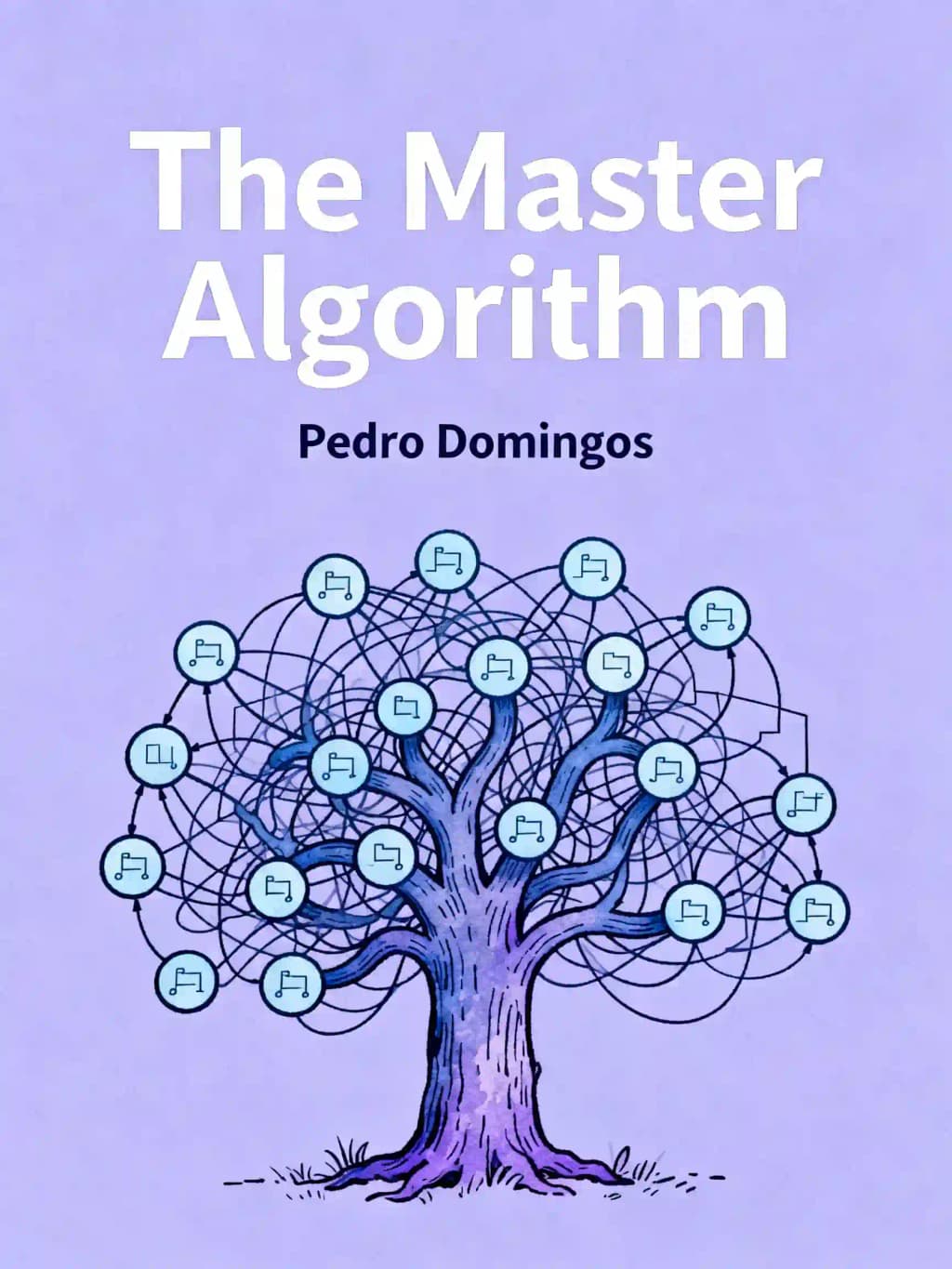
Ever wonder why Netflix seems to know exactly what you want to watch next? Or how your smartphone recognizes your face even in poor lighting? Behind these seemingly magical abilities lies a profound technological revolution that's reshaping our world: machine learning. Pedro Domingos' "The Master Algorithm" pulls back the curtain on this transformation, revealing how algorithms that learn from data are silently orchestrating much of modern life. The book has garnered praise from tech luminaries like Elon Musk, who called it "essential reading for anyone interested in the future," and Bill Gates, who noted it "explains complex concepts in clear, non-technical language." Published in 2015 amid growing public awareness of AI's influence, this book arrived at a pivotal moment when machine learning began transitioning from specialized technology to mainstream force. What makes this exploration particularly valuable is Domingos' unique position as both pioneer and synthesizer-he's spent decades working to unify the field's competing approaches into a cohesive whole.
Capítulo 2
The Silent Revolution Transforming Our Lives
Machine learning has quietly infiltrated nearly every aspect of our daily existence. Unlike traditional algorithms that follow explicit instructions, learning algorithms figure things out independently. When you search online, filter spam, shop on Amazon, or browse Netflix, these algorithms are working behind the scenes, making inferences from data to serve you better.
From the moment you wake up until you fall asleep, machine learning touches everything-your music recommendations, home temperature, car's fuel efficiency, email organization, credit card security, and even medicine. It helps police predict crime, doctors diagnose illness, and businesses understand customers.
What makes this technology revolutionary is that it builds itself. Learning algorithms are artifacts that design other artifacts, turning data into customized programs like master craftsmen. With enough information, they can make predictions about almost anything between the completely obvious and the truly unpredictable.
This represents a fundamental shift in how we create technology. Traditional programming requires humans to specify every step of a process, but machine learning inverts this relationship. Instead of inputting data into algorithms to get results, we input data and desired results to get algorithms. The learners create other algorithms automatically, writing programs so humans don't have to.
This approach resembles farming more than factory production-we plant algorithm seeds in data soil and harvest grown programs. Experts act as farmers nurturing the process rather than dictating every step. The true power lies in how computers can learn programs humans can't explicitly write, like driving cars or deciphering handwriting.
Companies inevitably turn to machine learning when they have too much data and complexity for programmers to handle manually. Amazon can't encode all customer tastes in a program, and Walmart makes billions of choices daily. Learning algorithms become essential matchmakers, finding producers and consumers amid information overload.
The progression from computers to internet to machine learning was inevitable-computers enable the internet, which creates data floods and limitless choice problems that machine learning solves. This concentrates power in algorithms: Google determines what information you find, Amazon what you buy. Companies with the most customers gather the most data, learn the best models, and attract more customers in a virtuous cycle.
Every business aspect can be improved through machine learning. Data becomes the strategic asset, and companies without machine learning simply can't compete with those using it-it's "spears against machine guns." While experts might write a thousand rules to predict customer preferences, algorithms learn billions of personalized rules.
Capítulo 3
The Master Algorithm: One Learning System to Rule Them All
The most astonishing aspect of machine learning is that the same algorithms can solve wildly different problems. While traditional programming requires separate code for each application, machine learning algorithms can tackle diverse challenges when given appropriate training data. A few core algorithms power most applications, from medical diagnosis to spam filtering, handwriting recognition to chess.
These algorithms are remarkably simple compared to the complex programs they replace-often just a few hundred lines of code versus millions. This raises a profound question: Could a single algorithm learn everything learnable from data? Domingos believes such a "Master Algorithm" exists-one that could take any data and assumptions as input and derive all knowledge implicit within them.
Several compelling arguments support this possibility. Neuroscience shows that the brain uses the same learning mechanism throughout the cortex-six-layered columns with similar wiring patterns where neurons fire in patterns, with connections strengthened when neurons fire together. The genome's relative simplicity compared to brain complexity suggests a universal algorithm rather than hardwired specialized functions.
Evolution provides another argument-life's infinite variety stems from a single mechanism: natural selection. Computer scientists recognize this as iterative search-trying candidate solutions, selecting and modifying the best ones, and repeating. If evolution could learn to create humans, it could conceivably learn anything, given sufficient computational power.
Physics offers further evidence through "the unreasonable effectiveness of mathematics in the natural sciences"-how laws induced from limited observations apply far beyond them with astonishing precision. If our complex world emerges from simple laws, then a single algorithm could induce all that can be induced.
According to Bayesians, their theorem is the engine that drives all learning-a simple formula that updates beliefs based on new evidence. With big data and modern computing, Bayesian methods can navigate vast hypothesis spaces, and we haven't yet discovered any limit to what they can learn.
Computer science provides another argument through NP-completeness, which reveals a profound unity among seemingly unrelated problems-from protein folding to theorem proving. These problems are mathematically equivalent, suggesting one algorithm could learn to solve them all.
The existence of computers themselves supports the Master Algorithm concept. Before Turing's universal machine, the idea that one device could solve problems across all domains seemed impossible. Just as the Turing machine is universal for deduction, the Master Algorithm would be universal for induction-able to learn any other algorithm by observing its input-output behavior.
Capítulo 4
The Five Tribes of Machine Learning
The journey toward the Master Algorithm requires understanding five distinct approaches to machine learning, each with its own philosophy, techniques, and unique contributions to artificial intelligence:
Symbolists approach machine learning through the lens of logic and reasoning. They believe intelligence emerges from symbol manipulation, similar to how mathematicians solve equations or how humans use language. Their master algorithm is inverse deduction, which works backwards to identify missing knowledge needed to complete logical chains. For example, a symbolist system might learn chess by breaking down winning strategies into logical rules and combinations. This approach excels at transparent reasoning and can explain its decisions clearly - crucial for applications like medical diagnosis or legal reasoning. However, symbolists struggle with uncertainty and messy real-world data where rules aren't clearly defined.
Connectionists draw inspiration from the human brain's architecture, focusing on networks of interconnected artificial neurons. Their master algorithm is backpropagation, which systematically adjusts connection strengths between neurons to reduce errors in the network's outputs. Modern deep learning networks, which power technologies like facial recognition and language translation, exemplify this approach. A convolutional neural network, for instance, can learn to recognize cats by automatically discovering features like whiskers, pointed ears, and fur patterns through millions of adjustments to its connections. While incredibly powerful at pattern recognition, these systems often operate as black boxes, making their decision-making process opaque and difficult to audit.
Evolutionaries take their cues from natural selection and genetic evolution. Instead of just tweaking parameters, they focus on evolving entire program structures through processes mimicking biological evolution. Their master algorithm is genetic programming, which creates populations of potential solutions that compete, mate, and mutate over generations. This approach has produced novel solutions in fields like antenna design, where evolved designs outperformed human engineers. However, the computational resources required can be enormous, as thousands of potential solutions must be evaluated over many generations.
Bayesians frame learning as probabilistic inference, continuously updating beliefs based on new evidence. They use Bayes' theorem to calculate how likely different hypotheses are given observed data. This approach excels in medical diagnosis, where symptoms might indicate multiple possible conditions with different probabilities. Bayesian systems can naturally handle uncertainty and incorporate prior knowledge, but complex models with many variables can become computationally intractable.
Analogizers learn by finding similarities between past and present situations. Their master algorithm, the support vector machine, determines which experiences to remember and how to combine them for predictions. This approach powers recommendation systems that suggest products based on similar users' preferences and spam filters that identify suspicious emails by comparing them to known patterns. While effective for classification and similarity-based tasks, analogizers may struggle with abstract concepts that can't be easily reduced to similarity measurements.
The integration of these five approaches is crucial because real-world problems often require multiple capabilities. Consider autonomous driving: it needs symbolists' rule-based reasoning for traffic laws, connectionists' pattern recognition for object detection, evolutionaries' adaptation to new situations, Bayesians' handling of uncertainty in sensor data, and analogizers' ability to recognize similar driving scenarios. The true Master Algorithm must combine these strengths while minimizing their individual weaknesses.
Capítulo 5
The Fundamental Challenge: Learning from Limited Data
At the heart of machine learning lies a philosophical problem posed by David Hume in the 18th century: how can we justifiably generalize from observed cases to unobserved ones? This represents the core challenge of induction and learning. For instance, just because we've seen thousands of white swans doesn't logically prove that all swans are white - a challenge that goes to the heart of scientific reasoning and machine learning alike.
Even with massive datasets containing millions of examples, we've essentially seen nothing compared to all possible combinations of features. Consider image recognition: a 1000x1000 pixel image with just binary colors has 21,000,000 possible configurations - far more than all images ever processed by all machine learning systems combined. Without generalization, learning becomes impossible, yet Hume's problem suggests there's no logically sound way to choose among competing generalizations that fit past data but make different predictions.
The "no free lunch" theorem, formalized by David Wolpert, sets a theoretical limit on how good a learner can be-no better than random guessing across all possible problems. For every scenario where an algorithm performs well, there exists another where it performs equally poorly. Take a simple example: an algorithm perfectly tuned to recognize cats will necessarily perform worse on non-cat images, illustrating the fundamental trade-off in optimization.
However, this doesn't doom machine learning because we only care about our specific world, not all possible worlds. The physical universe follows consistent laws and patterns that we can leverage. By incorporating knowledge about our world into algorithms - like the fact that nearby pixels in images tend to have similar colors, or that physical processes are usually continuous - we can overcome random guessing. Machine learning requires knowledge to prime the pump-data alone isn't enough. As Tom Mitchell says, bias-free learning is futile; preconceived notions are indispensable to learning.
Newton's Principle forms the foundation of modern machine learning: "Whatever is true of everything we've seen is true of everything in the universe." This powerful knowledge pump allows us to induce widely applicable rules, reducing their scope only when data forces us to. For example, we might start with the assumption that all objects fall at the same rate, only later refining this to account for air resistance.
The central challenge becomes avoiding overfitting-finding patterns that aren't actually true in the real world. A classic example is a model that perfectly memorizes training data but fails to generalize to new cases. Learners walk a narrow path between blindness (missing real patterns) and hallucination (seeing false ones). With exponentially growing hypothesis spaces, learning becomes a race between data quantity and hypothesis complexity. Modern deep learning models with billions of parameters exemplify this challenge, requiring massive datasets and careful regularization to avoid finding spurious patterns.
This fundamental tension between generalization and memorization underlies many practical challenges in machine learning, from choosing model architectures to determining optimal training times. Success requires carefully balancing prior knowledge with empirical evidence, while remaining humble about the limitations of both.
Capítulo 6
Beyond Supervised Learning: How Machines Discover Patterns
While supervised learning dominates many applications through its use of labeled examples, unsupervised learning represents a crucial frontier in artificial intelligence. Children learn primarily by observation and exploration, not from explicit instruction, and machines must develop similar capabilities to achieve more general intelligence. This mirrors how humans naturally acquire knowledge - babies learn to recognize faces and objects long before they can name them.
Clustering algorithms organize data into natural groupings without being told what those groups should be, similar to how a child learns to sort toys by type, color, or size through pure observation. The k-means algorithm tackles this challenge by iteratively assigning objects to the nearest prototype and updating those prototypes. While effective for spherical clusters, it struggles with irregularly shaped clusters. More sophisticated approaches like DBSCAN handle arbitrary shapes by focusing on density, identifying clusters as dense regions separated by sparse areas - much like how cities naturally form dense neighborhoods separated by less populated areas.
Dimensionality reduction complements clustering by finding ways to represent high-dimensional data with fewer variables, making patterns more apparent and computation more tractable. Principal component analysis works by finding the directions of greatest variation in data - like discovering that shops in a city mostly line up along main streets, reducing two-dimensional coordinates to a single dimension. Modern techniques like t-SNE and UMAP preserve local structure better, enabling visualization of complex datasets while maintaining meaningful relationships between points.
Reinforcement learning addresses how systems actively interact with their environment, representing a fundamental shift from passive observation to active experimentation. Instead of simply processing examples, it uses rewards and punishments to guide behavior - much like humans seek pleasure and avoid pain. The key insight is that not all states have immediate rewards, but every state has a value based on future potential rewards. This enables sophisticated decision-making, like a chess algorithm sacrificing a piece for positional advantage or a robot learning to balance by making continuous adjustments.
Relational learning enables algorithms to model interconnected networks rather than isolated examples, crucial for understanding real-world systems where context matters. By tying together weights across similar relationships, algorithms can generalize from a single network despite having only one data point per relationship. The real power emerges when relational learners turn sparse supervision into comprehensive knowledge by propagating information through networks - diagnosing a few people with flu allows inference about their friends and contacts, enabling epidemic prediction. This approach has revolutionized applications from social network analysis to drug discovery, where understanding molecular interactions is key.
These learning paradigms increasingly combine in hybrid systems that better mirror human learning, incorporating multiple forms of learning and reasoning. For instance, modern recommendation systems might use supervised learning for explicit ratings, clustering for user segments, and relational learning for social influences, creating more nuanced and effective predictions.
Capítulo 7
Markov Logic Networks: Toward the Master Algorithm
In 2003, Domingos made a breakthrough in machine learning by realizing we could unify logic and probability through Markov networks rather than Bayesian networks. The key insight was that any logical formula could serve as a template for Markov network features, effectively bridging the gap between symbolic and statistical AI that had existed for decades.
A Markov logic network (MLN) is a sophisticated set of weighted logical formulas that, when applied to entities, defines a Markov network over their possible states. For example, formulas like "Everyone has the flu" might have a low weight (reflecting its rarity), while "If someone has the flu, so do their friends" might have a higher weight (reflecting common transmission patterns). These create probabilistic patterns rather than strict logical rules, allowing for uncertainty and exceptions. When weights approach infinity, MLNs behave like classical logic systems with absolute rules; with simpler formulas and finite weights, they function as standard Markov networks, demonstrating their versatility as a unified framework.
Learning an MLN involves two critical processes: discovering formulas that are true in the world more often than random chance would predict, and determining their precise weights. This is accomplished through sophisticated structure learning algorithms that search the space of possible formulas, combined with weight learning methods that optimize the probability of the observed data. The resulting models can represent incredibly complex systems, from cellular biology for cancer diagnosis to social network dynamics and protein interaction networks.
Domingos' universal learner, Alchemy, represents a significant advancement in machine learning by handling all five types of unsupervised learning within a single framework. For reinforcement learning, it innovatively wraps delayed rewards around its core and learns state values through temporal difference learning. It performs chunking by condensing lengthy chains of rules into more efficient single rules, similar to how humans develop expertise. Clustering emerges naturally when an MLN has a single unobserved variable connected to all observable ones, while MLNs with multiple unobserved variables perform dimensionality reduction by capturing latent structure in the data.
Despite these impressive capabilities, Alchemy faces important practical challenges: it struggles to scale efficiently to truly big data sets and requires considerable expertise to use effectively. However, two key properties of real-world systems help make inference more tractable: hierarchical structure and entity classification. The world exhibits clear hierarchical organization, with most interactions occurring between subparts of the same larger system - for example, atoms primarily interact within molecules, and molecules within cells. Additionally, entities naturally fall into classes and subclasses (like species in biology or product categories in retail), allowing the system to make powerful generalizations and reduce computational complexity by treating similar entities similarly.
The future development of MLNs focuses on improving scalability through better inference algorithms and developing more intuitive interfaces for non-experts. Researchers are also exploring ways to incorporate deep learning architectures within the MLN framework, potentially combining the best of both approaches.
Capítulo 8
Living in a World Shaped by Learning Algorithms
Your digital future begins with a crucial realization: every interaction with a computer happens on two levels. First, you get what you immediately want-an answer, product, or service. Second, and more importantly long-term, you teach the computer about yourself. The more you teach it, the better it can serve-or manipulate-you.
Life becomes a game between you and the learners surrounding you. You can refuse to play and live a twentieth-century life in the twenty-first, or you can play to win by considering: What model of you do you want the computer to have? What data can you provide to produce that model?
Imagine if all your digital data-emails, documents, searches, purchases, health records, location data, photos-were compiled and analyzed by the Master Algorithm. The resulting model would be like a digital mirror reflecting not just your appearance but everything observable about you. This digital twin could become a powerful tool for introspection and could negotiate the world on your behalf-suggesting books, filtering communications, handling life's administrative annoyances, finding remedies for ailments, identifying job opportunities, and much more.
In the near future, everyone will have a digital half, and these models will constantly interact. Job hunting will involve your model interviewing with thousands of companies in seconds. Dating will mean your model pre-screening millions of potential matches before you meet the most promising candidates in person. Your digital half will function like power steering for your life-going where you want but with less effort from you.
As automation advances through machine learning, the nature of work will transform. Jobs requiring broader context and common sense are safer than narrowly defined tasks. Surprisingly, white-collar jobs like credit analysis have proven easier to automate than physical labor like construction, because evaluating applications is more straightforward than navigating complex environments.
The best defense against automation is to automate your own job first, freeing yourself to focus on aspects machines can't handle. Rather than competing with algorithms, harness them as extensions of your senses and brain. The most successful professionals are becoming "centaurs"-human-machine hybrids combining the strengths of both, like chess players using computer assistance.
Capítulo 9
The Future of Intelligence and Evolution
I.J. Good and later Vernor Vinge proposed that once machines surpass human intelligence, they could design even smarter machines, creating an "intelligence explosion" or "Singularity" that Ray Kurzweil predicts will arrive within decades. While machine learning is essential for this transition, a true mathematical singularity is unlikely.
Kurzweil's error lies in mistaking S-curves for exponentials. Technology improvement follows S-curves that flatten as they approach natural limits, not exponentials that grow indefinitely. Moore's law is already slowing, and his claim that evolution shows exponentially accelerating progress suffers from parallax bias-things closer to us appear to move faster.
Rather than a singularity, we're approaching a phase transition with the Turing point as its critical point-when machine learning overtakes natural learning. Natural learning evolved through three phases (evolution, brain, culture), and machine learning is the logical next stage. As humans coevolve with our creations, we'll eventually design cells with computers, fight disease with downloadable immune updates, and evolve into myriad different intelligent species.
Despite Hollywood's apocalyptic visions of AI takeover, there's little reason to fear the Master Algorithm will turn against humanity. Computers fundamentally lack autonomous will-they're engineered products with components that follow our instructions. The real problem isn't superintelligent machines but rather that relatively simple algorithms have already taken over critical decision-making processes without sufficient oversight.
The cure for cancer will likely be a program-call it CanceRx-that inputs a cancer's genome and outputs the drug to kill it. This massive program would combine knowledge of molecular biology with vast amounts of data in an MLN-like model that knows every pathway and reaction in human cells. It would instantiate its model with both a patient's normal cells and tumor cells, then test available drugs until finding one that kills the cancer without harming healthy tissue.
This system wouldn't emerge from simply feeding data into the Master Algorithm. Rather, it would result from worldwide collaboration among biologists, oncologists, and data scientists, incorporating data from millions of cancer patients. Machine learning would be the linchpin, assembling fragmentary knowledge into a coherent whole and finding patterns across different cancers.