Capítulo 1
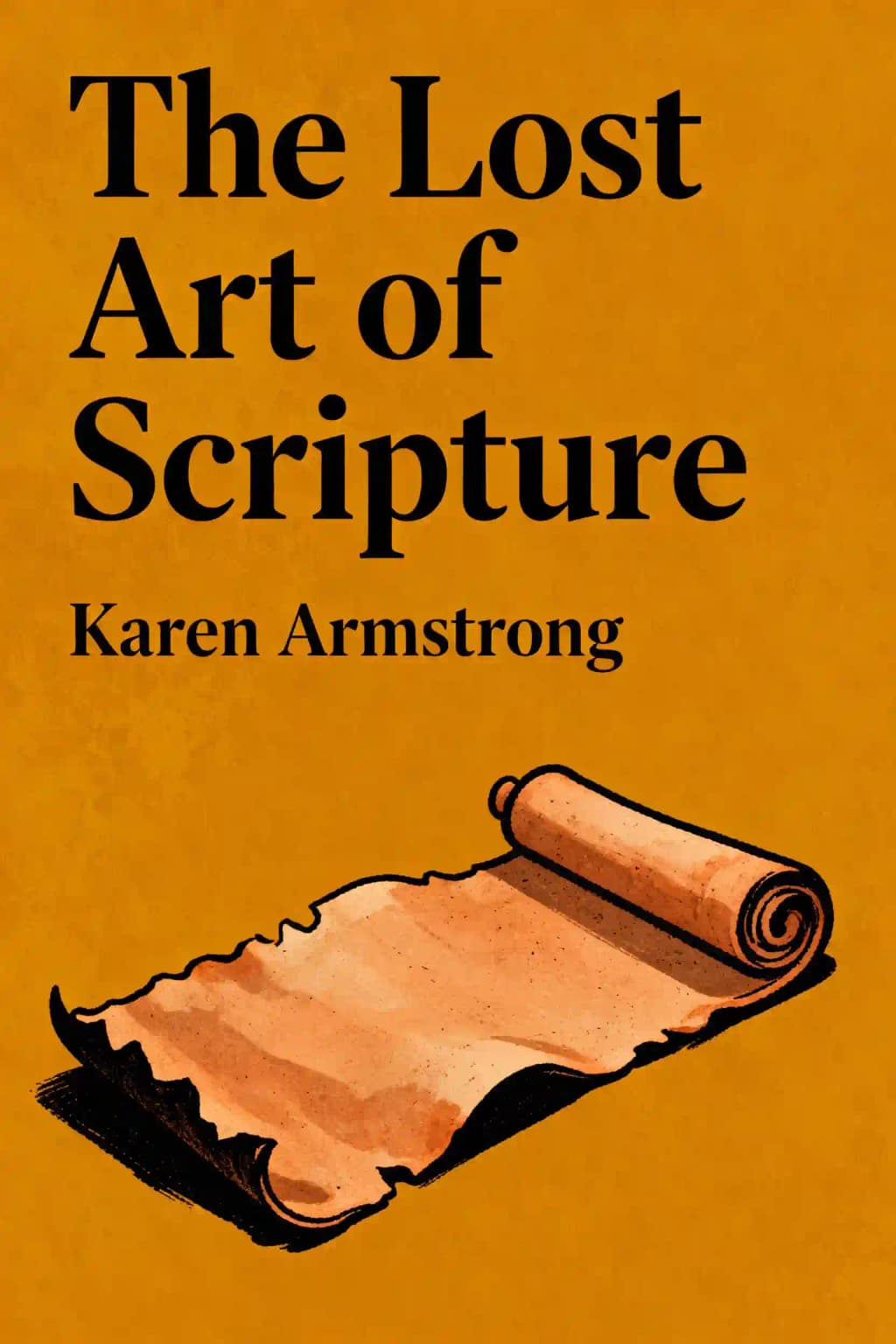
When Sacred Texts Transcend Words: The Lost Art of Scripture
In an era where religious texts are often wielded as weapons in culture wars or dismissed as outdated relics, Karen Armstrong's "The Lost Art of Scripture" arrives as a profound revelation. This groundbreaking work, beloved by spiritual seekers across traditions and praised by figures from the Dalai Lama to Elaine Pagels, challenges our modern misconception of sacred texts as mere repositories of doctrine or historical facts. Armstrong, with her characteristic depth and accessibility, reveals how scripture was originally intended as something far more dynamic-a transformative practice to be experienced through the body, emotions, and community rather than just the analytical mind. The book has struck a chord in our polarized times, becoming a surprise bestseller by offering a path beyond the false choice between rigid fundamentalism and dismissive secularism.
Capítulo 2
The Original Purpose of Sacred Texts
For millennia, humans have engaged with the transcendent through imagination and art. The 40,000-year-old Lion Man figurine from Germany's Hohlenstein-Stadel cave represents our unique capacity to envision what does not exist-the essence of human imagination that drives achievements in both science and religion. Modern neuroscience confirms that we never directly contact reality but only mental representations filtered through our nervous systems. From prehistoric cave paintings to hybrid divine figures, art and religion have been inseparable means of making sense of existence.
Our brain's hemispheres process reality differently-the left excels at language, analysis and problem-solving, while the right perceives holistically, seeing interconnections and unity. Modern education increasingly privileges scientific endeavors favoring left-brain thinking, but we need both hemispheres to function creatively. Throughout history, scripture served as a bridge between these modes of knowing, engaging both analytical understanding and intuitive wisdom.
The original purpose of scripture across traditions was never to provide a set of propositions to be intellectually accepted. Rather, sacred texts were meant to be performed, chanted, embodied, and lived. They were tools for transformation rather than information, designed to shift consciousness from everyday pragmatic thinking to a more expansive awareness of interconnection and meaning. When we reduce scripture to mere words on a page, we miss its essential nature as a multisensory, communal experience that engaged the whole person.
Armstrong demonstrates that across cultures-from ancient Israel to India, China to Arabia-scripture was originally experienced as sound, rhythm, and ritual movement. The Vedas were memorized and chanted with perfect precision; the Quran literally means "recitation"; Buddhist sutras were meant to be internalized through meditation; and Hebrew texts were brought to life through communal performance. These weren't merely aesthetic enhancements but the very essence of how scripture functioned.
Capítulo 3
Memory as Sacred Technology
In ancient Israel, scripture emerged as a technology of cultural memory. The Fall of Adam and Eve, one of the Hebrew Bible's most famous stories, draws on Mesopotamian Wisdom traditions where the serpent (described as arum-wise or shrewd) uses terminology from Sumerian wisdom literature when promising Eve divine-like awareness. This demonstrates that sacred texts don't fall directly from heaven but are human artifacts rooted in shared cultural understandings.
The covenant theme dominating Hebrew scripture reflected a widespread Middle Eastern concern with sacred contracts. Similarly, Egyptian scribes created educational curricula emphasizing "Maat" (truth, fairness, justice) that required following what we now call the Golden Rule. Ancient societies traced ideal norms to distant past figures not from nostalgia but as models for present action. The past became a "realisable present"-a project for each generation to achieve again.
Scribal education was rigorous and family-based. Students memorized core texts, proverbs, hymns, treaties and creation stories. Though written down, these texts were primarily memorized and recited, with manuscripts serving as reference points rather than primary reading materials. The scribes literally had "libraries in their heads," preserving cultural tradition through verbatim recitation. Yet this system didn't always stifle creativity. Exceptional scribes could transform and adapt ancient traditions, inserting new material to address current concerns. Scripture was essentially a work in progress, constantly evolving to meet new conditions.
When Jerusalem was destroyed in 586 BCE and its elite deported to Babylon, the exiles transformed ritual memory into mythos by liberating it from the past and bringing it into the present. Without their temple, they found new ways to experience divine intimacy through detailed bodily practices and prohibitions. The Priestly traditions in Leviticus and Numbers presented Yahweh not as confined to the temple but as a god on the move whose "glory" accompanies the people. This transformation created such a strong sense of divine presence that many eventually felt no need to return to Jerusalem.
Capítulo 4
Sound and Silence: India's Scriptural Tradition
Around 1500 BCE, Aryan pastoralists settling in the Punjab began compiling the Rig Veda ("Knowledge in Verse"), hymns originally revealed to seven rishis (seers) and transmitted orally with perfect accuracy. For these Aryans, sound itself was sacred-more important than meaning-and proper recitation connected them to divine presence.
Unlike our modern notion of scripture as fixed text, the Rig Veda was "a peculiar kind of canon... endlessly re-envisaged, and eternally unchanged." Even after writing arrived in India around 700 BCE, it was considered polluting and inappropriate for sacred texts. As one late-Vedic text declared, a student should not recite Veda after "eating meat, seeing blood, having intercourse, or engaging in writing."
For the Aryans, devas weren't remote gods but "shining" manifestations of transcendent power within the natural world. They understood the cosmos as governed by rta, the universal rhythm that pulled potentially warring elements together. The rishis somehow "saw" the ineffable in verbal form. Speech (Vac) was presented as the transcendent reality encompassing all devas and earthly things: "I move with the Rudras, with the Vasus... I spread out over all creatures and touch the very sky."
By the tenth century BCE, the Aryans refined their concept of supreme reality, now calling it the Brahman-the energy pervading the universe that enables all things to grow and thrive. Sacrificial rites often concluded with a brahmodya, a ritualized competition where poet-priests challenged each other to define the ineffable Brahman through verbal formulas. The contest continued until someone asked a question reducing everyone to silence. The victor won not through brilliance but by tipping participants into apprehension of the ineffable.
One late Rig Veda hymn presents such a brahmodya, asking how order emerged from primordial void: "Who really knows? Who will here proclaim it? Whence was this creation?" The rishi ultimately falls silent, admitting even the devas couldn't answer. The Aryans had learned that all religious language must eventually yield to silence-the true expression of awe and unknowing.
Capítulo 5
The Primacy of Ritual in Chinese Tradition
Unlike India's emphasis on sound, early Chinese civilization centered on ritual performance as the primary vehicle for scripture. The Zhou conquest of the Shang dynasty around 1050 BCE was annually reenacted in the Temple of Ancestors through ritual "hosting" (bin) of ancestors. Sixty-four dancers in dragon-embroidered tunics performed with the king who took the role of King Wu. Accompanied by blind musicians singing odes from the Shijing ("Classic of Odes"), they enacted the departure of the army, defeat of the Shang, and establishment of Zhou rule.
These performances challenged participants to remember that justice and peace were Heaven's requirements. Unlike modern poetry read in solitude, these odes were collective enterprises expressing community values through music and movement. The character shi ("ode") originally combined symbols for hand and foot (representing dance), later adding symbols for mouth and speech as words gained importance.
Music was fundamental to scripture's impact, creating physical responses that coordinated emotions and bonded participants. Through precise ritual gestures, participants achieved a form of kenosis (self-emptying) that revealed their sacred potential. By the eighth century BCE, the Chinese relied less on gods and more on morally correct actions aligned with Heaven (Tian), which operated almost like natural law.
The newly codified rites emphasized moderation and restraint, replacing the extravagant lifestyle of earlier times. Every detail of court life became strictly regulated-a stylized performance transforming everyday life into art. A junzi (aristocrat) had to know precisely where to stand, what to say, and how to say it. Modern science confirms what the Chinese intuited: bodily movements help constitute thought, not merely reflect it. The physical disciplines of li strove to recreate social order amid Zhou decline while cultivating yielding (rang).
Capítulo 6
Empathy as Scripture's Core Teaching
Confucius's disciples studied the Classics-Documents, Odes, Rites and Music-but this textual study was inseparable from constant practice of kindness and consideration toward others. Learning was fundamentally communal, with Confucius explaining: "In order to establish oneself, one should try to establish others. In order to enlarge oneself, one should try to enlarge others."
The core of Confucian teaching was ren, a concept Confucius refused to define because its meaning couldn't be contained within familiar categories. When Yan Hui asked how to acquire ren, Confucius replied: "Keji fuli"-"Curb your ego and surrender to li." The ritualized gestures of li would enable the junzi to cultivate the habit of yielding to others, developing an interior attitude of reverence through physical discipline.
Confucius articulated the Golden Rule in a pithy formula: "Do not impose on others what you yourself do not desire," explaining that "reciprocity" (shu) was the one word that could guide one's entire life. This altruism must become habitual, performed "all day and every day." The Analects cultivated a healthy suspicion of definitions and absolute truths, with Confucius rarely answering questions directly but offering different responses to different disciples.
This emphasis on empathy extended beyond China. The Buddha developed "the immeasurables," cultivating love and directing it to all beings until achieving equanimity. His insight became the Four Noble Truths, with the distinctive fourth truth offering the Noble Eightfold Path as escape from suffering. This path integrated morality (sila), meditation (samadhi), and wisdom (prana).
Capítulo 7
Embracing Unknowing: Scripture's Wisdom Beyond Words
The Mahabharata, India's massive epic, depicts a world where royal assassination is commonplace and dharma has collapsed. Unlike conventional scripture, it offers no easy answers or neat doctrines, instead presenting unresolvable contradictions and bringing both heroes and audience to despair. The epic forces readers to confront suffering without heroics, depicting death as squalid and degrading. Its central message emerges through wise counselors who advise against despair: suffering is inevitable and must be accepted with equanimity.
Similarly, early Daoists sought escape from violence by fleeing to nature, but later realized that suffering exists everywhere. The Daodejing forces readers to confront the limits of understanding through paradoxes where inaction surpasses action, ignorance exceeds knowledge, and emptiness trumps fullness. Laozi teaches that selfhood causes suffering: "The reason there is great affliction, is that I have a self. If I have no self, what affliction would I have?"
Zhuangzi discovered that abandoning self-assertion was key. Unlike the Yangists who tried to preserve the self, Zhuangzi found that seeing from the Dao's perspective meant relinquishing the ego. He achieved this not through yogic introspection but by observing humble artisans who, completely absorbed in their physical work, effortlessly achieved ekstasis-a self-forgetfulness allowing communion with the Way.
This embrace of unknowing appears across traditions. The Mahayana Buddhist tradition never sought to establish a unified doctrine but embraced diversity as a virtue. Its scriptures don't aim to find Buddhism's "essential" truth, rejecting essentialism as a fallacy that impedes understanding reality. The vast Prajnaparamita ("Perfection of Wisdom") anthology explores "emptiness"-the realization that all categories essential to ordinary experience lack solid foundation. This isn't nihilistic but opens practitioners to new perceptions, described as "the metaphysics of vision and dream" where rigid categories dissolve into flowing possibility.
Capítulo 8
Creative Interpretation: Midrash and Beyond
After Jerusalem's fall in 70 CE, the Pharisees established a center of learning at Yavne under Yohanan ben Zakkai. This academy welcomed scribes and priests who had lost their positions, developing a new class of teachers called rabbis ("my master"). The rabbis distinguished between written Torah (miqra) and its interpretation (midrash), which became the oral tradition transmitted from teacher to student.
Unlike solitary study, rabbinic exegesis was communal and argumentative, with minority opinions preserved because revelation was considered open-ended. Students learned not just from texts but by observing their teachers' embodiment of Torah in daily life-seeing scripture incarnate in how a rabbi ate, spoke, moved and prayed. Study became the path to divine presence: "If two sit together and interchange words of Torah, the Shekhinah abides among them."
The Jesus movement took Judaism in a different direction. Unlike the elite rabbis, Jesus led a movement of "little people"-itinerant preachers and healers ministering to Galilee's economically marginalized. His parables reveal a society divided between rich and poor, with desperate debtors and day laborers. He called for renewal of God's covenant with the "little people," proclaiming a Kingdom where the poor would be first and compassion essential.
The gospels aren't historical documents but midrash, weaving scripture to create meaning. Mark's crucifixion narrative was crafted as midrash, weaving together scriptural texts-primarily Psalm 22-to interpret Jesus's suffering. The psalm's lament of the righteous man mocked by enemies became the template for Jesus's final hours, including the cry "My God, my God, why have you deserted me?"
This creative interpretation continued in later traditions. The Bhagavad Gita, incorporated into the Mahabharata, marks a shift from Brahminic ritual to loving devotion toward a deva. Set on the battlefield of the Mahabharata, the Gita opens with the warrior Arjuna paralyzed by moral crisis. His charioteer Krishna reveals himself as Vishnu's avatar, explaining he descends into human form whenever dharma decays "to protect men of virtue and destroy men who do evil." Through devotion to him, anyone-regardless of caste, gender, or karmic burden-could achieve moksha.
Capítulo 9
The Embodiment of Sacred Texts
By the third century CE, Christianity had attracted educated elites from across the Mediterranean world, transforming scripture study into a sophisticated art. Origen's interpretive approach, combining Alexandrian allegoria with rabbinic midrash techniques learned in Palestine, would dominate Christian exegesis for over a millennium. He insisted that every word of scripture had been spoken by Christ and summoned readers to transformation.
Origen proposed that Solomon's three wisdom books represented the progressive journey to the angelic state. Scripture had a body, psyche, and spirit corresponding to three interpretive senses: Proverbs represented the literal sense (the body); Ecclesiastes taught the moral sense (the psyche); and Song of Songs revealed the spiritual or allegorical sense. His exegesis remained deliberately inconclusive, placing students in the proper spiritual posture while requiring them to complete the transformative work through meditation and virtuous living.
For Greek Christians, "mystery" (musterion) wasn't a conundrum but an experience achieved through ritual. The Trinity exemplified this-not merely a doctrine to intellectually accept, but a reality to experience through ritual meditation that kept the mind moving between the One and the Three until achieving intuitive understanding. Gregory of Nazianzus described this as an emotionally overwhelming experience: "When I see the Three together, I see but one Torch, and cannot divine or measure the undivided light."
Early Christian pilgrims approached holy sites not with historical criticism but with affectio, experiencing biblical events as present realities. Even Jerome, who focused on literal biblical interpretation, described seeing "the Lord lying in his winding sheet" when entering the Holy Sepulchre. Pilgrims like Egeria read scripture "on the very spot," creating sacramental re-enactments that made past events present through ritualized processions.
Capítulo 10
The Quran as Embodied Recitation
The scriptural revolution reached its pinnacle in 610 CE when Muhammad received the first revelation of the Quran in a cave on Mount Hira. The first divine command-"Iqrah!" ("Recite!")-established the fundamentally oral nature of this revelation, which would become the Quran or "Recitation." This moment marked a transformative shift in religious history, as the divine message was transmitted not through written text but through spoken word. The Quran proudly announces itself as an Arabic scripture, speaking to a people renowned for their sophisticated literary sensibilities - the Arabs of the 7th century who valued poetry as their supreme art form and possessed "one of the most finely tuned and scrutinising tastes in the history of prophetic speech."
The Quran functions as a living sacrament for Muslims, comparable to how Christians view communion-a breaking-through of the transcendent into everyday reality. While Christians see the Word embodied in Jesus, Muslims experience it through the vibrant, resonant sound of Quranic recitation during worship. The act of recitation (tajweed) follows precise rules of pronunciation, rhythm, and melodic patterns that have been preserved for centuries. When Muslims memorize the Quran (becoming huffaz), they take it into themselves in a form of holy communion, literally embodying the divine word. This memorization must occur through careful listening to proper recitation rather than simply reading text, making each recitation a powerful re-enactment of the original revelation to Muhammad.
Muslims acquire deeper spiritual meaning through an integrated system of physical movement and bodily rituals. The Five Pillars of Islam encompass comprehensive corporal disciplines: the five daily prayers (salah) involve precise physical movements that engage the entire body, from standing to prostration; determining the direction of Mecca (qibla) creates physical orientation that connects worshippers globally; Ramadan fasting fundamentally reverses normal bodily patterns for an entire month, creating heightened spiritual awareness through physical discipline; and the hajj pilgrimage's circumambulations around the Kaaba physically enact spiritual centering around the transcendent. These embodied practices create a holistic experience where physical movement, oral recitation, and spiritual meaning become inseparable.
The tradition of Quranic recitation continues to play a central role in Muslim life, from daily prayers to special occasions. Professional reciters (qari) are highly respected, and international competitions celebrate excellence in recitation. This oral tradition ensures that the Quran remains a living, breathing scripture rather than merely a written text, preserving its original character as divine speech while creating profound experiences of spiritual communion through sound and movement.
Capítulo 11
The Modern Loss of Scripture's Art
By the early sixteenth century, Europeans experienced profound societal changes that would transform their relationship with scripture. Martin Luther's revolutionary doctrine of sola scriptura ("scripture alone") appealed to democratically-minded townsfolk tired of clerical abuses. However, despite their biblical expertise, reformers soon discovered they couldn't agree on scriptural meaning. Luther and Zwingli's fierce disagreement about the Eucharist-whether "This is my body" should be interpreted literally or figuratively-led to numerous opposing treatises and the splintering of Protestant worship.
The Reformation marked a decisive shift from metaphorical to literalistic thinking. The reformers heralded the triumph of the written Word with its preference for clarity and definition. They abandoned the traditional four "senses" of scripture for a literal, historical reading, creating an intolerable tension in Western Christian thought. This aggressive, egotistic sparring contradicted the teachings of figures like Zhuangzi, Buddha, and the rabbis, who warned against certainty and being in love with one's own opinions.
Instead of sola scriptura, Descartes offered sola ratio ("reason alone"), discarding revelation and traditional theology in favor of radical doubt. Unlike scripture's kenotic transformation, Descartes' enlightenment was triumphant self-assertion. He reduced God to a "first and sovereign being" comprehensible to human minds, shrinking the ineffable Reality of mystics to fit rational boundaries. His philosophy aimed to dispel scriptural awe of nature, making humans "lords and masters" of a mechanistic universe.
Capítulo 12
Reclaiming Scripture's Transformative Power
We are losing the art of scripture in the modern world. Instead of reading sacred texts for transformation, we use them to confirm our biases-either that our religion is superior or that religion itself is worthless. Both believers and skeptics have adopted a doggedly literal approach unlike the inventive, mystical premodern spirituality.
Scripture was traditionally experienced within ritual contexts that dramatized and embodied its meaning. Music, produced by the right hemisphere of the brain, quieted the analytical left brain and evoked wonder, respect, and reverence for cosmos and humanity. Without this liturgical setting, an essential dimension of scripture is missing-like reading opera lyrics without the music.
Scripture has never yielded clear, univocal messages or incontrovertible doctrines. Instead, it was traditionally regarded as an "indication" pointing to the ineffable. From the Vedic rishis through the Upanishadic sages, Indian expositors knew they were attempting to express something beyond language. Even the Hebrew scriptures present Yahweh as opaque and inconsistent. The divine image embedded in Jewish consciousness was Ezekiel's baffling vision of God's kavod that defied categorization.
Scriptures were never regarded as the Last Word but as works in progress. From the Rig Veda onward, later texts were grafted onto older scriptures with different visions to address new concerns. Scripture always drew on the past to illuminate the present, never fixed in stone. In China, Confucians read their own ideas into Confucius' words, using him as soil for their own reflections. In India, Upanishadic sages radically reinterpreted the ancient rishis' mystical experiences, a process continuing in Vedantic writings today.
As our planet faces unprecedented climate crisis, scripture's cosmic dimension demands renewed attention. The "New Confucians" exemplify this approach, bringing modern philosophical perspectives to ancient texts while preserving their core wisdom. These scholars highlight Confucianism's ideal of "unity of Heaven and humanity" (tianrenheyi) as particularly relevant to our ecological crisis. Rather than using scripture to prove scientific theories, religious scholars could emphasize texts revealing nature's sacrality-whether in Quranic "sign verses," Vedic cosmic reverence, or Jain recognition of worldly suffering.
The scriptural ideal needs urgent restatement for the modern world. Scripture never slavishly returned ad fontes but moved forward creatively to address new challenges. Unless our traditions meet this urgent need, we render our scriptures irrelevant. The art of scripture requires us to engage these texts not as historical artifacts or dogmatic propositions, but as invitations to transformation-a journey that engages our whole being in the pursuit of wisdom, compassion, and a deeper connection to the mystery at the heart of existence.