Capítulo 4
The Breaking: Inside the Plebe System
The Institute's fourth-class system exists to break down freshmen completely before rebuilding them "in the image of the Institute man." This brutal transformation begins on Hell Night, where Will experiences what he describes as "the rape of boys." Throughout the barracks, a malignant virility is born in the hearts of plebes as they crawl across cement with bleeding knees, upperclassmen kicking them all the way to their rooms.
Will discovers an "amazingly limitless capacity for ruthlessness at the heart of the family of man" during his plebe year. The system destroys freshmen's ability to use the word "I"-this first-person pronoun becomes the unforgivable obscenity, and those who hold fast to it are quickly excised from the Corps. The Institute worships the first person plural-the shout of the uniformed mob. The plebe system is fundamentally a war between two pronouns, and anyone who can survive still using "I" is dangerous and lonely.
The cadre selects vulnerable freshmen each week they will "run out" through a process called "The Taming." Few survive it-they break you in their own time and way after studying you carefully. Bobby Bentley of Ocilla, Georgia becomes their primary target when he begins urinating in his pants whenever upperclassmen scream at him. The cadre makes him wear diapers and rubber pants, forces him to use a pacifier and baby bottle, and turns his classmates against him. Will and his fellow plebes initially abandon Bobby because they see themselves in his affliction.
The transformation comes when the cadre isolates Bobby and screams in his ears until he urinates. In an extraordinary act of solidarity, all thirty-seven of his classmates begin wetting their own pants in unison. It is a joyous, sacramental act of defiance. The cadre forces them face-down in their urine, makes them roll in it, soaking their uniforms. They do pushups until they collapse, enduring kicks and punches. Many vomit. Yet in that hideous, stinking baptism, they roll together as a class for the first time, united by a single, invincible will. On that night, the cadre couldn't hurt them. They had ceased being plebes and had united into an inseparable brotherhood.
The next evening, however, the battalion commander and regimental executive officer remove Bobby from formation. He never returns. His belongings disappear from his room. Some say he left because he felt ashamed of implicating his classmates. Others whisper a darker rumor-that a secret organization called The Ten had taken an interest in him after the R Company cadre failed to remove him. No one could survive the attention of The Ten.
Capítulo 5
Shadows of Charleston: Secret Lives and Hidden Truths
While navigating his senior year, Will develops a mysterious relationship with Annie Kate Gervais, a Charleston society girl who should be attending college but instead hides in her mother's house on Church Street. Their first encounter occurs when she berates him for parking near her home, insulting his "ludicrous nose" and questioning his "ethnic" Irish name while refusing to identify herself. This combative beginning evolves into secret meetings in her garden, where Annie Kate reveals she is pregnant and supposedly studying in California-no one in Charleston knows she's there.
As her pregnancy advances, Mrs. Gervais relocates Annie Kate to their family beach house on Sullivan's Island. Will visits her regularly, and they develop a ritual of collecting sand dollars during long walks on the beach. Annie Kate's situation reveals the cruel hypocrisy of Charleston society-her boyfriend offered to pay for an abortion but refused to marry her, and her mother has constructed an elaborate cover story to preserve their social standing.
Will falls deeply in love with Annie Kate, admiring how her body changes as pregnancy advances-her complexion blooming with vitality as she carries a life with its own heartbeat and needs. During one of their shell-hunting expeditions, he confesses his deepest fantasy-that he wishes the child was his, that he was calling to check on his wife and their baby. Standing on the black granite rocks of the seawall as the tide rolls in, Annie Kate takes his face in her hands and kisses him for the first time, a kiss that tastes "of salt and berries."
When Annie Kate goes into labor, Will rushes her to the hospital, professing his love again and promising to marry her whether she keeps the baby or gives it up for adoption. Tragically, the baby dies during birth, strangled by its umbilical cord. In the aftermath, Annie Kate coldly rejects Will, explaining she is "erasing" the entire year from her memory-including him, whom she associates with her "year of shame." Most devastating is her plan to present herself as a virgin to her future husband, as if nothing had happened. "There was no baby, Will," she tells him. "There was only a bad dream."
Capítulo 6
The Ten: Power and Corruption in the Shadows
Throughout Will's senior year, rumors persist about a secret organization called "The Ten" that supposedly preserves "the purity and integrity of the Corps of Cadets" by ensuring no unworthy cadet graduates. When Tom Pearce, the Institute's first black freshman, begins receiving threatening letters signed by "The Ten," Will initially dismisses their existence. However, a series of disturbing events-including the suicide of a plebe named Poteete who mentioned "being taken to a house" before his death-forces Will to investigate further.
Colonel Edward Reynolds, Will's English professor, confides that he had written a section about The Ten in his Institute history book, based on a letter from General Homer Stone discussing a cadet's qualifications for membership in an unnamed organization. However, this section mysteriously disappeared before publication, and later the letter itself was stolen from his files. "I believe The Ten exists, Mr. McLean," he admits passionately, "and I am afraid of them."
Will's investigation leads him to Bobby Bentley, who reveals the horrifying truth about his departure from the Institute years earlier. He hadn't simply quit; he'd been kidnapped from the barracks, blindfolded, bound, and taken to a mysterious house where ten hooded men wearing Institute rings tortured him all night. They doused him with gasoline and threw matches at him until he agreed to leave the school.
When Will learns that Tom Pearce has been taken from his room under false pretenses, he and his roommates devise a plan to follow them. Will discovers that Pearce is being tortured at General Durrell's plantation house-naked, tied to a chair, and subjected to electric shocks by masked figures who taunt him with racial slurs and death threats. Will recognizes several members of The Ten, including John Alexander and Cain Gilbreath, before creating a distraction that allows Pearce to escape.
The confrontation escalates when The Ten frames Pig for stealing gasoline. Despite Will's desperate defense during the honor court trial, Pig is found guilty and subjected to the "Walk of Shame" ceremony. Unable to face his family's disappointment or a life of dishonor, Pig walks deliberately into an oncoming train, choosing death over disgrace. His suicide devastates Will, who vows revenge against The Ten.
Capítulo 7
The Breaking Point: Honor, Sacrifice, and Betrayal
After Pig's death, Will lies in bed for three days, not merely mourning but methodically studying "the art of vengeance," waiting for his "cold black fury to crystallize." He sleeps over eighteen hours daily, drifting between consciousness and vivid dreams where he dissects every interaction with The Ten, searching for patterns and hidden meanings. His roommates bring him food and watch with growing concern as he fills notebook after notebook with observations and theories. Throughout the barracks, a palpable tension builds as cadets whisper about the circumstances of Pig's death. Dark humor emerges as a coping mechanism - graffiti appears in bathroom stalls saying "Dante Pignetti was railroaded out of the Institute," and "Justice for Pig" becomes an underground rallying cry.
Will and Mark's investigation leads them to the sprawling St. Croix mansion on a moonless night. They pick the lock and navigate the dark corridors until they find Commerce's private study. Among leather-bound volumes and family photographs, they discover his personal journals spanning decades. The revelations within are staggering: "The Ten" has existed at the Institute since Reconstruction, operating as a shadow government that shapes the school's destiny. Commerce had been inducted during his junior year, with his uncle - a prominent Charleston businessman - serving as his sponsor. The organization's tentacles reach deep into Charleston society, connecting generations of powerful families.
As they frantically scan through the entries for their own class year, they make a discovery that leaves them both physically ill - Tradd, their beloved roommate and trusted friend, is not only a member of The Ten but was groomed from childhood for membership. His entire friendship with them had been calculated, his every move orchestrated by his father and The Ten's leadership. The betrayal cuts deeper than any physical wound, shaking the foundation of their Institute experience.
Armed with photocopied evidence and a detailed dossier of The Ten's illegal activities - including grade manipulation, honor code violations, and systematic harassment - Will marches into General Durrell's office. He presents his ultimatum: either The Ten disbands permanently, or Mark Santoro will mail packets of evidence to the Governor, major newspapers, and military oversight committees. The General's facade cracks momentarily before he recovers, launching into a practiced speech about producing "citizen warriors" for America and maintaining necessary traditions. Will stands unmoved, his voice steady as he dismantles each justification. When the General mockingly asks what place Will McLean thinks he'll have in Institute history, Will's response carries the weight of absolute certainty: "I plan to write that history, sir." In that moment, both men understand that the old order's days are numbered, and the Institute will never be the same.
Capítulo 8
The Wearing of the Ring: Legacy and Liberation
On his final night as a cadet, Will walks through Charleston's cobblestone streets as an act of homage and farewell. He meanders through the historic district, past the antebellum mansions and beneath the spreading live oaks draped with Spanish moss. He had come to Charleston as a lonely, frightened boy who gradually grew fluent in devotion to the city's seductive charm - its wrought-iron gates, hidden gardens, and time-weathered brick walls. Now that boy is dying, and Will wants to leave him in the silent lanes South of Broad, offering a silent prayer of gratitude for his capacity for astonishment and survival in this beautiful, brutal place.
As graduation approaches, Will performs his own private ritual of liberation. He burns all his uniforms except his full dress in a satisfying blaze, watching the flames consume the fabric that had both confined and defined him for four years. He and Mark make solemn promises to each other to be careful in what lies ahead, though Mark would later break his promise about not winning medals in Vietnam. Mark would become the most decorated Institute graduate of the era, earning distinction after distinction before his untimely death in combat - a fate that would haunt Will for years to come.
At the graduation ceremony, beneath the hot Charleston sun, Will approaches General Durrell to receive his diploma. The General's eyes are cold as ice when he tells Will not to disgrace the ring. Will's response is both defiant and poignant - he simply utters "Dante Pignetti," the name of their fallen brother. Walking across the stage, Will feels something powerful growing within him - the witness, the keeper of memories both beautiful and terrible. The crowd sees only what they expect: a smiling graduate, another successful product of the Institute's system. They cannot perceive that their rigid system has inadvertently given him an inestimable gift: the profound understanding that though he wears the ring, he is fundamentally not one of them.
In a final act of personal conviction, Will seeks out the Bear to sign his diploma instead of the General. The Bear's refusal comes with unexpected wisdom that strikes deep into Will's heart. Pointing to Will's own name on the document, the Bear says simply, "There already is a man I can respect on your diploma." This final affirmation completes Will's transformation - he has emerged from the Institute's brutal forge not just surviving but transcendent. He has maintained his essential self despite every attempt to reshape it, preserved his capacity for compassion in an environment designed to harden hearts, and strengthened rather than compromised his moral compass. Though he wears the ring that marks him as an Institute man, he has transcended its traditional symbolism, forging his own definition of honor that extends beyond blind loyalty to embrace justice, mercy, and truth. His victory is not in rejection but in transformation - taking what was meant to break him and using it to become stronger in his own way.
Capítulo 9
The Witness: Finding Humanity Within Brutality
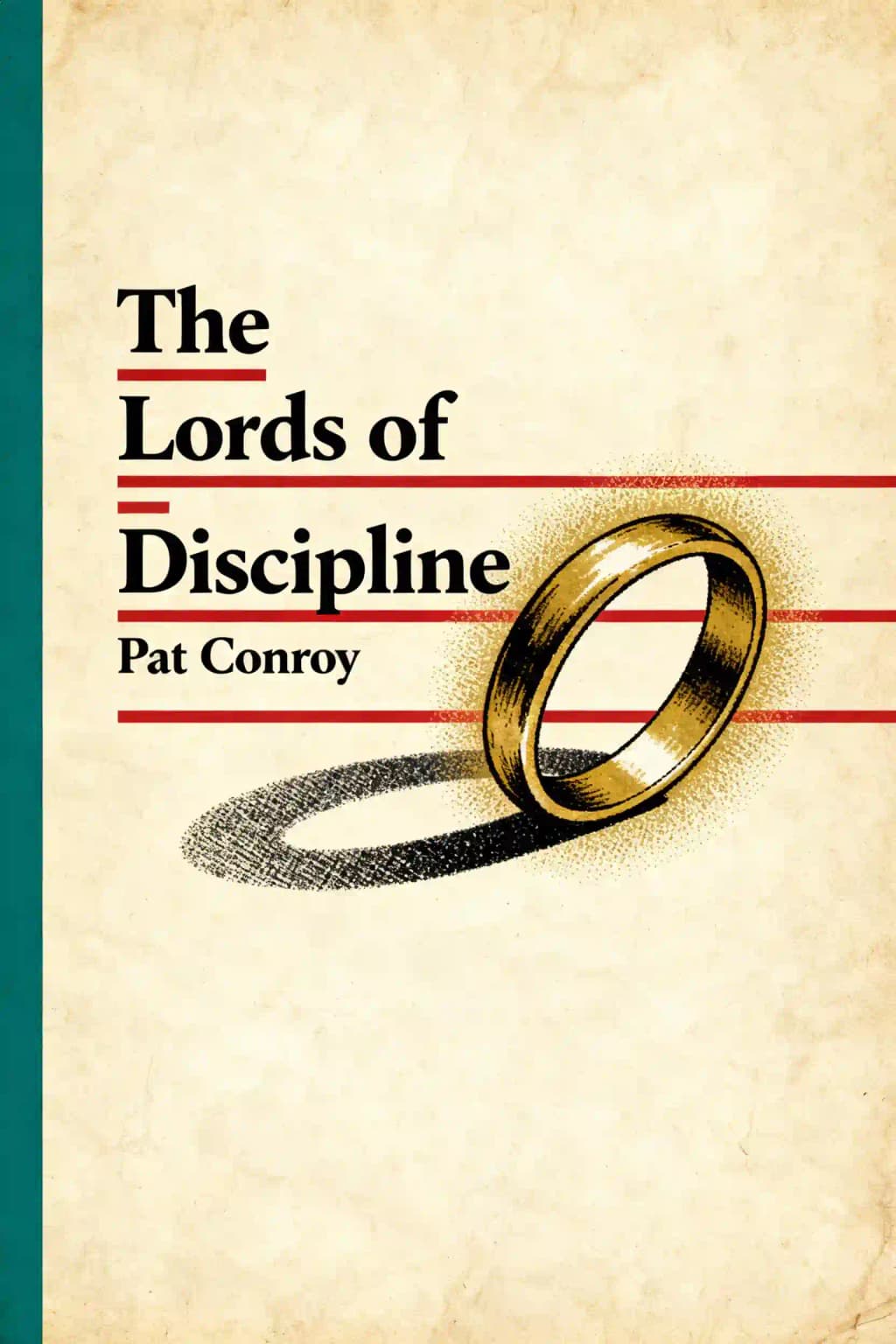
The Lords of Discipline ultimately explores how institutions designed to create men of honor can instead foster cruelty, conformity, and corruption. Through Will McLean's journey, we witness the profound paradox of military education - how systems meant to build character can simultaneously destroy it, how brotherhood can coexist with betrayal, and how honor can become a weapon rather than a virtue. The Institute, with its gleaming facades and proud traditions, serves as both crucible and cage, transforming young men through methods that often blur the line between discipline and abuse.
Will's evolution from frightened plebe to principled graduate embodies the novel's central question: What kind of man emerges from such a crucible? For some, like Pig, the Institute's rigid code becomes internalized to the point where dishonor equals death - a tragic manifestation of how completely the system can consume individual identity. For others, like the members of The Ten, the pursuit of order and tradition justifies any means, including torture and racism, revealing how institutional power can corrupt those who wield it. The Ten's actions demonstrate how easily the noble goals of tradition and excellence can become perverted into instruments of oppression. For Will, however, the experience creates something entirely different - a witness who can both wear the ring and critique what it represents, maintaining a crucial distance that allows for both understanding and judgment.
"I wear the ring," Will declares in the prologue, simultaneously expressing his hatred for the school and his love for it. This contradiction lies at the heart of the novel's exploration of masculinity, institutional power, and personal integrity. Through Will's eyes, we see how the Institute shapes its cadets through a complex web of traditions, relationships, and unwritten codes. The plebe system, designed to break down individual resistance, creates bonds of shared suffering that paradoxically strengthen both conformity and rebellion. In Commerce's relentless pursuit of uniformity, Will discovers the vital importance of maintaining one's individual conscience.
The Institute taught Will "about the kind of man I did not want to be" - a lesson learned not through formal instruction but through witnessing the moral compromises and casual cruelties of those around him. In this negative definition lies his positive identity - a man who values justice over tradition, compassion over conformity, and truth over loyalty. His relationships with Tradd, Mark, and Pig reveal different possible responses to institutional pressure, from complete surrender to tragic resistance. By bearing witness to both the Institute's brutality and its beauty, Will transcends its limitations while carrying its lessons. The ring he wears becomes not a symbol of his surrender to the system, but of his triumph over it - proof that even in the most rigid institutions, the human spirit can remain unbroken, unbowed, and ultimately, free. His journey demonstrates that true honor lies not in blind obedience to tradition but in maintaining one's humanity in the face of dehumanizing forces.