Capítulo 1
A Radical Journey Toward Faith and Community
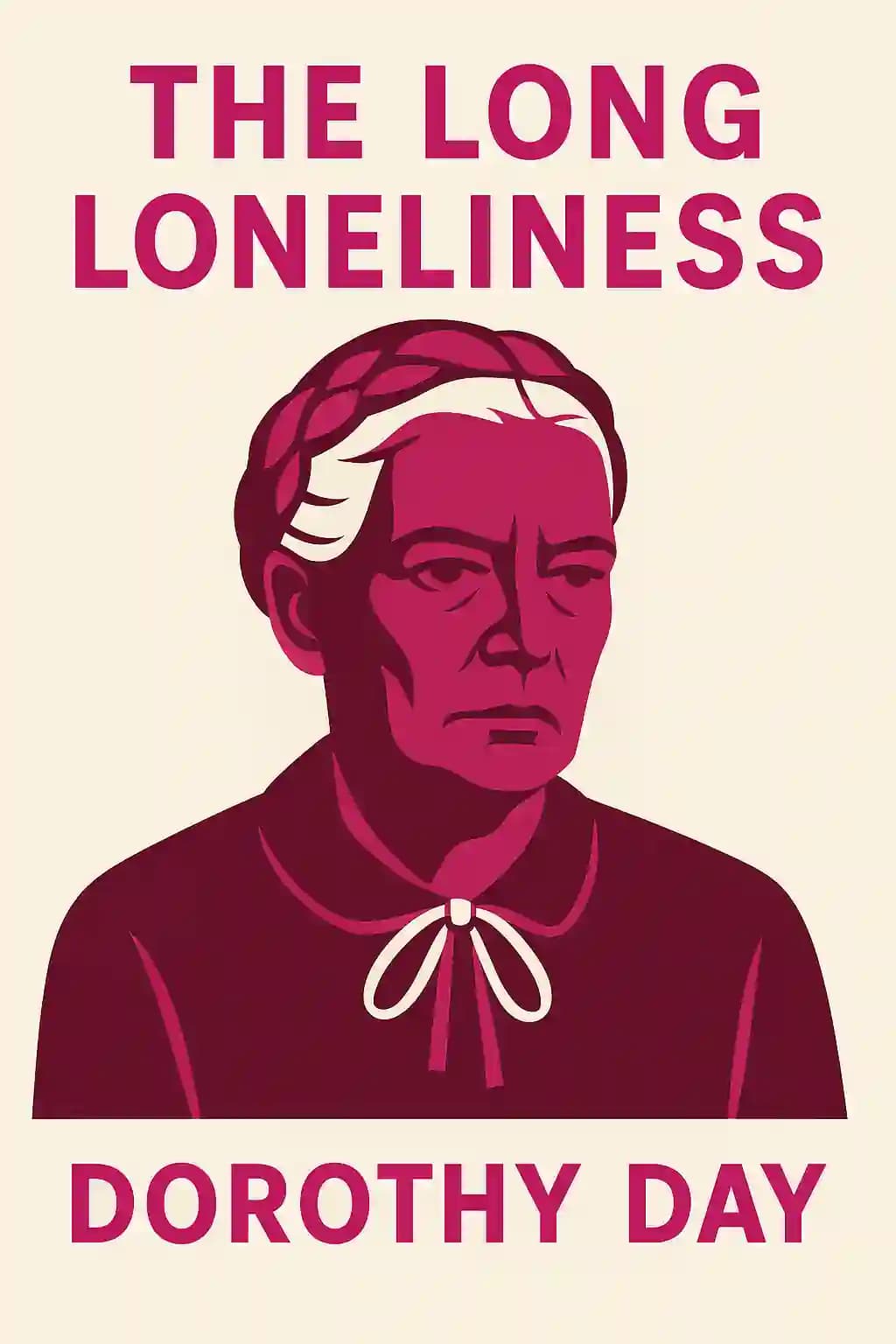
Dorothy Day's autobiography "The Long Loneliness" reads like a spiritual detective story, tracing her remarkable evolution from radical journalist to Catholic social activist. This book has captivated readers across the political spectrum since its 1952 publication, with fans ranging from Pope Francis, who cited Day as one of four "great Americans" in his address to Congress, to labor activists who admire her unflinching commitment to workers' rights. What makes this memoir so compelling is Day's raw honesty about her spiritual struggles and her refusal to separate faith from social justice. In a world increasingly divided between religious conservatives and secular progressives, Day's integration of radical politics with deep Catholic faith continues to challenge and inspire readers seeking authentic ways to live their convictions.
Capítulo 2
The Spiritual Seeker: Early Years and Religious Questioning
From childhood, Dorothy Day possessed an acute moral sense and spiritual curiosity that would define her life's journey. Growing up in a nominally Protestant family, she experienced early religious stirrings through unexpected channels. At eight, Methodist neighbors took her to Sunday school, awakening "real piety" that made her "smugly religious," singing hymns and praying on her knees while wondering why her family didn't join her. Simultaneously, she developed a terrifying fear of God and death-at night, blackness surrounded her, and God became a frightening noise growing louder until she woke screaming for her mother.
Her first meaningful Catholic encounter came through a neighbor girl named Mary Harrington, who told her stories of saints while they gazed at stars on a back porch in Chicago. Day recalled how her "heart swelled with enthusiasm and spiritual adventure" during these conversations. She wanted to "do penance for my sins and the world's," already sensing earthly imperfection. But it was Mrs. Barrett, a neighbor she discovered kneeling in prayer one morning, who gave Day her first impulse toward Catholicism. The sight of this woman in prayer sparked "an unforgettable surge of love and gratitude." Afterward, Day would kneel until her knees ached, insisting her sister join her in "practicing being saints"-a childhood game that foreshadowed her life's direction.
The Episcopal Church provided another spiritual touchstone through its liturgy. Attending services on Thirty-fifth Street, Day fell in love with the Psalms, Collect prayers, and anthems, memorizing many. "The Te Deum and Benedicite filled me with joy-their words calling on all creation to bless the Lord remained with me forever," she wrote. Whenever she encountered beauty in song, story, nature, or human love, she wanted to cry out with joy, and the Psalms provided an outlet for this enthusiasm. She longed for communion with humanity, thinking "if only I could sing, I would call upon the world to join me in praise."
As a teenager, Day's spiritual and physical desires created intense internal conflict. In letters to religious friends, she expressed shame about physical desires, considering them impure. "God is spiritual," she wrote. "We must harden ourselves to these feelings, for God is love and God is all, so the only love is of God and is spiritual without taint of earthliness." Her Anglo-Saxon family's physical reserve-never kissing or embracing casually like her Italian, Polish or Jewish friends-intensified this tension. "This withdrawal made us more intense, more sensual, more conscious of the flesh we continually denied," she reflected. Scripture that spoke to her conflicted heart became a lifeline: "My heart and my flesh crieth out for the living God."
This spiritual searching would be temporarily abandoned when Day entered university and embraced radical politics. She consciously rejected religion, feeling it conflicted with the radicalism she absorbed from writers like Jack London and Upton Sinclair. She even deliberately took God's name in vain to shock churchgoing friends. Her final break with religion came when a professor she admired suggested that religion was a comfort for the weak. In youthful arrogance, feeling she was "one of the strong," she decided to ruthlessly cut religion from her life, seeing it as "an opiate of the people."
Capítulo 3
Radical Politics and the Search for Justice
Day's university years marked her full immersion into radical politics. Living in harsh conditions-a bare, carpetless room with only a bed, table, chair and small stove-she earned her room by doing laundry on Saturdays, "often scrubbing the skin off my knuckles." For meals, she worked two-hour jobs for forty cents a day, sometimes going hungry when she prioritized writing over work. Despite these hardships, she "reveled in her freedom," attending only classes she wished and coming and going at any hour.
After university, Day moved to New York where she joined the vibrant radical scene. Her first job was at the Socialist daily New York Call on Pearl Street. When Russia's revolution erupted in March 1917, she joined thousands at Madison Square Garden, feeling "exultation, the joyous sense of victory" as the masses sang workers' hymns celebrating the triumph against the Czar. She moved from the Call to The Masses magazine, working with prominent radicals like Max Eastman and Floyd Dell.
That summer in New York was "magical" for Day-living in a MacDougal Street apartment, hosting her friend Rayna, walking with Mike Gold and Maurice Becker, singing revolutionary songs on piers at night. They made friends easily, sometimes bringing men from park benches to sleep in empty beds while they talked all night. The radical movement comprised distinct groups: "doctrinaire foreign Socialists discussing dialectics over tea; American I.W.W. workers from wheatfields and lumber camps; tiny anarchist groups; and liberal intellectuals."
Day's commitment to activism led to her first imprisonment when she joined suffragists picketing the White House. After being arrested and sent to the workhouse, she began a hunger strike that lasted ten days. "Those first six days were torturous-lying in darkness, feeling nausea and emptiness, losing all sense of identity," she recalled. She reflected deeply on injustice, questioning what was right and wrong, good and evil. "I identified with all prisoners, feeling their pain as my own." After requesting it for days, she finally received a Bible and found comfort in the Psalms.
Her political education took a darker turn when she was arrested during Palmer Red Raids at an I.W.W. headquarters. Unlike her earlier Washington arrest among solidarity-minded women activists, this experience-being forced to dress before leering detectives and stand exposed on a street corner awaiting the police wagon-revealed the ugliness of men's justice and pushed her more squarely toward revolution. "The humiliation was profound. We were arrested as supposed inmates of a disorderly house, forced to stand under glaring streetlights like common prostitutes."
In the jail cell, Day witnessed both corruption and unexpected kindness. Prostitutes brought in during vice raids showed her compassion, assuming her silence was a first-timer's despair. Children were brought in too-one little shoplifter whom the women comforted with money and stories. In the cell next to hers, a drug addict howled and beat her head against metal walls with such anguish as Day had never heard in all her hospital work. "This suffering, self-inflicted yet uncontrollable, revealed the depth of the world's disorder, the unspeakable dreariness of sin."
Capítulo 4
Natural Happiness and the Path to Conversion
Day's spiritual journey took an unexpected turn when she entered into a common-law marriage with Forster, "an Englishman by descent and a biologist whose sympathies were decentralist and anti-industrialist." Their life on Staten Island beach brought her profound contentment, filled with natural pleasures, eclectic neighbors, and simple living. She read voraciously while maintaining connections with radical friends.
Despite her happiness, Day found herself increasingly drawn to prayer, sensing there was "a greater happiness to be obtained from life than any I had ever known." William James's writings on poverty as a spiritual vocation resonated deeply with her, especially his praise for "the liberation from material attachments, the unbribed soul" that came from simplicity.
Her relationship with Forster brought "natural happiness" that paradoxically led her toward God. His love of nature awakened her appreciation for creation, though he couldn't understand her growing faith. Their love felt connected to the divine, especially as they anticipated their child. "I realized that while pregnancy limited my physical freedom, it brought a deeper liberation," she wrote. After years of fearing she couldn't bear children, the prospect of motherhood completed something essential in her that had been missing.
The birth of her daughter Tamar became the catalyst for Day's conversion. She struggled with the conflict between her growing faith and her relationship with Forster, knowing that baptizing Tamar would cause "a rending in my human relations." She felt torn between loving God and loving man, yet through her complete love-both physical and spiritual-she had come to know God. Despite her fear, she was determined to have Tamar baptized, wanting her to have "the structure and instruction my own life had lacked."
With no Catholic acquaintances to consult, Day approached a nun walking near St. Joseph's-by-the-Sea, who gave her a catechism and religious literature. Sister Aloysia visited regularly for lessons, "chiding me for my slow learning while bringing vegetables from her garden." When Tamar was baptized in July at Our Lady, Help of Christians, Forster provided lobsters for the celebration feast but then left in protest, "seeing my spiritual yearnings as morbid escapism while he exulted in his materialism."
After her own baptism, Day faced the painful reality of separation from Forster, whose anarchist and atheist beliefs made him unable to accept her conversion. "The tension between us had been unbearable-he would leave repeatedly, unable to reconcile with my growing religious absorption," she recalled. Though she loved him deeply "in every way, as a wife, as a mother even," their relationship became impossible.
Her baptism itself brought no particular joy. She approached the sacraments "grimly, coldly," plagued by doubts and feeling like a hypocrite. Beyond personal heartbreak, she struggled with abandoning her radical political work. She still opposed capitalism and imperialism, yet was joining a Church she perceived as "lined up with property, with the wealthy, with capitalism, with all the forces of reaction." Despite these conflicts, she never regretted becoming Catholic.
Capítulo 5
Peter Maurin and the Birth of The Catholic Worker
The pivotal moment in Day's life came when she returned from covering the Hunger March to Washington and found Peter Maurin waiting in her apartment-"a stocky, ragged man in his mid-fifties with strong hands and shoulders, looking every bit the worker he was." This French peasant would become her mentor and collaborator in founding The Catholic Worker movement.
Peter spoke of ideas rather than personalities, stressing theory's importance. "Lenin said, 'There can be no revolution without a theory of revolution,' so I am trying to give the theory of a green revolution," he told her. He pointed out her education lacked Catholic background and began remedying this through discussions of Church history and the prophets of Israel. His ambition was tremendous despite his simplicity: to create a new synthesis like St. Thomas had done in the Middle Ages, building "a society in which it is easier for people to be good."
Peter envisioned a three-part program: round-table discussions for clarification of thought, houses of hospitality for immediate relief of suffering, and farming communes for long-term social reconstruction. His vision combined radical social critique with traditional Catholic teaching, emphasizing personal responsibility and direct action rather than state solutions.
With Peter's encouragement, Day decided to use two small checks she'd received for articles to print twenty-five hundred copies of an eight-page tabloid newspaper for fifty-seven dollars through the Paulist Press. They would sell it for a penny to make it affordable to anyone. When the first issue appeared on May Day with articles about labor, strikes, and unemployment alongside Peter's "Easy Essays," The Catholic Worker was born.
The paper grew explosively-from 2,500 copies in May 1933 to 100,000 by year's end and 150,000 by 1936. Young people sold it on streets or left free copies in public places. They received letters from readers who found the paper in the most unlikely places-"under a mattress in Mexico, five miles underground in a Nova Scotia mine, wrapping half-soled shoes in Rome."
Their community grew organically. Houses of hospitality sprang up quickly across the country as unemployed college graduates volunteered with them. Within a few years, thirty-three houses and farms operated nationwide, with Catholic Worker papers published in multiple cities and even in Australia and England. Voluntary poverty remained a hallmark of these communities-many still lacked central heating, using stoves in winter, with backyard toilets and minimal amenities.
Capítulo 6
The Works of Mercy: Living the Gospel Radically
The Catholic Worker movement was built on the foundation of the corporal and spiritual works of mercy-feeding the hungry, clothing the naked, sheltering the homeless, visiting the sick and imprisoned, and instructing the ignorant. Day and her companions took these Gospel imperatives literally, opening their doors to anyone in need without questions or requirements.
Their Mott Street house in New York became their home for fourteen years, eventually occupying twenty-four rooms for men and twelve for women. The conditions were primitive-"two rooms on either side with one toilet between them, open fireplaces, a sink and washtub in each kitchen." Despite the challenges, they maintained an open-door policy, turning no one away.
The discomfort in their houses was real. Their first Philadelphia house drew water from a single spigot at the end of an alley serving half a dozen houses. It was lit by oil lamps, so cold and poverty-stricken that little Puerto Rican and Spanish children visiting exclaimed it couldn't be Catholic-it must be Communist. "How painful to hear such criticisms!" Day wrote. Many Catholics distrusted them because of their emphasis on voluntary poverty, their worker-ownership principles, and even the word "worker" on their masthead. "They thought us Communists in disguise, wolves in sheep's clothing," though they were simply living out the social encyclicals of the popes.
Day's commitment to the works of mercy was inseparable from her faith. As Peter Maurin always added, these works should be done "at a personal sacrifice." Eric Gill said "Christ came to make the rich poor and the poor holy." This voluntary poverty was not romanticized-Day was clear-eyed about its difficulties and discomforts-but she saw it as essential to authentic Christianity.
Father Pacifique Roy, who became an important spiritual mentor to the community, taught them to act always for the "supernatural motive" in their works of mercy-"not for praise or pride, but for love of God." There was little freedom in life except in our intentions, he said. We could do things because we were compelled to, or because we loved God.
Roy's favorite principle was sowing and reaping a hundredfold. "If you need money, give what you have away. If you need time, spend time in prayer or with the poor. Where there is no love, put love and you will take out love." This paradoxical approach to charity-giving away what you yourself need-became a cornerstone of Catholic Worker spirituality.
Capítulo 7
Land and Community: Peter Maurin's Vision
Peter Maurin's social vision always led to the land-he recognized the human craving for property ownership but knew it was only attainable through community, with people forming farming communes to live partially in common, sharing work, machinery, and schools. He admired the collective farms in Palestine and believed similar models could work in America.
For Peter, community was the social answer to loneliness. He envisioned communities of families combining private and communal property on farming communes-"an organic growth, not a five-year plan or blueprint." While Father John McGoey in Canada and Monsignor Luigi Ligutti with the Catholic Rural Life Conference successfully established land-based communities for unemployed families using government assistance, Peter resisted government funding, believing "he who is a pensioner of the state is a slave of the state." Instead, he advocated borrowing from parish credit unions or relying on donations of land, money, and labor.
Peter emphasized labor for a new order with the slogan "Work, not wages"-borrowed from the I.W.W. and Communists. This phrase contained revolutionary potential: people wanted meaningful work and ownership more than mere wages. Critics might question whether people truly desire work over easy relief checks, but Peter understood human nature. His solution was developing a philosophy of work that would make people desire poverty and hard work-achievable through example and God's grace.
Catholic Worker farms spread across America-in California, New Jersey, Massachusetts, Ohio, Michigan-as young people embraced these ideas. Some failed due to isolation, lack of water, funds, or agricultural knowledge. The movement attracted diverse groups with different expectations: families saw farming communes as designed for them, scholars claimed the agronomic university concept, while the sick and unemployed viewed farms as refuges for the helpless.
One main difficulty in these ventures was the lack of skills, money, equipment, and leadership. Day believed groups of families could succeed on the land if they "surrounded a chapel, were disciplined by family life and daily Mass attendance, accepted mutual authority with division of skills and labor, and had one coordinator." With initial subsidies, free and clear, young families could work out remarkable ways of life.
Capítulo 8
Pacifism and the Challenge of War
The Catholic Worker movement maintained a consistent pacifist stance through multiple conflicts-the Ethiopian War, Spanish Civil War, World War II, and the Korean War. This position often brought criticism and misunderstanding, even from within their own ranks. After World War II, they received messages from Catholic Worker groups criticizing their pacifism. "It struck me as strange-we had been writing about pacifism for fifteen years, yet some members were only beginning to understand its implications," Day wrote.
Their pacifism was grounded in theological reflection. They published articles by Father John J. Hugo, who wrote "The Immorality of Conscription" and "Catholics Can Be Conscientious Objectors" under the New York Archdiocese's imprimatur. European voices included Father Stratman's "The Church and War" and Father Ude's "Thou Shalt Not Kill."
Bob Ludlow, their pacifist theorist, argued that the early Church had a pacifist tradition that had fallen into obscurity. He noted that early saints and Church Fathers were critical of the military, with rules that baptized persons shouldn't join the army and soldiers who converted were admonished to shed no blood. This tradition survived partially in canon law forbidding clergy from bloodshed.
Ludlow compared pacifism's moral demands to Catholic sexual morality, arguing that "if the Church refuses compromise on sexual ethics despite daily difficulties, it should likewise take an uncompromising stance against war." To the common question about defending loved ones from armed attackers, he advocated restraint and confinement rather than killing, insisting that "perfect love casts out fear and love overcomes hatred."
The community witnessed the power of moral force over violence firsthand. When a World War I veteran-turned-maniac attacked Arthur Sheehan with a breadknife, they physically restrained him without deadly force. Though they couldn't hold him and he threw objects violently, they managed to help Arthur escape and get the attacker psychiatric care.
Different members held varying positions on pacifism. Tom Sullivan, a war veteran who served in the Pacific, edited their pacifist paper but wouldn't call himself pacifist, believing "if others must suffer in war, he would suffer with them." Jack English, who survived being shot down and imprisoned in Romania during the war, remained influenced by theologian friends who kept him from embracing absolute pacifism. These diverse perspectives kept the community grounded in reality as they wrestled with profound questions about just war, spiritual weapons against tyranny, and the courage to face martyrdom and loneliness.
Capítulo 9
The Long Loneliness and the Answer of Community
The title of Day's autobiography points to what she saw as the fundamental human condition-loneliness-and its only lasting remedy: community. She experienced this loneliness throughout her life, from her childhood moves to her radical years, from her separation from Forster to the challenges of single motherhood.
"The only answer in this life to the loneliness we are all bound to feel is community-living together, working together, sharing together, loving God and loving our brother," she wrote. This insight came from both her daughter Tamar's experience as a young mother and an elderly woman's lament about isolation.
Day's community was not an idealized vision but a messy, challenging reality. It included difficult personalities like Steve Hergenhan, a German carpenter whose bitterness increased over time, especially against their works of mercy policy. When he became ill with cancer, he returned to them at Mott Street-"we were his family after all." Though initially horrified to be in a hospital for the cancerous poor, he gradually became reconciled, realizing that "his suffering was the spiritual work of his life."
The Catholic Worker community faced internal conflicts as well. At Maryfarm, a willful leader's family refused to listen when they explained they were creating a retreat house. "They took over the lower farmhouse, conducting raids on retreat house supplies while claiming they were the 'true Catholic Workers' and our retreat house was a 'perversion of the movement.'" When they allowed their goats to destroy young orchards, they reached a crisis point and eventually had to separate properties.
Despite these challenges, the community persevered. Peter Maurin's death in 1949 marked both sorrow and release after years of suffering. Once a brilliant teacher, his final five years were marked by silence after his mind failed him. "We who loved him understood God had completed Peter's self-stripping-taking even his keen intellect, the one thing he had left," Day wrote. Like St. Francis, Peter had embraced poverty completely, "living without honors or recognition, never speaking ill of others, and seeing Christ in everyone he met."
Day concluded her autobiography with a reflection on how it all began "so simply-we were just sitting there talking when Peter Maurin came in. Then people formed lines needing bread, and somehow we divided what little we had, and there was always enough." Everything happened organically, almost casually. Some say poverty defines The Catholic Worker, others say community is its essence-"we are not alone anymore." But the final word is love, sometimes "a harsh and dreadful thing" testing our very faith.
"We cannot love God without loving each other, and we know each other in the breaking of bread," she wrote. "Heaven is a banquet and life too, even with just a crust when shared in companionship. Through our long loneliness, we've learned that love comes with community."