Capítulo 1
When Energy Rules: The Invisible Laws That Power Our Universe
Have you ever wondered why ice melts, why your coffee cools down, or why life itself is possible? Peter Atkins' "The Laws of Thermodynamics" reveals the profound principles governing these everyday phenomena. This slim volume has become required reading in physics departments worldwide, with Stephen Hawking reportedly calling it "the perfect introduction to thermodynamics." Beyond academia, these laws have inspired artists like Tom Stoppard, whose play "Arcadia" uses entropy as a central metaphor, and influenced thinkers from economists to philosophers. Though thermodynamics began with steam engines, its reach extends to the cosmos itself. As physicist C.P. Snow famously remarked, not knowing the second law of thermodynamics is like never having read Shakespeare-it's that fundamental to understanding our world. Let's explore the elegant framework that explains why anything happens at all.
Capítulo 2
The Zeroth Law: Establishing Temperature's True Meaning
Temperature seems intuitive-we experience hot and cold daily-but what is it really? The zeroth law (named last but logically first) provides the answer through a simple observation: when two systems in contact no longer exchange energy, they've reached thermal equilibrium. If system A is in equilibrium with B, and B with C, then A must be in equilibrium with C. This transitive property allows us to assign a numerical value-temperature-to equilibrium states, creating a foundation for quantitative temperature measurement.
Consider everyday examples of thermal equilibrium: a cup of coffee left on a desk eventually matches room temperature, metal silverware adjusts to match your hot soup's temperature, and a thermometer stabilizes to display body temperature. In each case, systems naturally progress toward equilibrium through energy exchange. This equilibrium-seeking behavior is universal, from oceans absorbing atmospheric heat to stars radiating into space, and even in the cosmic microwave background radiation that pervades our universe.
At the molecular level, temperature reveals something astonishing about the nature of matter. Rather than being a substance or simple property, temperature is a sophisticated parameter determining how molecules distribute across energy states. In a gas at room temperature, molecules move at various speeds following the Maxwell-Boltzmann distribution-some crawl while others race at supersonic velocities, with most clustering around an average speed. Raise the temperature, and this distribution stretches, with more molecules achieving higher energies. For instance, in air at room temperature (20C), nitrogen molecules move at average speeds of about 500 meters per second, but at 100C, this increases to roughly 550 meters per second.
This molecular understanding explains why temperature feels so fundamental to our experience. A cup of coffee at 90C has molecules vibrating and colliding more vigorously than the same coffee at 20C. When you touch something hot, you're literally feeling the impact of billions of energetic molecules transferring their kinetic energy to your skin's molecules. This molecular motion explains why metals feel cold to touch (they conduct heat rapidly from your skin) while wood at the same temperature feels warmer (it transfers heat more slowly).
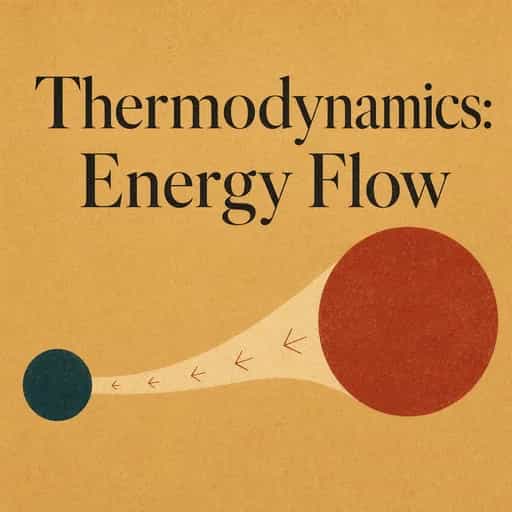
Temperature establishes the direction of spontaneous energy flow-always from higher to lower temperature regions. This directionality becomes crucial for the laws that follow, particularly the second law, which explains why your hot coffee inevitably cools rather than spontaneously heating up. The process is irreversible under normal conditions: a cold cup of coffee won't spontaneously heat up by drawing heat from its surroundings.
The zeroth law might seem trivial, but its implications are profound. It provides the foundation for all thermodynamics by establishing temperature as a measurable, universal property that determines energy flow between systems. This law enables the development of temperature scales (Celsius, Fahrenheit, Kelvin) and makes possible practical applications from refrigeration to industrial processes. Without it, we couldn't formulate the other laws of thermodynamics or understand the universe's energy transformations. Modern technologies like thermal imaging cameras, temperature-controlled semiconductor manufacturing, and climate control systems all rely on this fundamental principle.
Capítulo 3
The First Law: Energy's Eternal Persistence
"Energy can neither be created nor destroyed, only transformed." This elegant statement of the first law of thermodynamics might be familiar, but its implications are profound. Rather than assuming energy as a known concept, thermodynamics builds understanding from the fundamental idea of work-motion against an opposing force.
Consider lifting a weight. You perform work against gravity, storing energy that can later be recovered. All work, whether stretching springs, cycling against wind, or climbing stairs, can be understood as equivalent to raising a weight. The first law recognizes that when a system is enclosed in thermally non-conducting walls, the same amount of work-however performed-brings about the same change of state.
This path-independence is remarkable. Imagine climbing a mountain by different routes-steep and direct or gentle and winding. Though your experiences differ dramatically, the change in altitude remains identical. Similarly, a system's internal energy (U) depends only on its current state, not how it arrived there. The work required between states equals the change in internal energy: U(final) - U(initial).
When thermal insulation is removed, something fascinating happens-more work is typically needed to reach the same final state. This reveals energy can transfer through another means: heat. Unlike work, which involves ordered motion (like all atoms in a weight moving upward together), heat transfers energy through random molecular motion. When a hot pan touches cold water, the vigorously vibrating metal atoms jostle neighboring water molecules, transferring energy through countless microscopic collisions.
This distinction explains why fire (chaotic energy release) preceded engines (controlled energy conversion) in human history. Harnessing random molecular motion for useful work requires sophisticated understanding, while releasing energy chaotically is comparatively simple.
The first law introduces another crucial concept: enthalpy (H = U + pV). This clever thermodynamic property accounts for energy used in expansion work. When combustion occurs in an open container, the change in enthalpy equals the heat generated, automatically accounting for energy lost as work. This explains why steam burns are so dangerous-water's enthalpy of vaporization (2 kJ/g) represents enormous energy transferred directly to skin.
Perhaps most profoundly, the conservation of energy connects to the fundamental structure of time itself. Noether's theorem reveals that energy conservation arises from time's uniformity-the fact that physical laws remain constant throughout time. When early thermodynamicists studied steam engines, they were unwittingly investigating the universe's deepest symmetries.
Capítulo 4
The Second Law: Why Things Happen
If the first law tells us what's possible, the second law tells us what's probable. It might be the most liberating scientific principle ever discovered, explaining why anything happens at all-from engines running to thoughts forming in our brains.
The second law introduces entropy (S), a property measuring energy quality. Low entropy represents concentrated, useful energy; high entropy indicates dispersed, less useful energy. Every spontaneous process increases the total entropy of the universe, revealing nature's fundamental tendency toward disorder.
Consider a steam engine. Sadi Carnot discovered its maximum efficiency depends only on the temperatures of the hot source and cold sink: 1 - (T_sink/T_source). A power plant using steam at 573 K (300C) with surroundings at 293 K (20C) can achieve maximum 46% efficiency-regardless of engineering brilliance. Perfect efficiency would require either absolute zero surroundings or infinitely hot steam, both impossible.
William Thomson (Lord Kelvin) formulated this limitation as: "No cyclic process is possible in which heat is taken from a hot source and converted completely into work." Nature taxes heat-to-work conversion, requiring some energy be paid to surroundings as heat. Meanwhile, Rudolf Clausius observed that heat flows spontaneously from hot to cold bodies but never the reverse without external work-another expression of the same principle.
At the molecular level, entropy represents disorder in terms of unpredictability. When gas expands, its molecules spread over greater volume, making their positions less predictable and increasing entropy. Ludwig Boltzmann quantified this with his famous formula S = k log W, where W represents the number of ways molecules can be arranged with the same total energy. This statistical approach perfectly matches Clausius's classical definition, confirming entropy's dual nature as both a macroscopic property and a measure of microscopic disorder.
Some substances retain entropy even at absolute zero. In solid carbon monoxide, each molecule can lie in either of two directions, creating 2^N possible arrangements and a residual entropy of 0.21 J K^-1 for a 1g sample. Ice similarly has randomness in hydrogen atom positioning, explaining its residual entropy of 0.19 J K^-1 per gram.
The second law explains why refrigerators require electricity-they must perform work to move heat from cold to hot regions, ensuring a net entropy increase. A heat pump operating between 0C outdoors and 20C indoors can theoretically deliver 15 joules of heat for every joule of electricity consumed, though practical efficiencies are lower.
Most profoundly, we ourselves are metaphorical steam engines. All structure creation requires coupling to processes that generate greater disorder elsewhere. Our bodies metabolize food, creating disorder while building ordered structures like proteins or organized thoughts. The Sun serves as our ultimate energy source, its nuclear fusion enabling life through entropy production. As John Donne intuited centuries before thermodynamics: "No man is an island"-we all depend on our surroundings for the entropy increases that enable our existence.
Capítulo 5
Free Energy: The Currency of Change
When chemists, biologists, and engineers speak of "free energy," they're referring not to monetarily free energy but to energy available to do useful work rather than dissipate as heat. Two formulations of free energy-Helmholtz and Gibbs-help determine whether processes will occur spontaneously and how much work they can perform.
The Helmholtz energy (A = U - TS) assesses spontaneity at constant temperature and volume. When a process decreases Helmholtz energy, it happens spontaneously and can perform useful work. Molecularly, A represents orderly stored energy available for work, with TS representing disordered energy unavailable for work. When a process decreases entropy (like freezing water), some energy must be released as heat to compensate, leaving only U - TS available for work.
The Gibbs energy (G = H - TS) focuses on non-expansion work at constant temperature and pressure-conditions typical in chemistry and biology. Like Helmholtz energy, Gibbs energy represents orderly stored energy available for useful work. At constant pressure and temperature, spontaneous processes show negative G values.
Visualize the Gibbs energy of water in different phases. As temperature rises, G decreases because the TS term grows larger, subtracting more from H. Since ice has lower entropy (more ordered molecules), its G value decreases less steeply with temperature than liquid water's. At 0C, the lines cross, and liquid becomes more stable. Similarly, at 100C, vapor becomes most stable as its line crosses the liquid's.
Our bodies sustain life through Gibbs energy transformations. Non-spontaneous processes like protein synthesis require coupling to spontaneous reactions that release Gibbs energy-like a heavy weight lifting a lighter one as it falls. Adenosine triphosphate (ATP) serves as this "heavy weight." When ATP loses its terminal phosphate group to form ADP, it releases substantial Gibbs energy that enzymes harness to link amino acids into proteins. Building a typical 150-amino-acid protein requires energy from about 450 ATP molecules.
Chemical reactions reach equilibrium when their Gibbs energy reaches a minimum value. This equilibrium point varies by reaction-sometimes lying close to pure reactants (like gold dissolving in water), sometimes near pure products (like hydrogen-oxygen combustion). A battery exemplifies this principle: it drives electrons through a circuit as its chemical reaction proceeds toward equilibrium, but dies when the minimum Gibbs energy is reached and no further net reaction occurs.
Understanding free energy reveals why some reactions happen spontaneously while others require input, why ice melts at 0C rather than -10C or +10C, and ultimately, how life itself maintains its extraordinary organization in a universe tending toward disorder.
Capítulo 6
The Third Law: The Unreachable Zero
The third law of thermodynamics states that absolute zero temperature is unattainable through any finite sequence of processes. Like trying to reach the horizon, we can approach but never arrive at 0 Kelvin. This limitation becomes particularly clear when temperature is expressed as (1/kT), where absolute zero corresponds to infinite - a mathematical impossibility in real physical systems. This fundamental barrier exists not due to technological limitations, but rather due to the quantum nature of matter itself.
At extremely low temperatures, matter exhibits extraordinary properties that reveal quantum mechanical behavior. Superconductivity emerges near liquid helium temperatures (4K), where electrical resistance vanishes completely. Helium itself becomes superfluid around 1K, displaying bizarre behavior like flowing without viscosity, creeping up container walls against gravity (the Onnes effect), and conducting heat with infinite efficiency. Other quantum effects become prominent: electrons pair up into Cooper pairs, atoms form Bose-Einstein condensates, and materials display quantum tunneling effects. These phenomena demonstrate how quantum effects dominate as thermal motion diminishes.
The third law can be restated more formally: the entropy of every pure, perfectly crystalline substance approaches the same value (conventionally set to zero) as temperature approaches absolute zero. This formulation provides a crucial bridge between statistical mechanics and classical thermodynamics, allowing us to interpret entropy changes not just as abstract quantities but as concrete measures of molecular disorder. The law implies that perfect order is achieved only at absolute zero - a state that cannot be reached.
Unlike the first and second laws, the third law doesn't introduce a new thermodynamic function or conservation principle. Instead, it establishes that entropy can be expressed on an absolute scale, similar to how the second law enabled absolute temperature measurements. This has profound practical implications: chemists can calculate precise equilibrium compositions of chemical reactions using thermal data, enabling optimization of industrial processes from petroleum refining to pharmaceutical manufacturing.
Fascinatingly, while absolute zero is unreachable, negative absolute temperatures are physically meaningful in certain carefully prepared systems. In a two-level system like electron spins in a magnetic field, negative temperature occurs when population inversion is achieved - more electrons occupy the higher energy state than the lower one. This creates a unique thermodynamic situation: at positive temperatures approaching zero, all electrons occupy the ground state; at negative temperatures just below zero, they predominantly populate the excited state.
Systems with negative temperatures exhibit counterintuitive thermodynamic behavior: when energy leaves as heat, their entropy increases; when heat enters, entropy decreases - the opposite of normal systems. Heat spontaneously flows from negative to positive temperature systems, always increasing total entropy in accordance with the second law. Most remarkably, heat engines operating between positive and negative temperature reservoirs can achieve efficiencies exceeding 100% of traditional Carnot limits, as the negative temperature reservoir actually contributes energy as its inverted population equalizes.
The third law requires careful amendment across the T=0 boundary: it becomes impossible in finite cycles to cool to absolute zero from above, or to heat to absolute zero from below. This limitation reflects fundamental quantum uncertainty principles rather than merely practical engineering challenges. Modern ultra-low temperature experiments, reaching temperatures below one nanokelvin, continue to reveal new physics while confirming this fundamental limit.
Capítulo 7
The Molecular Dance: Statistical Foundations of Thermodynamics
While classical thermodynamics deals with bulk properties without requiring belief in atoms, statistical thermodynamics explains these properties through atomic behavior. This molecular perspective transforms abstract thermodynamic laws into vivid, comprehensible processes.
Temperature, from this view, is the parameter determining how molecules distribute across energy states. In a gas, molecules move at various speeds-some sluggish, others supersonic-following the Maxwell-Boltzmann distribution. Higher temperatures stretch this distribution, increasing the proportion of high-speed molecules.
Work and heat, indistinguishable once absorbed by a system, differ fundamentally in their transfer mechanisms. Work involves uniform motion of atoms (like all atoms in a weight moving upward together), while heat involves random motion (like the chaotic vibrations of atoms in a hot object jostling those in a cooler one).
Entropy gains particular clarity through statistics. Boltzmann's expression S = k log W reveals entropy as proportional to the logarithm of the number of microscopic arrangements corresponding to a macroscopic state. A gas has higher entropy than a solid because its molecules can arrange themselves in vastly more ways while maintaining the same total energy.
This statistical view explains why entropy always increases in isolated systems: not because it's impossible for entropy to decrease, but because it's overwhelmingly improbable. Just as a shuffled deck of cards could theoretically return to factory order, but practically never will, molecules could theoretically all move in coordinated patterns, but the probability is vanishingly small.
The molecular perspective also clarifies why free energy represents available work. In a system with low entropy, energy is stored in orderly molecular arrangements that can be harnessed for work. As entropy increases, energy becomes distributed across more molecules in more random patterns, making it harder to extract useful work.
Even the third law gains intuitive meaning: as temperature approaches absolute zero, molecules settle into their lowest energy states, minimizing the number of possible arrangements and reducing entropy toward zero.
Statistical thermodynamics bridges the microscopic world of atoms and the macroscopic world of our experience, showing how the collective behavior of countless particles gives rise to the elegant laws governing energy transformations throughout the universe.
Capítulo 8
Thermodynamics Beyond Physics: Life, Information, and the Universe
Thermodynamics extends far beyond steam engines and laboratory experiments, offering profound insights into life, information, and cosmic evolution.
Living organisms appear to defy the second law by maintaining highly ordered structures in a universe tending toward disorder. The resolution lies in understanding that life doesn't violate thermodynamics-it exploits it masterfully. Organisms are open systems that increase order locally by creating greater disorder in their surroundings. Plants capture solar energy to build complex molecules, animals consume these molecules, and both release heat and waste that increase environmental entropy.
The ATP cycle exemplifies this principle. Our cells continually convert ADP to energy-rich ATP through metabolism, then harness ATP's free energy to power essential functions before it reverts to ADP. This cyclical process maintains life's organization while increasing the universe's total entropy through heat dissipation.
Information theory reveals another dimension of thermodynamics. Claude Shannon's information entropy, measuring uncertainty in communication systems, shares the same mathematical form as thermodynamic entropy. This connection suggests that information processing-whether in computers or brains-necessarily generates heat and increases entropy, explaining why computers require cooling and brains consume substantial energy.
Cosmologically, the second law may determine the universe's ultimate fate. As stars burn their nuclear fuel, converting concentrated energy to dispersed radiation, the universe's entropy steadily increases. Some cosmologists propose that this progression toward maximum entropy-a "heat death" where all energy is uniformly distributed-represents the universe's final state, though quantum fluctuations and the nature of dark energy complicate this picture.
Thermodynamics also illuminates sustainability challenges. Fossil fuels represent concentrated energy from ancient sunlight, and their rapid consumption increases entropy through combustion products and waste heat. Renewable energy sources like solar power don't circumvent thermodynamic limits but tap into the Sun's ongoing entropy production rather than Earth's finite stores of concentrated energy.
Perhaps most profoundly, thermodynamics shapes how we understand causality itself. The arrow of time-our perception that time flows in one direction-aligns with entropy's increase. We remember the past but not the future because the past had lower entropy than the present. Every causal process, from breaking eggs to forming memories, increases entropy, giving time its apparent directionality.
Far from being merely a specialized branch of physics, thermodynamics provides a universal framework for understanding change throughout the cosmos-from subatomic particles to living cells to galactic superclusters-all governed by the same elegant principles that explain why your coffee cools to room temperature.
Capítulo 9
The Elegance of Limits: What Thermodynamics Teaches Us
Thermodynamics reveals something profound about our universe: its fundamental laws are primarily about limitations. The first law states we cannot create energy; the second law states we cannot convert heat completely to work; the third law states we cannot reach absolute zero. Yet within these constraints lies extraordinary creative potential.
These limits aren't arbitrary restrictions but emerge from the statistical behavior of countless particles. They represent not what's forbidden by decree but what's overwhelmingly improbable given the nature of energy and matter. The second law doesn't absolutely prohibit your scattered papers from spontaneously reorganizing-it just makes the probability so vanishingly small that you'll never observe it.
This framework offers a philosophical lesson: creativity often flourishes within constraints. Life evolved within thermodynamic boundaries, developing ingenious mechanisms to harvest energy and maintain order. Human civilization likewise advances not by circumventing these laws but by cleverly working within them-finding more efficient energy conversions, reducing waste heat, and developing technologies that approach theoretical limits.
The laws also teach us humility. No perpetual motion machine will ever provide unlimited energy; no perfect engine will convert all heat to work; no process will reverse entropy's increase in isolated systems. These aren't temporary technological limitations but fundamental constraints on what's possible in our universe.
Yet thermodynamics also inspires wonder. The same principles governing steam engines explain why stars shine, why chemical reactions occur, and how life maintains its extraordinary complexity. The laws apply equally to quantum systems, biological cells, and cosmic structures-a remarkable universality spanning vastly different scales.
Perhaps most powerfully, thermodynamics connects to deep questions about time, information, and the universe's evolution. The inexorable increase of entropy may define time's direction, set limits on information processing, and ultimately determine cosmic fate. These connections reveal thermodynamics not as a narrow technical field but as a foundational framework for understanding reality itself.
From everyday experiences like brewing coffee to profound questions about life's origin, thermodynamics provides an elegant, powerful lens for viewing the universe's energy transformations. Its laws, discovered through practical studies of heat engines, have revealed themselves as universal principles governing change throughout the cosmos-truly among science's greatest intellectual achievements.