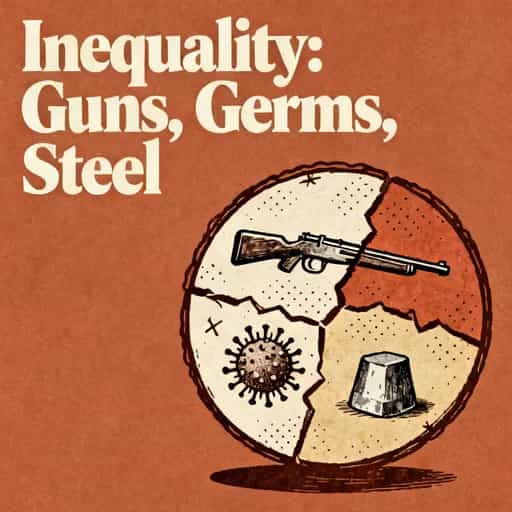
"The Great Leveler" reveals history's brutal truth: only catastrophic violence - wars, revolutions, pandemics, and state collapses - has ever significantly reduced inequality. Scheidel's provocative thesis challenges our optimism: can we achieve equality without destruction? A sobering perspective that's reshaped economic discourse worldwide.
Walter Scheidel, the acclaimed Austrian historian and Stanford University professor, is the author of The Great Leveler: Violence and the History of Inequality from the Stone Age to the Twenty-First Century. A leading expert in ancient social and economic history, Scheidel combines rigorous academic research with transdisciplinary analysis to explore the roots of inequality.
His work, including influential titles like Escape from Rome and Rome and China, bridges classical studies and modern socioeconomics, offering frameworks for understanding systemic disparities.
A prolific scholar with over 260 publications, Scheidel holds the Dickason Professorship in the Humanities at Stanford and is the world’s most cited active Roman historian. His insights on inequality have been featured in the New York Times, Financial Times, and The Economist, cementing his reputation as a public intellectual. The Great Leveler has been translated into 14 languages, reflecting its global impact on debates about wealth, power, and historical change.
The Great Leveler argues that significant reductions in economic inequality throughout history have only occurred through violent upheavals like wars, revolutions, state collapses, and pandemics. Walter Scheidel identifies these as the "Four Horsemen of Leveling," demonstrating how catastrophic events disrupt wealth concentration. The book spans prehistoric societies to modern economies, challenging the idea that peaceful reforms can achieve lasting equality.
This book is essential for historians, economists, and policymakers interested in the cyclical nature of inequality. It also appeals to readers seeking a data-driven analysis of how crises reshape societies. Scheidel’s interdisciplinary approach bridges economic history, political science, and sociology, making it valuable for academics and informed general audiences alike.
Yes—Scheidel’s rigorous research and global historical scope provide a compelling, if grim, perspective on inequality. While the focus on violence may unsettle some, the book’s evidence-based arguments (e.g., World Wars, the Black Death) offer critical insights into socioeconomic patterns. It’s particularly recommended for those exploring alternatives to Thomas Piketty’s views on inequality.
Scheidel’s "Four Horsemen" are mass mobilization warfare (e.g., World Wars), transformative revolutions (e.g., Bolshevik Revolution), state collapse (e.g., fall of the Roman Empire), and lethal pandemics (e.g., Black Death). These events forcibly redistribute wealth by destroying elites’ assets, disrupting institutions, or reducing labor supply. Historically, they are the only proven drivers of significant equality gains.
Scheidel argues Piketty oversimplifies war’s role in reducing inequality by generalizing France’s WWI experience to other nations. While Piketty emphasizes capital taxation, Scheidel asserts that violent shocks—not policy—are the primary historical equalizers. However, both agree that peace and stability tend to increase wealth concentration over time.
Key examples include:
While Scheidel observes that violence has been the primary driver of leveling, he questions whether modern societies can achieve equality peacefully. He acknowledges the moral repugnance of past methods but warns that without systemic reforms, inequality may persist or worsen.
Critics argue Scheidel underestimates peaceful reforms’ potential (e.g., New Deal policies) and overemphasizes Western examples. Some note that the "Four Horsemen" framework ignores cultural and technological factors influencing inequality. Others question its pessimistic outlook for contemporary policy solutions.
The book focuses on material wealth disparities within societies, measured through metrics like Gini coefficients and top income shares. It examines asset ownership, income distribution, and access to resources rather than social or political inequality.
Yes—Scheidel’s analysis clarifies why recent inequality trends (e.g., post-1980 wealth concentration) align with historical patterns of stability favoring elites. It raises urgent questions about climate change, pandemics, and political instability as potential future "levelers".
Collapsed states (e.g., Mayan civilization, post-Soviet Russia) destroy centralized wealth networks, erase debt records, and eliminate elite-controlled institutions. This resets economic hierarchies but often leads to chaos rather than sustainable equality.
Scheidel is skeptical of nonviolent solutions but speculates that universal basic income, inheritance taxes, or technological disruptions might help. However, he stresses that no peaceful method has yet matched the equalizing impact of the "Four Horsemen".
Sinta o livro através da voz do autor
Transforme conhecimento em insights envolventes e ricos em exemplos
Capture ideias-chave em um instante para aprendizado rápido
Aproveite o livro de uma forma divertida e envolvente
Violent shocks have been necessary to flatten inequality.
Throughout recorded history, the most powerful leveling invariably resulted from mass mobilization warfare.
The truly transformative crises have been rare: mass mobilization warfare, transformative revolutions, state collapse, and lethal pandemics.
My class has won.
Inequality has predictably resurged.
Divida as ideias-chave de The Great Leveler em pontos fáceis de entender para compreender como equipes inovadoras criam, colaboram e crescem.
Destile The Great Leveler em dicas de memória rápidas que destacam os princípios-chave de franqueza, trabalho em equipe e resiliência criativa.

Experimente The Great Leveler através de narrativas vívidas que transformam lições de inovação em momentos que você lembrará e aplicará.
Pergunte qualquer coisa, escolha a voz e co-crie insights que realmente ressoem com você.

Criado por ex-alunos da Universidade de Columbia em San Francisco
"Instead of endless scrolling, I just hit play on BeFreed. It saves me so much time."
"I never knew where to start with nonfiction—BeFreed’s book lists turned into podcasts gave me a clear path."
"Perfect balance between learning and entertainment. Finished ‘Thinking, Fast and Slow’ on my commute this week."
"Crazy how much I learned while walking the dog. BeFreed = small habits → big gains."
"Reading used to feel like a chore. Now it’s just part of my lifestyle."
"Feels effortless compared to reading. I’ve finished 6 books this month already."
"BeFreed turned my guilty doomscrolling into something that feels productive and inspiring."
"BeFreed turned my commute into learning time. 20-min podcasts are perfect for finishing books I never had time for."
"BeFreed replaced my podcast queue. Imagine Spotify for books — that’s it. 🙌"
"It is great for me to learn something from the book without reading it."
"The themed book list podcasts help me connect ideas across authors—like a guided audio journey."
"Makes me feel smarter every time before going to work"
Criado por ex-alunos da Universidade de Columbia em San Francisco

Obtenha o resumo de The Great Leveler como PDF ou EPUB gratuito. Imprima ou leia offline a qualquer momento.
History tells us a disturbing truth: societies naturally drift toward inequality, and only catastrophic violence has ever significantly reversed this trend. Walter Scheidel's groundbreaking work "The Great Leveler" reveals this uncomfortable pattern with meticulous evidence spanning thousands of years. Imagine a world where the gap between rich and poor grows relentlessly during peaceful times, only to collapse when disaster strikes. This isn't dystopian fiction-it's the actual rhythm of human civilization. From ancient Rome to modern America, the story repeats: stability breeds inequality, while chaos destroys it. As Warren Buffett candidly admitted, "There's been class warfare going on for the last 20 years, and my class has won." Scheidel's work explains why this victory has been so complete and why peaceful solutions remain so elusive.