Capítulo 1
A Revolutionary Text That Changed the World
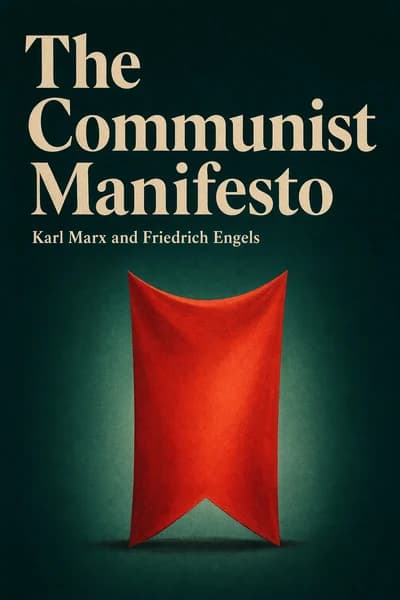
In 1848, a slim pamphlet of barely 12,000 words was published that would go on to become one of the most influential political documents ever written. "A spectre is haunting Europe-the spectre of Communism." With these ominous words, Karl Marx and Friedrich Engels launched their manifesto into a world on the brink of revolution. Today, this text remains required reading in universities worldwide, having sold millions of copies and been translated into hundreds of languages. Celebrities from David Bowie to Tupac Shakur have cited its influence, while political movements across the globe continue to invoke its principles. Whether revered or reviled, The Communist Manifesto stands as a watershed moment in political thought-a text that fundamentally altered how we understand class, economics, and social transformation. Its impact reaches far beyond communist states, having profoundly shaped labor movements, social welfare systems, and political discourse in capitalist societies as well.
Capítulo 2
The Historical Context: Industrial Revolution and Class Struggle
The Communist Manifesto emerged during a period of unprecedented social and economic transformation. The industrial revolution had radically altered the European landscape, creating sprawling factories and urban centers where workers labored under brutal conditions. In 1840s England, children as young as six worked fourteen-hour days in coal mines, crawling through narrow tunnels to operate ventilation doors or haul coal carts. Factory workers in Manchester lived in squalid tenements without sanitation, their life expectancy barely reaching thirty years. Disease was rampant - cholera, typhoid, and tuberculosis spread rapidly through overcrowded housing districts where dozens of families shared single water pumps and privies.
Meanwhile, factory owners amassed fortunes previously unimaginable. Industrial magnates like the Rothschilds in banking and the Krupp family in steel production built vast commercial empires. Their mansions featured indoor plumbing and gas lighting while workers lived without basic amenities. The contrast was particularly stark in cities like London, where elegant neighborhoods stood within walking distance of notorious slums like Seven Dials and Whitechapel.
This disparity between growing wealth and deepening poverty wasn't lost on Marx and Engels. Having witnessed these conditions firsthand-Engels managed his father's textile factory in Manchester-they recognized that this wasn't merely unfortunate circumstance but the systematic result of a new economic order they called "capitalism." Engels documented his observations in "The Condition of the Working Class in England" (1845), providing detailed accounts of worker exploitation that would inform their later collaborative work.
What distinguished Marx from other social critics was his scientific approach. Rather than merely lamenting poor conditions like contemporary reformers such as Robert Owen, he sought to uncover underlying laws governing social development. After years of studying political economy, philosophy, and history, he concluded that human society progresses through distinct economic stages, each defined by its production methods and ownership structure: from primitive tribal societies (with collective ownership) to slave-owning systems, then feudalism, and finally capitalism. Each transition, he argued, was driven by internal contradictions within the existing system.
The Communist League, a small revolutionary organization of German workers and intellectuals, commissioned Marx and Engels to write their manifesto in November 1847. Published in February 1848, it coincided with a wave of revolutions sweeping across Europe-from Paris to Vienna to Berlin-though these ultimately failed to establish working-class power. The document initially received limited attention but gradually gained influence as workers' movements grew throughout the nineteenth century, particularly with the formation of the First International in 1864.
Marx and Engels revised their prefaces over the years, noting how conditions had changed-particularly after the Paris Commune of 1871, which taught them that workers couldn't simply take over existing state machinery but needed to create entirely new forms of governance. The Commune's brief existence-where workers established their own democratic institutions-provided practical lessons about revolutionary politics. Despite these adjustments, they maintained that their fundamental analysis remained sound: history is driven by class struggle, and capitalism creates the conditions for its own demise through its inherent contradictions and cyclical crises.
Capítulo 3
Bourgeoisie and Proletarians: The Central Conflict
The Manifesto's first section presents Marx and Engels' revolutionary analysis of history through the lens of class conflict. "The history of all hitherto existing society is the history of class struggles," they declare, establishing their central framework. From ancient Rome's patricians and plebeians to medieval lords and serfs, society has always been marked by oppressor and oppressed in constant opposition. Under capitalism, these complex class relations have simplified into two great hostile camps: bourgeoisie (capitalists who own the means of production) and proletariat (workers who must sell their labor to survive).
The bourgeoisie, emerging from medieval feudalism, has created unprecedented productive forces through industrialization. "It has accomplished wonders far surpassing Egyptian pyramids, Roman aqueducts, and Gothic cathedrals," Marx and Engels acknowledge. Capitalism has revolutionized production through steam power, machinery, and the factory system. It has transformed sleepy villages into sprawling metropolitan centers, established global trade networks spanning continents, and subjected nature to human domination through chemistry and engineering. The bourgeoisie has also revolutionized social relations, dissolving traditional feudal bonds and replacing them with naked self-interest and cash payment.
Yet this system contains fatal contradictions that manifest in increasingly severe economic crises. The bourgeoisie resembles "the sorcerer who is no longer able to control the powers of the nether world whom he has called up by his spells." Periodic crises of overproduction reveal capitalism's fundamental instability - warehouses fill with unsold goods while workers starve, productive capacity exceeds market demand, and speculation creates financial bubbles that inevitably burst. These crises are resolved only temporarily by destroying productive forces, conquering new markets, or more thoroughly exploiting old ones, merely postponing larger collapses.
Meanwhile, the proletariat develops through distinct historical stages. Initially, workers direct their rage at immediate oppressors - smashing machines, burning factories, attacking individual capitalists - but gradually form trade unions and political organizations as industry concentrates them in urban centers. Factory discipline teaches workers cooperation, while improved communication enables coordination across regions. The bourgeoisie unwittingly aids this process by drawing workers into political struggles against aristocratic privilege and providing them education to operate increasingly complex machinery.
Competition for jobs and national rivalries initially divide workers, but their growing class consciousness eventually overcomes these divisions. Even portions of the bourgeoisie - particularly intellectuals who comprehend the historical movement - join the revolutionary cause, just as aristocrats once joined the bourgeois revolution. Unlike previous revolutionary classes that sought to preserve their particular form of property, the proletariat owns nothing and thus aims to abolish the existing property system entirely.
The bourgeoisie creates its own destruction by concentrating workers in factories, intensifying exploitation to maintain profits, and periodically plunging society into crisis. Modern industry creates a working class with "nothing to lose but their chains" and everything to gain through revolution. As Marx and Engels dramatically conclude this section: "What the bourgeoisie therefore produces, above all, are its own grave-diggers. Its fall and the victory of the proletariat are equally inevitable."
Capítulo 4
The Communist Program: Abolition of Private Property
The Manifesto's second section directly confronts bourgeois objections to communism, particularly regarding property. When accused of wanting to abolish property, Marx and Engels respond bluntly: "Precisely so; that is just what we intend." But they immediately clarify that they specifically target bourgeois property-a system already denying property to nine-tenths of society.
Personal property for use isn't their concern-they aim at capital, property that exploits wage labor. Under capitalism, they argue, living labor merely increases accumulated labor (capital). Property becomes power over others' labor, extracting value without creating it. The bourgeois notion of freedom merely means "free trade, free selling and buying"-freedom to exploit.
Marx and Engels systematically dismantle common objections. When told abolishing property would end productivity, they counter that capitalism already makes workers into appendages of machines while owners contribute nothing productive. When accused of destroying culture, they note bourgeois "culture" merely trains the majority to function as machines. When charged with undermining the family, they argue the bourgeois family is already based on capital and private gain, while proletarians experience its practical absence as economic pressures tear families apart.
Perhaps most controversially, they address accusations of wanting to establish "community of women"-essentially shared sexual access. They turn this charge back on their accusers, arguing that bourgeois marriage already functions as a system of "wives in common" through adultery and prostitution, with bourgeois men treating each other's wives as property while systematically exploiting proletarian women.
On nationality, they assert workers have no country to lose since they have no stake in national wealth. National differences are already vanishing under capitalism's global reach-"national one-sidedness and narrow-mindedness become more and more impossible."
The Communist revolution aims to raise the proletariat to the ruling class and use state power to centralize production. The Manifesto outlines transitional measures including progressive taxation, nationalization of banks, centralization of communication and transport, expansion of state factories, equal liability of all to labor, and free public education. These measures would vary by country but generally involve "despotic inroads on the rights of property."
Their ultimate vision transcends the state itself: once class distinctions disappear through the centralization of production, public power loses its political character. In place of bourgeois society with its classes and class antagonisms, they envision "an association, in which the free development of each is the condition for the free development of all."
Capítulo 5
Critical Analysis of Socialist Alternatives
Marx and Engels devote considerable attention to analyzing competing socialist and communist tendencies, distinguishing their scientific socialism from other variants they consider inadequate or misguided.
Reactionary Socialism encompasses three subcategories. Feudal Socialism represents aristocrats who, having lost political battles against the bourgeoisie, cynically champion workers' interests while actually pursuing revenge against their bourgeois usurpers. Despite occasionally striking at the bourgeoisie's core, feudalists conveniently forget they exploited under different conditions, complaining not that the bourgeoisie created a proletariat but that it created a revolutionary one.
Petty-Bourgeois Socialism represents intermediate classes caught between proletariat and bourgeoisie-small manufacturers, shopkeepers, and peasants facing extinction under modern industry. This socialism accurately diagnoses capitalism's contradictions but proposes reactionary solutions, seeking either to restore old production methods or constrain modern industry within outdated property relations.
German or "True" Socialism emerged when French socialist literature reached Germany as its bourgeoisie began challenging feudalism. German intellectuals appropriated these ideas without their revolutionary context, transforming concrete social criticism into vague philosophical concepts like "Alienation of Humanity." This neutered socialism conveniently served absolute governments against the rising bourgeoisie while representing reactionary petty-bourgeois interests.
Conservative or Bourgeois Socialism represents segments of the bourgeoisie seeking social reforms merely to preserve bourgeois society-essentially wanting "a bourgeoisie without a proletariat." These reformers develop systems requiring workers to abandon hostility toward the bourgeoisie while remaining within existing social boundaries. Their practical variant argues that only economic reforms-not political ones-can benefit workers, yet these never challenge fundamental capital-labor relations.
Critical-Utopian Socialism (Saint-Simon, Fourier, Owen) emerged during the proletariat's infancy. These thinkers recognized class antagonisms but viewed workers as lacking historical initiative. Without material conditions for proletarian emancipation, they sought new social sciences to create these conditions artificially. They substituted personal invention for historical action, appealing to society at large rather than advocating revolutionary action. As class struggle developed, these systems lost practical value, with disciples forming reactionary sects opposing historical development.
Through this analysis, Marx and Engels position their communism as the only truly scientific understanding of capitalism's contradictions and the proletariat's revolutionary potential.
Capítulo 6
Revolutionary Strategy and International Solidarity
The Manifesto concludes by outlining Communist tactics in relation to existing opposition movements, presenting a sophisticated framework for revolutionary action. Rather than forming a separate party opposed to other working-class parties, Communists represent the interests of the entire proletariat across national boundaries. They distinguish themselves through two key approaches: advancing working-class interests regardless of nationality and representing the movement's future while simultaneously fighting for immediate practical aims.
This strategic flexibility manifests differently across various national contexts, demonstrating the Manifesto's nuanced understanding of local conditions. In France, Communists ally with Social-Democrats against the bourgeoisie while maintaining critical distance from purely revolutionary rhetoric, recognizing the practical need for tactical alliances. In Switzerland, they support the Radicals despite their mixed class composition, acknowledging the progressive role these forces play in challenging conservative power. In Poland, they back the party demanding agrarian revolution as a prerequisite for national liberation, understanding that peasant emancipation and national independence are interlinked struggles. In Germany, they fight alongside the bourgeoisie against monarchy and feudal remnants while never ceasing to instill class consciousness in workers, ensuring German workers will ultimately turn bourgeois social conditions into weapons against their creators.
Germany receives special focus as it approaches a bourgeois revolution under advanced European conditions. Marx and Engels predict this revolution will merely prelude an imminent proletarian uprising, reflecting their sophisticated analysis of uneven development. This prediction stems from their observation that Germany combines elements of feudal backwardness with advanced industrial development, creating unique revolutionary potential.
The Manifesto's final paragraph - "The proletarians have nothing to lose but their chains. They have a world to win. Working Men of All Countries, Unite!" - remains one of political literature's most stirring calls to action. This internationalist perspective directly challenged nationalist divisions that kept workers fighting each other rather than their common oppressors, offering a powerful alternative to narrow nationalism.
Marx and Engels understood that capital operated globally and therefore required coordinated global resistance. They identified multiple mechanisms through which ruling classes exploited national differences: promoting xenophobia, encouraging competition between national labor markets, and using colonial exploitation to pacify domestic working classes. Their analysis showed how competition among workers across borders undermined collective bargaining power and suppressed wages globally. Their vision of international proletarian revolution directly opposed both reactionary national chauvinism and the bourgeois cosmopolitanism that merely facilitated global markets while maintaining class exploitation.
The Manifesto's strategic framework remains relevant for understanding how capital uses national divisions to maintain power, and how international solidarity can counter this. Its emphasis on combining immediate practical struggles with long-term revolutionary goals provides a model for political action that acknowledges both the necessity of tactical compromises and the importance of maintaining revolutionary perspective.
Capítulo 7
The Soviet Experiment: A Critical Assessment
The Communist Manifesto's historical significance cannot be separated from the Soviet experiment that claimed its mantle. Vladimir Pozner, who lived in the USSR for nearly forty years and was a Communist Party member for twenty-three, offers a crucial perspective on this implementation. His firsthand experience of the system's daily realities, from the 1950s through the 1980s, provides valuable insights into both its achievements and contradictions.
Marx believed a society without poverty could be created by abolishing private ownership of production means and establishing collective property. The Soviet Union did abolish private property-but crucially, never instituted genuine public collective ownership. Instead, state ownership replaced private ownership, with production means controlled by government bureaucracy rather than democratic worker control. This created a new class of party officials and managers who effectively became the new ruling elite, wielding power over resources and decision-making in ways that often mirrored capitalist hierarchies.
This fundamental distinction undermines claims that Soviet society represented true communism as Marx envisioned. The struggle between the "democratic" world and the "Communist" world was actually between private and state ownership forms-essentially two variants of capitalism, with bourgeois capitalism ultimately proving stronger. The Soviet system developed its own forms of exploitation, with workers still alienated from meaningful control over their labor and working conditions.
Despite this fundamental deviation, the Soviet system did provide aspects that many found admirable: guaranteed employment, free education and healthcare, retirement pensions, and paid vacations. Housing, while often basic, was provided at minimal cost. The literacy rate rose from 37% to near 100% within a generation. The Soviet economic miracle following World War II-rebuilding a devastated country into a superpower-reinforced faith in the system for many adherents. From 1928 to 1955, industrial production increased by 2,049%, though often at tremendous human cost.
Khrushchev's 1956 denunciation of Stalin and the release of Gulag prisoners briefly suggested reform was possible. His "Secret Speech" exposed Stalin's crimes and initiated a period of "thaw" that saw some liberalization in arts and culture. However, events like the 1956 Budapest uprising revealed the system's willingness to crush dissent, with Soviet tanks rolling into Hungary to suppress popular demands for democratic reforms. Many supporters rationalized these actions by comparing them to American interventions abroad in places like Guatemala and Iran, though this moral equivalence ultimately proved unsustainable as evidence of systematic repression mounted.
The Soviet experience raises profound questions about revolutionary transformation. Can state power implement emancipatory change without reproducing domination in new forms? Can centralized planning replace market mechanisms without creating new hierarchies? The Soviet experiment suggests these questions remain unresolved challenges for revolutionary politics. The legacy of this experiment continues to influence debates about socialism, state power, and economic democracy in the 21st century, particularly as new movements seek alternatives to both market capitalism and state socialism.
Capítulo 8
The Manifesto's Enduring Relevance
Nearly 175 years after its publication, why does the Communist Manifesto still resonate? Its continued relevance stems from capitalism's persistent contradictions that Marx and Engels identified with remarkable prescience.
Their description of capitalism as a revolutionary force that "constantly revolutionizes the instruments of production" perfectly captures our era of disruptive technology. Their analysis of globalization-"The need of a constantly expanding market for its products chases the bourgeoisie over the entire surface of the globe"-reads like contemporary commentary on multinational corporations. Their recognition that capitalism "has pitilessly torn asunder the motley feudal ties that bound man to his 'natural superiors'" anticipates ongoing debates about tradition versus modernity.
Even their prediction of economic crises-"commercial crises that, by their periodical return, put the existence of the entire bourgeois society on its trial"-was vindicated by the 2008 financial collapse and subsequent recessions. Their observation that each crisis is resolved "by enforced destruction of a mass of productive forces" and "by the conquest of new markets" remains the playbook of contemporary capitalism.
The Manifesto's analysis of how capitalism commodifies everything-"leaving no other nexus between man and man than naked self-interest"-speaks directly to our hyper-commercialized culture where even personal data becomes a marketable asset. Their insight that capitalism reduces professional work to "wage-labor" anticipates today's gig economy and precarious employment.
Perhaps most relevant is their understanding that capitalism creates immense wealth alongside immense poverty. Today's staggering wealth inequality-with billionaires accumulating fortunes while workers struggle with stagnant wages-confirms this core observation. The fact that eight men now own as much wealth as the bottom half of humanity would not have surprised Marx and Engels.
What keeps the Manifesto vital isn't just its critique but its revolutionary optimism-the belief that human society can be fundamentally transformed through collective action. In an age of climate crisis, pandemic, and resurgent authoritarianism, this vision of collective emancipation offers a powerful alternative to both market fundamentalism and nationalist reaction.
Whether one embraces or rejects its revolutionary program, the Communist Manifesto remains essential reading for understanding our world-a text that, in its own words, cannot be countered by "a holy alliance to exorcise this spectre."
Capítulo 9
The Revolutionary Partnership: Marx and Engels
The Manifesto's power stems partly from the remarkable intellectual partnership behind it. Karl Marx and Friedrich Engels represented an unlikely revolutionary duo that transformed political thought through their collaboration.
Marx, born to a Jewish rabbinical family in Trier, Prussia, became radicalized at university before committing to communism in Paris. Despite living in abject London poverty-three of his children died of malnutrition and illness-he produced monumental works while maintaining revolutionary correspondence worldwide. His systematic analysis of capitalism in Das Kapital remains a cornerstone of economic thought.
Engels came from the very class they criticized-his father owned textile factories in Germany and England. Living a double life as bourgeois businessman and communist revolutionary, Engels directly observed industrial capitalism's effects on workers. His study "The Condition of the Working Class in England" provided crucial empirical foundation for their theoretical work.
Their partnership transcended mere collaboration. Engels financially supported Marx's family for decades, allowing Marx to develop his theories without succumbing to poverty. After Marx's death, Engels dedicated himself to editing and publishing his friend's unfinished manuscripts, ensuring Das Kapital's completion.
What made their partnership revolutionary was the synthesis of Marx's philosophical depth and Engels' practical knowledge of industrial capitalism. Marx contributed dialectical analysis and economic theory, while Engels provided firsthand understanding of factory conditions and military expertise. Together, they created a comprehensive critique of capitalism that integrated philosophy, economics, history, and revolutionary strategy.
Their relationship embodied the intellectual solidarity they advocated-crossing national boundaries (German and English contexts) and class origins (middle-class intellectual and industrial capitalist) to forge a unified revolutionary vision. Their personal friendship demonstrated that consciousness could indeed transcend immediate class interest, as Engels abandoned his class position to support proletarian revolution.
The Communist Manifesto stands as testament to this extraordinary partnership-a document that continues to challenge, provoke, and inspire long after its authors have passed into history. Whether one views it as dangerous revolutionary tract or visionary emancipatory text, its power to move minds remains undiminished by time.