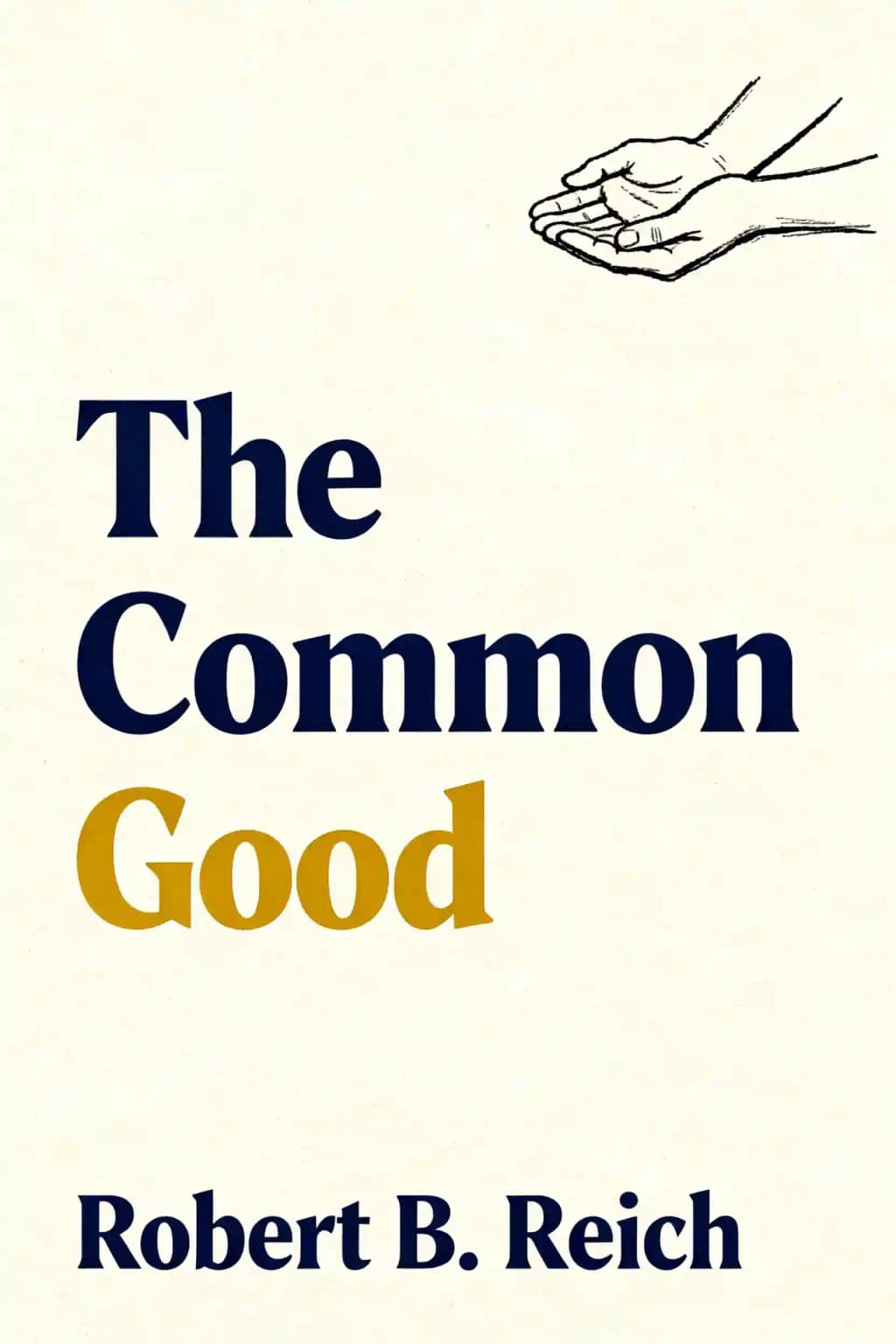
In "The Common Good," Robert Reich confronts our fractured society and asks: Can America survive without shared values? A powerful manifesto for civic responsibility that challenges both conservatives and liberals to rediscover what unites us in an age of toxic tribalism.
Robert B. Reich, author of The Common Good, is a renowned political economist and bestselling author known for his incisive analyses of economic inequality and social policy. A professor at the University of California, Berkeley’s Goldman School of Public Policy, Reich served as U.S. Secretary of Labor under President Bill Clinton, shaping national conversations on labor rights and economic justice.
His book explores themes of civic responsibility and systemic inequality, informed by decades of government service and academic research. Reich’s influential works, including Saving Capitalism and The System: Who Rigged It, How We Fix It, blend policy expertise with accessible storytelling, earning translations into over 20 languages.
A co-founder of The American Prospect and the Economic Policy Institute, Reich’s insights extend to media platforms like his Netflix documentary Saving Capitalism and frequent commentary on economic issues. Honored with the Vaclav Havel Vision Foundation Prize for advancing social thought, he was named one of Time Magazine’s “Ten Most Successful Cabinet Secretaries of the Century.” His books are widely cited in policy debates and academic circles, cementing his legacy as a leading voice for equitable reform.
The Common Good examines how prioritizing shared societal values over individualism can restore civic trust. Reich traces the erosion of collective responsibility through historical events like the 2008 financial crisis and proposes solutions like ethical leadership and civic education. The book argues that systemic greed and corruption undermine democracy, urging a return to moral stewardship.
Civic leaders, policymakers, and readers interested in political ethics or social cohesion will find this book valuable. It offers actionable insights for addressing polarization and revitalizing democratic principles, making it relevant for educators and activists seeking systemic change.
Yes, for its incisive analysis of America’s moral decline and actionable steps to rebuild collective responsibility. Reich blends historical examples with policy ideas, making it essential for understanding modern societal challenges.
Reich argues that selfish individualism—exemplified by corporate greed and political scandals—has eroded trust in institutions. He emphasizes restoring truth-telling in public discourse, reinvesting in civic education, and fostering ethical leadership to realign society with shared values.
He defines it as the shared norms and moral obligations that bind society, such as fairness, honesty, and collective well-being. These principles form the foundation of national identity and democratic stability.
Key examples include Watergate, the 2008 financial crisis, and corporate malfeasance like the Wells Fargo scandal. Reich shows how these events prioritized personal gain over public trust, weakening societal cohesion.
While Saving Capitalism focuses on economic systems, The Common Good emphasizes moral philosophy and civic responsibility. It complements his earlier work by linking ethical values to policy solutions.
Key steps include promoting transparency in governance, prioritizing truth in media, and overhauling education to teach democratic participation. Reich also stresses holding leaders accountable for ethical breaches.
Some argue Reich avoids directly addressing partisan politics, opting for universal principles over partisan accountability. Critics suggest systemic change requires confronting ideological divides more explicitly.
He sees schools as critical for teaching civic engagement, critical thinking, and democratic values. Education, in his view, is the bedrock of sustaining a society oriented toward the common good.
Notable lines include: “A society’s success is measured by its commitment to shared values, not individual wealth” and “Truth is the first casualty of a fractured common good.” These underscore the need for collective moral stewardship.
As polarization and institutional distrust persist, Reich’s framework offers a roadmap for rebuilding ethical citizenship. Its emphasis on unity and accountability resonates amid ongoing debates about democracy’s future.
Sinta o livro através da voz do autor
Transforme conhecimento em insights envolventes e ricos em exemplos
Capture ideias-chave em um instante para aprendizado rápido
Aproveite o livro de uma forma divertida e envolvente
Without this foundation, there is no society.
My investors expect me to maximize profits.
This stakeholder approach fueled rapid economic growth and middle-class expansion in the post-war era.
Divida as ideias-chave de The common good em pontos fáceis de entender para compreender como equipes inovadoras criam, colaboram e crescem.
Destile The common good em dicas de memória rápidas que destacam os princípios-chave de franqueza, trabalho em equipe e resiliência criativa.

Experimente The common good através de narrativas vívidas que transformam lições de inovação em momentos que você lembrará e aplicará.
Pergunte qualquer coisa, escolha a voz e co-crie insights que realmente ressoem com você.

Criado por ex-alunos da Universidade de Columbia em San Francisco
"Instead of endless scrolling, I just hit play on BeFreed. It saves me so much time."
"I never knew where to start with nonfiction—BeFreed’s book lists turned into podcasts gave me a clear path."
"Perfect balance between learning and entertainment. Finished ‘Thinking, Fast and Slow’ on my commute this week."
"Crazy how much I learned while walking the dog. BeFreed = small habits → big gains."
"Reading used to feel like a chore. Now it’s just part of my lifestyle."
"Feels effortless compared to reading. I’ve finished 6 books this month already."
"BeFreed turned my guilty doomscrolling into something that feels productive and inspiring."
"BeFreed turned my commute into learning time. 20-min podcasts are perfect for finishing books I never had time for."
"BeFreed replaced my podcast queue. Imagine Spotify for books — that’s it. 🙌"
"It is great for me to learn something from the book without reading it."
"The themed book list podcasts help me connect ideas across authors—like a guided audio journey."
"Makes me feel smarter every time before going to work"
Criado por ex-alunos da Universidade de Columbia em San Francisco

Obtenha o resumo de The common good como PDF ou EPUB gratuito. Imprima ou leia offline a qualquer momento.
What happens when the unwritten rules that hold a society together begin to unravel? Picture the small American town where nobody locked their doors at night-not out of naivety, but because trust was woven into the fabric of daily life. That world feels increasingly distant. Over the past five decades, something fundamental has shifted in how Americans relate to one another and to the institutions that govern our lives. The common good-that invisible web of mutual obligation and shared values-has been systematically exploited by those with the power to do so. This isn't just about politics or economics; it's about the erosion of trust itself. When Martin Shkreli raised the price of a life-saving drug by 5,000 percent, defending his actions with "This is a capitalist society," he wasn't just being ruthless. He was revealing how far we've drifted from the understanding that we're bound together in something larger than individual gain. The real danger isn't one person's greed-it's that exploitation breeds more exploitation. Like the first thief in that unlocked-door town, early violators of social norms gain tremendous advantage. But once trust breaks, everyone else must adopt costly defensive measures, and the entire system degrades. We're now living in the aftermath of that degradation, and the question facing us is stark: Can we rebuild what's been lost?