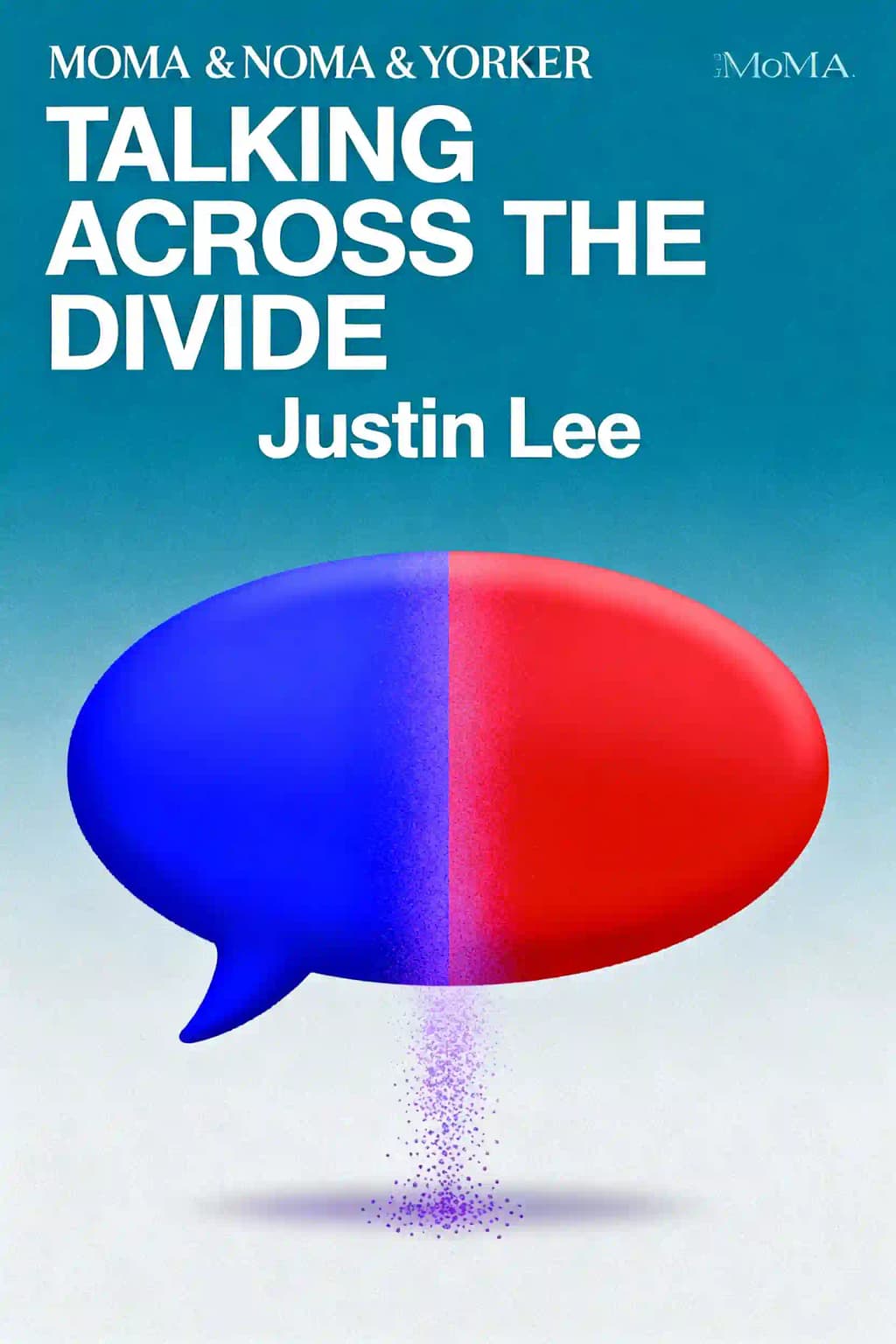
In a world where polarization dominates, Justin Lee's "Talking Across the Divide" offers proven strategies to transform heated disagreements into productive conversations. Could the five barriers he identifies be why 86% of Americans feel misunderstood? Social justice activist Lee reveals the psychology behind changing minds.
Justin Lee, author of Talking Across the Divide: How to Communicate with People You Disagree With—and Maybe Even Change the World, is a renowned bridge-builder and LGBTQ advocate with over 25 years of experience fostering dialogue in polarized spaces.
A faith-based communicator and founder of Nuance Ministries (formerly The Gay Christian Network), Lee blends his background in theological disputes about sexuality—explored in his seminal book Torn, now a college textbook—with scientifically grounded conflict resolution strategies.
His work has been featured in The New York Times, NPR’s All Things Considered, and Anderson Cooper 360, and he speaks globally on grace-centered communication. Lee’s insights stem from reconciling his conservative Southern Baptist upbringing with his LGBTQ advocacy, a journey documented in Torn, which has inspired international support groups and remains a touchstone for faith communities.
Talking Across the Divide expands his methods to political and social divides, incorporating behavioral research and real-world case studies. Translated into multiple languages, Lee’s books are praised for combining practical frameworks with compassionate storytelling.
Talking Across the Divide provides actionable strategies for communicating with people who hold opposing views. Justin Lee combines psychology, personal anecdotes, and research to address five barriers to dialogue—ego protection, loyalty bias, comfort, misinformation, and worldview protection—and offers techniques like strategic dialogue and mirroring to foster understanding and change minds.
This book is ideal for leaders, educators, activists, or anyone navigating polarized relationships. It’s particularly valuable for those seeking to bridge divides in workplaces, families, or communities, especially on contentious topics like politics, religion, or social justice.
Yes—readers praise its practicality, real-world examples, and evidence-based methods. Lee’s approach is used in college courses and by professionals, making it a standout guide for improving communication in divisive environments.
The barriers are:
Lee provides tailored strategies to overcome each.
Strategic dialogue prioritizes active listening and empathy to make others feel heard. By avoiding debates and instead asking open-ended questions, it reduces defensiveness and creates space for reevaluating beliefs, even on deeply held issues.
Mirroring involves paraphrasing someone’s words to demonstrate understanding. This builds trust and lowers resistance, showing the speaker their perspective is valued—a critical step before introducing alternative viewpoints.
Lee advises sharing personal stories of how you corrected your own misconceptions, rather than outright dismissing false claims. Repetition and gentle, evidence-based counterpoints help dismantle misinformation over time.
Yes—the book’s methods are designed for high-stakes conflicts, including politics. By focusing on shared values and using strategic dialogue, it helps break echo chambers and reduces polarization.
Unlike theoretical guides, Lee’s work draws on 25+ years of frontline experience mediating LGBTQ+ and faith conflicts. It blends academic research with actionable steps, emphasizing humility and patience over quick fixes.
Yes. The book includes techniques like role-playing conversations, crafting “bridge-building” questions, and journaling to identify personal biases. These tools help readers apply strategies in real-time.
Some note the process requires significant time and emotional labor, which may not suit all situations. Critics also highlight that success depends on mutual willingness to engage, which isn’t always present.
Lee, drawing from his evangelical background, stresses respecting core identities while gently challenging harmful assumptions. The book advocates finding common ground through shared values rather than attacking beliefs directly.
Sinta o livro através da voz do autor
Transforme conhecimento em insights envolventes e ricos em exemplos
Capture ideias-chave em um instante para aprendizado rápido
Aproveite o livro de uma forma divertida e envolvente
It's like we live on different planets.
Dialogue is more effective than debate at changing minds.
Strategic dialogue is 'an art form, not a magic formula.'
Arguments and debates fail because they create defensiveness.
Divida as ideias-chave de Talking Across the Divide em pontos fáceis de entender para compreender como equipes inovadoras criam, colaboram e crescem.
Destile Talking Across the Divide em dicas de memória rápidas que destacam os princípios-chave de franqueza, trabalho em equipe e resiliência criativa.

Experimente Talking Across the Divide através de narrativas vívidas que transformam lições de inovação em momentos que você lembrará e aplicará.
Pergunte qualquer coisa, escolha a voz e co-crie insights que realmente ressoem com você.

Criado por ex-alunos da Universidade de Columbia em San Francisco
"Instead of endless scrolling, I just hit play on BeFreed. It saves me so much time."
"I never knew where to start with nonfiction—BeFreed’s book lists turned into podcasts gave me a clear path."
"Perfect balance between learning and entertainment. Finished ‘Thinking, Fast and Slow’ on my commute this week."
"Crazy how much I learned while walking the dog. BeFreed = small habits → big gains."
"Reading used to feel like a chore. Now it’s just part of my lifestyle."
"Feels effortless compared to reading. I’ve finished 6 books this month already."
"BeFreed turned my guilty doomscrolling into something that feels productive and inspiring."
"BeFreed turned my commute into learning time. 20-min podcasts are perfect for finishing books I never had time for."
"BeFreed replaced my podcast queue. Imagine Spotify for books — that’s it. 🙌"
"It is great for me to learn something from the book without reading it."
"The themed book list podcasts help me connect ideas across authors—like a guided audio journey."
"Makes me feel smarter every time before going to work"
Criado por ex-alunos da Universidade de Columbia em San Francisco

Obtenha o resumo de Talking Across the Divide como PDF ou EPUB gratuito. Imprima ou leia offline a qualquer momento.
In a world where Thanksgiving dinners become political battlegrounds and social media transforms into tribal warfare zones, we desperately need new ways to communicate. What makes Justin Lee's approach so compelling is his unique position straddling America's deepest divides-as a gay man raised in an evangelical Christian household, he's spent his life as a cultural translator between worlds that often can't comprehend each other. We now live in a nation so divided that people point to different "facts" and make wildly different assumptions about reality. As one of Lee's friends described it, "It's like we live on different planets." This polarization manifests in gridlocked government, stalled progress, and fractured families. Ironically, the internet that should connect us drives us apart. Pre-internet, smaller social circles necessitated resolving disputes with neighbors. Today, we can instantly drop people who disagree while receiving validation from like-minded individuals worldwide. Beyond our conscious choices, technology creates personalized "filter bubbles" showing altered versions of reality. Two people searching for the same term receive entirely different information, reinforcing existing beliefs. This matters because search engines are where most people turn for answers about what's true.