Capítulo 1
The Mental Model Revolution: How Super Thinking Transforms Decision-Making
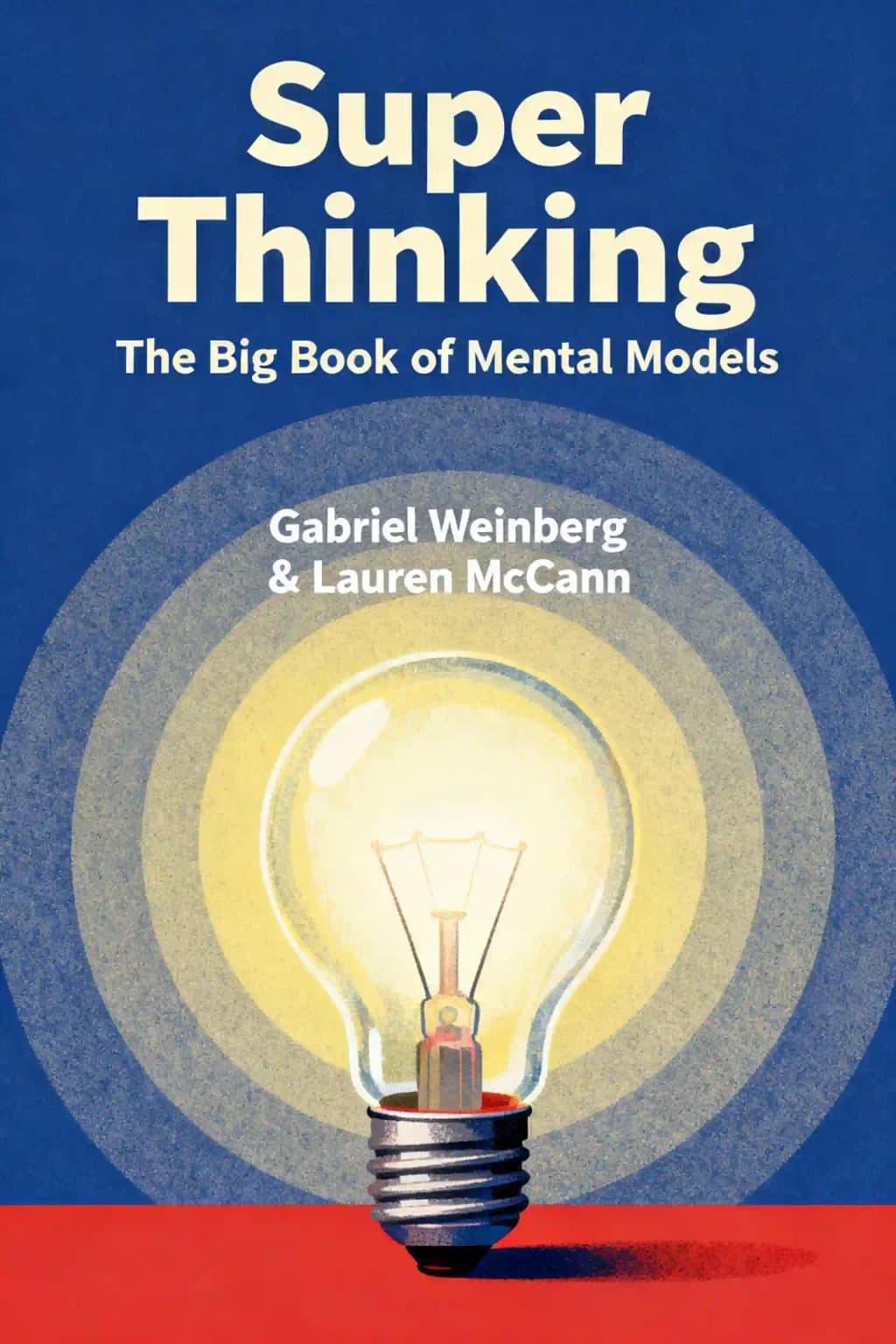
Imagine having a toolkit that lets you analyze any situation with precision, spot patterns others miss, and make decisions with remarkable clarity. This is what mental models offer - powerful frameworks that create quick mental pictures of situations, applicable across diverse contexts. Gabriel Weinberg and Lauren McCann's "Super-Thinking" has become a cult favorite among Silicon Valley executives, Wall Street analysts, and thought leaders like Tim Ferriss precisely because it delivers this toolkit in accessible form. The book's popularity stems from its practical approach to complex thinking - it doesn't just explain concepts but teaches readers how to apply them. As Elon Musk, a vocal advocate of mental models, once said: "You need to view knowledge as a semantic tree. Make sure you understand the fundamental principles before you get into the leaves." This book helps you build that tree, branch by branch, in a way that transforms how you approach every challenge in your professional and personal life.
Capítulo 2
The Building Blocks of Better Decisions
Each morning, after their kids head to school, Gabriel Weinberg and Lauren McCann take walks discussing their lives, careers, and current events. During these daily conversations, they discovered that certain analytical frameworks kept emerging across vastly different topics - from analyzing financial investments to understanding social movements. These recurring concepts ranged from widely-known principles like opportunity cost and confirmation bias to more nuanced ideas like Goodhart's law and availability cascades. These mental models serve as cognitive shortcuts, creating quick mental pictures of situations that can be readily applied to similar scenarios in the future.
Most mental models, despite their fundamental importance, aren't systematically taught in educational institutions, even at the university level. While the authors gained some exposure through their MIT education, they acquired the majority through years of independent reading, professional experiences, and conversations with experts across various fields. These models serve as powerful tools to decode complex situations, identify patterns in seemingly chaotic events, and make more effective decisions in both personal and professional contexts.
The power of mental models lies in their transferability across disciplines. For instance, the concept of "critical mass" originated in nuclear physics but provides valuable insights in social movements, startup growth, and cultural change. "Network effects" from economics helps understand both business dynamics and social media behavior. These broadly applicable models become "super models" that grant the analytical superpower of "super thinking" - a more sophisticated way to process and understand the world around us.
Super models function as intellectual shortcuts to higher-level reasoning. Once you identify relevant models in a situation, you can bypass basic analysis and immediately engage with more sophisticated questions. It's similar to how understanding multiplication eliminates the need for repeated addition - mental models allow you to operate at a more efficient, strategic level of problem-solving. For example, understanding the model of "inversion" allows you to immediately approach problems by considering what could go wrong, rather than just focusing on desired outcomes.
However, mastering these super mental models requires dedication and practice. Like superheroes developing their powers, the journey involves more than just acquiring knowledge. The initial exposure to mental models is comparable to Spider-Man's transformative spider bite - it's just the beginning. True mastery comes through consistent application, learning from mistakes, and gradually building an intuitive understanding of when and how to apply each model. With time and practice, these models become second nature, allowing you to automatically process situations through multiple analytical lenses, much like the Hulk who maintains a constant state of readiness with his "always angry" approach.
The real value emerges when you can layer multiple models simultaneously, creating a rich, multidimensional understanding of complex situations. This ability to combine models - perhaps applying game theory with psychology's anchoring effect while considering systems thinking - creates a powerful framework for decision-making that far exceeds simple cause-and-effect reasoning.
Capítulo 3
First Principles: The Foundation of Sound Thinking
Arguing from first principles is the foundation for being wrong less often. This means thinking from the bottom up, using basic building blocks of what you believe is true to build sound conclusions. First principles are self-evident assumptions forming the foundation of your conclusions - like ingredients for a chef or axioms for mathematical formulas.
With first principles thinking, you can approach unfamiliar situations or find innovative solutions to familiar problems, similar to how NASA engineers improvised solutions during the Apollo 13 crisis using only available materials. Elon Musk demonstrated this approach when challenging conventional wisdom about battery costs, breaking down batteries to their constituent materials to reveal they could be much cheaper than commonly believed.
This approach deliberately starts from scratch, avoiding potential traps of conventional wisdom. Even if you ultimately agree with conventional wisdom, you'll gain deeper understanding.
However, thinking alone isn't enough. Your assumptions need testing in the real world through "de-risking" - identifying and testing critical assumptions that could cause failure. For startups, this means testing assumptions about product buildability, market demand, profitability, competitive advantage, and market size.
The "minimum viable product" (MVP) concept helps test assumptions quickly with just enough features to get real feedback. As Reid Hoffman said, "If you're not embarrassed by the first version of your product, you've launched too late." This prevents "premature optimization" - wasting time perfecting something based on untested assumptions.
This approach extends beyond business to any context: minimum viable organization, communication, strategy, or experiment - because your first plan is probably wrong and needs real-world feedback for improvement.
Capítulo 4
The Lens of Perception: How Framing Shapes Reality
We all see the world through our own frame of reference, which dramatically shapes our perception of reality. In physics, this concept is central to Einstein's theory of relativity - like how a person on a moving train perceives themselves as stationary while an outside observer sees them in motion. Even time itself appears different from different frames of reference.
When making decisions, you must account for your perspective to avoid being unknowingly influenced by it. This requires actively seeking multiple viewpoints to gain fuller understanding.
Framing is a powerful mental model that can work as either trap or tool. How you present information dramatically affects how it's received - like pitching a project as an opportunity to outshine competitors rather than as an expensive resource drain. News headlines demonstrate this effect perfectly, with the same event framed completely differently depending on the source's perspective.
Research shows misleading headlines significantly impair readers' memory of article content, as demonstrated in studies where identical articles with different headlines led readers to remember different facts.
Nudging is another subtle influence technique where small environmental cues push behavior in certain directions. A famous study showed how simply changing verbs in a question about car collision speed (from "contacted" to "smashed") caused people who watched the same footage to estimate dramatically different speeds.
Anchoring reveals how first impressions disproportionately influence decisions. The Economist famously exploited this by offering three subscription options: web-only ($59), print-only ($125), and print+web ($125). Though nobody chose print-only, its presence anchored customers to the higher price point, making print+web seem like a bargain. When the useless middle option was removed, web-only subscriptions jumped from 16% to 68%.
All these effects stem from availability bias - our tendency to overweight information recently or prominently presented to us, explaining why people often believe violent crime is increasing despite decades of decline.
Capítulo 5
The Empathy Advantage: Understanding Others' Perspectives
Understanding others requires deep empathy. Most significant world problems involve people - like how starvation persists despite sufficient global food production because distribution fails due to human factors like corruption.
We frequently misunderstand others' motivations by assuming they share our perspective, context, or circumstances. To overcome this, several mental models can help:
The "third story" approach asks you to imagine how an impartial observer would describe a conflict situation. This helps you see beyond your own narrative and the other person's opposing view to find objective truth. Acknowledging this perspective during difficult conversations reduces defensiveness.
The "most respectful interpretation" (MRI) encourages giving others the benefit of the doubt. When someone doesn't respond to your email, assuming they're busy gathering information builds more trust than assuming they're ignoring you.
Hanlon's razor advises "never attribute to malice what can be explained by carelessness." This is especially valuable online where tone is easily misinterpreted.
These models help overcome the fundamental attribution error - our tendency to blame others' behavior on their character while attributing our own actions to circumstances. This self-serving bias explains why we judge someone running a red light as reckless while justifying our own speeding as necessary.
The "veil of ignorance" asks us to consider policy decisions as if we didn't know our place in society. When contemplating remote work policies, managers should imagine being employees with various life circumstances rather than deciding solely from their privileged position.
The "birth lottery" acknowledges how much success comes from luck rather than merit. The "just world hypothesis" dangerously assumes people always get what they deserve, leading to victim-blaming.
"Learned helplessness" explains why people stop trying to improve difficult situations after repeated failures. Utah's successful Housing First approach to homelessness demonstrates how providing stability and guidance can overcome this condition by helping people regain control of their lives.
Capítulo 6
The Unintended Consequences Trap
Unintended consequences often follow predictable patterns that can be avoided with the right mental models. The tragedy of the commons extends to vaccination, where herd immunity protects everyone when enough people are vaccinated. Historical data shows dramatic reductions in deaths from diseases like diphtheria, measles, and polio following widespread vaccination. However, when vaccination rates drop below critical thresholds (95% for measles), outbreaks occur, as seen in Minnesota in 2017.
The concept of herd immunity applies beyond medicine to social norms and community standards. When enough people violate norms (like Italy's "Only fools pay" attitude toward taxes), negative behaviors become normalized and difficult to reverse. This creates a "putting the genie back in the bottle" problem, where restoring order requires far more effort than maintaining it would have - as seen in hollowed-out urban centers like Detroit.
These unintended consequences are called externalities - effects that spill over to parties not directly involved in an activity. Negative externalities can be internalized through taxes, fines, regulations, or marketplaces like cap-and-trade systems for emissions.
Moral hazard occurs when people take greater risks because they feel protected from consequences - like driving recklessly in a rental car after purchasing insurance. This phenomenon extends to principal-agent problems, where agents (financial advisors, politicians, real estate agents) make decisions for principals but may prioritize their own interests.
Studies show real estate agents sell their own homes for about 3% more than clients' homes by keeping them on the market longer. As Freakonomics explains, this happens because agents earn only 1.5% of the sale price, so an extra $10,000 on your home means just $150 for them - insufficient motivation to hold out for better offers.
Goodhart's law warns that "when a measure becomes a target, it ceases to be a good measure." The Soviet Union discovered this when setting production targets: factories produced useless items that technically met requirements (like single gigantic nails) rather than useful products.
This creates perverse incentives where people focus on achieving metrics rather than desired outcomes. Examples include teachers cheating on standardized tests, hospitals manipulating rankings, and paleontologists discovering locals were smashing large bone fragments into small pieces to maximize bounty payments.
Capítulo 7
The Time Management Revolution
Like Germany fighting on two fronts in both World Wars, dividing your attention between multiple major goals often leads to failure. Multitasking forces your brain to context-switch between activities, wasting time and reducing performance. True breakthroughs come from deep work - focusing intensely on one important problem at a time.
Peter Thiel famously enforced this at PayPal, insisting each person focus on exactly one thing to ensure they tackled A+ problems rather than easier B+ ones. The Eisenhower Decision Matrix helps prioritize tasks by urgency and importance, emphasizing that quadrant II activities (important but not urgent) like strategic planning often get overshadowed by urgent distractions.
Watch out for bike-shedding - groups spending disproportionate time on trivial matters they understand rather than complex important ones. Remember opportunity cost: every choice means forgoing alternatives, so value your time appropriately. This extends to everyday decisions like driving farther for cheaper gas - if you save $2 but spend 6 minutes, you're valuing your time at only $20/hour.
Leverage - like Archimedes' lever that amplifies small force into large movement - is about finding activities that produce outsized results. In finance, leverage means borrowing money to multiply potential gains (and losses). For individuals, high-leverage activities produce the greatest effects for the least effort.
The Pareto principle (80/20 rule) helps identify these opportunities - typically 80% of results come from 20% of efforts. This pattern appears everywhere: 80% of healthcare spending comes from 20% of patients, 85% of wealth owned by 20% of people. When improving a webpage, focus on the headline and hero section for maximum impact.
After addressing this low-hanging fruit, you'll encounter diminishing returns - each additional hour produces less impact. Eventually, you might even reach negative returns, where continuing becomes counterproductive, leading to burnout or injury. The key is knowing when to switch to another high-leverage activity based on opportunity cost.
Capítulo 8
The Power of Systems Thinking
Before the Industrial Revolution, light-colored peppered moths dominated in Manchester, England, using pale trees for camouflage. By 1895, dark moths increased from 0.01% to 98% of the population as pollution darkened trees, demonstrating natural selection in action. When pollution cleared after 1956, light moths returned. This showcases how traits providing reproductive advantages become more prevalent as species evolve to fit changing environments.
Natural selection drives not only biological evolution but also societal evolution, as ideas, practices, and products adapt to changing tastes and technology. With increasing connectivity through the internet and globalization, these societal shifts happen faster than ever before, requiring constant adaptation to changing environmental pressures.
Inertia - an object's resistance to changing its state of motion - applies metaphorically to our resistance to changing beliefs and behaviors. The longer we hold beliefs, especially those formed in childhood, the harder they become to question or revise, even when contradicted by new evidence. Scientific theories evolve (like dinosaur extinction theories or nutritional guidance about saturated fat), but outdated "facts" persist in our thinking.
Organizations suffer from similar inertia through "strategy taxes" - suboptimal decisions made to maintain consistency with long-term commitments. Google's Chrome browser likely won't add strong anti-tracking features because it would contradict their advertising strategy, while Apple's Safari can implement such features without this constraint.
The concept of critical mass explains how ideas gain momentum and permeate society. In physics, critical mass is the amount of nuclear material needed to create a self-perpetuating chain reaction - below this threshold, nuclear elements are relatively harmless; above it, you have enough material for an atomic explosion.
This model applies to any system where accumulation reaches a threshold causing major change, often called a tipping point. Most popular technologies and ideas have tipping points that propelled them into mainstream adoption, following S-curves of adoption. Network effects drive these adoption patterns - the value of a network grows nonlinearly as more nodes join, following Metcalfe's law.
Many global systems like the economy and weather are chaotic systems - while you can identify trends, precise long-term predictions are impossible. Edward Lorenz, pioneer of chaos theory, introduced the butterfly effect metaphor to explain how these systems are extremely sensitive to small changes in initial conditions. This unpredictability makes adaptability crucial for success.
Capítulo 9
Beyond Data: Making Sense of Statistics
Human nature leads us to use past experience to guide decisions, but this shortcut doesn't always yield good thinking. Anecdotal evidence - informally collected evidence from personal stories - often leads to incorrect conclusions when used to make generalizations or when weighted more heavily than scientific evidence. As Michael Shermer notes, "Anecdotal thinking comes naturally, science requires training."
The fallacy that "correlation does not imply causation" often arises when people mistakenly attribute causality between correlated events, overlooking confounding factors that influence both the assumed cause and observed effect. For example, people often blame flu vaccines for illness symptoms that coincide with vaccination, ignoring that vaccines are administered during cold and flu season when people are naturally more likely to get sick.
To evaluate scientific evidence properly, define a hypothesis before collecting data to avoid the Texas sharpshooter fallacy (drawing targets around bullet holes after shooting). The gold standard in experimental design is the randomized controlled experiment, where participants are randomly assigned to experimental and control groups.
When reviewing or conducting experiments, we must be vigilant about subtle biases that can skew results. Selection bias occurs when participants aren't randomly assigned to experimental groups or when samples aren't representative of the broader population. Survivorship bias emerges when we only consider "survivors" while ignoring those who didn't make it - like focusing on successful college dropouts while forgetting countless failed ones.
A fundamental mistake when interpreting data is overstating results from samples that are too small. While the legitimate law of large numbers states that larger samples yield averages closer to the true average, people often fall prey to the fallacy of small numbers. The gambler's fallacy illustrates this - believing a streak of outcomes increases the probability of the opposite outcome next, when each event remains independent.
Conditional probability helps us make better estimates by incorporating additional information. For example, knowing someone is a woman changes the probability estimate for their height. This concept is written as P(A|B) - the probability of A given B. People often confuse this with P(B|A), committing the inverse fallacy.
Replication is essential to verify study results aren't flukes, yet many fields face a replication crisis with fewer than 50% of positive results being reproducible. Data dredging (p-hacking) contributes significantly to this problem - running multiple statistical tests increases the chance of finding a false positive, similar to rolling a twenty-sided die multiple times.
Capítulo 10
Market Power: Building Sustainable Advantages
Extraordinary success requires making contrarian bets that prove correct. The consensus-contrarian matrix shows that being wrong yields no returns regardless of approach. Being right but following consensus yields only regular returns. The real outsized returns come from being both right and contrarian - taking intelligent leaps of faith that others initially dismiss as crazy.
As venture capitalist Andy Rachleff explains, most investors want high returns without risk, which doesn't exist. This reluctance to embrace contrarian thinking explains why many passed on eBay, dismissing it as just "Beanie babies" while others recognized its revolutionary potential. Bill Gurley notes: "Being 'right' doesn't lead to superior performance if the consensus forecast is also right."
Successful contrarian bets require knowing something others don't - what Peter Thiel calls a "secret." These secrets can be ideas others haven't thought of or opportunities hidden in plain sight, like Airbnb connecting property owners with travelers. Timing is crucial - pushing ideas too early wastes resources, as seen with Apple's Newton versus the iPad.
Even brilliant secrets with perfect timing require excellent execution to succeed. Being first to market provides advantages only if you can achieve product/market fit before competitors. As Andy Rachleff explains, "First to market seldom matters. Rather, first to product/market fit is almost always the long-term winner."
When you achieve product/market fit, the effect resembles a resonant frequency in physics - the energy amplifies dramatically, not just incrementally better but exponentially so. Like a glass shattering when struck with precisely the right tone, true market resonance produces 10x results - products flying off shelves, messages deeply connecting with audiences.
Once you achieve product/market fit, it's time to protect your position. Warren Buffett popularized the term "moat" - like the water surrounding a castle - to describe sustainable competitive advantages. These can include protected intellectual property, specialized skills, exclusive access to relationships or materials, strong brands, distribution channel control, uniquely qualified teams, network effects, and a higher pace of innovation.
Organizations with effective moats create "lock-in" when customers perceive "switching costs" as too high. These costs manifest as cancellation fees, trusted relationships, equipment costs, learning curves, network effects, or brand loyalty. Facebook users feel locked in because their social connections are there.
Market dominance is never permanent. Kodak, despite inventing the first digital camera in 1975, failed to pivot effectively when digital photography disrupted their profitable film business. Clayton Christensen's "Innovator's Dilemma" explains this pattern: incumbents face the difficult choice of cannibalizing existing profitable businesses to embrace disruptive technologies.
Mental models unlock higher-level thinking, but require practice to truly master. As Richard Feynman noted, there's a profound difference between knowing a concept's name and truly understanding it. To become a genuine super thinker, find thinking partners who can provide feedback, practice writing to clarify your thoughts, and gradually expand your "circle of competence." As Charlie Munger advises, the most successful thinkers read constantly and practice applying multidisciplinary ideas throughout life.