Capítulo 1
A Spiritual Harvest: Cultivating Faith Through Soil
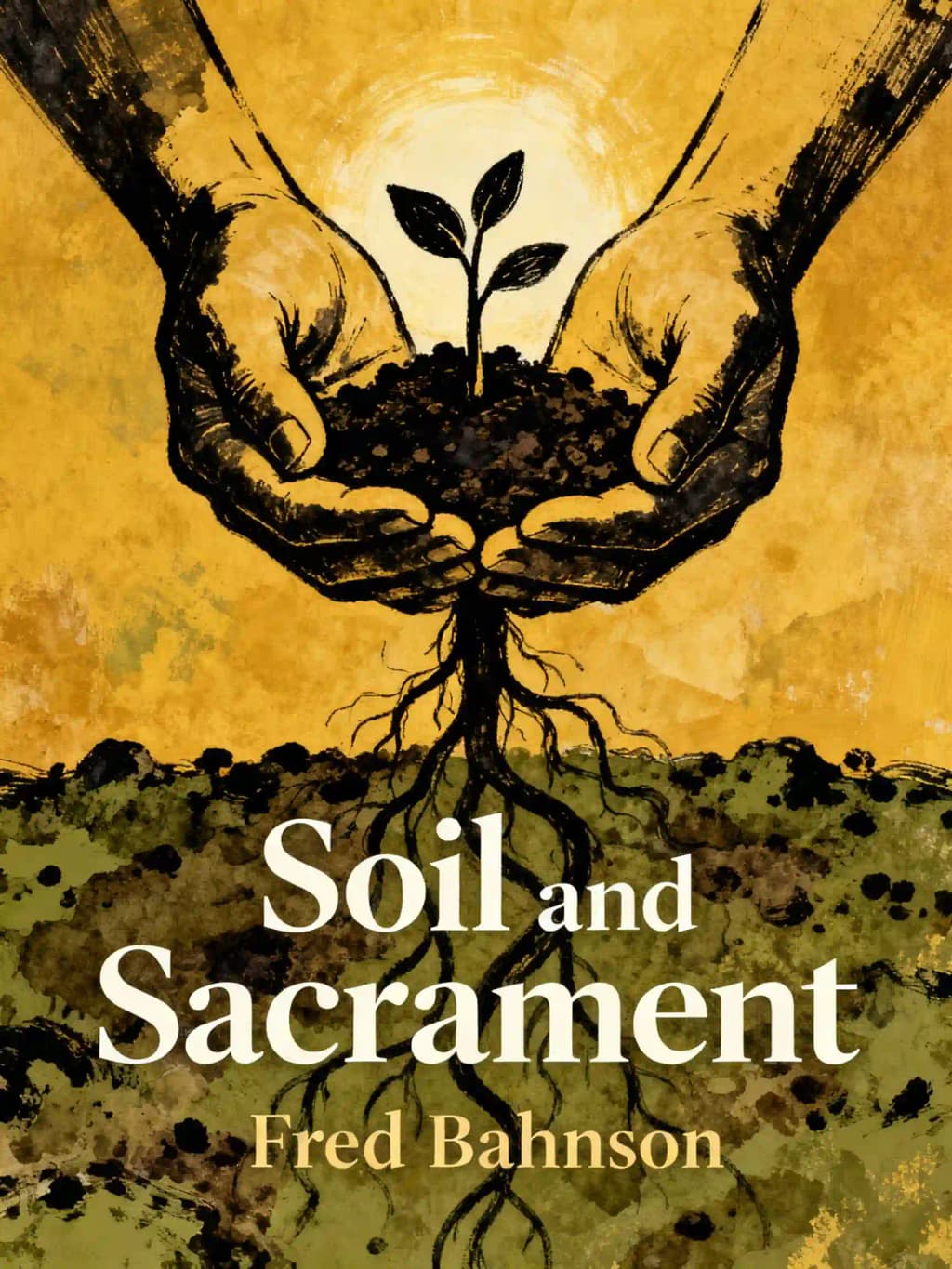
When Fred Bahnson stood alone in Anathoth Community Garden that first Sunday of Advent, he faced a profound realization. Despite creating a thriving five-acre plot with vegetables from arugula to Zapotec tomatoes, he had given himself so completely to the land that little remained for his family. The garden had become an extension of his body, but his soul was withering. This moment of reckoning would launch him on a pilgrimage across America to discover how faith communities were reconnecting spirituality and agriculture. Published in 2013, "Soil and Sacrament" quickly became a landmark text in the growing food and faith movement, with Barbara Kingsolver praising it as "a beautiful exploration of humanity's oldest act of faith." The book arrived as Americans were increasingly questioning industrial food systems and seeking more meaningful connections to what they eat. Bahnson's journey reveals how working the soil isn't merely about growing food-it's about cultivating the human spirit.
Capítulo 2
The Monastic Rhythm: Finding God in Darkness and Soil
Prayer begins in darkness. At Mepkin Abbey, a Trappist monastery in South Carolina, the 3 AM buzzer summons monks from their cells into the twenty-degree December night. They glide silently across the cloistered lawn into the abbey church, where the faint aroma of incense lingers. Near the bare granite altar stands a leafless poplar tree in an earthen pot, symbolizing winter's barrenness and Advent's expectant waiting.
This is where Bahnson's pilgrimage begins-seeking a rooted spirituality where he might meet Jesus "crouching in the dirt." The monks' daily rhythm alternates between prayer and work (ora et labora), a balance that had eluded him at Anathoth Garden. During his week-long retreat, he joins the brothers in their mushroom operation, where they pack pasteurized wheat chaff, cottonseed hulls, and mushroom spawn into long plastic tubes.
Brother Anthony-Maria, a former Philadelphia cab driver with quiet demeanor but lively humor, shares his journey to monasticism: "I wanted to pray like Saint Anthony and become light." Brother Dismas, slight but wiry strong, had come to the Trappists after studying theology at Notre Dame, realizing he "needed to put the faith in my hands." For these monks, manual labor is incarnational-"Jesus became flesh, muscle, sinew. He put his body where the question was." The monastic life anchors spiritual seeking through bodily discipline.
The choreography of monastic life is a constant movement between retreat and connection, a dance rehearsed for 1,500 years. As Rilke wrote: "The stir of departure-Someone being carried to his grave, and another, taking up the pilgrim's staff, to ask in unknown places for the path where he knows you are waiting."
During Bahnson's final Vespers at Mepkin, the Lord's Prayer brings him to tears. The liturgy breaks his heart open toward God. He realizes these monks aren't spiritual escapists fleeing the world, but humans confronting their own wayward hearts, united in seeking the Divine Mystery. After the service, a palpable fullness lingers in the air as they all move about, drunk on God's presence.
Father Kevin advises him to set aside twenty minutes of silence each morning and practice gratitude, which leads to humility, then praise, and finally attention to those with whom he shares life. Most of us aren't called to solitude or chastity, but to embrace God while also embracing one another. Mepkin offers some answers about sacramental cultivation of soil and spirit, but Bahnson needs to dig deeper into his calling to feed people.
Capítulo 3
Roots of Vocation: From Activism to Agriculture
Before becoming a gardener, Bahnson sought peace as a Christian activist in Chiapas, Mexico. In 2001, after divinity school and nonviolent activist training, he joined Las Abejas ("the Bees"), a Mayan Catholic civil society targeted by government persecution. Their motto: "Our Weapon is the Word of God." He wanted to stand with these modern martyrs before the next attack.
In their San Cristobal courtyard, his fellow peace activist Lino cultivated the "three sisters"-corn, beans, and squash-using indigenous techniques that had sustained Mesoamericans for millennia. The corn provided structure for the beans, which fixed nitrogen for the corn, while squash vines covered the soil to retain moisture. This ancient agricultural wisdom would later inform Bahnson's own farming practices.
On Maundy Thursday, Jose invited Bahnson to his home where his wife Angelina prepared a traditional breakfast. He watched her make waj (tortillas) from masa ground on an ancient mortar passed down through generations. Speaking Tzotzil while eating waj and chenek (black beans) felt like participating in an ancient liturgy-eating his way into mystery. As Robert Farrar Capon writes, "Man's real work is to look at the things of this world and to love them for what they are."
After breakfast, Jose and Bahnson hiked through Yibeljoj, where paramilitaries watched them silently, then up to his coffee fields. With only machetes, they cleared woody weeds and laid them against the slope to prevent erosion and nourish the cafetales. This simple work-scrape, pull, chop, sweep-felt like co-creation with God. The Abejas embodied the Hebrew understanding of peace as shalom, a completeness where God, people, and land dwell in harmony.
Before they parted, Jose handed Bahnson a bag of yellow maiz seeds, saying "Los sembras en su propio suelo" (Plant them in your own soil). This simple gift would become a metaphor for Bahnson's emerging vocation.
On the San Cristobal rooftop, reading Isaiah 30, he finally understood his calling: "This is the way; walk in it." The way would lead him to farming-becoming a co-creator with God by caring for soil. That summer of 2001, he planted his first garden on his parents' land in North Carolina. He tried planting Jose's maiz kernels, but crows ate them before they could sprout-a lesson in the patience and perseverance farming requires.
Capítulo 4
The Lord's Acre: Growing Community Through Shared Harvest
The spring after his Mepkin Abbey visit, Bahnson explored a garden in western North Carolina that originated from a Depression-era farming ministry. In 1935, Secretary of Agriculture Henry Wallace praised the Lord's Acre Plan, a project created by James G.K. McClure, a Presbyterian minister who had established the nationally renowned Farmers' Federation cooperative in 1920. McClure's plan revived the biblical concept of tithing by encouraging farmers to plant an extra acre for God. The initiative spread quickly but eventually faded after World War II.
In 2008, Bahnson's father-in-law Will Hamilton helped revive McClure's idea, creating a communal food garden to supply fresh organic vegetables to the local food pantry. This reincarnation, also called the Lord's Acre, began the same year Bahnson left Anathoth.
Garden manager Susan Sides, a former writer for Mother Earth News, shared stories like that of "Emma," a troubled neighbor who stole watermelons from the garden. Rather than retaliating, Susan showed remarkable patience and grace, embodying the Eastertide spirit of generosity.
The half-acre garden produced an astounding eight tons of vegetables annually, all donated to Food for Fairview, which served about seventy-five families weekly. Beyond just feeding the hungry, the Lord's Acre created a space where Christians and non-Christians worked together harmoniously. As Susan concluded, "Everyone who comes here hungers for something. Some hunger for food. Others hunger for community. Or beauty. But we all hunger."
The Lord's Acre also inspired the Fairview Welcome Table, a weekly community feast modeled after a Black Mountain chef's initiative-not a dreary soup kitchen but a dignified meal with white tablecloths and silverware, free to anyone who needed it. Breaking bread together has been Christianity's central ritual since the Last Supper, yet modern churches have lost their connection to daily bread.
Wednesday evenings at the Lord's Acre were community workdays, often featuring potlucks and music. Rosetta, owner of a popular vegan restaurant, brought food for everyone, explaining: "Food is the physical embodiment of prayer. When people are fed, they are warm and relaxed. It's how you reach people."
Capítulo 5
Anathoth Garden: Planting Seeds of Reconciliation
In 2004, while Bahnson's wife Elizabeth interned at a small Methodist church in rural Cedar Grove, tragedy struck when local store owner Bill King was murdered. At a prayer vigil following his death, Scenobia Taylor, a Black landowner whose ancestors had been sharecroppers, was moved to action. After a dream in which God told her to donate land to the community, she eventually gave five acres to Cedar Grove UMC with the stipulation it would remain a community garden in perpetuity.
Pastor Grace initiated community conversations about faith and land, inviting Bahnson to help start a garden. Despite his initial reluctance, he felt an unmistakable internal summons-not a voice but a Presence slowly filling his imagination until he could think of nothing else. Based on one meeting, he quit his writing job without another lined up, applied for grants, and in August 2005 joined the church staff as garden director. It was foolish looking back, but a holy kind of foolishness.
When Bahnson read Jeremiah, he found their mission. The prophet instructed exiles in Babylon to "plant gardens and eat what they produce" and to "seek the shalom of the city." Shalom isn't just absence of violence but living harmoniously with community and land. Jeremiah linked garden-planting with seeking shalom-symbiotic practices like companion planting. His message wasn't to fight Babylon but to opt out and flourish where you're planted.
Yet their situation was complex-they weren't exiles but privileged landowners surrounded by the truly marginalized: rural poor, migrant workers, and addicts. Within five miles of Cedar Grove, twenty families lacked indoor plumbing. North Carolina had a rapidly growing Latino population displaced by NAFTA's economic pressures. Welcoming these landless people to grow food at what they named "Anathoth Garden" seemed one way to seek shalom.
Not everyone supported the garden. Some of Scenobia's family questioned why she'd give land to a white church. Church members worried about theft or violence since the land sat near where Bill King was murdered and near known crack houses. Racial tensions surfaced-when Pastor Grace had welcomed the church's first Black member years earlier, some had left in protest. When one member suggested building the garden closer to the church, Pastor Grace responded, "The reasons you don't want to build the garden down there are exactly the reasons why we should."
Capítulo 6
Tierra Nueva: Healing Wounds Through Working the Land
Bahnson's pilgrimage next took him to Tierra Nueva ("New Earth") in Washington's Skagit Valley, where Bob and Gracie Ekblad had created a transformative ministry serving society's most marginalized members - migrant workers, gang members, and those struggling with addiction. Their farm operation was deliberately modest - just an acre of vegetables with a few weathered outbuildings - but its impact on the community proved far more extensive than its physical footprint suggested.
The farm's labor force consisted primarily of juvenile offenders performing court-mandated community service. Among them was Porky, a young Latino who discovered that the rhythms of agricultural work offered a compelling alternative to "getting high all day." The farm's structured environment provided these youths with something many had never experienced: the satisfaction of seeing direct results from their labor. Through planting, tending, and harvesting crops, they learned valuable lessons about patience and delayed gratification - qualities that stood in stark contrast to the immediate but destructive rewards of street life.
One of Tierra Nueva's most compelling narratives centered on Bones, once the most feared gang shot-caller in Skagit Valley, now serving time in solitary confinement. His story illuminated the cyclical nature of poverty and violence in agricultural communities. Bones had spent his earliest years in these same fields, watching his mother pick berries while secretly running a dangerous side business selling cocaine-filled burritos to other workers. His childhood was a catalog of trauma - sexual abuse, extreme violence (including shooting a rival gang member when he was just ten), and witnessing both his stepfather's suicide and a neighbor's brutal murder.
By twenty-nine, having spent nearly half his adult life behind bars, Bones experienced an unexpected spiritual awakening. He conceived a vision for "Hope for Homies," a farm-based rehabilitation program for troubled youth - a particularly surprising development given his professed hatred of animals. Despite his horrific past, something in his hands seemed to remember the soil's regenerative potential, suggesting the possibility of redemption through working the land.
During Bahnson's prison visit, Bones articulated his dream with surprising tenderness - he wanted to create what his own childhood had lacked: a peaceful garden sanctuary where children could play without fear of violence or drugs. His "Hope for Homies" initiative would extend beyond just farming to provide refuge for pregnant teenagers and abandoned children, creating the supportive community he never had. The conversation's emotional climax came when Bones, searching for words during their recorded interview, finally landed on "embrace" - a powerful metaphor for both the acceptance he sought and hoped to offer others.
After the prison visit, Chris directed Bahnson to Ezekiel's prophetic vision about people finding security on their soil when divine intervention breaks their bonds of oppression. During a final gathering with Bob and Chris, they prayed over Bahnson's chronic back injury. The author experienced an unexpected moment of spiritual transformation - what he called a "baptism of tears" - feeling waves of warmth, fullness, and temporary physical relief through their touch and prayers, reinforcing the farm's mission of holistic healing through community and connection to the land.
Capítulo 7
The Garden as Sanctuary: Creating Space for Healing and Connection
The Anathoth garden evolved into far more than a place to grow vegetables - it became the beating heart of the community, fostering connections across social, economic, and cultural divides. The garden's internship program attracted idealistic college graduates from across the country, who found themselves immersed in experiences far removed from their academic studies. These young interns learned practical farming skills while navigating delicate social situations, like delivering fresh produce to Mrs. Terrell, who became notorious for answering her door in various states of undress, teaching them lessons in dignity and humor that no classroom could provide.
The garden attracted an eclectic cast of regular characters, none more memorable than Burley, who made his grand entrances on a riding lawnmower that resembled a mobile patriotic display. His machine, festooned with American flags, spinning pinwheels, and an array of humorous license plates, became as much a fixture of the garden as the vegetables themselves. Though living on disability payments, Burley found purpose in volunteering to maintain the grass areas, his contribution saving countless hours of manual labor. His enthusiasm was so infectious that he was immediately welcomed as a full member of the garden community.
The partnership with Apogee Homes brought new dimensions of both joy and challenge to the garden. Twice-weekly visits from their residents created a rhythm of interaction that enriched everyone involved. Ninety-two-year-old Miss Marie would spend hours carefully planting seeds, whispering encouragement to each one as if sharing secrets with grandchildren. Her gentle presence contrasted with other residents like Mack, who would regale anyone within earshot with detailed stories about the "good old days" of farming with DDT, while Miss Odell developed a mischievous habit of rearranging plant labels, creating amusing confusion during harvest time.
The garden's true power lay in its ability to facilitate profound human connections across traditional social boundaries. When Clarence, a young man with severe disabilities, found comfort resting his head on Bahnson's shoulder while they worked together, it transcended the usual caregiver-client relationship. Similarly, Adela, who had recently lost her husband and relocated from Michoacan, found solace in the familiar rhythms of agricultural work. Her bleached white hands, marked by years of domestic labor, joined others in carrying water buckets from the creek before the well was installed, demonstrating how physical labor could bridge cultural and linguistic gaps.
These daily interactions revealed the garden's deeper purpose as a sanctuary for healing and human connection. It became a space where social hierarchies dissolved naturally through shared work and purpose. The privileged worked alongside the marginalized, college graduates learned from experienced farmers, and everyone discovered that the soil held wisdom about more than just growing food. The garden created an environment where mutual respect and understanding grew as abundantly as the vegetables, proving that the most valuable harvest was often the human connections cultivated alongside the crops.
Capítulo 8
Adamah Farm: Harvesting Ancient Wisdom for Modern Hunger
Bahnson's final pilgrimage took him to Adamah Farm at the Isabella Freedman Jewish Retreat Center in Connecticut during Sukkot, the Jewish harvest festival. Unlike pagan harvest celebrations focused on fertility gods, Sukkot commemorates Israel's forty years of desert wandering and God's provision. The temporary shelters (sukkahs) remind Jews of their dependence on God rather than permanent dwellings.
According to Deuteronomy, Sukkot uniquely commands joyfulness and inclusion of everyone-"your son and daughter, your male and female slave, the Levite, the stranger, the orphan, and the widow." Danny, a rabbinical student who helps Bahnson navigate Jewish practices, explains that "the agrarian setting is key" to experiencing this commanded joy.
At the Center for Cultural Proliferation, Bahnson joins Sam in making kimchi with "artisanal" proportions of garlic, cabbage, and other ingredients. The visceral, ancient work of pounding cabbage with a three-foot wooden mallet satisfies his peasant yearnings. This fermentation work connects him to ancient food preservation practices that sustained communities through winter.
Janna takes Bahnson to see the Sadeh, their four-acre field devastated by Hurricane Irene. Before the storm, it was "a farm in full swing" producing 30% of their yearly income. After the flood waters receded, they found rotted crops, lost topsoil, and sand deposits. "It was hard to look at-I was crying-but I was also just awed by the beauty. It was thrilling. It was so surreal." Despite the loss, Janna maintains perspective: "In organic agriculture we say we're not lords over the land. The flood showed me how I had approached the land with too much control."
Nigel believes Jews should "evangelize" practices like Sabbath and keeping kosher (asking "Is this fit to eat?"). "Planet Earth right now needs Shabbat. I don't care whether you keep it on Friday or Sunday or Tuesday, but just think if seven billion people set aside one day a week to just stop." Most Jews are "freaked out about being perceived as arrogant," but Nigel sees Judaism as "an amazing, miraculous part of the ecosystem of Planet Earth" that should be shared more widely.
Capítulo 9
A Vision for Spiritual Agriculture: Cultivating Shalom in Broken Soil
A year after his visit to Mepkin Abbey, Bahnson settled with his family on his parents' mountain farm. They created a permaculture orchard and terraced vegetable beds on their hillside-the same place where he once unwittingly fed crows with Jose's maiz. Though directing a Food & Faith program at a divinity school, their family maintains a rich subsistence garden that provides vegetables year-round and a dozen fruits. They ferment kimchi and sauerkraut, cook most meals from scratch. Though their income is modest, their life feels "indescribably rich, abundant, blessed."
Father Kevin's wisdom proves true-the more Bahnson gives thanks, the more he sees everything as gift. Inspired by Mepkin, he's begun cultivating mushrooms, learning which wild ones offer meals and which bring death. But he doesn't rely on serendipity; like prayer, mushroom growing requires cultivation. He stacks shiitake logs behind his house, watching mycelium connect dead wood with living soil in a reciprocal relationship.
Anathoth's vision of shalom continues spreading. Bahnson has encountered dozens of similar faith-infused garden projects worldwide, each sharing a desire to deepen faith through connection to land and community. When he asks what motivates their work, answers vary but all address the hunger Susan mentioned-not just for good food but for friendship and communion. Unlike coffee shops where people stare at screens, communal gardens create genuine interaction across boundaries. "In a garden there's no hierarchy," Susan Sides notes.
Other examples flourish, like Genesis Farm in New Jersey, where "eco-nuns" of the Sisters of Saint Dominic have practiced Green Christianity for thirty years through CSA programs, eco-literacy, and Transition Town trainings that prepare communities for a post-fossil fuel world. The London Ferrell Community Garden in Lexington, Kentucky serves as a place for racial reconciliation, honoring a black minister who heroically remained during a cholera epidemic but whose grave was later excluded when the white Episcopal cemetery erected a fence.
Even bikers are joining the movement. Crossfire United Methodist Church in North Wilkesboro, North Carolina-a congregation of bikers, ex-convicts, and recovering addicts-runs food ministries serving one of the state's poorest counties. "Man, all this time," Pastor Duncan told Bahnson, "bikers just want people to know that we're people, too. We just want to feed people."
For those asking how to start a project like Anathoth, Bahnson offers these guidelines: Find land, even poor land, because you can create good soil. Secure water through wells, irrigation, swales, ponds or cisterns. Avoid building fences or locking gates-if someone takes your produce, let them. Buy only the best tools-digging forks, spades, scythes, rakes, trowels, wooden flats, and a U-bar broadfork that will last generations. Use machines sparingly, as they compact soil and substitute power for knowledge. Plant the best organic seed in compost-fed soil.
Most importantly, welcome the strays, the rejects, the outliers. Though you need responsible workers, your garden is primarily for the widow in her negligee, the exhausted migrant worker, the troubled souls with their shadowed fears and unnamed sorrows. Find the meek and lowly, those who struggle to complete tasks or fill out forms. Love them-they are your garden's prize crop. For theirs is the kingdom of heaven. With them did the Son of Man go eating and drinking. It is they who will inherit the earth.
Soil is truly a portal to multiple worlds-opening us inward to God's mercy and love, and outward to the needs of others and the joyful messiness of human connection. Our hunger defines us-one part pain, one part desire-and we shouldn't be ashamed of our ache to be filled. As a stream seeks the sea, our souls seek the Ground of our being. Our desire makes us most like God.