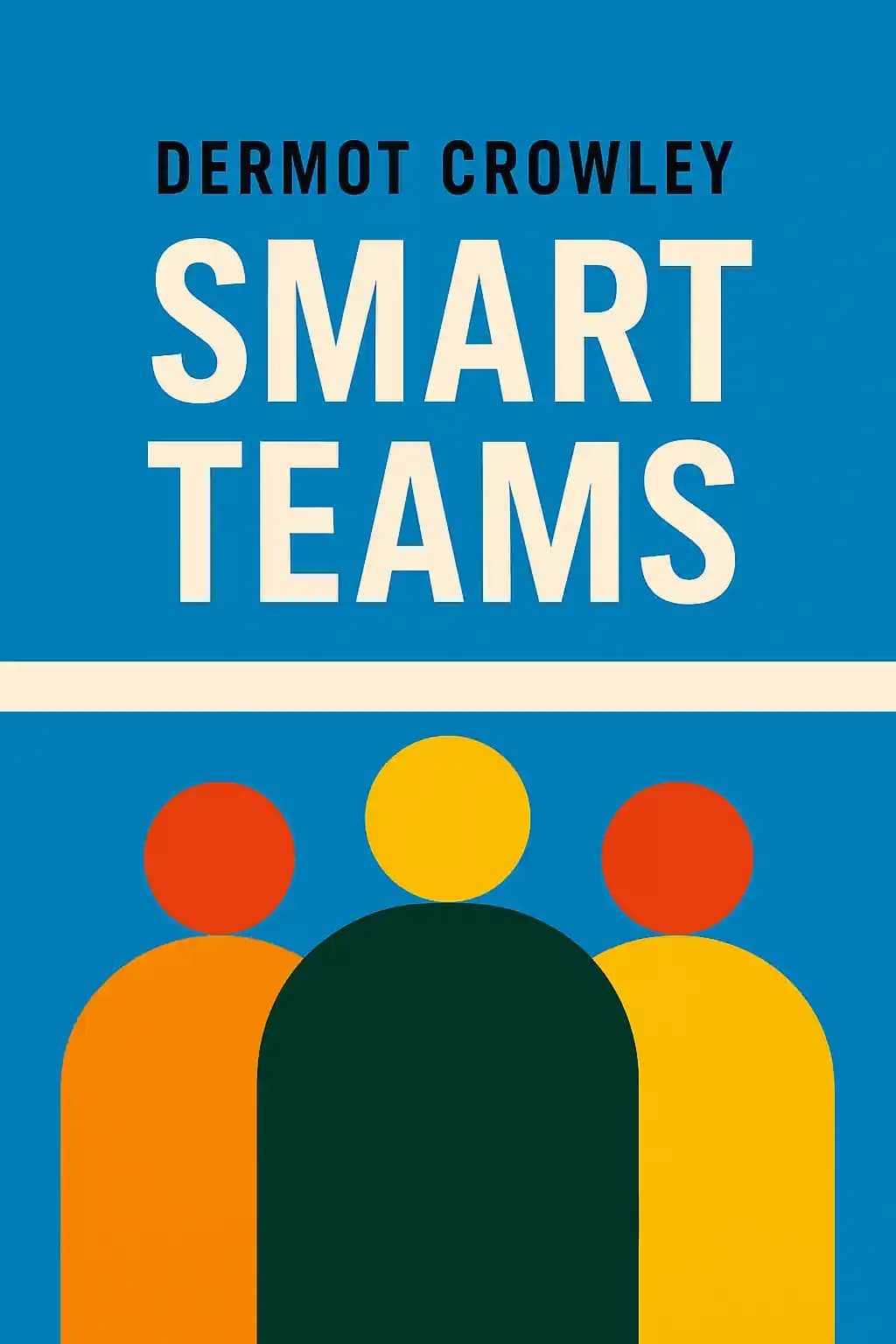
"Smart Teams" reveals how to eliminate workplace friction that silently kills productivity. Dermot Crowley's 2018 guide has become essential reading for business leaders seeking the elusive balance between communication and efficiency. What hidden productivity killer is your team facing right now?
Dermot Crowley, author of Smart Teams, is an Australian productivity expert and founder of Adapt Productivity, specializing in workplace efficiency and collaborative strategies.
With over two decades of experience, Crowley has established himself as a leading voice in modern productivity, blending practical frameworks with tools like Microsoft Outlook to transform team dynamics. His work emphasizes prioritizing tasks, reducing digital overload, and fostering accountability in fast-paced environments.
Alongside Smart Teams, he authored the bestselling Smart Work and Urgent!, which provide actionable systems for individual and organizational effectiveness. Crowley’s methodologies are widely adopted by Australian corporations, financial institutions, and government agencies, cementing his reputation as a trusted advisor in operational excellence.
His insights have been featured in corporate training programs and industry conferences, focusing on aligning technology with human behavior. Smart Teams has been recognized as a practical guide for leaders aiming to optimize collaboration in hybrid work models.
Smart Teams by Dermot Crowley provides actionable strategies to transform unproductive team behaviors into collaborative, high-performance workflows. It emphasizes fostering "superproductive" cultures by reducing email overload, streamlining meetings, and improving project coordination. The book equips leaders and teams with principles to enhance communication, accountability, and work-life balance while achieving impactful results.
This book is ideal for managers, team leaders, and professionals seeking to improve team productivity and collaboration. It offers practical guidance for those struggling with inefficient meetings, email overload, or fragmented workflows. Remote teams, project managers, and organizational leaders will find actionable tactics to build trust and drive results.
Yes, Smart Teams is valuable for its evidence-based frameworks to address common productivity pitfalls. Crowley combines leadership insights with step-by-step strategies, such as creating team charters and reducing interruptions. Reviews highlight its practicality for fostering accountability and improving workplace dynamics.
The book outlines four pillars of high-performing teams: purpose, autonomy, mastery, and collaboration. It stresses aligning teams around clear goals, empowering decision-making, developing skills, and fostering open communication. Crowley also emphasizes "superproductivity" through intentional workflows and reduced distractions.
Crowley advocates for fewer, shorter, and more focused meetings. Tips include setting agendas, limiting attendance to key stakeholders, and using collaboration tools for pre-meeting updates. The goal is to minimize time wasted in unproductive discussions and prioritize actionable outcomes.
"Superproductive" behaviors involve minimizing interruptions, reducing email noise, and promoting deep work. Teams establish norms like designated "focus hours," clear communication channels, and project management systems to avoid multitasking and context-switching.
The book recommends setting email protocols, such as avoiding unnecessary "reply all" responses and using subject-line keywords (e.g., "ACTION" or "FYI"). Teams are encouraged to replace lengthy email threads with quick check-ins or collaborative platforms for real-time updates.
Leaders are tasked with modeling productive behaviors, setting team agreements, and providing resources for success. Crowley highlights the importance of trust-building, conflict resolution, and empowering team members to take ownership of their roles.
Yes, the strategies apply directly to remote work, emphasizing clear communication, structured collaboration tools, and outcome-focused goals. Crowley advises leveraging technology for asynchronous updates while maintaining regular check-ins to sustain team cohesion.
Smart Teams expands on concepts from Crowley’s Smart Work (focused on personal productivity) by addressing team dynamics. It provides complementary frameworks to align individual efficiency with collective goals, ensuring organizational coherence.
Some may find the strategies overly reliant on self-discipline or organizational buy-in. Critics note that implementing cultural shifts requires sustained effort, which may challenge teams resistant to change. However, the book’s structured approach mitigates these hurdles.
With remote work and AI-driven tools reshaping collaboration, Crowley’s focus on intentional communication and workflow optimization remains critical. The principles adapt well to evolving workplace trends, helping teams navigate digital distractions and maintain productivity.
Sinta o livro através da voz do autor
Transforme conhecimento em insights envolventes e ricos em exemplos
Capture ideias-chave em um instante para aprendizado rápido
Aproveite o livro de uma forma divertida e envolvente
Slowing down actually helps teams accomplish more.
The missing piece isn't individual productivity-it's team productivity.
Most of this information is just noise drowning out important signals.
Constant distractions and interruptions fragment our attention.
We need is a slow work movement.
Divida as ideias-chave de Smart Teams em pontos fáceis de entender para compreender como equipes inovadoras criam, colaboram e crescem.
Destile Smart Teams em dicas de memória rápidas que destacam os princípios-chave de franqueza, trabalho em equipe e resiliência criativa.

Experimente Smart Teams através de narrativas vívidas que transformam lições de inovação em momentos que você lembrará e aplicará.
Pergunte qualquer coisa, escolha a voz e co-crie insights que realmente ressoem com você.

Criado por ex-alunos da Universidade de Columbia em San Francisco
"Instead of endless scrolling, I just hit play on BeFreed. It saves me so much time."
"I never knew where to start with nonfiction—BeFreed’s book lists turned into podcasts gave me a clear path."
"Perfect balance between learning and entertainment. Finished ‘Thinking, Fast and Slow’ on my commute this week."
"Crazy how much I learned while walking the dog. BeFreed = small habits → big gains."
"Reading used to feel like a chore. Now it’s just part of my lifestyle."
"Feels effortless compared to reading. I’ve finished 6 books this month already."
"BeFreed turned my guilty doomscrolling into something that feels productive and inspiring."
"BeFreed turned my commute into learning time. 20-min podcasts are perfect for finishing books I never had time for."
"BeFreed replaced my podcast queue. Imagine Spotify for books — that’s it. 🙌"
"It is great for me to learn something from the book without reading it."
"The themed book list podcasts help me connect ideas across authors—like a guided audio journey."
"Makes me feel smarter every time before going to work"
Criado por ex-alunos da Universidade de Columbia em San Francisco

Obtenha o resumo de Smart Teams como PDF ou EPUB gratuito. Imprima ou leia offline a qualquer momento.
In today's workplace, genuine productivity feels increasingly elusive. We've mastered personal productivity hacks yet still drown in emails, meetings, and urgent requests. Why? Because we're missing the crucial piece: team productivity. The counterintuitive truth is that slowing down actually helps teams accomplish more. Think of productivity like sailing a boat-when barnacles build up on the hull, you expend enormous energy just to maintain speed. Similarly, our workplaces accumulate productivity-killing friction through rushed communications, pointless meetings, and constant interruptions. The solution lies in what Dermot Crowley calls "game theory productivity," inspired by Nobel Prize winner John Nash. The best results come when everyone does what's best for both themselves and the group. Most of us operate with either a selfish mindset (focusing solely on our own productivity regardless of how it affects others) or a selfless mindset (helping everyone else at the expense of our own work). Neither works. Instead, we need a "serving mindset" that balances personal efficiency with team effectiveness. Consider how often you send rushed, poorly written emails that create extra work for recipients, or accept meeting invites when you know you can't attend. These seemingly minor behaviors compound across an organization, creating massive productivity drains. When everyone operates with awareness of how their actions affect the group, productivity increases exponentially-like removing those barnacles from the boat. Suddenly, everything moves with less effort.