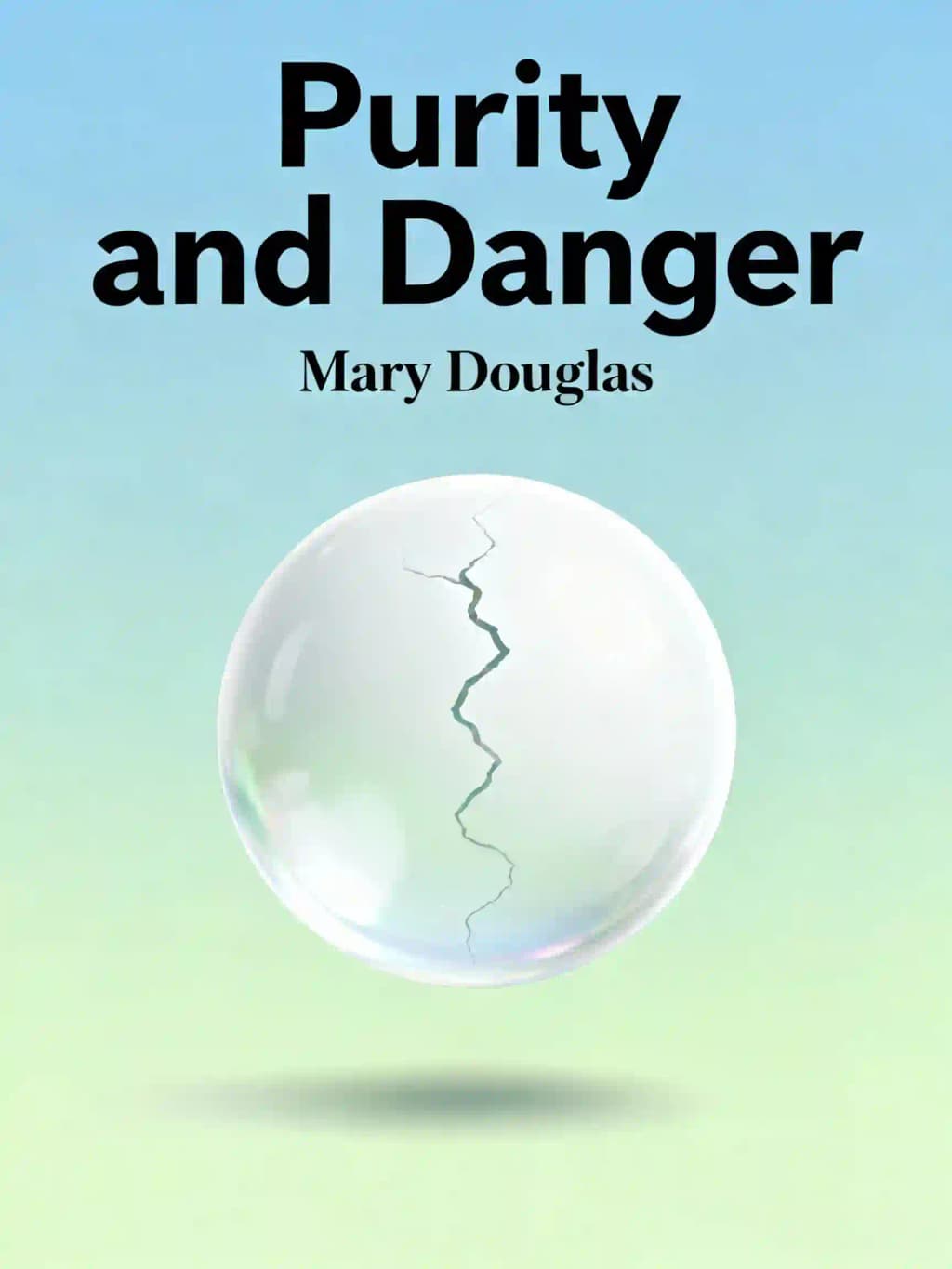
Mary Douglas's 1966 masterpiece deconstructs how societies define "dirt" to maintain order. This anthropological classic revolutionized our understanding of taboos across cultures. When we label something "impure," are we protecting social boundaries or revealing our deepest cultural anxieties?
Dame Mary Douglas (1921–2007) was a pioneering British cultural anthropologist and the author of the seminal work Purity and Danger: An Analysis of Concepts of Pollution and Taboo, a foundational text in social anthropology.
Renowned for her groundbreaking research on symbolism, rituals, and classification systems, Douglas reshaped modern understandings of how societies construct meaning through cultural norms.
A professor at University College London and later a global academic influencer, her fieldwork with the Lele people in the Belgian Congo informed her theories on the social roots of purity taboos and ritual practices. Her other acclaimed works, including Natural Symbols and Risk and Culture, further explore the interplay between social structures and human cognition.
Purity and Danger, translated into over 20 languages, remains a cornerstone of anthropological studies, cited in disciplines ranging from religious studies to sociology. Douglas’s legacy endures through her enduring frameworks, such as the concept of “matter out of place,” which continues to inform analyses of contemporary issues like public health and environmental ethics.
Purity and Danger analyzes how societies classify dirt and impurity as symbols of disorder threatening social systems. Douglas argues that "dirt" represents anomalies—elements that defy cultural categories—and explores rituals managing these threats. The book compares British hygiene norms, biblical Jewish laws, and Indigenous practices to reveal universal patterns in pollution beliefs.
Anthropology students, scholars of religion, and readers interested in cultural symbolism will find this book essential. Its interdisciplinary insights appeal to those exploring how societies construct moral order through rituals, taboos, and classifications.
Yes—it’s a foundational text in cultural anthropology that reshaped understanding of pollution rituals. Douglas’s analysis of kosher laws and cross-cultural taboos remains influential, though her later retractions (e.g., revising her stance on biblical dietary rules) add depth to critical discussions.
Key ideas include:
Douglas links rituals to societal anxiety over blurred boundaries. For example, kosher laws prohibit ambiguous animals (like pigs) to reinforce symbolic boundaries between categories. Rituals like washing or sacrifices restore perceived order.
Anomalies—like hybrid animals or ambiguous substances—expose weaknesses in cultural classification systems. Societies label them “dirty” to justify exclusion, thereby reinforcing shared norms and coherence.
Initially, Douglas argued pork prohibition stemmed from pigs’ ambiguous traits (cloven-hoofed but non-ruminant). In a 2002 update, she retracted this, proposing the laws instead symbolically linked permissible animals to sacrificial altar practices, emphasizing ritual interdependence.
Critics argue Douglas overemphasized universal patterns, neglecting historical context. Some find her anomaly theory reductionist, while others praise her cross-cultural framework despite revisions to specific claims (e.g., kosher laws).
Douglas treats British housekeeping and Lele tribal rituals as equally valid systems. By juxtaposing examples, she challenges ethnocentric views of “primitive” practices, showing all cultures use purity rules to manage existential threats.
Dirt symbolizes chaos; labeling it “polluting” justifies rituals that reaffirm societal structure. For instance, hygiene rituals in modern homes parallel taboo practices in traditional societies, both aiming to impose cognitive order.
She interprets pollution as a symbolic language: taboos reflect deeper anxieties about boundary transgression. For example, menstrual taboos might encode fears of social disintegration, not literal “uncleanliness”.
Its framework helps analyze modern issues like vaccine hesitancy (seen as “pollution” fear) or digital privacy norms. The book’s lens for decoding cultural anxieties ensures enduring interdisciplinary applications.
Sinta o livro através da voz do autor
Transforme conhecimento em insights envolventes e ricos em exemplos
Capture ideias-chave em um instante para aprendizado rápido
Aproveite o livro de uma forma divertida e envolvente
Dirt is matter out of place.
Holiness in the Old Testament means completeness and order.
Humans are ritual animals.
Ritual doesn't merely express experience but actively modifies and creates it.
It is impossible to have social relations without symbolic acts.
Divida as ideias-chave de Purity and Danger em pontos fáceis de entender para compreender como equipes inovadoras criam, colaboram e crescem.
Destile Purity and Danger em dicas de memória rápidas que destacam os princípios-chave de franqueza, trabalho em equipe e resiliência criativa.

Experimente Purity and Danger através de narrativas vívidas que transformam lições de inovação em momentos que você lembrará e aplicará.
Pergunte qualquer coisa, escolha a voz e co-crie insights que realmente ressoem com você.

Criado por ex-alunos da Universidade de Columbia em San Francisco
"Instead of endless scrolling, I just hit play on BeFreed. It saves me so much time."
"I never knew where to start with nonfiction—BeFreed’s book lists turned into podcasts gave me a clear path."
"Perfect balance between learning and entertainment. Finished ‘Thinking, Fast and Slow’ on my commute this week."
"Crazy how much I learned while walking the dog. BeFreed = small habits → big gains."
"Reading used to feel like a chore. Now it’s just part of my lifestyle."
"Feels effortless compared to reading. I’ve finished 6 books this month already."
"BeFreed turned my guilty doomscrolling into something that feels productive and inspiring."
"BeFreed turned my commute into learning time. 20-min podcasts are perfect for finishing books I never had time for."
"BeFreed replaced my podcast queue. Imagine Spotify for books — that’s it. 🙌"
"It is great for me to learn something from the book without reading it."
"The themed book list podcasts help me connect ideas across authors—like a guided audio journey."
"Makes me feel smarter every time before going to work"
Criado por ex-alunos da Universidade de Columbia em San Francisco

Obtenha o resumo de Purity and Danger como PDF ou EPUB gratuito. Imprima ou leia offline a qualquer momento.
What if I told you that your disgust at stepping in dog poop shares deep connections with ancient religious taboos? Mary Douglas's groundbreaking work "Purity and Danger" revolutionized our understanding of something seemingly mundane: dirt. Far from being a dry academic text, this influential anthropological work has shaped fields from religious studies to risk management, with figures from Jacques Derrida to Lady Gaga citing its influence. At its core lies a deceptively simple insight: dirt isn't a scientific category of harmful substances-it's fundamentally about order and classification. Dirt is matter out of place. Shoes aren't inherently dirty, but shoes on a dining table violate our sense of proper order. Food isn't dirty, but cooking implements in a bedroom feel wrong. These reactions reveal our pattern-making tendency, where we construct stable worlds by selecting stimuli that fit our established assumptions and rejecting those that don't.