Capítulo 1
A World on Fire: Navigating Chaos Through Change
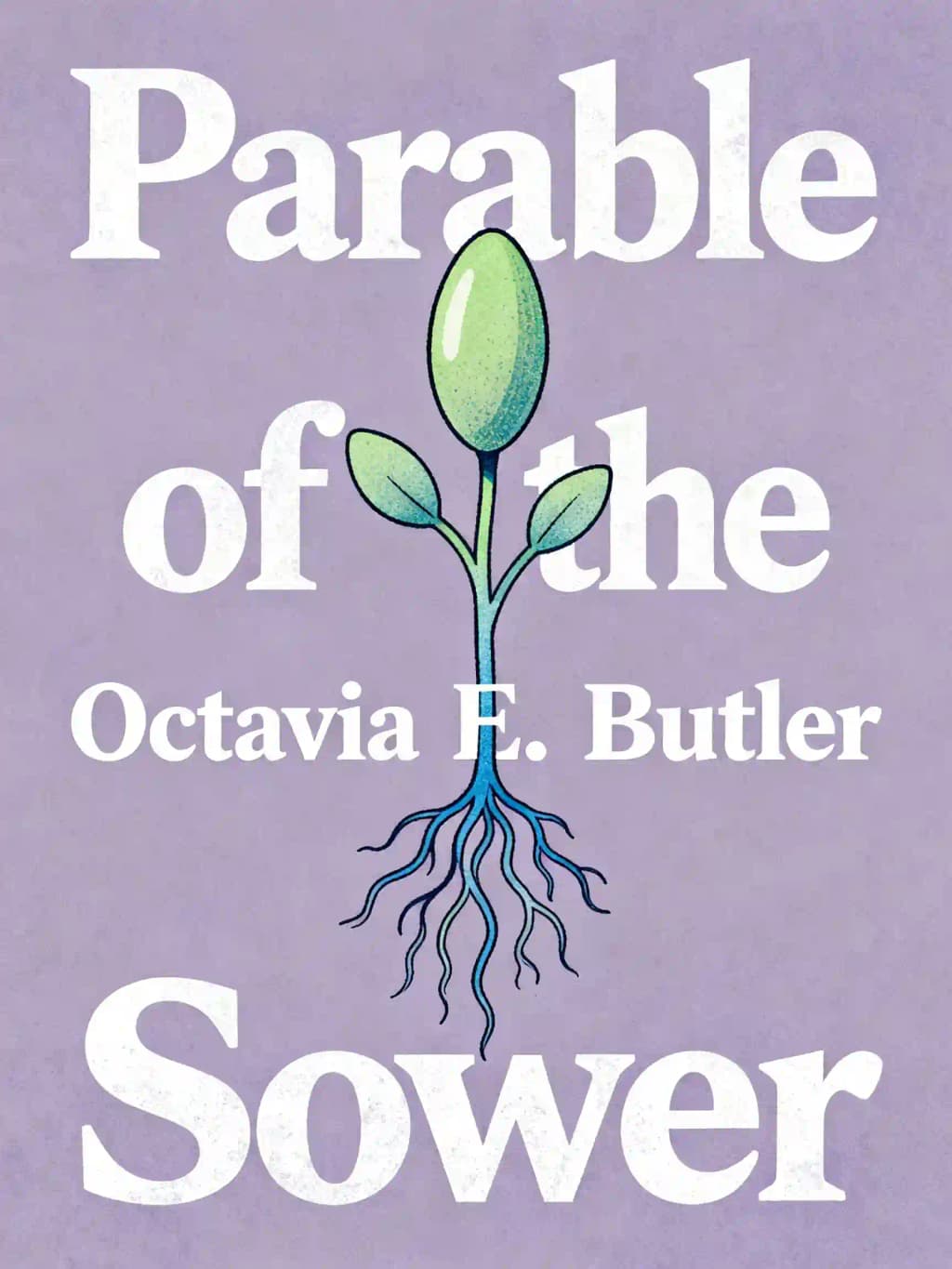
In a world where water costs more than gasoline, where gated communities are the last bastions of middle-class life, and where corporations buy entire towns, Octavia E. Butler's "Parable of the Sower" offers a chillingly plausible vision of America's collapse. Published in 1993 but set in the 2020s, this prophetic novel has gained a cult following among climate activists, social justice advocates, and even celebrities like Janelle Monae, who cited it as inspiration for her album "Dirty Computer." The book's unflinching portrayal of societal breakdown caused by climate change, wealth inequality, and corporate greed resonates deeply with contemporary readers facing similar emerging crises. Through protagonist Lauren Olamina's journey from sheltered teenager to visionary leader, Butler crafts not just a dystopian warning but a profound meditation on adaptation, community, and hope in the face of devastating change.
Capítulo 2
The Walled Garden: Life in a Disintegrating America
Lauren Olamina begins her story in 2024, living in a walled neighborhood in Robledo, California. At fifteen, she's already developing a belief system called Earthseed, centered on the concept that "God is Change." Her philosophical writings reflect a mature understanding of humanity's precarious position and the need to adapt to survive. Lauren suffers from hyperempathy syndrome-she physically feels others' pain and pleasure-caused by her mother's drug use during pregnancy. This condition, which she keeps secret from all but her closest family, makes her uniquely vulnerable in a violent world, forcing her to develop extraordinary self-control and strategic thinking.
The America of 2024 is barely recognizable. Climate change has made water scarce and expensive, with prices reaching $5 per gallon and rising monthly. Poverty and homelessness are rampant, with entire families living in abandoned cars and makeshift camps along highways. Most middle-class families live in walled communities, protected by concrete barriers topped with broken glass and razor wire. Lauren's father, a Baptist minister and college professor, maintains order in their neighborhood through community cooperation and armed vigilance, organizing regular shooting practice and security rotations. Though Lauren participates in community rituals like her baptism, she no longer believes in her father's God, secretly writing her own religious texts that blend pragmatism with spirituality.
The weekly journey to church requires passing through dangerous streets filled with homeless people, addicts, and corpses-an excruciating experience for Lauren, who feels others' suffering through her hyperempathy. She describes watching addicts on "pyro," a drug that makes users want to set fires, and seeing children with hollow eyes begging for food. The neighborhood has become an island of relative stability in a sea of desperation.
The neighborhood functions as a microcosm of cooperation amid chaos, with roughly thirty people working together to survive. When three-year-old Amy Dunn accidentally starts a fire in her family's garage, the community responds according to their well-rehearsed fire plan-adults forming bucket brigades and using precious stored water while teenagers help move valuable supplies and elders watch children. No one calls the fire department because they can't afford the service fees, which start at $500 per visit. Later, when garden thieves strike, stealing precious food and water, Lauren's father organizes armed patrols and martial arts training, teaching residents to defend themselves without wasting ammunition.
Outside their walls, society continues to crumble. Presidential candidate Christopher Donner wins election by promising to dismantle environmental protection laws and space programs while suspending worker protection laws to create "private labor camps" for the homeless. News reports describe increasingly catastrophic events: hurricanes killing hundreds in Florida and Louisiana, cholera outbreaks in Mississippi spreading through contaminated water supplies, drug-induced arson spreading from Los Angeles to Chicago, and measles epidemics devastating unvaccinated communities. Lauren meticulously notes these signs of societal collapse in her journal while others try to maintain normalcy, hosting neighborhood dinners and continuing to send their children to the community school. The contrast between Lauren's clear-eyed assessment of their situation and her community's determination to preserve a semblance of pre-collapse life creates a powerful tension throughout these early chapters, foreshadowing the inevitable destruction of their fragile sanctuary.
Capítulo 3
Seeds of Change: Lauren's Evolving Theology
As external threats mount, Lauren develops her Earthseed philosophy-a pragmatic belief system designed for survival in a world of constant change. Unlike traditional religions that promise divine intervention or salvation, Earthseed acknowledges harsh reality: "God is Power-Infinite, Irresistible, Inexorable, Indifferent. And yet, God is Pliable-Trickster, Teacher, Chaos, Clay. God exists to be shaped. God is Change."
Lauren's theology emerges from critical questioning of traditional religious concepts. After witnessing a hurricane kill over 700 people, mostly the street poor, she questions whether God cares about human suffering. She compares the biblical God of Job to Zeus playing with toys, indifferent to human pain. Instead of praying to an unresponsive deity, Lauren proposes adaptation to Change-a force that can be shaped but not resisted.
The development of Earthseed represents Lauren's intellectual journey from passive acceptance to active engagement with reality. She explicitly distinguishes her belief from traditional religion, noting her God "doesn't love me or hate me or watch over me." Prayers, in her view, only help the person praying by focusing their resolve. This pragmatic approach contrasts sharply with her father's faith, which emphasizes endurance and salvation in the afterlife.
While gardening, Lauren discovers the name "Earthseed" for her belief system and articulates its ultimate purpose: "The Destiny of Earthseed is to take root among the stars." Inspired by news of newly discovered planets, she envisions humanity's eventual spread beyond Earth-a long-term vision that provides hope despite Earth's deteriorating condition. This cosmic perspective gives her immediate struggles meaning, positioning current hardships as necessary steps toward a greater purpose.
Lauren's theology isn't merely abstract philosophy but practical wisdom for survival. When her father disappears, she steps up to preach on perseverance using the parable of the importunate widow from Luke 18:1-8, emphasizing that "the weak can overcome the strong if the weak persist." Though she presents a hopeful message publicly, privately she believes their community's days are numbered: "We'll be moved, all right. It's just a matter of when, by whom, and in how many pieces." This duality-maintaining hope while preparing for disaster-becomes Lauren's defining characteristic and the core of Earthseed's approach to life.
Capítulo 4
Family Fractures: The Price of Survival
The disintegration of Lauren's family mirrors the broader societal collapse. Her younger brother Keith, unable to tolerate the confines of their walled community, repeatedly runs away. When he returns at age fourteen, he reveals his life outside-sleeping in cardboard boxes, stealing food, eventually robbing and possibly killing a man with $23,000. Keith shows no remorse, saying "I didn't feel nothing" about his crimes. His story exposes the brutal reality beyond their walls, including "Paints"-drug users who shave their heads, paint their skin, and immolate wealthy people while experiencing sexual pleasure from watching fire.
Keith's fate foreshadows the community's future. After bringing Lauren birthday money, he disappears again, only to be found dead-systematically tortured, his skin cut and burned away while his face was left recognizable though his eyes were burned out. The wounds showed days of torture, suggesting he'd crossed drug dealers. At Keith's funeral, Lauren admits to Curtis Talcott that she both loved and hated her brother, seeing him as sociopathic. She reflects that if hyperempathy syndrome were more common, people couldn't torture others as they did Keith.
The family fractures further when Lauren's father disappears. Despite extensive searching through hills filled with squalor, death, and evidence of cannibalism, they find no trace of him. The uncertainty of his fate torments Lauren more than Keith's death-at least with Keith they knew he was dead. Cory, Lauren's stepmother, falls into a "walking coma" of grief, leaving Lauren to step into leadership roles both at home and in the community.
These family tragedies force Lauren to mature quickly. When Reverend Robinson comes to preach her father's funeral (though there's no body), Lauren reflects that her father must be dead, as he would have found his way home otherwise. She takes over her stepmother's neighborhood school while Cory teaches at the college through computer hookups. The community reorganizes, with various members taking on her father's church duties. This cooperative response to tragedy demonstrates the resilience Lauren will later build upon when forming her own community.
Capítulo 5
Privatized Dystopia: Corporations as the New Government
As traditional government structures crumble under environmental and social pressures, corporations emerge as the dominant power brokers-not as benevolent saviors but as calculating opportunists exploiting widespread desperation. The multinational conglomerate KSF (Kagimoto, Stamm, Frampton) exemplifies this trend when it takes control of Olivar, a small coastal city near Los Angeles facing multiple existential threats: rising sea levels that threaten to submerge portions of the town, increasing earthquake activity, and waves of desperate refugees seeking shelter. The wealthy, predominantly white community, driven by fear and pragmatism, votes to privatize their town, willingly accepting significantly reduced salaries in exchange for guaranteed security, stable food supplies, and sophisticated engineering solutions to protect them from the encroaching ocean.
Lauren's father, with his deep understanding of historical power dynamics, immediately identifies this arrangement as "debt slavery," drawing parallels to sharecropping and company towns of the past. He astutely observes that KSF wouldn't likely accept a Black and Hispanic family anyway, recognizing the implicit racial barriers in corporate feudalism. Lauren shares his skepticism, particularly concerned about the potential for abuse by corporate security forces, who would have nearly unlimited power over employees. She envisions a system where workers' rights would gradually erode under the guise of protection and necessity.
Despite these grave concerns, many of their neighbors view Olivar as their last hope for survival in an increasingly chaotic world. The Garfield family, including Lauren's close friend Joanne, makes the difficult decision to relocate there, reasoning that life in a secure apartment complex-even without the freedom to maintain their own gardens or move freely-is preferable to facing constant danger in their deteriorating neighborhood. Their choice reflects a growing willingness to sacrifice autonomy for the promise of safety.
The true nature of corporate feudalism becomes painfully clear through Emery Tanaka Solis's harrowing story. After escaping from agricultural company debt slavery, she reveals the brutal reality: workers paid in company scrip instead of real currency, trapped in an endless cycle of debt through inflated prices at company stores, and treated as disposable assets rather than human beings. The death of her husband from untreated appendicitis-a easily treatable condition-demonstrates the company's callous disregard for worker welfare. The mysterious disappearance of her young sons and threats to take her daughter expose how corporations use family separation as a tool of control.
The stark contrast between corporate "security" and genuine freedom emerges as a central theme in the narrative. While Olivar's model promises protection from immediate physical threats, it creates new, more insidious forms of oppression through economic and social control. Lauren's decision to pursue the riskier path of independence, despite its dangers, stems from her conviction that true security can only come through self-reliance and authentic community building. This fundamental choice-between corporate protection with its golden handcuffs and dangerous but genuine freedom-raises critical questions about societal organization during times of crisis and the true cost of sacrificing autonomy for security.
Capítulo 6
Baptism by Fire: The Destruction of Robledo
Lauren's fears materialize when pyro addicts attack their neighborhood, crashing a truck through their gate and setting houses ablaze. In the chaos of gunfire and screaming, Lauren loses track of her family. She witnesses neighbors being shot and killed, including Natalie Moss who is shot in the face. After killing one attacker, Lauren flees toward the hills, eventually finding shelter in a burned-out garage.
The next day, Lauren returns to scavenge through her destroyed home, finding some of her father's clothing, an extra holster for her gun, and-most importantly-hidden money from beneath a rock by the lemon tree. Walking through the neighborhood, she sees numerous corpses-Richard Moss, Robin Baiter, Russell Dory and many others. Outside the neighborhood, she encounters Zahra Moss (Richard's youngest wife) and Harry Baiter, both bloodied but alive. Zahra claims to have witnessed Lauren's family being killed.
This catastrophic event transforms Lauren from a visionary with theories into a survivor who must put her ideas into practice. The destruction of Robledo represents the death of the old world-with its walls, illusions of security, and attempts to preserve pre-collapse normalcy. Lauren emerges from this baptism by fire with nothing but her Earthseed writings, practical survival knowledge, and two reluctant companions.
The trio decides to head north, with Lauren disguising herself as a man for safety. At Hanning Joss, a secure shopping complex, Lauren spends her emergency money on essential supplies: dried foods, water purification tablets, sleepsacks, and ammunition. They begin their journey west on the 118 freeway, joining a diverse crowd of travelers heading toward the coast. Lauren observes the dangerous reality of freeway travel-armed pedestrians, predatory "Keiths," and desperate people carrying everything they own.
This journey represents Lauren's transition from theory to practice. The survival skills she studied in books must now be applied daily. Her hyperempathy, previously a hidden vulnerability, becomes a constant challenge as she navigates a world filled with suffering. Yet her preparation gives her an edge that many others lack-she anticipated this collapse while others denied its possibility.
Capítulo 7
The Road North: Building Community Through Shared Purpose
Lauren's journey north becomes a process of gathering like-minded individuals into a nascent Earthseed community. Despite initial wariness, Harry Baiter and Zahra Moss join her, pooling their resources and skills. When dogs attack their beach camp, Lauren shoots one to protect a nearby family with a baby, despite the painful kickback that temporarily leaves her gasping for breath due to her hyperempathy. This act of protection convinces Travis and Gloria Natividad Douglas to join them with their six-month-old son Dominic.
The group grows organically through mutual aid. After an earthquake, they rescue two women named Allie and Jill Gilchrist from a collapsed house. When scavengers attack them, Lauren kills her attacker, experiencing his death through her hyperempathy. They also meet Taylor Franklin Bankole, a 57-year-old doctor who shares Lauren's Yoruba surname and joins their group. Later, they accept Emery Tanaka Solis and her daughter Tori, escaped slaves from an agricultural company, and Grayson Mora and his daughter Doe, who Lauren suspects are also escaped slaves.
This diverse group represents a microcosm of society's survivors-different ages, races, and backgrounds united by the need to survive. Lauren establishes clear principles: they kill only in self-defense, fight together, help each other, and never steal from one another. She begins teaching reading to those who need it and shares Earthseed philosophy with interested members. Travis becomes her first convert, deeply engaged by discussions about God as Change, followed by Zahra, who appreciates the community-building aspects though she's less interested in the space exploration vision.
The journey tests their growing bonds. When bald attackers assault them, Jill is killed carrying Tori to safety. They bury her under rocks among oak trees to protect her body from scavengers. Later, they endure a terrifying firestorm that chases them along the highway, forcing them to keep moving through the night through choking smoke, ash, and scorching heat. Despite exhaustion and dwindling water supplies, they survive by working together.
These shared hardships forge stronger connections than any abstract philosophy could. Lauren's leadership emerges naturally through her preparation, clear thinking, and willingness to take necessary risks while protecting others. The community becomes the living embodiment of Earthseed principles-adapting to change, shaping circumstances when possible, and working together toward survival and eventual prosperity.
Capítulo 8
Acorn: Planting the Seeds of a New World
The group's journey reaches its pivotal moment when they arrive at Bankole's land in Humboldt County's coastal hills. The property, strategically positioned between Highway 101 and Cape Mendocino, spans across 23 acres of wild, untamed territory. The landscape is a mix of challenges and opportunities - dry brush sprawls across the hills, while redwood and oak trees dot the terrain, and old logging stumps remind visitors of the area's industrial past. Their isolation is both a blessing and a curse, providing safety through distance but leaving them vulnerable without nearby allies.
The initial discovery proves devastating: Bankole's sister's house and outbuildings have been reduced to charred ruins. The remains they find - five skulls and scattered bones among the ashes - tell a story of violence that foreshadows the challenges ahead. The victims include Bankole's sister, her husband, and their three children, their deaths a stark reminder of the world's brutality.
Yet amid this tragedy, the land offers remarkable potential for survival and growth. The working well provides essential water security, while the existing garden yields tomatoes, squash, and root vegetables. Mature fruit trees - apple, pear, and plum - promise future harvests. The surrounding forest offers abundant timber for construction, and the elevated position provides natural defense advantages. Lauren's extensive seed collection, carefully maintained throughout their journey, includes drought-resistant varieties and medicinal plants that could prove crucial for their survival.
Lauren's advocacy for establishing Earthseed here becomes a turning point. She argues that the very challenges that make the location dangerous - its isolation and wildness - are also its strengths. The group's debate about staying reveals their different priorities: security versus opportunity, immediate safety versus long-term sustainability. After three days of discussion and careful property assessment, they commit to building their community.
Their immediate focus becomes twofold: preparing a winter garden and constructing basic shelter before the rainy season. They begin by clearing land for planting, using salvaged materials to build temporary structures, and establishing security protocols. The name "Acorn" emerges from Lauren's observation of the oak trees on the property and becomes a powerful metaphor for their endeavor - small, resilient, and containing vast potential.
The establishment of Acorn represents more than just physical settlement; it embodies the practical application of Earthseed's principles. Lauren transitions from theoretical teacher to community organizer, implementing systems for food production, security, education, and governance. The community faces immediate challenges: suspicious neighbors who might pose threats, the possibility of corporate land grabs, and the continuing breakdown of society around them.
The novel concludes with a poignant ceremony - the funeral for Bankole's family. The use of Natividad's intricately knitted shawl to wrap the remains becomes a powerful symbol of their values. Bankole's objection that "such a thing should serve the living" and Lauren's insistence on the ritual demonstrates their ongoing negotiation between practicality and maintaining human dignity. As winter approaches, Lauren continues documenting Earthseed's development, now with tangible examples of its principles in action: change as the only constant, community as survival, and adaptation as strength.
Capítulo 9
Shaping Change: Lauren's Evolution from Prophet to Leader
Throughout her journey, Lauren transforms from a solitary visionary into a pragmatic leader. Her initial Earthseed writings, penned in her journal during quiet nights in Robledo, are theoretical manifestos developed in the relative safety of her walled community. These early writings focus on abstract concepts of God as Change and humanity's destiny among the stars. As she faces real-world challenges-the destruction of her home, the dangers of the road, the complex needs of her growing group-her philosophy evolves from abstract theology to practical guidance, incorporating lessons learned from harsh experience.
Lauren's hyperempathy syndrome, initially seen as a dangerous weakness in her violent world, becomes a moral compass that prevents her from becoming hardened by the brutality around her. When forced to kill in self-defense, whether facing highway robbers or protecting her group from raiders, she experiences her victims' deaths as if they were her own, making each act of violence a personal sacrifice rather than a casual necessity. This shared suffering gives her unique insight into human vulnerability and interconnection-core concepts in Earthseed's emphasis on community. Her condition forces her to develop innovative non-violent solutions whenever possible, leading to strategic thinking that benefits the entire group.
Her leadership style evolves to balance pragmatism with compassion, demonstrated in numerous critical moments. When Allie confronts her about Earthseed, calling religion "dog shit," Lauren calmly establishes that while they don't need to join her belief system, they must stand with the group in trouble. She handles internal conflicts with similar wisdom, like mediating between Travis and Natividad or helping integrate new members into the group. She maintains discipline without tyranny, creating structure through mutual agreement rather than force. Her teaching of reading and writing to group members, particularly to Jill and Allie, demonstrates her commitment to empowerment rather than dependency.
Most significantly, Lauren learns to balance immediate survival needs with long-term vision. While focused on practical matters like food, water, and shelter, she never abandons her ultimate goal of "taking root among the stars." She implements this dual focus through concrete actions: establishing garden plots while teaching astronomy, organizing defense training while discussing space travel, and building immediate community while planning for future settlements. This dual focus-addressing present necessities while working toward future possibilities-distinguishes her from both shortsighted survivalists and impractical dreamers.
By the novel's end, Lauren has become what her world desperately needs: a leader who can both respond to current crises and envision a better future. Her evolution from prophetic teenager to community founder demonstrates Earthseed's central premise-that by understanding Change as the fundamental reality, we can shape it rather than being destroyed by it. This is evident in how she transforms the Acorn community from a desperate gathering of survivors into a sustainable settlement with its own culture and purpose. In a world of collapse, Lauren creates possibility; amid destruction, she builds. Her story offers not just a warning about potential futures but a template for facing them with courage, adaptability, and hope, providing practical examples of how vision and action can combine to create meaningful change even in the most challenging circumstances.