Capítulo 1
The Universe Through Stephen Hawking's Eyes
Stephen Hawking's office door stood slightly ajar that June day in 1998. Inside, his computer displayed a scrolling message: "To boldly go where Star Trek fears to tread." Despite being unable to move, confined to his wheelchair by ALS, Hawking radiated intellectual vitality. His office walls featured Marilyn Monroe alongside a photo of him playing poker with Einstein and Newton on the Enterprise's holodeck. Two blackboards stood nearby-one with recent calculations, the other possibly containing his last handwritten equations from the early 1980s.
When I entered, his opening statement through his computer voice was direct: "Andrei claims there are infinitely many universes. This is outrageous." He was referring to physicist Andrei Linde's multiverse theory. When I asked why we should worry about other universes, Hawking's answer revealed his deepest motivations: "Because the universe we observe appears designed. Why is the universe the way it is? Why are we here?"
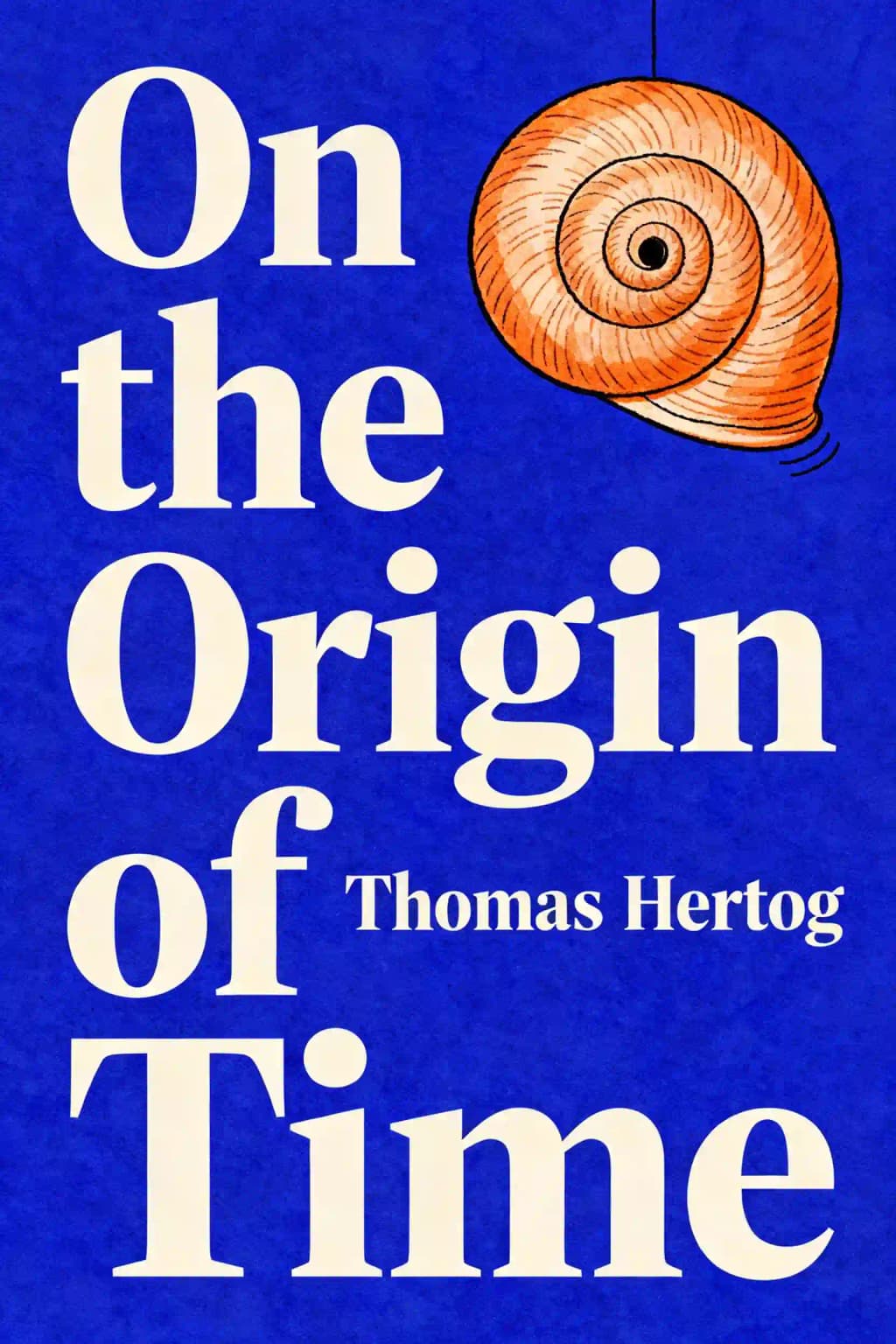
This question would drive our twenty-year collaboration until his death in 2018, culminating in a revolutionary theory that would transform our understanding of cosmic origins, challenge the multiverse concept, and redefine humanity's place in the cosmos. "On the Origin of Time" chronicles this intellectual journey-a quest to understand not just how the universe began, but why it exists at all.
Capítulo 2
The Riddle of Cosmic Design
Our universe appears remarkably fine-tuned for life. The cosmic expansion history shows a "Goldilocks" pattern-rapid initial expansion, followed by a slowdown allowing galaxy formation, then acceleration again. This pattern created the perfect conditions for stars, planets, and eventually life to develop.
Even more striking is how fundamental constants seem precisely calibrated for our existence. Gravity's weakness allows stars to burn for billions of years rather than collapsing quickly. The tiny temperature variations in cosmic background radiation (one part in 100,000) are exactly what's needed to form galaxies-slightly larger would produce black holes, smaller would yield no galaxies at all.
Other cosmic coincidences include our universe having exactly three spatial dimensions (more would make atoms unstable; fewer wouldn't allow complex systems), the neutron-proton mass ratio (1.0014), and carbon production in stars dependent on precise nuclear force balancing. Most staggering is dark energy's incredibly small value-10^-123 of its "natural" value-which allowed the universe to "hesitate" for eight billion years before accelerating, creating the window for galaxies to form.
This apparent fine-tuning creates a profound puzzle: why does the universe seem designed for life? This question has driven physics beyond typical inquiries about natural phenomena toward deeper reflections on physical laws themselves.
For nearly two millennia, Aristotle's teleological worldview dominated, seeing purpose in nature and suggesting a Final Cause directing the cosmos. The scientific revolution challenged this, replacing teleology with discoverable rational laws. Newton's Principia unified the heavens and Earth through mathematical equations, establishing the paradigm physics has followed since.
Biology abandoned teleological thinking through Darwin's theory of evolution, showing how simple mechanisms could produce apparent design without requiring a Designer. While physical laws are deterministic, biological evolution incorporates randomness, making it predominantly retrospective-we understand evolution by looking backward but cannot predict its exact path forward.
This randomness extends beyond biology to human history, where frozen accidents like Christianity's rise profoundly shaped subsequent events without being causally inevitable. Evolution continuously builds on an enormous chain of such accidents, where lower levels of complexity set the environment for higher levels, but leave room for surprising turns where exceedingly improbable pathways are realized.
Capítulo 3
When Cosmology Met Quantum Physics
Einstein's general relativity transformed our understanding of gravity and spacetime. Rather than a mysterious force, gravity became the geometric curvature of spacetime itself. Massive objects like the sun warp the fabric of spacetime, creating "valleys" that guide planets into their orbits.
This revolutionary framework breathes life into spacetime, transforming it from Newton's static backdrop into a flexible, physical field. Einstein's equation elegantly shows how matter and energy determine spacetime geometry, with gravity emerging from this relationship. As John Wheeler put it, "Matter tells spacetime how to curve. Spacetime tells matter how to move."
Black holes, initially considered mathematical oddities, were predicted by Einstein's theory. In the 1960s, Roger Penrose proved that all sufficiently massive stars collapse to black holes at life's end. His 1965 paper showed how a collapsing star creates an event horizon-a one-way membrane through which nothing can escape. Inside this horizon, space and time swap roles, with the center containing a singularity of infinite curvature where general relativity breaks down.
When two black holes orbit each other, they generate gravitational waves-ripples in spacetime that drain energy from the system, causing the black holes to spiral inward and eventually merge. These mergers are the most violent events in the universe, generating waves more powerful than all light radiated by all stars combined. In 2015, the LIGO team detected these waves from a merger that occurred over a billion years ago, confirming Einstein's predictions.
Einstein initially tried to create a static universe model by introducing the cosmological constant (), representing a form of dark energy that creates cosmic repulsion to balance gravity's pull. Though his static universe model proved incorrect, it marked the birth of modern relativistic cosmology.
Georges Lemaitre discovered the true cosmological implications of relativity in 1927: Einstein's equations indicated an expanding universe. This wasn't an ordinary explosion with a center, but rather space itself stretching everywhere, causing light from distant galaxies to redshift as wavelengths stretched along with space.
Lemaitre's most profound insight was the "zero of time" in his diagrams. While his 1927 expanding universe had no beginning, by 1929 he realized the universe must have had a past unimaginably different from the present. He envisioned the origin as a "super-heavy primeval atom" whose disintegration yielded today's cosmos-"a fireworks theory of cosmic evolution."
Both Einstein and Eddington initially rejected the idea of a beginning, preferring cycles of contraction and expansion. However, relativistic cosmology pointed strongly toward a genuine beginning-creating a profound paradox: the big bang became both the cornerstone and Achilles' heel of cosmology-inevitable yet beyond understanding.
Capítulo 4
Hawking's Quantum Cosmology Revolution
Drawn to cosmology by his desire to "fathom the depths of understanding," Stephen Hawking arrived at Cambridge in 1962. Working with mathematician Roger Penrose, he realized he could prove that an expanding universe must have had a singularity in its past-a point where spacetime bends to a breaking point and general relativity loses all predictive power.
This breakthrough, central to Hawking's 1966 PhD dissertation, demonstrated that time itself must have had a beginning approximately 13.8 billion years ago. George Ellis, a fellow student, created a pear-shaped diagram showing our observable universe with light rays converging into the past due to matter's gravitational focusing effect, visually representing how our past light cone bends inward toward the initial singularity.
This cosmological model creates a profound puzzle-regions separated by more than a few degrees in the sky represent patches of the universe that couldn't have causally interacted since the beginning, yet somehow share nearly identical temperatures to within one ten-thousandth of a degree. This "horizon problem" suggested our observable universe contains millions of causally disconnected regions that inexplicably share identical properties.
Hawking recognized early that "Einstein's theory does not give a unique model for the universe" because it provides dynamic field equations but not boundary conditions. He argued that a complete theory must include both dynamics and boundary conditions, challenging the view that boundary conditions belong to metaphysics or religion.
For Hawking, the initial singularity didn't mark the limit of scientific inquiry but rather indicated Einstein's spacetime framework fails under extreme conditions where quantum effects dominate. He envisioned a profound marriage of relativity and quantum theory that would transcend physics' age-old dualism of laws versus conditions.
In 1976, Hawking and Jim Hartle successfully applied the sum-over-histories framework to black holes, describing Hawking radiation as particles escaping by following quantum paths through the event horizon. Encouraged by this success, they turned to the big bang singularity.
Their groundbreaking "no-boundary proposal" suggested that the universe has no singular beginning point. Instead, as one moves backward in time toward the origin, the time dimension gradually transforms into a space dimension, creating a smooth, rounded "bowl" shape. This geometric transformation-rotating time by 90 degrees into a spatial dimension-became known as the "Euclidean approach to quantum gravity."
The no-boundary wave function represented a radical departure from traditional physics by blending laws and boundary conditions. Stephen believed this theory eliminated the need for a creator, as the universe could have emerged from nothing, being "completely self-contained and not affected by anything outside itself."
Capítulo 5
Inflation and the Multiverse Challenge
When I joined Stephen in June 1998, his quantum cosmology program was thriving amid cosmology's golden decade of discovery. The Cosmic Background Explorer (COBE) satellite had confirmed the existence of tiny temperature variations in the cosmic microwave background radiation-crucial evidence that the early universe contained seed density contrasts needed for galaxies to form.
Stephen was deeply attached to his no-boundary hypothesis but emphasized that a theory's true test lies in its predictions. This led to his interest in cosmic inflation-the theory that the universe underwent a brief burst of superfast expansion early in its history, swelling by a factor of 10^30 in less than a split second. This expansion boom explained why the universe appears so uniform on large scales, as even the most distant regions would have been close together initially.
Inflation not only creates a vast uniform universe but also explains the tiny temperature fluctuations in the cosmic microwave background (CMB). The inflaton field, being quantum in nature, experiences microscopic quantum jitters that inflation stretches to macroscopic wavelike variations. When inflation ends and releases its energy as heat, these variations manifest as temperature fluctuations in the CMB and density variations in matter that eventually seed galaxy formation.
Stephen lived to witness the confirmation of inflationary theory through the European Space Agency's Planck satellite. Planck produced an exquisitely detailed map of the CMB, revealing temperature variations that matched inflation's predictions with stunning precision. The pattern of oscillations in these variations not only confirmed inflation but also revealed the universe's composition: ordinary visible matter (5%), dark matter (25%), and dark energy (70%).
Despite inflation's success, a critical problem emerged: the no-boundary proposal predicts only minimal inflation, whereas our universe required extensive inflation to grow large enough for billions of galaxies. The theory seems to favor universes unlike our own, creating a significant challenge for the no-boundary concept.
Meanwhile, a competing vision emerged from Andrei Linde and Alexander Vilenkin that completely inverted the problem of inflation's origin: the multiverse. They proposed that inflation is eternal by nature and actually difficult to stop. While some regions experience fluctuations that end inflation and produce hot big bangs, other regions experience strengthening jumps that accelerate inflation, generating even more volume and spawning further inflating regions.
This creates a cosmic quilt of slowly expanding "island universes" embedded within an infinitely inflating space-a multiverse where each island functions as a separate universe, physically disconnected from others by the rapidly expanding inflating regions between them.
Capítulo 6
The String Theory Landscape
The Standard Model of particle physics unifies three fundamental forces and matter particles. Despite its extraordinary precision, it contains about twenty unexplained parameters-constants of nature-whose values must be determined experimentally rather than derived from theory.
The Higgs field gives particles mass through a dynamic process that unfolded as the early universe cooled, involving the breaking of mathematical symmetry. In the universe's first moments, when temperatures exceeded 10^15 degrees, the Higgs field averaged zero and particles were massless. But around 10^-11 seconds after the big bang, as temperatures dropped, the Higgs field condensed to a nonzero value, giving particles mass and differentiating the weak force from electromagnetism.
Grand Unified Theories (GUTs) reveal that the laws of physics we observe today emerged through a series of symmetry-breaking transitions in the early universe. Crucially, these transitions weren't uniquely determined-they involved quantum randomness that could have yielded different outcomes, much like how biological evolution depends on frozen accidents.
String theory offers a solution to unifying gravity with quantum fields by replacing point particles with tiny vibrating strands of energy. These universal strings can vibrate in different patterns to produce all particle species, including gravitons (quanta of gravity). By smearing points into filaments, string theory tames troublesome quantum jitters by introducing a fundamental fuzziness at the smallest scales.
Early string theorists hoped a powerful mathematical principle would identify the unique shape of extra dimensions, explaining the Standard Model's parameters through pure mathematics. These hopes collapsed with the discovery that extra dimensions come in countless configurations. String theorists found more possible shapes than atoms in the observable universe, each creating its own "string symphony" of physical laws.
The discovery of string theory's vast spectrum of branching pathways revolutionized multiverse theory. It predicted that an eternally inflating cosmos would host an unimaginable diversity of island universes, each with its own cascade of transitions as it expanded and cooled. In this view, what we call "laws of physics" are merely local patterns-frozen relics reflecting how our particular cosmic patch cooled from its hot big bang.
At a landmark 2003 Stanford conference, Leonard Susskind argued that string theory should be understood not as a unique physical law but as a metalaw governing countless island universes. The troubling implication was that string theory alone couldn't predict which universe we should observe-as a physical theory, the multiverse seemed to diminish physics' predictive power. Susskind proposed resolving this by combining the multiverse with the anthropic principle, which would select biofriendly patches from the cosmic quilt.
Capítulo 7
The Anthropic Principle's Limitations
By century's end, Stephen Hawking grew deeply concerned that anthropic reasoning undermined science's rational foundation. The core problem was that anthropic reasoning requires assuming we are "typical" inhabitants of the multiverse, but this typicality criterion is inherently ambiguous. To reason anthropically, one must specify which biophilic properties determine typicality, but these selections are arbitrary.
Weinberg's cosmological constant prediction illustrates this problem. His value depends entirely on his chosen reference class. Tegmark and Rees showed that including variations in galactic seed size would predict a value a thousand times larger than observed. More creative reference classes lead to absurd conclusions, like predicting we should be vacuum-fluctuated brains with false memories.
This fundamental ambiguity means anthropic multiverse cosmology fails to make unambiguous predictions-the minimum requirement for any scientific theory. Cosmologists call this the "measure problem"-we lack an objective way to weight different island universe populations, undermining the theory's predictive power.
The typicality reasoning flaw mirrors problems in other historical sciences. Had Darwin assumed humans were "typical," he would have sought the most common evolutionary tree containing Homo sapiens, ignoring his crucial insight that evolution involves countless chance events.
At its core, multiverse theory asserts fundamental limits to evolution. It frames ancient evolution against unchanging metalaws, assuming timeless principles at physics' foundation-a master equation governing the cosmic mosaic. This represents the essential conflict between Hawking and Linde: whether change or eternity ultimately prevails.
Capítulo 8
Top-Down Cosmology: A New Paradigm
Upon returning from lunch one day, Stephen declared it was "time to stop playing God." He asserted that physical theories don't exist in some Platonic heaven-we aren't angels viewing the universe from outside. Instead, both we and our theories are part of the universe we're describing, never fully decoupled from us.
Stephen proposed adopting what he called a "worm's-eye viewpoint"-acknowledging our position within the cosmos rather than pretending to observe it from without. His revolutionary proposal was to adopt a "top-down" philosophy of cosmology where we work backward in time from our observations rather than forward from some imagined beginning.
This perspective connects to the historic Einstein-Bohr debate. Einstein objected to quantum mechanics' probabilistic nature and observer-dependence, famously declaring that "God does not play dice." Bohr countered that "no phenomenon is a real phenomenon until it is an observed phenomenon," arguing that measurement itself causes wave functions to collapse from superpositions into definite states.
The breakthrough in quantum theory came through fully integrating observership into its mathematical framework. Hugh Everett III demolished Bohr's artificial boundary between quantum and classical worlds by applying quantum mathematics universally. Everett proposed a single universal wave function that includes observers and everything else, evolving smoothly along all possible historical pathways without collapse.
In Everett's framework, quantum observation doesn't collapse possibilities but causes wave functions to branch into distinct fragments representing different measurement outcomes. Observers themselves split into nearly identical copies-one on each branch-distinguished only by which measurement result they recorded.
From an observer's perspective, quantum measurements prune the branching tree of possible futures. At each fork in the road, only one branch survives in any observer's experience-more precisely, on each branch, only that branch appears to survive. The other branches evolve independently but become irrelevant to that observer, drifting away into possibility space through decoherence.
The architecture of quantum cosmology forms an interconnected triptych combining three essential elements: a model of cosmogenesis (like the no-boundary hypothesis), a notion of evolution (like Feynman's many possible histories in string theory's landscape), and crucially, observership.
Capítulo 9
The Holographic Universe
The top-down cosmology approach needed firmer theoretical grounding, which came from the holographic revolution sweeping theoretical physics. The holographic principle suggested our four-dimensional universe might be a projection from a higher dimension, inverting Plato's cave allegory-rather than our world being shadows of perfect forms, perhaps gravity and spacetime themselves are projections from a hidden reality.
In 1997, Juan Maldacena discovered a revolutionary duality that connected string theories with gravity to particle theories without gravity. This "holographic duality" linked supergravity in anti-de Sitter (AdS) space-a negatively curved "snow globe world" with an impenetrable boundary-to quantum field theories operating solely on that boundary surface.
Remarkably, these theories operated in different dimensions: if AdS space had four dimensions, the quantum field theory existed in just three. This meant everything about strings and gravity in the interior could be encoded in particle interactions on the boundary surface-like learning everything about an orange by analyzing only its skin.
The primary challenge in applying holography to cosmology is that our expanding universe resembles de Sitter space rather than anti-de Sitter space. While AdS has negative curvature pulling objects inward, our universe's positive curvature (from dark energy) pushes everything apart.
However, Stephen realized that from a semiclassical perspective using imaginary time, both spaces appear remarkably similar. When projected onto a flat plane, both resemble Escher-like disks with most of their volume concentrated near a spherical boundary. This insight led to Stephen's proposal for a dS-QFT duality paralleling Maldacena's AdS-CFT correspondence.
The crucial difference is that while AdS holograms generate an emergent spatial dimension, expanding universe holograms generate an emergent time dimension. This means that in holographic cosmology, history itself is holographically encrypted-perhaps the most profound entry in the holographic dictionary.
Holography fundamentally validates the top-down approach to cosmology. If the universe's past projects from entangled quantum particles in a lower-dimensional hologram, then the backward-in-time perspective becomes intrinsic to cosmology itself. The hologram becomes more fundamental than time, with the expanding universe emerging as output rather than input.
Capítulo 10
At Home in the Universe
Holography transforms our understanding of Hawking's no-boundary proposal. Rather than describing creation from nothing, it suggests that physics itself fades away as we approach the big bang. The no-boundary hypothesis becomes not a law of the beginning but the beginning of law itself, where the question of the ultimate cause evaporates.
This perspective has profound implications for multiverse theory. Holographic cosmology reveals no evidence of island universes in any known holograms. Instead, the interior wave functions encompass only a small patch of the string landscape. As Stephen concluded, "Holographic cosmology excises the multiverse like Ockham's razor."
In a quantum universe, past and future emerge from possibilities through questioning and observing. This observership transforms possibilities into actualities, giving observers a creative role in cosmic affairs with a backward-in-time element-as if today's observations retroactively fix the big bang's outcome.
Hawking's no-boundary model, conceived top-down, reveals that tracing the universe backward leads to time itself evaporating. Rather than creation from nothing, this represents an epistemic horizon with no space, time, or physical laws. The holographic perspective shows time as emergent, with regression becoming increasingly fuzzy until information runs out.
Quantum cosmology reveals biological and cosmological evolution as different levels of one evolutionary tree-biology in high-complexity realms, cosmology in low-complexity layers, all woven together by the universal wave function. The emergence of physical laws follows Darwinian principles, bridging the conceptual divide between biology and physics.
Stephen's final theory offers hope by rejecting the "view from nowhere" and presenting a cosmology that sees the universe as our home. Like Einstein, he believed humanity's future depends on understanding our deepest roots, which drove his big bang studies.
Throughout our journey together, Stephen longed for humanity to embrace a cosmic perspective and think in terms of deep time. His final theory contains the seed of a new worldview based on science yet grounded in humanity. Stephen believed our courage to question and depth of answers would help navigate Earth's future safely, and his life after his ALS diagnosis remains a powerful metaphor for human potential. His parting message urged us to see Earth as one planet with one human race, working together as global citizens toward a future we want to visit.