Capítulo 1
The Art of Living with Less: Finding Freedom in a World of Excess
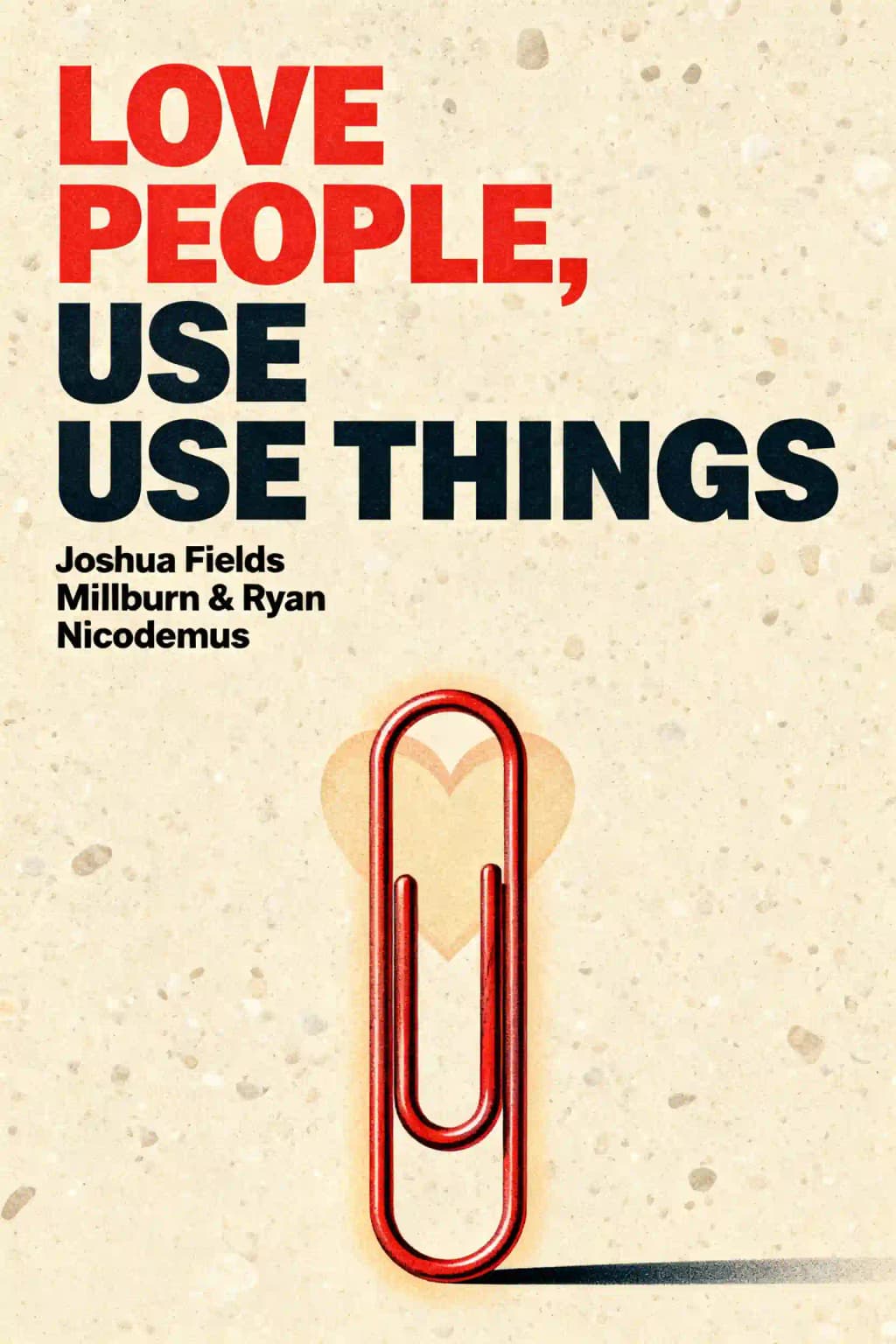
In a world obsessed with more, Joshua Fields Millburn and Ryan Nicodemus offer a radical alternative. Their philosophy of minimalism has resonated with millions seeking escape from the crushing weight of consumerism. "Love People, Use Things" isn't just another decluttering manual-it's a profound exploration of our most essential relationships, beginning with our possessions and extending to our deepest human connections. The book has become something of a cultural phenomenon, with celebrities like Dave Ramsey and Elizabeth Gilbert praising its wisdom. When COVID-19 struck, many found its principles unexpectedly relevant, as the pandemic forced a global reassessment of what truly matters. Through personal stories of addiction, financial ruin, and eventual redemption, the authors demonstrate how removing the excess from our lives creates space for what genuinely brings fulfillment-not the endless pursuit of things, but the cultivation of meaningful relationships.
Capítulo 2
The Burden of Too Much: How Stuff Weighs Us Down
The average American household contains over 300,000 items, yet these possessions often bring stress rather than happiness. The true cost of our belongings extends far beyond the purchase price-they demand space, maintenance, repair, and eventual replacement, not to mention the emotional toll they take. Instead of waiting until we can afford things, we plunge ourselves into debt. The average American carries four credit cards with over $16,000 in debt. Before the pandemic, 80 percent of Americans were in debt, collectively owing more than $14 trillion.
Our consumption habits are staggering: Americans spend more on jewelry than education, our homes have doubled in size over fifty years, and we discard 40 pounds of clothing annually. Shopping is the favorite leisure activity for 93 percent of American teenagers, with $1.2 trillion spent yearly on non-essential goods. Meanwhile, half of households have no savings, 62 percent couldn't produce $1,000 in an emergency, and nearly 50 percent couldn't gather $400 in a crisis-even among high-income earners. This isn't an income problem but a spending problem affecting all economic classes.
We continue consuming and expanding with average homes of 2,800 square feet and 52,000 storage facilities-six times the number of Starbucks. Our garages overflow with unused items, and American children own 40% of the world's toys while playing with only 12 of their average 200 toys daily. If everyone consumed like Americans, we'd need nearly five Earths to sustain us.
We cling to outdated items like rotary phones and cassette tapes out of nostalgia, even though we no longer use them. Our basements, closets, and attics are stuffed with things we've forgotten about. But as the world changes, so do our needs. Learning to let go allows what's useless to us to become valuable to others. Everything eventually loses its utility-in a hundred years, USB cables and iPhones will be as obsolete as what now gathers dust in our storage spaces. The willingness to let go is one of the most mature virtues we can develop.
Capítulo 3
Breaking Free: The Minimalist Journey
Minimalism begins with asking how your life could improve with less. For Joshua, this journey started in Dayton, Ohio-a city known for aviation, funk music, and now as the epicenter of the opioid crisis. Born on an Air Force base in 1981, his childhood initially seemed idyllic with his father working as an Air Force physician and his mother as a secretary. However, his father soon developed schizophrenia and bipolar disorder, worsened by alcoholism. After his parents' divorce when Joshua was four, his mother began drinking heavily.
They moved to a dilapidated duplex in a poor suburb. His mother traded food stamps for alcohol, drank for days on end, and chain-smoked. Their home reeked of urine and cigarettes and was infested with cockroaches. Often their electricity was cut off, and they slept at strangers' homes. Occasionally, grocery bags mysteriously appeared at their door-his mother attributed them to Saint Anthony.
When his mother died, Joshua faced her apartment full of possessions. The living room overflowed with antique furniture and doilies, the kitchen with dishes, the bathroom with toiletries, and her closet contained fourteen winter coats-a mile from the beach in Florida. Initially, he rented storage space, but when he found boxes of his old schoolwork under her bed, he realized an important truth: our memories don't reside in our things but within ourselves. Instead of storing everything, he gave away her possessions to friends and charities, keeping only a few meaningful items and photographing the rest. This experience taught him that sentimental items become more valuable when you're selective about what you keep, and that letting go is liberating.
Unlike the chaotic hoarders on television, Joshua was an organized hoarder. His basement contained neatly labeled storage boxes, his recreation room resembled an electronics store, his office had floor-to-ceiling bookshelves, and his walk-in closets were perfectly organized with designer clothing. Despite the apparent order, he felt suffocated by his possessions. He began minimalism by asking himself how a simpler life would enrich him. By removing one thing daily, he entered a positive spiral. After eight months, he had discarded 95% of his possessions. Now he owns only things that serve a purpose or bring joy. This clearing out created space for deeper questions about what truly matters in his life.
Capítulo 4
From Emptiness to Purpose: Finding What Matters
Ryan Nicodemus grew up in a dysfunctional family. After his parents' divorce, he lived with his mother and later stepfather in a trailer surrounded by drugs, alcohol, and domestic violence. His mother lived on welfare and constantly complained about money problems. As a teenager, Ryan worked for his father's painting business, where he entered luxurious homes. On a hot summer day, working in a beautiful suburban house, he was impressed by the seemingly happy residents and their possessions. He asked his father how much he would need to earn to live like that. The answer-$50,000 per year-became his life goal.
During their senior year of high school, Ryan shared his dream with Joshua: earning $50,000 per year would make him happy. Joshua adopted the same goal. After school, Joshua became a representative at a telecommunications company and later brought Ryan in as a salesman. Ryan quickly reached his financial goal but discovered it didn't make him happy. He kept moving the goalpost-maybe he needed $65,000, or $90,000, or a six-figure income. By 2008, Ryan had achieved everything he had ever wanted: a prestigious position, a successful career, a high salary, a new car annually, and a large house. But despite his apparent success, he also had enormous debts and felt miserable. He tried to fill the emptiness in his life with more and more things, paid for with money he didn't have, for things he didn't need.
Although Ryan's life looked perfect from the outside, it was a mess beneath the surface. Alcohol played an increasingly large role-he drank daily and often drove home drunk, totaling at least three new cars. A low point came when he vomited everywhere, including on a colleague's carpet, a birthday cake, and his own thousand-dollar suede jacket. His decline accelerated through pill addiction, beginning with a Percocet prescription for a broken thumb. Soon he was using up to forty painkillers a day and spending $5,000 monthly on alcohol and pills. After an overdose, he ended up in a psychiatric institution, leading to even more debt. He cheated on virtually every girlfriend, lied to everyone, and neglected his loved ones, including his mother who lived nearby. Despite his material possessions, he lacked purpose, passion, and direction. He worked 60-80 hours weekly but neglected his health, relationships, and creativity. When Joshua asked what he was passionate about, he replied, "I have no idea." He lived for things, for his career, for alcohol and pills-but he wasn't really living.
Capítulo 5
The Transformation: Embracing Minimalism
Ryan's life resembled an empty shopping mall-hollowed out by years of excessive consumption and neglected human relationships. As he approached thirty, he noticed that Joshua, his best friend of twenty years, seemed happy despite recent losses. During lunch at Subway, he asked why Joshua was "so damn happy." Joshua told him about minimalism and how shedding excess had created space for what truly matters. Ryan decided on the spot to become a minimalist: "I'm in!" Wanting faster results than Joshua's eight-month process, they devised the "packing party"-they would pack all his belongings as if he were moving, after which he could only unpack things he needed in the following three weeks. After nine hours of packing, his house was filled with boxes reaching halfway to the ceiling. After 21 days, it turned out he hadn't touched 80 percent of his possessions. He decided to get rid of everything that remained packed and felt free for the first time in his adult life. By removing the superfluous, space was created for meaningful change. He developed a sense of community instead of consumerism and focused on people instead of things.
After his transformation, Ryan wanted to share his story to help others. Because writing was one of Joshua's passions, they started a blog together: TheMinimalists.com. In the first month, their site attracted 52 visitors-a modest beginning that showed them people were interested in their message. Those 52 visitors grew to 500, then 5,000, and eventually millions per year. They discovered that when your story is valuable to others, people spontaneously share it with friends and family. Ten years after choosing a simpler life, as "The Minimalists," they help more than 20 million people lead more meaningful lives with fewer possessions-all because the simple message of letting go to make room for what's important proves valuable to people.
Minimalism begins with fewer possessions, but it's much more than just decluttering. You can get rid of everything and still feel miserable, perhaps even more so because you've removed the things with which you masked your unhappiness. Removing the superfluous is just one ingredient in the recipe. The problem isn't consuming, but mindless consuming. The solution is making more conscious choices. Minimalists don't strive for less for the sake of less, but for space for more: more time, passion, creativity, experiences, meaning, and freedom. If the term "minimalism" intimidates you, you can choose another word that better fits your vision: intentionalism, enoughism, essentialism, or functionalism. This book isn't a guide to decluttering your home-there are plenty of those already. It aims to take you beyond that first step to the more difficult next phase: learning to live intentionally and creating space for the right kind of more.
Capítulo 6
Reclaiming Your Relationship with Possessions
The first relationship we need to examine is with our possessions. The Kirkendolls, a couple who married at 24 and lived their dream life with four children, pets, and a house outside Minneapolis, discovered an unexpected liberation when a fire destroyed their home and belongings. Though they lost everything, their children were safe, their family intact, and their relationship stronger than a month before. Instead of seeing disaster, they saw opportunity: "What are we going to do with our newfound freedom?"
Many people in the Western world chase happiness through impulse purchases and status symbols, but this often leads to discontent. Although we think we're pursuing happiness, what we're really seeking is freedom. However, true freedom isn't "doing what you want when you want"-that leads to self-imposed tyranny. Freedom isn't a material possession and can't be measured like time or distance. The more we chase apparent freedom (sports cars, large houses, promotions), the further we stray from true freedom. The average American believes they're free in their manicured yard, but in reality, they're enclosed by the fence of their dream existence.
To effect change, rules are useful, though they may seem limiting. The authors have established minimalist rules that help resist the temptations of consumerism. The No-Junk Rule divides possessions into three categories: essential things (basic needs), non-essential things (valuable additions), and junk (things that obstruct meaningful living).
Even the Minimalists still struggle with consumerist temptations. Advertisements are everywhere: from jackets in banner ads to watches in magazines. But a Rolex doesn't give you more time, a Mercedes doesn't get you to your destination faster. Often, we actually sacrifice our time to buy the illusion of time. Luxury items can be fine in themselves, but the problem arises when we believe these things make our lives more meaningful. Possessions can support a meaningful life, but they don't give it meaning.
Americans are exposed to 4,000-10,000 advertisements daily. Before the twentieth century, advertising primarily connected producers with people who genuinely needed their products. With industrialization, this changed: manufacturers needed consumers for their increased production. Edward Bernays, Freud's nephew and founder of modern advertising, realized that appealing to unconscious desires was more effective than rational arguments. Globally, half a trillion dollars is now spent annually on advertising, and advertising agencies have increasingly penetrated the human psyche.
Capítulo 7
Minimalist Strategies for a Meaningful Life
Modern advertising often manufactures problems to sell solutions. Consider Viagra: originally a blood pressure medication, it was rebranded when male subjects reported unexpected effects, with advertisers coining "erectile dysfunction" to create a $3 million yearly market. This practice extends to pharmaceutical ads that mask side effects behind idyllic imagery. Notably, only the US and New Zealand allow such direct-to-consumer pharmaceutical advertising.
Advertisers create false urgency through phrases like "Decide now!" and "While supplies last!" exploiting our instinctive response to scarcity. These limitations are typically artificial-companies rarely refuse money due to timing. The simple truth remains: not buying saves 100% of the cost.
The impact of advertising on our environment is striking. Vermont, one of four US states banning billboards, offers noticeably calmer landscapes. Globally, about 1,500 cities have prohibited advertising displays, including Sao Paulo's removal of 15,000 billboards in 2007. While we accept advertising as the cost of "free" media, this costs us twenty minutes per hour on commercial channels. Alternative models exist: Netflix, Apple Music, and Wikipedia demonstrate people's willingness to pay for ad-free experiences or support through voluntary contributions.
Living in Los Angeles revealed how powerful the allure of luxury items can be, from granite countertops to exclusive sneakers. The core of minimalism challenges this: you probably don't need that. The American dream has shifted from modest contentment to endless consumption, driven by dopamine-fueled purchasing. The essential question becomes: how much is enough? This varies individually and evolves with circumstances. The sweet spot lies where intentional living meets satisfaction-having neither too little nor excessive abundance.
Capítulo 8
The Freedom of Letting Go: Practical Minimalism
With every expenditure, you give up a piece of freedom. Before buying something, ask yourself six crucial questions: 1) For whom am I buying this? Our possessions don't reveal who we are, but who we want to be. Buy only what's truly for yourself, not to present an image to others. 2) Does this add value to my life? Everything you own should serve you as a tool or provide aesthetic pleasure. 3) Can I afford it? If you need a credit card or have to borrow money, you can't afford it. 4) Is this the best use of my money? Consider alternatives and priorities. 5) What is the real value? Calculate the full cost including storage, maintenance, and psychological burden. 6) Would the best version of myself buy this? These questions eventually become a habit that yields much: less clutter and more money for what truly matters.
Ten years after Ryan's experimental packing party, we decided to start a practical study to see how a similar approach would work for others. In April 2019, 47 participants took part in a coordinated packing party where they packed their belongings as if they were moving. Participants could choose from three options: packing their entire house, a room, or multiple rooms. For 21 days, they only unpacked what added value or brought joy. The approach varied greatly: Natalie packed her entire house room by room, Abigail shared an apartment with her non-minimalist husband and packed selectively, while Ellie, a minimalist for years, needed only two hours to pack everything. The first items unpacked-from toothbrushes and coffee makers to computers and musical instruments-revealed what was truly essential in their daily lives.
Ryan offers practical advice for improving your relationship with possessions through five concrete "do's": map the benefits of fewer possessions, establish personal rules, make an inventory of your possessions (by categorizing items as essential, non-essential, or junk), part with unnecessary belongings, and seek support from others. He also warns against five pitfalls: don't expect immediate results, don't be guided by others' expectations, don't assume you'll be unhappy without certain things, don't keep anything "just in case," and focus on letting go rather than just organizing. Ryan emphasizes that decluttering is a process that takes time but leads to more freedom and happiness.
Capítulo 9
The Power of Truth: Confronting Our Inner Reality
Joshua opens with his personal story about his mother developing lung cancer. He describes their difficult relationship due to her alcoholism during his childhood, but also her extraordinary goodness and care for others. Despite her problems, she organized annual Thanksgiving feasts for hundreds of needy people. Joshua reflects on how letting go of material possessions often reveals deeper truths about ourselves, and how difficult it is to accept our imperfections.
Joshua explores how depression and addiction often stem from a lack of connection and meaning, not just biological factors. He quotes journalist Johann Hari who states that "the opposite of addiction isn't sobriety, it's connection." Joshua's mother became depressed and started drinking when she no longer felt connected to her environment. He shares insights from politician Pete Buttigieg about how de-industrialization in the American Midwest has led to a "lack of connection," causing despair and making people create a false reality. The problem isn't just economic but also social-a geographical and interpersonal gap between people. Ironically, the number of trusted friends decreases as people move into larger houses.
Joshua describes how his marriage to Keri fell apart because he ignored the truth and lied, even to himself. He remained in an unsatisfying relationship because it was comfortable enough-a six on the comfort scale. But as he explains: "Discomfort makes room for truth-it exposes flaws-and comfort for lies." Their relationship wasn't intentionally chosen but followed a predetermined path. They lacked the essential elements for a healthy relationship that Dr. Christopher Ryan identifies: chemistry, agreement, and love. Joshua and Keri had love, but no agreement on fundamental issues like children, community life, and finances, leading to unspoken resentment that tainted everything.
Joshua distinguishes between mistakes and bad decisions. A mistake is unconscious, like a wrong answer on a test; a bad decision is a conscious choice without considering the consequences. He confesses that he cheated on his wife after his mother's death-not a mistake, but a reprehensible decision stemming from earlier unspoken choices. Dismissing bad decisions as mistakes is unfair and avoids responsibility. Joshua argues that we should celebrate mistakes and learn from bad decisions, but never confuse the two. Acknowledging the truth is difficult but liberating.
Capítulo 10
Self-Care: The Foundation of Meaningful Living
Joshua introduces his experience with depression, which began in 2019 and which he calls "the new great depression." He describes how he was previously an incorrigible optimist who didn't sink into depression even in difficult times. Even during his chaotic twenties in business, he made everyday encounters something exuberant through his enthusiastic response "Extraordinary!" when people asked how he was doing.
Joshua explains that his enthusiastic responses weren't meant to create a happy impression, but to make himself more aware of the present moment. He acknowledges his own difficulty with being present in the now and sees minimalism as a tool to remove material distractions, allowing us to look at ourselves better. He emphasizes that mindfulness requires attention, energy, and focus, while appreciation asks for recognizing the exceptional in the ordinary-both difficult in our overcrowded, hurried world full of distractions.
Joshua shares that even ten years after his "Mr. Extraordinary" period, he still struggles with living in the moment. He draws inspiration from two thinkers with opposing beliefs: Christian preacher Rob Bell and atheist Sam Harris. He recounts Bell's retelling of the Moses story, in which God instructs Moses "to be on the mountain"-a metaphor for being fully present in the moment instead of constantly being concerned with what's to come. Joshua emphasizes that people have been struggling with distraction for thousands of years, and that rest is as important as action to truly enjoy life.
Joshua discusses Bell's three enemies of "being in the here": boredom (the idea that there's nothing interesting), cynicism (the idea that there's nothing new to realize), and despair (the feeling that nothing matters). He adds his own interpretation: if you're bored, you're boring; if you're cynical, you're not trying hard enough; if you surrender to despair, you have no eye for the here and now. He acknowledges that these 'spiritual diseases' separate us from the fundamental truth that we are here, and hinder us from appreciating the beauty of the here and now.
Capítulo 11
Healing the Body, Healing the Mind
Joshua describes how after a period of exceptional well-being in 2018, he plunged into a deep depression. He reflects on his lifelong struggle with his body: as a child, he became obese when his mother developed alcohol problems; as a teenager, he lost weight unhealthily by stopping eating; and as a twentysomething, he neglected his health for his career. He blindly trusted medications without adjusting his lifestyle, not knowing that his skin problems and other ailments were largely caused by food allergies and a disrupted microbiome from years of antibiotic use.
Joshua discusses the confusion surrounding healthy eating due to contradictory dietary advice. After interviewing three experts with radically different diets (vegan, carnivore, and omnivore), he identifies their commonalities: avoid processed food, sugar, gluten, chemical additives, and refined oils. He presents guidelines for a "minimalist diet": eat real food, not too much or too little, avoid inflammatory foods, choose organic and local, and focus on the problem rather than the symptoms.
Joshua connects his health problems with minimalism: both revolve around intentional living and taking responsibility. He describes how for years he treated his body carelessly, as if it were indestructible and replaceable. Even when he thought he was being healthy, he made poor decisions regarding nutrition, medication, exercise, sleep, and stress. He concludes that health problems, like excess possessions, don't disappear on their own; when you ignore problems, both clutter and disease only increase.
Joshua shares the story of Marta Ortiz, who discovered during a minimalism experiment how much she neglected her health. By packing all her belongings in boxes and only unpacking the necessities, she gained insight into her excessive stress, poor eating habits, and lack of exercise and sleep. Even after her introduction to minimalism, she continued taking on too many commitments. Confronting the excess in her life led to strict boundaries, healthier eating, and more conscious shopping. By letting go of distracting possessions, she created space to live more intentionally and improve her well-being-a kind of free medicine.
Capítulo 12
Living Your Values: Aligning Actions with Principles
Ryan begins with a personal story about how he stole a tie for a job interview at eighteen. He was caught and arrested, a painful lesson that nevertheless didn't prevent him from later compromising his values to pursue the "American dream."
We all make small compromises that eventually have major consequences. Ryan describes how he gave up his dream of becoming a sound engineer for a better-paying job at a "soulless company." Like barracudas blindly rushing at shiny objects, we humans chase trends, possessions, and jobs that ultimately don't make us happy. By constantly compromising our values, our entire life eventually becomes one big compromise.
Ryan introduces Jacques Lacan's concept of "object A": the thing we think will give us satisfaction-whether it's a watch, car, house, promotion, or relationship. The treacherous aspect of object A is that it constantly changes and ultimately always disappoints. Philosopher Peter Rollins explains that people are structurally inclined to believe in an absolute solution that makes everything better, but this solution doesn't exist. When object A disappoints, we often seek the opposite, in an endless cycle of desire and disappointment.
Ryan distinguishes four levels of well-being, illustrated with food metaphors. Pleasure (like eating a piece of cake) is fleeting and can even be harmful if it becomes the goal. Happiness (eating a healthy meal) comes from making good decisions that align with who you want to be. Satisfaction (following a consistently healthy diet) arises from making good choices over the long term. Joy, the highest form of well-being, only occurs when other people are involved, like sharing a meal with someone you care about. Joy differs from the other forms in that it makes room for negative emotions and doesn't need to be constantly fed with desire.
There are five fundamental values that almost everyone shares: health, relationships, creativity, growth, and contribution. These form the unwavering foundation on which your life should be built. Without health, you can't enjoy even the simplest things. Without relationships, you can't lead a meaningful life. Without creativity-something where you can express your inspiration-you find no fulfillment. The concept of 'following passion' is misleading because it assumes everyone is born with a ready-made passion, while creativity is a better description of this fundamental value.
Capítulo 13
Money Matters: Finding Financial Freedom
Joshua begins with his personal experience of financial irresponsibility. As an eighteen-year-old, he got his first credit card, and for the next ten years, he spent money like water. He justified his spending with the thought that he was spending what his future, more successful self would earn. Eventually, he had fourteen credit cards that had all reached their limit. Despite rising incomes-at 22 his first house, at 23 his first Lexus, at 24 his second Lexus, and at 25 a Land Rover-he never found the satisfaction he sought. Instead, he dug an increasingly deep financial hole.
Joshua shares shocking statistics about Americans' financial situation: 25% have to borrow money for unexpected expenses of $400, the same percentage has saved nothing for retirement, and many deny themselves medical care due to costs. He argues that debt robs us of our freedom, security, and identity, and that the new American dream is to be debt-free. As an example of success, he mentions his friend Jamar Hocker, who doesn't work for more possessions but for freedom. Joshua describes his collaboration with Dave Ramsey, whose "financial sermons" come from tough love and have helped millions of Americans. Through Ramsey's "7 Baby Steps," Joshua paid off his own six-figure debt, which has brought him financial freedom and enables him to contribute more to others.
Joshua discusses the many causes of financial crises, including medical emergencies, job loss, and inflation. However, he emphasizes that we are responsible for our financial choices. Through his work with Dave Ramsey, he discovered why so many people in the richest country in the world are broke. Ramsey's powerful message, delivered as "financial poetry," emphasizes that most people are broke despite appearing to be doing fine. They spend more than they earn, have no emergency fund, and take unwise loans. Ramsey concludes that "being broke and stupid is normal in America" and encourages people to be "unusual" and "counter-cultural."
Joshua appreciates Ramsey's practical advice and shares his "7 Baby Steps" to become debt-free: start with an emergency fund of $1,000, pay off debts via the "debt snowball," build a larger emergency fund, invest for retirement, save for your children, pay off your mortgage early, and build wealth to be generous. By following these steps, Joshua has eliminated his own six-figure debt, which has brought him financial freedom, peace, and new possibilities.
Capítulo 14
Creativity: Making Space for What Matters
Joshua's first job at age three, cleaning litter at his apartment complex for two dollars a week, taught him fundamental lessons about work, earning, and the power of asking. He learned that every creative enterprise starts with questions, and our creations are the answers.
For years, Joshua maintained two separate personas: his professional business self and his hidden creative self, believing them incompatible. Eventually, he recognized that his business career was inherently creative - developing leadership skills, solving problems, and helping others were all forms of creation.
Despite wanting to be a writer, Joshua spent years merely "aspiring" without writing. Unlike craftspeople who understand the necessity of work, he expected writing to happen mysteriously. He hid behind excuses and "writer's block" until discovering the simple solution: showing up daily to write, regardless of the outcome. His focus on results rather than process contradicted minimalist principles.
Our creative potential is directly impacted by our relationship with distractions. Minimalism involves both decluttering and "un-distracting." Technology has become our primary distraction - we check smartphones 150 times daily, make 2,617 swipe movements, and spend over 10.5 hours on devices. This creates an "attention wall" between people, a problem Joshua addresses by treating digital communications with the same courtesy as phone calls, responding outside of social situations.
Capítulo 15
Loving People: The Heart of Minimalism
In a world changed by COVID-19, I discovered that this book had unintentionally become a manual for pandemic preparation. While soldiers and megaphones filled my nightmares, the reality of empty stores and social distancing became our new normal. The pandemic forced us to confront what is truly essential: not our possessions, but our relationships.
Intentional living proved to be the best preparation, not hoarding supplies. The economy collapsed as soon as people only bought necessities, revealing its vulnerability. Just as after the 2008 crisis, people are now again looking for solutions to overconsumption.
The pandemic posed the question: what is essential? This answer differs per person and changes over time. In crisis, we must let go of non-essential matters to discover what truly matters. This forced home isolation opened many eyes: people are important, not things. This book helps you clear out the clutter in your life-material, mental, emotional, and relational-so you can connect with what really counts.
The title "Love people, use things" is inspired by Bishop Fulton J. Sheen who said: "Remember to love people and use things, instead of loving things and using people." This wisdom, which Joshua saw hanging above his mother's bed as a child, was later echoed by rapper Drake and summarized by The Minimalists as their core message with which they conclude every podcast. Minimalism isn't a new idea-it goes back to the stoics and major religions-but the problem it solves is more modern than ever: people are seduced by materialism and neglect loved ones for worthless things. This book offers proven solutions and shows how your life in the modern world can improve by learning to rely less on material things.
We have a language problem: we use the same word "love" for deep affection and superficial preferences. If we define love too broadly, it loses its power. We should have more words for different types of love, just as the Inuit have 53 words for snow. Love is essential-without love, trust, goodness, and kindness are colorless. A life without love is empty and superficial. Yet we often prefer to pursue being sexy, cool, or popular, because that's easier than cultivating real love. Love isn't something you find, but what you cultivate by being loving. Paradoxically, you must let go of love to keep it. You can love someone without approving of their behavior. Our greatest challenge is that we confuse excitement and attraction with love, especially in our relationship to possessions. We can use things without loving them, because love is reserved for people.