Capítulo 1
A Dystopian Dance of Light and Shadow
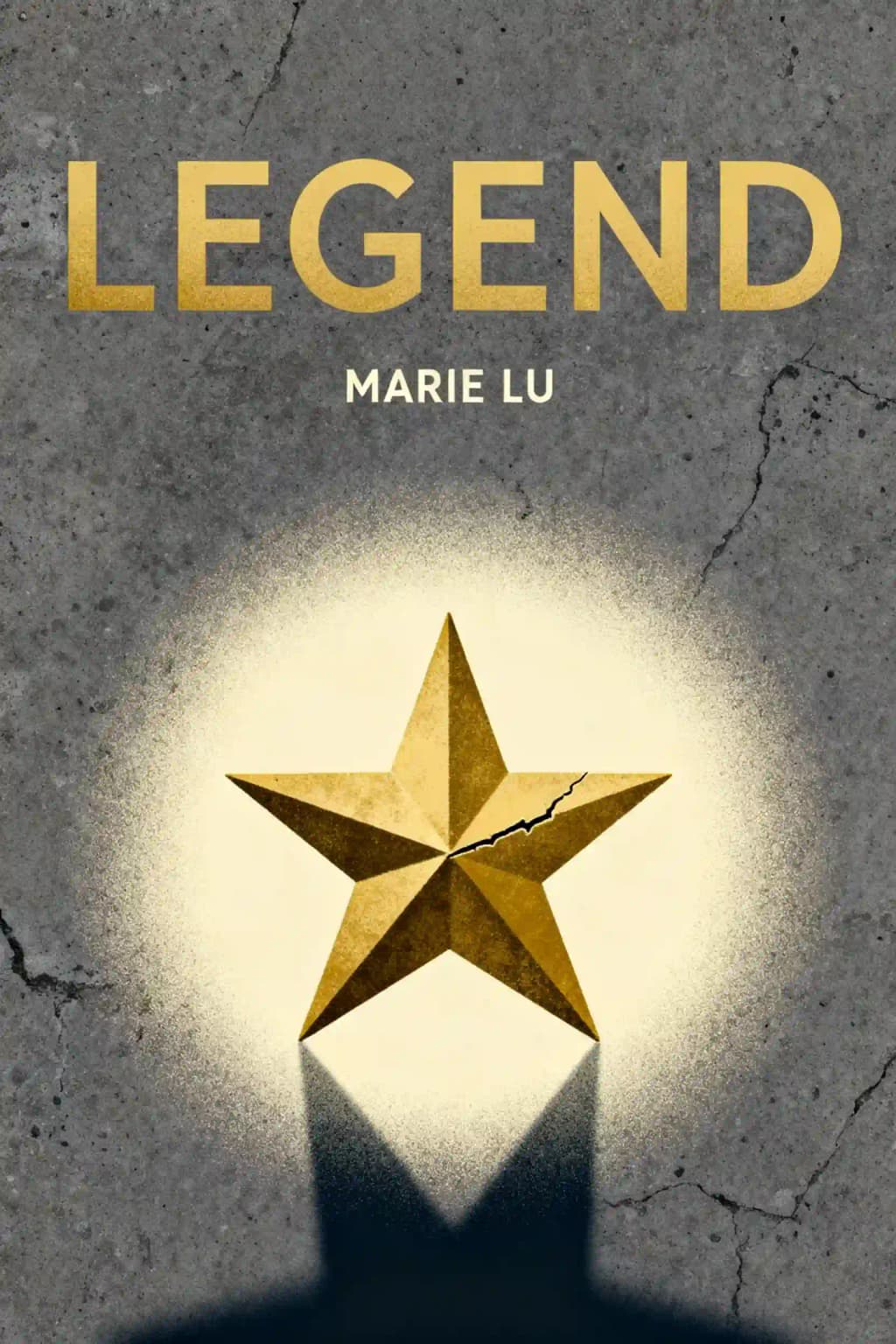
In the decade since its 2011 release, Marie Lu's "Legend" has captivated millions with its razor-sharp vision of a divided America. This dystopian romance thriller became an instant New York Times bestseller, launching Lu's career and spawning a beloved trilogy that's now being adapted for the screen by BCDF Pictures. What makes this novel particularly fascinating is how it emerged from Lu's early attempts to reimagine Les Miserables as a teen cat-and-mouse chase between a criminal and detective. The book's appeal crosses demographic lines-praised by critics for its tight pacing and dual perspectives while becoming a favorite among celebrities like Lilly Singh and BTS's RM, who have publicly recommended it. Perhaps most telling is how its themes of government control, inequality, and resistance continue to resonate more strongly each year, making "Legend" not just entertainment but a prescient commentary on our own societal divisions.
Capítulo 2
A Republic Divided: The Dystopian World of Legend
The Republic of America emerges from the ashes of the western United States - a militaristic nation whose very foundation rests on perpetual conflict with its eastern neighbor, the Colonies. This transformed landscape serves as more than mere backdrop; it functions as a living, breathing character that shapes every aspect of its inhabitants' lives. Los Angeles, the Republic's crown jewel, stands as a monument to inequality, where gleaming skyscrapers and advanced technology in the wealthy sectors cast long shadows over the crumbling infrastructure and desperate poverty of the poor districts.
The society's cornerstone is the Trial - a sophisticated examination all citizens must undertake at age ten that determines their entire life trajectory. Those who excel earn placement in elite universities, guaranteed healthcare, and positions of influence. High scorers, marked by their distinctive rings, enjoy privileges like unlimited water rations and access to advanced medical care. Those who fail face dire consequences: forced labor in factories, deployment to toxic waste cleanup sites, or mysterious disappearances into "labor camps" from which few return. This system, marketed as pure meritocracy, masterfully maintains social control while ensuring a steady supply of desperate recruits for the Republic's military machine.
Lu's worldbuilding excellence lies in crafting a reality that feels unnervingly possible. The Republic's mechanisms of control echo historical authoritarian regimes while incorporating modern surveillance technology. Massive JumboTrons broadcast a constant stream of propaganda, featuring the charismatic Elector Primo's speeches and carefully edited war footage. Military parades occur weekly, complete with precision aircraft formations and displays of advanced weaponry. Public executions are transformed into media spectacles, complete with commentary and replay footage, normalized as family entertainment.
The society's psychological manipulation runs deep. Daily pledge ceremonies incorporate patriotic songs and virtual reality experiences celebrating the Republic's glory. Children learn revised history in schools, where the former United States is portrayed as a failed experiment in dangerous democracy. The wealthy sectors host regular "Victory Festivals" celebrating military successes, while in poor sectors, soldiers in hazmat suits mark infected homes with glowing red Xs - these marks often serving as death sentences rather than quarantine warnings.
The Republic's bioweapons program reveals its darkest aspects. Through sophisticated laboratories disguised as research facilities, the government develops and strategically releases different strains of plagues. These serve multiple purposes: population control in overcrowded poor sectors, testing grounds for biological weapons, and justification for increased military presence in "troubled" areas. The wealthy receive vaccinations while the poor serve as unwitting test subjects, their deaths recorded as valuable data points.
This carefully constructed world creates the perfect crucible for the story's protagonists - two exceptional young people whose paths would never have crossed in the normal order of things. One from the elite sectors, trained to uphold the system; the other from the poor districts, skilled in surviving its cruelties. Their eventual meeting ignites a chain reaction that threatens to unravel the Republic's carefully maintained facade, exposing the rotting foundation beneath its gleaming surface.
Capítulo 3
Day: The Boy Who Walks in the Light
Daniel Altan Wing - known throughout the Republic as the legendary criminal "Day" - embodies the spirit of resistance in a society designed to crush it. At fifteen, he's already the Republic's most wanted fugitive, not for violence but for his Robin Hood-like sabotage against military targets and his uncanny ability to escape capture. His missions range from disrupting military supply lines to exposing government corruption, all while maintaining a strict no-kill policy that sets him apart from other rebels. What makes Day extraordinary isn't just his physical prowess but his fundamental decency in a world that rewards cruelty.
Day's origin story reveals the Republic's true nature in stark detail. Despite scoring perfectly on his Trial (a fact deliberately hidden from him), he was subjected to brutal medical experiments and left for dead - likely because of his poor background and mixed heritage. The Republic's scientists treated him as disposable, performing painful procedures without anesthesia and documenting his expected death with clinical detachment. Instead of dying, he escaped and reinvented himself as a symbol of defiance, using his presumed death to become a ghost that haunts the Republic's conscience. His signature - a streak of red in his blond hair - becomes a rallying point for others who question the Republic's authority, inspiring countless acts of resistance across the poor sectors.
What drives Day isn't ideology but love, a motivation that makes him both powerful and vulnerable. Everything he does - from stealing plague medicine to risking capture - stems from his desperate need to protect his family, particularly his mother and younger brothers John and Eden. When Eden contracts a suspicious variant of the plague, Day's investigation reveals disturbing patterns in the disease's spread, suggesting government involvement. His break-in at the hospital for medicine demonstrates both his exceptional skills and his willingness to sacrifice everything for those he loves.
Day's perspective provides the emotional heart of the story, offering an unflinching look at life in the Republic's margins. Through his eyes, we experience the crushing weight of the Republic's boot on the poor sectors - the casual violence of the military patrols, the deliberate spreading of disease as population control, the public executions of the infected that serve as both warning and entertainment. His observations reveal a government at war with its own citizens, one that views the poor as expendable resources rather than people deserving protection. The contrast between the gleaming high-rises of the wealthy sectors and the crumbling tenements of Day's neighborhood becomes a powerful metaphor for the Republic's moral decay.
Perhaps most poignantly, Day embodies hope in a hopeless world. His very name reflects his philosophy: "Each day means everything's possible again. You live in the moment, you die in the moment... You try to walk in the light." This outlook - maintaining humanity in an inhumane system - makes him not just a criminal but a genuine threat to the Republic's control. His actions inspire others not through grand gestures but through small acts of kindness and courage, proving that resistance doesn't always require violence, sometimes it just requires refusing to become what your oppressors want you to be.
Capítulo 4
June: The Prodigy with Perfect Vision
June Iparis embodies the Republic's ideal citizen - a prodigy whose abilities border on the superhuman. At just fifteen, she's shattered academic records by graduating from Drake University, the nation's most prestigious military academy, years ahead of her peers. Her perfect Trial score - a feat officially achieved by no other citizen, though Day's hidden perfect score exists in classified records - marks her as exceptional even among the elite. Orphaned at age seven, June was raised by her older brother Metias, a high-ranking military officer who shaped her into the Republic's most promising young agent.
What makes June such a compelling character is the stark contrast between her extraordinary intellectual capabilities and her emotional blind spots. Her analytical prowess manifests in almost supernatural ways - she can calculate trajectories in seconds, spot microscopic details others miss, and piece together complex puzzles from seemingly unrelated clues. She can read a person's entire life story in their posture, deduce their social class from their shoe wear patterns, and identify their fighting style from a single defensive stance. Yet this same brilliant mind remains unable to question the Republic's propaganda, having internalized its ideology so completely that she's blind to its obvious contradictions.
June's carefully constructed world shatters when Metias is murdered during what appears to be a hospital break-in by Day. Her grief manifests as a cold, calculating rage that drives her to become the youngest special agent in Republic history. She approaches the hunt for Day with military precision, turning her personal vendetta into a methodical pursuit that showcases both her tactical genius and her emotional vulnerability.
The investigation forces June to go undercover in the impoverished sectors - a world entirely foreign to her privileged upbringing. Here, she witnesses firsthand the brutal realities of life outside the Republic's favor: children dying from manufactured plagues, families struggling for basic necessities, and military forces exercising unchecked violence against civilians. These experiences, combined with her unexpected connection to Day - whom she meets while undercover and falls for before learning his identity - begin to erode her unwavering faith in the Republic's righteousness.
June's most admirable quality is her intellectual honesty when confronted with evidence that challenges her worldview. Upon discovering the Republic's deception about Day's Trial results, uncovering her brother's secret investigation into government-created diseases, and learning the truth about her parents' mysterious deaths, she demonstrates remarkable courage in facing these uncomfortable truths. Rather than clinging to her indoctrination, she systematically reevaluates everything she's been taught. This transformation - from the Republic's most promising weapon to its most formidable opponent - showcases her true strength: the ability to admit when she's been wrong and take decisive action to correct course. Her intimate knowledge of the Republic's inner workings, combined with her prodigious skills, makes her an especially dangerous enemy to the system she once served without question.
Capítulo 5
A Forbidden Connection: Day and June's Relationship
The heart of "Legend" lies in the electric connection between Day and June-two prodigies shaped by the same system into apparent enemies. Their relationship develops through layers of deception, with neither initially knowing the other's true identity. This creates a delicious dramatic irony as readers watch them fall for each other while knowing the devastating truth that will eventually emerge.
Their first meeting occurs when June goes undercover in the poor sectors, disguised as a street urchin. Day rescues her from angry gamblers after a street fight, not realizing she's the military prodigy hunting him. Their attraction is immediate and powerful-two exceptional minds recognizing something familiar in each other despite their different backgrounds.
What makes their connection compelling is how it transcends their circumstances. Despite being raised to view the world differently, they share core values: loyalty to family, quick thinking under pressure, and a fundamental sense of justice. Their similarities reveal the arbitrariness of the Republic's class divisions-had Day been born in June's sector, he might have become a military legend rather than a criminal one.
The pivotal moment comes when June discovers Day's identity and betrays him to the Republic, leading to his capture and his mother's execution. This betrayal, born of her belief that Day killed her brother, sets up what should be an insurmountable barrier between them. Yet as June uncovers the truth-that Day didn't kill Metias, that the Republic has been lying to them both-she chooses Day over the system that raised her.
Their relationship becomes transformative for both characters. Day helps June see beyond her privileged perspective to recognize the Republic's cruelty, while June gives Day hope that change might be possible from within the system. Together, they represent the possibility of bridging the Republic's divisions-the poor and privileged united against common oppression.
By the novel's end, their relationship has evolved from enemies to reluctant allies to something deeper-two people who recognize they are "the same person born into different worlds." This connection, forged through tragedy and betrayal, becomes the foundation for their fight against the Republic.
Capítulo 6
The Republic's Dark Secrets: Conspiracy and Control
As Day and June's stories converge, "Legend" reveals its most chilling aspect-the systematic conspiracy at the heart of the Republic. What initially appears to be mere inequality gradually unfolds as something far more sinister: a government actively experimenting on its citizens and culling the population through engineered disease.
The first hint comes when Day notices strange markings on plague-quarantined homes-some with a third line cutting through the standard X. Later, he observes mysterious numbers (318, 2544) near these homes and detects the sound of liquid flowing through pipes beneath the ground. These clues, initially puzzling, gradually form a horrifying picture.
The full truth emerges through Metias's hidden research, which June discovers through a coded message in his journals. The Republic isn't just failing to cure plagues-it's creating them, using poor sectors as testing grounds for biological weapons intended for use against the Colonies. Each year's "plague outbreak" is deliberately released to eliminate those deemed genetically inferior while perfecting the Republic's bioweapons program.
This revelation transforms the novel from a simple dystopian romance into something more profound-a meditation on how governments use fear to control populations. The plague creates a perpetual state of emergency that justifies military occupation of poor sectors, public executions, and the elimination of political dissidents under the guise of quarantine procedures.
Even more disturbing is the revelation about the Trial system. Day's hidden perfect score reveals that the Republic doesn't actually use the Trial to identify talent but to identify threats. Those who score too well from poor backgrounds aren't elevated but eliminated or experimented on-ensuring the elite remains exclusively those born into privilege. June's own parents were killed after her father discovered these practices and attempted to resign from the laboratory developing the plagues.
These conspiracies explain why Day became so important to capture-not because his crimes were particularly devastating, but because his very existence disproved the Republic's fundamental lie about merit determining destiny. A poor boy with a perfect score who escaped death and thrived outside the system represents a fundamental threat to the Republic's control.
Capítulo 7
Sacrifice and Survival: The Price of Resistance
"Legend" doesn't romanticize resistance. Instead, it shows the devastating personal cost of standing against an authoritarian regime. Throughout the novel, characters make increasingly painful sacrifices, culminating in John's decision to take Day's place at the execution-a moment that crystallizes the novel's exploration of what we owe each other in the face of systemic evil.
The pattern of sacrifice begins with Day's mother, who works her fingers raw to support her children in a system designed to keep them impoverished. It continues with Metias, who dies investigating the Republic's plague conspiracy, and with the countless protesters massacred in the square after Day's capture. Each death represents the Republic's willingness to eliminate anyone who threatens its control.
Day and June both make significant sacrifices throughout the novel. Day risks capture repeatedly to protect his family, while June sacrifices her privileged position and future when she chooses to help Day escape. But it's John's sacrifice that delivers the novel's most powerful emotional blow.
John's decision to take Day's place at the execution fulfills his childhood promise: "I would rather die than see them hurt you." This act of self-sacrifice ensures that Day survives to continue searching for Eden and fighting the Republic. It also represents the novel's core message-that resistance isn't just about fighting back but about protecting what makes us human in an inhuman system.
The aftermath of John's execution forces both protagonists to confront difficult questions about the value of their resistance. Day must live with the knowledge that his brother died in his place, carrying both the gift and burden of that sacrifice. June must reconcile her role in setting these events in motion, having initially hunted Day before switching sides. Together, they face the question of whether any victory against the Republic can justify such personal losses.
By the novel's end, both characters understand that survival itself can be an act of resistance. As they flee toward Vegas to continue searching for Eden, they carry with them the memory of those who sacrificed everything to get them there. Their determination to continue fighting honors those sacrifices while acknowledging the painful truth that resistance rarely comes without terrible cost.
Capítulo 8
The Power of Perspective: Dual Narratives and Truth
"Legend" derives much of its power from its alternating first-person perspectives, with chapters switching between Day and June's viewpoints. This structure does more than simply advance the plot from two angles-it fundamentally explores how perspective shapes our understanding of truth and justice.
The novel opens with Day watching soldiers mark his family's home with a plague quarantine symbol, worried about his younger brother Eden. From his perspective, the Republic is clearly the enemy-soldiers execute the sick rather than treating them, and the government hoards medicine that could save lives. His criminal activities seem not just justified but morally necessary in this context.
June's early chapters present a completely different reality. From her privileged position, the Republic represents order and opportunity. The military provides structure after her parents' death, and her brother Metias represents the ideal she aspires to. When Metias is killed, her pursuit of Day feels like justice rather than persecution.
What makes this dual perspective so effective is how it forces readers to hold two contradictory truths simultaneously. Both characters are sympathetic, intelligent, and morally justified in their initial actions, despite being on opposite sides. This creates tension not just in the plot but in the reader's own understanding of right and wrong in this world.
The brilliance of Lu's approach becomes clear when these perspectives begin to merge. As June experiences life in the poor sectors firsthand, she begins to see the Republic through Day's eyes. Simultaneously, as Day interacts with June, he recognizes that not everyone in the Republic's military is a faceless oppressor. This convergence of perspectives doesn't simplify the moral landscape but complicates it, suggesting that truth is rarely as clear-cut as propaganda on either side would suggest.
By the novel's end, both characters have developed a more nuanced understanding of their world-one that incorporates elements of both their original perspectives while transcending the limitations of each. This merged perspective becomes the foundation for their resistance, based not on ideology but on a shared commitment to exposing the Republic's lies and protecting the vulnerable from exploitation.
Capítulo 9
A Revolution Begins: The Novel's Conclusion and Legacy
"Legend" concludes not with victory but with escape and the promise of continued resistance. After Day's dramatic rescue and John's sacrifice, he and June flee Los Angeles during Hurricane Evonia, heading toward Vegas to find Tess before searching for Eden at the warfront. This open-ended conclusion perfectly sets up the trilogy while establishing the novel's central message-that resistance is not a single act but a continuous commitment.
The final scenes take place in an abandoned railway car during the storm, with Day and June planning their next moves while processing their grief. Despite everything they've lost, they find comfort in each other, recognizing that they are "the same person born into different worlds." This connection, forged through tragedy and betrayal, becomes the foundation for their fight against the Republic.
Day's explanation of his name provides the philosophical heart of the conclusion: "Each day means everything's possible again. You live in the moment, you die in the moment... You try to walk in the light." This outlook-maintaining hope and humanity in an inhumane system-defines not just Day's character but the novel's approach to resistance. Revolution isn't just about tearing down the old order but about preserving what makes life worth living in the process.
The novel's legacy extends beyond its immediate conclusion into the broader trilogy and its impact on dystopian literature. Unlike many dystopian works that focus exclusively on the system's corruption, "Legend" maintains a deeply personal focus throughout. The Republic's crimes matter not as abstract evils but as specific harms done to people we care about-Day's mother, June's brother, Eden's infection, John's sacrifice.
This personal approach to political resistance makes "Legend" particularly resonant. It suggests that meaningful change doesn't begin with grand ideologies but with individual choices to protect those we love and stand against injustice when we encounter it. June's decision to help Day escape isn't motivated by a sudden conversion to revolutionary politics but by her recognition of specific lies she can no longer accept.
As Day and June wait for "the beginning of a rainy dawn," readers are left with the understanding that their fight has just begun. The Republic's power remains largely intact, Eden is still missing, and they are now fugitives with limited resources. Yet in finding each other-in bridging the divide between their worlds-they've already achieved something revolutionary. Their partnership represents the possibility of uniting the Republic's divided population against their common oppressors, suggesting that the most powerful resistance begins when we see beyond the divisions those in power use to control us.