Capítulo 1
Leadership Begins with a Rubber Chicken and Ends with Trust
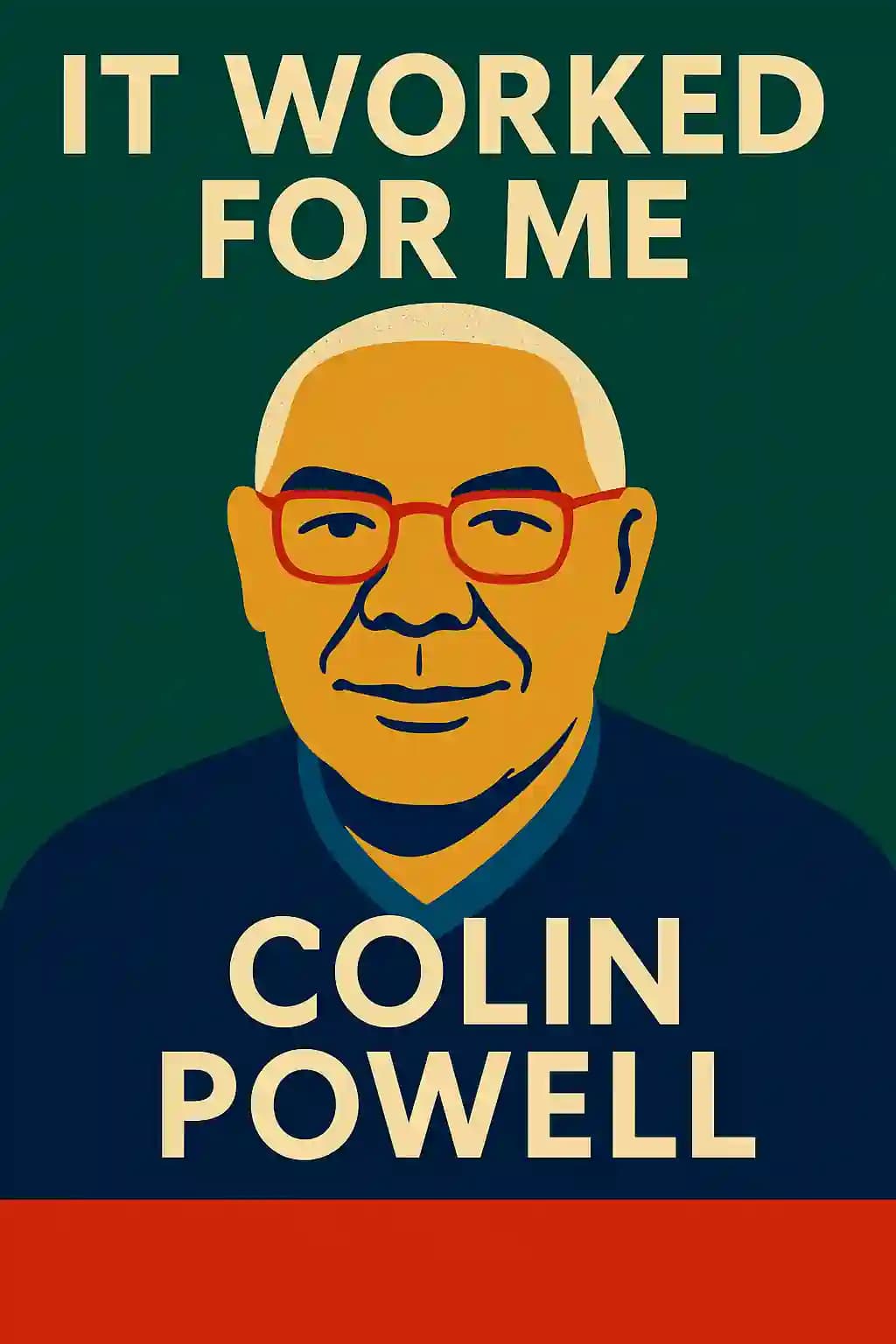
Colin Powell's memoir "It Worked For Me" stands as one of the most influential leadership books of the 21st century, consistently appearing on the reading lists of Fortune 500 CEOs and military academies alike. What makes this book particularly compelling is how Powell-the first African American to serve as Secretary of State and Chairman of the Joint Chiefs of Staff-distills complex leadership principles into accessible wisdom through personal stories rather than abstract theory. When Oprah Winfrey interviewed Powell about the book, she remarked that its principles had fundamentally changed her approach to running her media empire. The book's cultural impact extends beyond business and military circles; its "Thirteen Rules" have been adapted for everything from parenting guides to classroom posters, making Powell's leadership philosophy part of America's shared vocabulary of success.
Capítulo 2
The Thirteen Rules: A Leadership Framework for Life
Powell's journey begins with his famous "Thirteen Rules"-leadership principles collected throughout his career that appear framed on his office wall. While all thirteen merit attention, several stand out as particularly transformative. Rule 11 emphasizes that organizations must have purpose beyond mere profit or risk reduction. When addressing credit rating company executives focused solely on minimizing losses, Powell reminded them their true purpose was helping people buy homes and educate children. Google's mission "to organize the world's information and make it universally accessible and useful" exemplifies how serving society creates success.
Rule 12-"Don't take counsel of your fears or naysayers"-emerged from Powell's experience in Vietnam in 1963. After surviving an ambush where one soldier died, he lay awake realizing they'd likely be ambushed again the next day. As a leader, he had to control his fear rather than let it control him. Naysayers, Powell notes, take the safest position but kill progress. "How many cynics have built empires or great cities?" he asks pointedly.
Perhaps most impactful is Rule 13: "Perpetual optimism is a force multiplier." In military terms, a force multiplier increases effectiveness without requiring more resources. Powell illustrates this through a powerful story about a Korean training exercise where his battalion had to march twenty miles back to camp after trucks weren't available. His operations officer suggested making it a qualifying march for the Expert Infantryman's Badge. Though Powell worried about pushing exhausted troops, his officer insisted they could succeed. After completing the difficult march, the battalion fell into formation for the final mile, singing cadence and waking the entire camp. By demanding much while believing in his troops, Powell witnessed how optimism multiplied their capabilities.
Capítulo 3
Know Yourself: The Foundation of Authentic Leadership
Powell emphasizes that leadership begins with self-knowledge and maintaining perspective. From his teenage years working at Jay Sickser's toy store in the Bronx, where the Russian Jewish immigrant owner told him, "Collie, I want you should get an education and do well. You're too good to just be a schlepper," Powell learned the value of mentorship and hard work. Later experiences-from integrating a Pepsi bottling crew to serving in top government positions-reinforced his commitment to doing his best regardless of circumstances.
To maintain perspective, Powell relies on family and everyday encounters. When he first wore the Army's new battle dress camouflage fatigues home in the 1980s, his twelve-year-old daughter merely looked up from the television and announced, "Mom, the GI Joe doll is home." He frequently recalls a street sweeper featured on the news who took pride in his work, loved his family, and was thrilled when promoted to drive a mechanized sweeper. "Despite my titles and medals," Powell reflects, "when ultimately judged, he may have a few points on me-he touched all the important bases in life."
Powell warns against becoming what Major General Charles Gettys called "busy bastards"-those who work absurd hours and constantly generate new ideas. While he worked hard and expected the same from subordinates, Powell created environments where people could have lives outside the office. He admired President Reagan's approach-typically in the residence by six and off to Camp David Friday afternoons. "The nation remained safe without constant presidential activity," Powell notes, "and staff could recharge."
Perhaps most touching is Powell's commitment to kindness, inspired by an elderly priest's wisdom: "Always show more kindness than seems necessary, because the person receiving it needs it more than you will ever know." As Secretary of State, Powell visited parking garage attendants-mostly immigrants making just above minimum wage. When he asked how they decided the order cars would exit, they revealed their system: those who acknowledged them, smiled, or knew their names got out first; those who ignored them waited longest. "Kindness isn't weakness but confidence," Powell concludes.
Capítulo 4
Taking Care of People: The Heart of Leadership
Powell's leadership philosophy centers on a fundamental truth: take care of your people, and they'll take care of you. Early in President George W. Bush's administration, Powell invited the President to the State Department for a briefing on Mexico. Rather than having senior officials present, Powell announced that two junior Mexico desk officers would brief the President directly-no rehearsals, no PowerPoint slides. Though staff looked skeptical, the officers performed brilliantly, providing everything the President needed to know. Word spread rapidly: "The new Secretary trusted us. So did the President."
This approach reflects Powell's belief that trust must be given from the start unless evidence suggests otherwise. "When you trust your people, they'll trust you, work hard for you, and protect you," he explains. Similarly, Powell encouraged his Assistant Secretaries to engage with Congress without fear, assuring them they'd work as a team if problems arose.
Powell compares leadership to mammalian behavior, noting how lion mothers gradually expand boundaries for their cubs while providing structure and protection. "We're forgetting our mammalian nature," he observes. "We evolved to survive in tribes, not as individuals." Children need structure, nurturing, and clear expectations to succeed. The Army functions similarly-sergeants serve as tribal elders, molding recruits through structure and discipline.
Another core principle is making on-the-spot corrections. "Never walk past a mistake," Powell insists, as this reinforces standards, teaches moral courage, shows followers you care about the mission, sets an example for subordinate leaders, and prevents mistakes from propagating. Corrections should be firm yet fair, with explanations that turn encounters into positive learning experiences.
Powell also established a bias toward trusting field commanders over his staff, announcing when taking command that "the guys in the field are right and the staff is wrong." This approach established that staff worked for field units, not just for him, forcing staff to work diligently to solve field problems. The flip side was equally important-if a field commander complained and was wrong, they'd face a serious conversation. This system created mutual accountability, with staff and field units working together to solve problems before escalation.
Capítulo 5
Navigating the Digital World: Information as Currency
As Secretary of State in 2001, Powell found a department technologically stuck in the past-incompatible systems, obsolete Wang computers, limited internet access, and poor security. Working with Undersecretary Grant Green, he secured funding for 44,000 new computers, ensuring every desk in every embassy had internet access within two years. But changing "brainware"-how people thought about information-proved the greater challenge. Powell wanted to move the department from a "lunar" time-bound world to a transactional one where communication happens at the speed of light.
Powell's information management approach centers on four simple rules now hanging in intelligence offices worldwide:
• Tell me what you know.
• Tell me what you don't know.
• Then tell me what you think.
• Always distinguish which from which.
He learned this approach through hard experience. During the 1991 Gulf War, the CIA claimed General Schwarzkopf was overestimating Iraqi tank and artillery destruction based on satellite imagery. The dispute revealed that satellite analysts were using narrow "soda-straw" views while Schwarzkopf relied on multiple sources including pilot debriefings and aerial photos. The multisource approach proved more accurate.
Powell emphasizes that bad news doesn't improve with age. He always insisted his staff inform him about problems immediately. "Early notification allowed me to provide guidance about potential solutions or approaches to avoid," he explains. The 2003 Abu Ghraib prison scandal illustrates what happens when information doesn't flow properly. Though an investigation was launched, the true severity wasn't communicated up the chain. When CBS's 60 Minutes broke the story with photos in late April, the administration was caught unprepared.
Powell also warns about first reports following events, which can be entirely accurate, partially accurate, or completely wrong. When managing first reports, he developed a mental checklist: Does it make common sense? Does it fit the context? How much time do I have? How can I confirm it? What are the risks of delaying action if true versus acting too quickly if false? What are the stakes?
Capítulo 6
Achieving 150 Percent: Leadership That Multiplies Effectiveness
Powell believes great leaders take followers beyond 100% to 150% of what seemed possible. This requires clear guidance, effective time management, and creating a unified team spirit. When starting with new staff, Powell provided detailed instructions including: never act on unclear instructions; never sign my name; avoid using personal money on my behalf; beware the "General Wants" syndrome where casual observations trigger expensive actions; and never make calendar commitments without approval.
Time management was particularly crucial-Powell insisted on accurate calendars and phone logs, punctuality, and efficient meetings. He preferred written information to oral presentations, as writing encourages discipline and allows identifying inconsistencies in advance. "I process paperwork quickly," he notes. "If you don't get a response within 24 hours, something's wrong."
General George Joulwan's slogan "One Team, One Fight" captures an essential leadership principle Powell embraced. As Chairman of the Joint Chiefs of Staff, Powell commanded nothing but worked through influence and persuasion. He commissioned a manual emphasizing this unified spirit, writing that when our Armed Forces go to war, every soldier, pilot, sailor and Marine must believe they're the best in the world while simultaneously functioning as part of a joint team.
Powell also believes in creating various intramural competitions within units-best supply room, best soldier, best clerk-with standards that make winning possible for anyone putting forth the effort. "Without competition, we become dull, unfocused, and flabby, both mentally and physically," he observes.
Effective leaders must think through solutions several levels deep, examining secondary effects rather than settling for wishful thinking. After installing beer machines in barracks seemed like a perfect morale solution, Powell's sergeant cautioned: "Putting machines in the barracks won't end the bitching. They'll just start to bitch about the brand of beer in the machines, except they will be drunk when they bitch." This principle applied at a much larger scale in Iraq in 2003, where American leaders failed to consider how their actions would affect Iraq's complex sectarian society.
Capítulo 7
The Powell Doctrine: Decisive Force with Clear Purpose
The "Powell Doctrine" emerged after Desert Storm, though it exists in no military manual. While commentators emphasize "overwhelming force," Powell prefers "decisive" force-achieving successful outcomes without necessarily burying your adversary. This distinction is crucial: decisive force means applying exactly what's needed to achieve objectives efficiently, rather than simply maximizing destruction. His approach begins with avoiding war when possible, using all diplomatic, economic and political means first. But military force must remain visibly available to support diplomacy, serving as a credible deterrent that strengthens diplomatic efforts.
When force becomes necessary, it must be applied decisively with a clear political objective. Leaders must think operations through from start to finish, including exit strategies, while maintaining public support. These aren't rigid rules but guidelines for decision-making, recognizing that crises often emerge unexpectedly. Powell emphasizes that military action should answer specific questions: What are we trying to achieve? Is military action worth the cost? Do we have a clear exit strategy? Have we exhausted all other options?
Powell's approach rests on fundamental principles of war he first learned as an ROTC cadet, particularly "Objective" (direct operations toward clearly defined, decisive objectives) and "Mass" (concentrate combat power at decisive places). The successful Panama invasion (1989) and Desert Storm (1991) exemplified these principles. In Panama, Operation Just Cause had clear objectives: removing Noriega, restoring democracy, and protecting American citizens. In Desert Storm, the coalition's focused goal was liberating Kuwait, achieved through overwhelming force applied precisely where needed.
Related to this is what Powell calls the "Pottery Barn rule"-"if you break it, you own it." This concept emerged during his August 2002 meeting with President Bush about Iraq, where he cautioned that while our military could easily defeat Iraq's army, the aftermath would be chaotic and unpredictable. He emphasized that military victory would create responsibilities for rebuilding and stabilization that could last years. When war came in 2003, we achieved swift military victory but failed to establish control afterward. We disbanded the Iraqi army and purged Baath party members down to teachers-eliminating institutions we should have built upon and creating thousands of angry, jobless potential insurgents. This outcome illustrated Powell's warning about post-conflict responsibilities and the importance of planning beyond initial military success.
The doctrine's enduring relevance lies in its emphasis on careful deliberation before military action and comprehensive planning for both combat operations and their aftermath. It provides a framework for decision-makers to evaluate potential military interventions and their long-term consequences, while recognizing that each situation requires unique consideration and adaptation.
Capítulo 8
February 5, 2003: When Intelligence Failed
February 5, 2003 remains permanently seared into Colin Powell's memory as a day that would forever alter his legacy-the day he delivered his fateful speech about Iraq's weapons of mass destruction to the United Nations Security Council. When Barbara Walters later confronted him in an interview, asking if this presentation was a "blot" on his distinguished career, Powell responded with characteristic directness: "Yes, and there's nothing I can do about it."
The intelligence community's certainty about Saddam Hussein's WMD program seemed absolute at the time. The case appeared rock-solid: George Tenet, the Director of Central Intelligence, had presented Congress with a National Intelligence Estimate that made forceful claims about Iraq's biological, chemical, and nuclear weapons programs. Multiple intelligence agencies had contributed to this assessment, and their confidence level was reportedly high. Satellite imagery, human intelligence sources, and intercepted communications all seemed to paint a consistent picture of an active weapons program.
However, when Powell first received the National Security Council's draft presentation, he was deeply troubled. The document was a jumbled collection of assertions, many lacking proper verification or reliable sourcing. What followed was an intensive four-day effort where Powell's staff, working alongside CIA analysts, meticulously reviewed every claim. They operated out of CIA headquarters, sometimes working through the night, scrutinizing each piece of evidence. Powell personally insisted on removing numerous allegations that couldn't be thoroughly verified, including Vice President Dick Cheney's repeated attempts to insert claims about supposed connections between Iraq and the September 11 attacks-connections that intelligence agencies had already dismissed.
The aftermath proved devastating. After Baghdad fell to coalition forces in April 2003, extensive searches revealed no weapons of mass destruction. The intelligence failure was catastrophic-ranking among the most significant miscalculations in American intelligence history. The mobile biological weapons labs that Powell had highlighted in his presentation, complete with detailed diagrams, turned out to be hydrogen production facilities for weather balloons. Other "suspicious sites" yielded nothing but abandoned buildings and outdated equipment.
In subsequent years, Powell has engaged in deep self-reflection about his role. "I've asked myself repeatedly if I should have detected the NIE's fundamental weaknesses," he wrote in his memoirs. "The analysts believed their assessments. I believed them. Yes, a blot will always be attached to my UN presentation, but I didn't lie-I believed what I presented." This episode would not only impact Powell's reputation but would also lead to substantial reforms in how intelligence is gathered, analyzed, and presented to policymakers.
Capítulo 9
The Gift of a Good Start: Education as the Golden Door
Powell's passion for education stems from his own transformative experience. Despite an unremarkable academic career in high school, City College of New York (CCNY) became the turning point in his life. Nearly sixty years later, he's considered one of their greatest sons, with multiple distinguished awards, an institute bearing his name, and the prestigious title of Distinguished Visiting Professor-"which would make most of my professors spin in their graves," he jokes, reflecting on his mediocre grades but eventual success.
"New York City believed kids like me deserved a shot," Powell explains with characteristic warmth. "They taxed themselves to educate the 'whole people'-poor immigrant kids, Jews excluded from other schools, working students attending night classes. This education was the Golden Door for America's huddled masses." The metaphor of the Golden Door, borrowed from Emma Lazarus's poem on the Statue of Liberty, perfectly captured CCNY's role as a catalyst for social mobility.
Though Powell barely graduated with a C average, he received a comprehensive liberal arts education that equipped him with critical thinking skills, cultural awareness, and leadership abilities. These foundations allowed him to perform alongside-and often outperform-graduates from prestigious military academies. His experience proved that academic excellence isn't always measured by grades but by personal growth and practical application of knowledge.
Today, the Colin Powell Center at CCNY focuses on leadership training and service learning, helping students similar to his younger self-mostly minority, immigrant, and first-generation college students with big dreams but limited resources. The center emphasizes practical leadership skills, community engagement, and the importance of giving back to society.
Education became Powell's family crusade, extending far beyond his personal success story. In 1997, he founded America's Promise Alliance, now skillfully chaired by his wife Alma, to deliver five essential promises to children: caring adults in their lives (including mentors and teachers), safe places to learn and grow, comprehensive healthcare access, quality education with marketable skills, and meaningful opportunities to serve others. These promises reflect Powell's belief that education exists within a broader ecosystem of support.
This philosophy was perfectly illustrated when a 10-year-old boy at a Boys and Girls Club asked if Powell would be where he is if his parents hadn't cared about him. Powell's response encapsulated his entire educational philosophy: "The answers are here at the Boys and Girls Club, at your church, in your school. You can make it if you believe in yourself as much as they believe in you." This message emphasizes that success requires not just individual effort but also community support and institutional access - the very elements that transformed his own life at CCNY.
Through his advocacy and organizations, Powell continues to work toward ensuring that the Golden Door of education remains open for future generations, just as it was for him decades ago. His story serves as both inspiration and blueprint for educational opportunity in America.
Capítulo 10
It's All About People: The Essence of Leadership
Throughout his memoir, Powell returns to a fundamental truth: organizations don't accomplish things-people do. As Admiral Hyman Rickover once said at a promotion ceremony: "Organizations don't get things done. Plans and programs don't get things done. Only people get things done." This principle shaped Powell's leadership philosophy across his military career, diplomatic service, and personal life, leading him to prioritize human connections over bureaucratic processes.
Powell's most influential mentors weren't famous figures but everyday people who profoundly shaped his character and worldview. The immigrant Russian Jewish toy store owner, Mr. Sickser, who urged him to finish his education, demonstrated the value of persistence and learning. Sammy Fiorino, a neighborhood friend, taught him poker and street smarts, lessons that would later prove valuable in both military strategy and diplomatic negotiations. Miss Ryan, his terrifying but transformative high school English teacher, instilled in him a lifelong appreciation for clear communication and precise language. Colonel Brookhart introduced him to military standards and professional discipline, showing him how attention to detail could transform an organization. Captain Miller taught him an unforgettable lesson about weapon responsibility through a fabricated "lost pistol" incident, demonstrating how powerful experiential learning could be in developing leadership skills.
In his diplomatic career, Powell consistently found that human connections transcended political boundaries and formal protocols. When hosting then-Vice President Hu Jintao of China, he promised to show him the real New York on his next visit, including buying him a hot dog from an immigrant vendor. This simple gesture created a lasting personal bond. Years later, whenever they meet, Hu's first words in English are always "When do we get hot dogs?" This exemplifies what Powell calls "hot dog diplomacy" - the art of building relationships through authentic, human moments. He reflects: "Hot dog diplomacy may not be earth-moving, but it builds human relationships that sustain official ones through good times and bad-not unlike how Ping-Pong opened relations with China."
Powell's leadership approach emphasizes the importance of understanding and connecting with people at all levels. He regularly visited troops in the field, spoke with junior staff members, and maintained relationships with former colleagues regardless of their rank or status. This approach proved particularly effective during crisis situations, where trust and personal relationships often made the difference between success and failure.
Powell concludes with a simple yet profound observation: "A life is about events, challenges met or not, successes and failures. But more than all these combined, it's about how we touch and are touched by the people we meet. The people in my life made me what I am." This philosophy underscores his belief that leadership is fundamentally about human connections and the lasting impact we have on each other's lives.