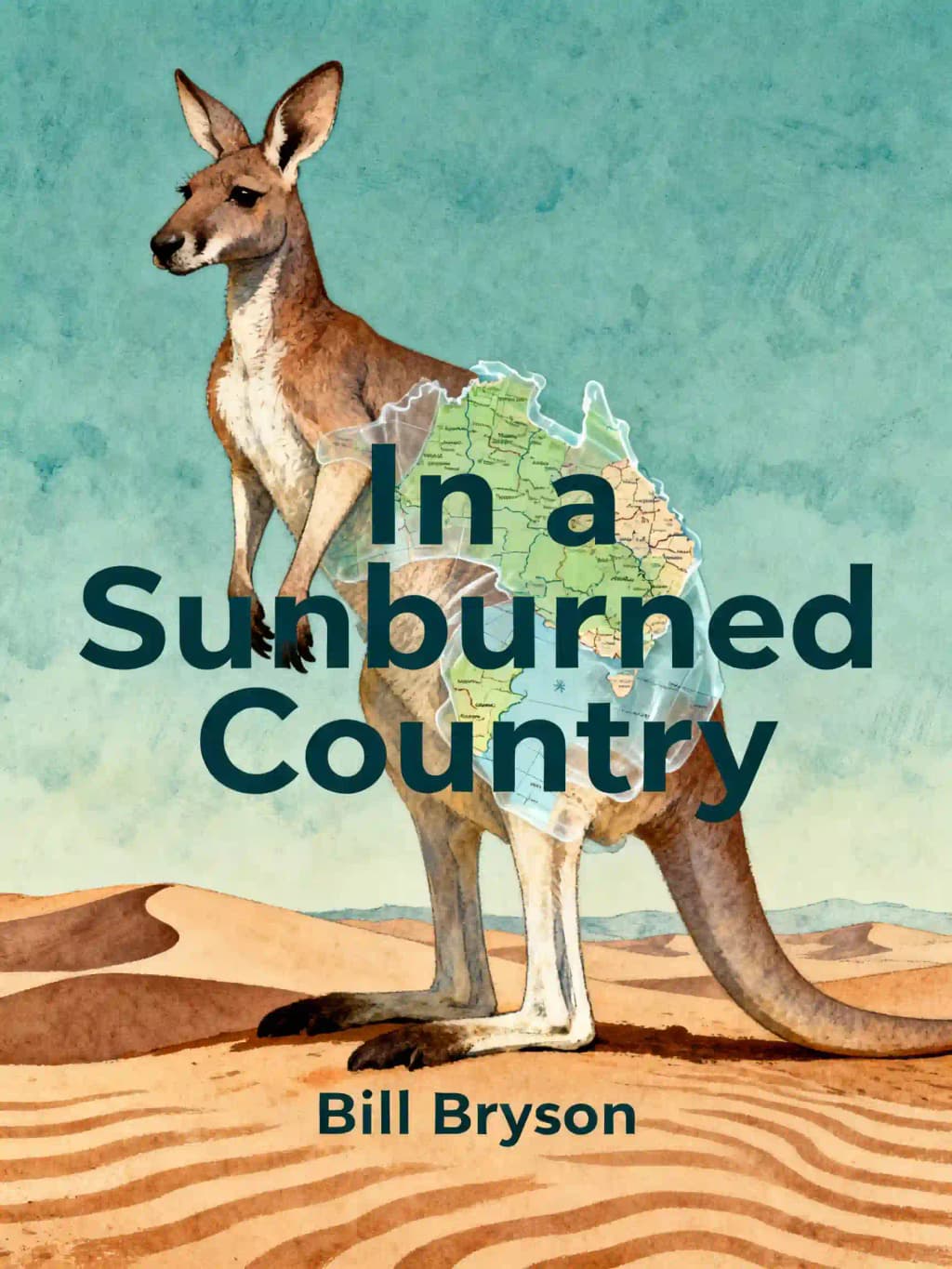
Bryson's hilarious travelogue unveils Australia's deadly wildlife, ancient Aboriginal culture, and quirky roadside attractions. Biblical scholar Bart Ehrman praised this journey through a land where deadly jellyfish lurk and giant bananas stand as monuments to Australian eccentricity.
Bill Bryson, bestselling author of In a Sunburned Country, is celebrated for his witty, accessible explorations of travel, science, and language. Born in Des Moines, Iowa, in 1951, Bryson spent two decades in England as a journalist before becoming a literary icon with works like Notes from a Small Island and A Walk in the Woods—the latter adapted into a 2015 film. His signature blend of humor and meticulous research shines in In a Sunburned Country, a travel memoir chronicling Australia’s landscapes, history, and quirks, reflecting his knack for transforming factual depth into engaging storytelling.
Bryson’s expertise spans genres, from the Appalachian Trail odyssey in A Walk in the Woods to the scientifically comprehensive A Short History of Nearly Everything, which demystifies cosmology for general audiences.
Honored with an OBE for contributions to literature, his books have sold over 16 million copies worldwide and been translated into more than 30 languages. In a Sunburned Country remains a standout, praised for its vivid portrayal of Australia’s rugged beauty and Bryson’s trademark curiosity-driven narrative voice.
In a Sunburned Country chronicles Bill Bryson’s journey across Australia, blending travelogue, history, and humor. Bryson explores the continent’s vast, arid landscapes, unique wildlife, and vibrant cities like Sydney and Perth, while delving into its colonial past and the resilience of Indigenous cultures. The book balances awe for Australia’s natural beauty with witty observations about its dangers, from deadly creatures to nuclear testing in remote deserts.
This book is ideal for travelers, history enthusiasts, and fans of Bryson’s signature humor. Readers curious about Australia’s geography, Aboriginal history, or quirky anecdotes—like secret uranium mining or encounters with kangaroo carcasses—will find it engaging. Its blend of factual rigor and lighthearted storytelling appeals to those seeking both education and entertainment.
Yes. Bryson’s vivid storytelling and deep curiosity make Australia’s complexities accessible and entertaining. He highlights the country’s contradictions—its welcoming cities versus its lethal wildlife, its modern ethos versus suppressed Indigenous histories—while maintaining an affectionate tone. The book remains a timeless primer for understanding Australia’s cultural and environmental uniqueness.
Key themes include Australia’s geographic extremes, its colonial legacy, and the tension between human settlement and nature. Bryson emphasizes the Outback’s inhospitable vastness, the overlooked contributions of Aboriginal communities, and the country’s paradoxical charm despite hidden dangers like unexploded bombs or venomous species.
Bryson portrays the Outback as a forbidding, desolate landscape marked by red sand, sparse vegetation, and eerie silence. During his train journey from Sydney to Perth, he notes the near-total absence of life beyond occasional lizards or saltbushes, underscoring its harshness and surreal beauty.
The book reveals lesser-known history, such as mid-20th-century British nuclear tests in the Great Victoria Desert and the marginalization of Aboriginal people. Bryson critiques how Australia’s colonial past and environmental exploitation are often glossed over in mainstream narratives.
Bryson highlights Australia’s “great social failing”: systemic neglect of Aboriginal communities. He critiques the lack of dialogue around their displacement and cultural erasure, comparing it to injustices faced by Native Americans. His empathetic portrayal urges acknowledgment of this unresolved legacy.
Bryson marvels at Australia’s biodiversity, geographic isolation, and “sunburned” landscapes. He contrasts its modern cities with remote towns like White Cliffs, where residents live underground to escape heat. The country’s ability to harbor ancient cultures and bizarre creatures—like venomous jellyfish or flightless birds—cements its singularity.
Yes. Bryson’s wit shines in anecdotes about absurd hazards (e.g., radioactive waste signs near picnic areas) or quirky locals. His failed attempts to nap outdoors—interrupted by flies or heat—and self-deprecating tales of cultural missteps add levity to darker themes.
Like A Walk in the Woods, it combines travel adventures with historical deep dives, but focuses more on cultural critique. While less science-focused than A Short History of Nearly Everything, it retains Bryson’s knack for making complex topics engaging through humor and meticulous research.
The book’s exploration of environmental stewardship, Indigenous rights, and climate resilience resonates in 2025. As Australia faces escalating wildfires and cultural reckonings, Bryson’s insights into its fragile ecosystems and social divisions remain urgently pertinent.
Bryson grappled with extreme heat, vast distances, and Australia’s deadly wildlife—from sharks to venomous snakes. Navigating desolate regions like Broken Hill and confronting the psychological toll of the Outback’s emptiness underscored the continent’s unforgiving nature.
Sinta o livro através da voz do autor
Transforme conhecimento em insights envolventes e ricos em exemplos
Capture ideias-chave em um instante para aprendizado rápido
Aproveite o livro de uma forma divertida e envolvente
Australia defies expectations at every turn.
Evolution ran wild in spectacular ways.
The Opera House exists by small miracle.
Australia is mostly empty and a long way away.
The outback wants you dead.
Divida as ideias-chave de In a sunburned country em pontos fáceis de entender para compreender como equipes inovadoras criam, colaboram e crescem.
Destile In a sunburned country em dicas de memória rápidas que destacam os princípios-chave de franqueza, trabalho em equipe e resiliência criativa.

Experimente In a sunburned country através de narrativas vívidas que transformam lições de inovação em momentos que você lembrará e aplicará.
Pergunte qualquer coisa, escolha a voz e co-crie insights que realmente ressoem com você.

Criado por ex-alunos da Universidade de Columbia em San Francisco
"Instead of endless scrolling, I just hit play on BeFreed. It saves me so much time."
"I never knew where to start with nonfiction—BeFreed’s book lists turned into podcasts gave me a clear path."
"Perfect balance between learning and entertainment. Finished ‘Thinking, Fast and Slow’ on my commute this week."
"Crazy how much I learned while walking the dog. BeFreed = small habits → big gains."
"Reading used to feel like a chore. Now it’s just part of my lifestyle."
"Feels effortless compared to reading. I’ve finished 6 books this month already."
"BeFreed turned my guilty doomscrolling into something that feels productive and inspiring."
"BeFreed turned my commute into learning time. 20-min podcasts are perfect for finishing books I never had time for."
"BeFreed replaced my podcast queue. Imagine Spotify for books — that’s it. 🙌"
"It is great for me to learn something from the book without reading it."
"The themed book list podcasts help me connect ideas across authors—like a guided audio journey."
"Makes me feel smarter every time before going to work"
Criado por ex-alunos da Universidade de Columbia em San Francisco

Obtenha o resumo de In a sunburned country como PDF ou EPUB gratuito. Imprima ou leia offline a qualquer momento.
What happens when an entire continent-one filled with prehistoric creatures, living fossils, and landscapes that would be world-famous anywhere else-somehow slips beneath the world's radar? Australia defies logic at every turn. It houses the planet's most venomous creatures, plants thought extinct for 100 million years, and rock formations that stir something ancient in the soul. Yet this massive country receives less international coverage than minor nations or trivial subjects. When Prime Minister Harold Holt vanished while swimming in 1967-imagine a U.S. President disappearing without trace-it barely registered globally. This paradox forms the heart of understanding Australia: a land teeming with wonders yet perpetually overlooked. The continent exists as both familiar and utterly foreign, mundane yet extraordinary. With 80% of its flora and fauna found nowhere else on Earth, Australia operates as evolution's private laboratory, isolated for 45 million years and running wild experiments that produced the platypus, funnel web spiders, and trees that dwarf sequoias. This is a country mostly empty and far away, seemingly not needing attention-yet entirely worthy of it.