Capítulo 1
The Caged Bird's Triumphant Song
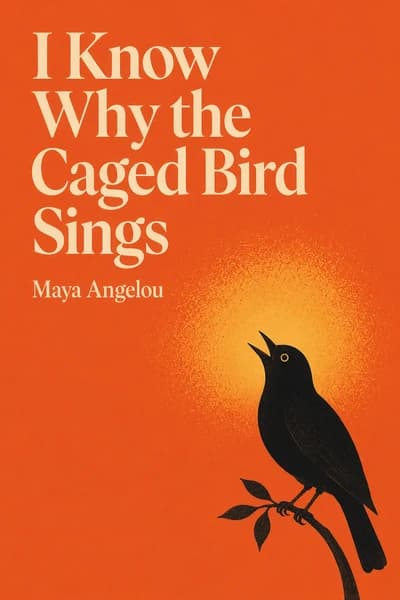
In 1969, a voice emerged that would forever change American literature. Maya Angelou's "I Know Why the Caged Bird Sings" burst onto the literary scene with raw honesty and lyrical power, becoming the first nonfiction bestseller by an African American woman. The memoir stunned readers with its unflinching portrayal of trauma alongside moments of profound beauty and resilience. Oprah Winfrey has cited it as the book that "set her free," while James Baldwin, who encouraged Angelou to write it, called it "a Biblical study of life in the midst of death." Beyond its literary acclaim, the book revolutionized how we discuss childhood trauma and racism in America. When we encounter Angelou's young protagonist Marguerite Johnson (Maya's birth name), we witness a remarkable transformation-from a self-described "too-big Negro girl with nappy black hair" to a young woman who discovers her voice and power against seemingly impossible odds.
Capítulo 2
Stamps, Arkansas: The Cocoon of Early Childhood
At three years old, Maya and her four-year-old brother Bailey arrive in Stamps, Arkansas, wearing identification tags and carrying the invisible weight of parental abandonment. Their grandmother, whom they call Momma, runs the William Johnson General Merchandise Store-the heart of the Black community. The Store becomes Maya's first universe, a place where she learns precision in measuring flour and sugar, dreams of tasting the pineapples that sit in cans on the shelves, and observes the rhythms of rural Black life.
The cotton season forms the economic backbone of this world. Each morning, pickers gather with supernatural optimism, only to return by dusk, defeated by weighted scales and the mathematical certainty that they'll never earn enough to sustain themselves through the year. Young Maya watches this cycle with growing awareness, absorbing the harsh realities of Black Southern existence.
Uncle Willie, crippled since childhood when a babysitter dropped him, maintains his dignity despite his disability in a society where even able-bodied Black men struggle. Maya witnesses his rare moment of vulnerability when he hides his cane during a visit from schoolteachers, attempting to stand straight behind the counter. She understands his momentary need to escape his disability, feeling closer to him than ever before.
Life in Stamps is defined by rigid segregation. Most Black children don't know what white people look like beyond their difference and the dread they inspire. Maya remembers never believing whites were really real, with their "too-small feet" and "see-through skin." To her, people were those who lived on her side of town-these others were simply "whitefolks." The journey through the white part of town feels like exploring hostile territory, where Black children must maintain hypervigilance.
In this environment, Momma Henderson's salvation rests on two commandments: "Thou shall not be dirty" and "Thou shall not be impudent." Even in bitter winter, the children wash nightly, and all adults require proper address. Everyone respects these laws except the "powhitetrash" children who invade the Store, taking liberties Maya would never dare, calling Momma by her first name despite the fact that she owns their land.
Capítulo 3
The Power of Words: Literature as Salvation
In Stamps, Maya falls in love with Shakespeare, her "first white love," though she and Bailey choose to memorize James Weldon Johnson's "The Creation" instead, knowing Momma would question a white author. This early conflict between literary passion and racial consciousness highlights the complex relationship between art and identity that Maya navigates throughout her childhood. Books become her refuge and salvation, offering escape from the confines of her reality. She devours everything from adventure stories to poetry, finding in each genre a new lens through which to view her world and possibilities beyond Stamps.
When Mrs. Bertha Flowers, "the aristocrat of Black Stamps," takes an interest in young Maya, she introduces her to the transformative power of spoken language. Mrs. Flowers embodies refinement and culture in the segregated South, her very presence challenging the limitations placed on Black women. Her home, with its polished furniture and carefully tended garden, becomes a sanctuary of learning for Maya.
"Words mean more than what is set down on paper," Mrs. Flowers tells her. "It takes the human voice to infuse them with deeper meaning." This lesson becomes fundamental to Maya's understanding of literature and language. As Mrs. Flowers reads from A Tale of Two Cities, her voice "nearly singing" as she transforms the familiar words into poetry, Maya experiences a profound awakening. The characters spring to life, and the boundary between written word and lived experience dissolves. Mrs. Flowers gives her a book of poems to memorize, inviting her into "the private lives of strangers" and offering a chance to "exchange the Southern bitter wormwood for a cup of mead with Beowulf." Through these assignments, Maya learns not just to read but to inhabit the literature she encounters.
Running home from this encounter, Maya feels transformed-"liked" and "respected not as Mrs. Henderson's grandchild or Bailey's sister but for just being Marguerite Johnson." This revelation of being valued for herself rather than her family connections marks a crucial step in her development of self-worth. The validation from Mrs. Flowers becomes a cornerstone of Maya's emerging identity as a writer and intellectual.
Years later in San Francisco, Maya finds salvation in Miss Kirwin, "that rare educator who was in love with information." In her classroom, knowledge itself becomes the focus, transcending racial barriers. Unlike other teachers who either went out of their way to be "liberal" with her or ignored her completely, Miss Kirwin "never seemed to notice that I was Black and therefore different." This color-blind approach to education-focusing solely on Maya's intellect rather than her race-provides another crucial building block in her self-concept. Through Miss Kirwin's teaching, Maya discovers that the life of the mind offers freedom from social constraints and prejudices, a lesson that echoes Mrs. Flowers' earlier guidance about the liberating power of literature.
These literary encounters and mentorships shape Maya's understanding of both language and identity, teaching her that words can bridge divides, challenge assumptions, and create new possibilities for understanding both self and world.
Capítulo 4
Bailey: The Kingdom Come
Bailey is everything in Maya's world-her protector, confidant, and first love, embodying a presence that shapes her entire childhood. Where she is "big and grating," he is "small and graceful," their physical contrasts highlighting their complementary nature. Her skin is "shit color" while his is "velvet-black," yet these differences only strengthen their bond. He loves her fiercely, defending her when elders criticize her features by asking about their children's affliction with "the Uglies," demonstrating early on his role as her champion against the world's cruelties.
Bailey moves through life with "oiled precision" and seems to bend time itself, finding more hours in the day than seems possible. He excels effortlessly at everything he touches: methodically completing chores, mastering homework assignments, devouring books with remarkable speed, dominating childhood games, and even praying in church with a conviction that impresses the congregation. His cleverness shows in small acts of mischief, like stealing pickles from the barrel under Uncle Willie's watchful eye, running with pickle juice streaming down his "ashy legs, smelling like a vinegar barrel or a sour angel." These moments of shared rebellion cement their alliance.
Their bond transcends ordinary sibling relationships, forming a sacred partnership that sustains them both. After finishing their daily chores at the Store, they create magical worlds within the confines of their grandmother's rules, always staying within yelling distance. Bailey's leadership transforms simple children's games into adventures: his voice rings clear and true during hide-and-seek, calling out with perfect timing; his innovative twists make follow-the-leader an exercise in imagination; and his daring spins off the end of pop-the-whip simultaneously terrify and thrill Maya. "Of all a lonely child's needs," she reflects, "the most essential is an unshakable God. My pretty Black brother was my Kingdom Come." In Bailey, Maya finds both spiritual anchor and earthly protector.
As adolescence arrives, their paths begin to diverge with painful inevitability. In San Francisco, Bailey undergoes a transformation that mirrors the urban environment, running with street boys in zoot suits, his once-proper speech now colored with street slang and urban swagger. When sixteen-year-old Bailey falls into an impossible love with their mother, his response is both dramatic and destructive. He acquires a white prostitute as if to replace what he cannot have, flashing a diamond ring and expensive clothes like armor against his pain. The inevitable confrontation with their mother leads to his departure from home, a moment Maya witnesses with quiet devastation. As she watches her brother pack his belongings, his face "balled up like a fist," she can no longer recognize the boy who once protected her from "goblins and gremlins," marking the end of their shared childhood kingdom.
Capítulo 5
Trauma and Its Aftermath
At eight years old, Maya experiences a devastating sexual assault by her mother's boyfriend, Mr. Freeman. The trauma is rendered with heartbreaking clarity: "a breaking and entering when even the senses are torn apart." The violation occurs in her mother's bed, transforming a space of safety into one of terror. After the rape, Mr. Freeman issues a chilling threat to kill Bailey, Maya's beloved brother, if she reveals what happened. The physical aftermath becomes impossible to hide as Maya's condition deteriorates, leading to her hospitalization where Bailey, showing the deep bond between siblings, gently coaxes the truth from her.
The courtroom scene unfolds with brutal precision. Maya, still recovering physically and emotionally, faces the harsh fluorescent lights and cold formality of the justice system. When the defense attorney's questioning turns to previous contact with Mr. Freeman, Maya finds herself trapped in an impossible situation. Unable to admit to an earlier incident of molestation, fearing it would devastate her family and confirm their worst fears about her "watching out" for herself, she lies under oath. This moment of childhood self-preservation carries devastating consequences when Mr. Freeman receives only a one-year sentence and is released that same day.
The news of Mr. Freeman's violent death behind the slaughterhouse - apparently kicked to death - creates a spiral of guilt that threatens to consume Maya. "Where was the balance in that? One lie surely wouldn't be worth a man's life." The weight of believing she caused a death through her testimony, however indirect, proves too heavy for her young psyche. Convinced she has "forfeited my place in heaven forever," she retreats into a fortress of silence, speaking only to Bailey, her lifeline to the world.
What begins as a clear manifestation of severe trauma - her selective mutism - is tragically misinterpreted by adults around her as mere stubbornness or rebellion. Teachers and family members, unable or unwilling to recognize the depths of her psychological wounds, label her behavior as impudence and sullenness, expecting her to simply "snap out of it" and return to normal.
The long shadow of this childhood trauma extends into Maya's adolescence, particularly affecting her relationship with her own sexuality. When she deliberately initiates sex as a teenager, it's less about desire and more about proving something to herself and others - an attempt to "clarify my position to the world" and find her way "into that strange and exotic land of frills and femininity." The experience proves mechanical and emotionally vacant, described in stark terms as "laborious gropings, pullings, yankings and jerkings" conducted in complete silence. The physical numbness she experiences - feeling neither pain nor pleasure - serves as a stark reminder of how Mr. Freeman's abuse years earlier has fundamentally altered her relationship with intimacy and her own body.
Capítulo 6
Race, Identity, and Resistance
Throughout her childhood, Maya witnesses the complex dance of racial dynamics in America. In Stamps, the Joe Louis heavyweight championship fight becomes a powerful symbol of racial pride and anxiety. The Store is packed to capacity, with people wedging themselves along walls and children gathered on the porch listening through the radio. When the announcer declares Louis is against the ropes, the entire gathering feels it as a collective blow-"my race groaned. It was our people falling." To them, it represents another lynching, another rape, another whipping.
When Louis rallies and knocks out his opponent, the celebration erupts. The announcer's words-"The winnah, and still heavyweight champeen of the world... Joe Louis"-wash over them like a blessing. Nobody leaves for home too quickly-it wouldn't be safe for Black families on lonely country roads on a night when Joe Louis had proved "we were the strongest people in the world."
Maya's graduation from eighth grade becomes another powerful moment of racial identity. When a white school official delivers a condescending speech suggesting that Black students should aspire only to vocational careers rather than academic achievement, Maya feels the collective wound. But when Henry Reed leads the Negro National Anthem, she truly hears the powerful lyrics for the first time: "We have come over a way that with tears has been watered, We have come, treading our path through the blood of the slaughtered." While tears slip down many faces, they aren't wiped away in shame. Maya feels renewed pride, no longer just a graduate but "a proud member of the wonderful, beautiful Negro race."
In San Francisco during World War II, Maya observes how the Fillmore district undergoes a "visible revolution" as Japanese businesses quietly transform into Black-owned establishments when the Japanese are removed and Southern Blacks arrive to work in war plants. The Black newcomers show no sympathy for the displaced Japanese, blinded by their newfound economic opportunities. The narrator reflects on how "the aroma of chitlings, greens and ham hocks" replaces the smells of Japanese cuisine, revealing the complex interplay of oppression and opportunity among marginalized groups.
Capítulo 7
Motherhood and Female Identity
Maya's relationship with her mother, Vivian Baxter, forms a complex thread throughout the narrative, weaving together themes of beauty, belonging, and maternal instinct. When they reunite in St. Louis after years of separation, Maya is struck by her mother's overwhelming physical presence - her beauty "literally assailed me" with her precisely painted red lips, smooth butter-colored skin, and dazzling smile that could illuminate a room. The impact of this first encounter crystallizes Maya's understanding of their separation: "She was too beautiful to have children." This realization carries both admiration and a subtle accusation, highlighting the tension between maternal responsibility and personal freedom.
Bailey, in contrast, falls instantly and completely in love with their mother, their shared physical beauty and magnetic personalities creating an immediate, almost telepathic bond that Maya observes from the outside. Their similar features and mannerisms seem to confirm their natural connection, while Maya feels like an awkward outsider in their presence, reinforcing her sense of displacement.
Mother moves through life "like a pretty kite that floated just above my head," maintaining a careful distance while remaining visible and present. Maya watches her navigate the world with grace - singing blues songs in her rich voice while Syrian brothers compete for her attention, managing her life with an effortless charm that seems both admirable and unreachable. Despite this apparent emotional detachment, she proves herself a competent provider and surprisingly direct mentor, especially when Maya approaches her with intimate concerns about her developing body and fears of becoming a lesbian. Her response is characteristically straightforward and definitive: "I made arrangements, a long time ago, to have a boy and a girl. Bailey is my boy and you are my girl. The Man upstairs, He don't make mistakes."
When sixteen-year-old Maya discovers her pregnancy, she conceals it for eight months before leaving a note for her parents, triggering a sequence of events "reminiscent of a Moliere comedy." The family's reaction defies conventional expectations - there's genuine surprise that they hadn't noticed, but no moral outrage. Mother's practical response cuts through potential drama with simple questions about Maya's wishes regarding the father. When Maya declines marriage, Mother's matter-of-fact statement, "Well, that's that. No use ruining three lives," demonstrates her progressive mindset and unconditional support.
The transformation of their relationship reaches a pivotal moment after Maya gives birth. Paralyzed by her self-perceived awkwardness, Maya initially fears touching her newborn son. Mother's response is both practical and profound - she handles the baby with natural confidence and insists he sleep with Maya despite her fears of accidentally harming him. When Maya awakens to find her son safely nestled in the protective arch of her arm, Mother delivers one of the narrative's most powerful lessons: "See, you don't have to think about doing the right thing. If you're for the right thing, then you do it without thinking." This moment marks Maya's initiation into motherhood and a deeper understanding of her own mother's complex nature.
Capítulo 8
Finding Voice in a World of Silence
Throughout her childhood, Maya struggles to find her voice-both literally after her trauma-induced silence and figuratively as she seeks to define herself. Following the devastating assault that left her mute for nearly five years, her journey from muteness to self-expression parallels her growth from victim to survivor. Mrs. Bertha Flowers, an educated Black woman who becomes Maya's mentor, helps initiate this transformation by teaching her that "words mean more than what is set down on paper" and that "it takes the human voice to infuse them with deeper meaning." Through their afternoon reading sessions with works by Dickens, Shakespeare, and Poe, Mrs. Flowers demonstrates how language can be both a refuge and a tool for empowerment.
Maya's determination to become "the first Negro on the San Francisco streetcars" represents another crucial step in finding her voice. For three weeks she persists, facing daily rejection and calculated indifference from the Market Street Railway Company. Through Mother's quiet but unwavering support and her own tenacity-"weaving a cat's ladder of near truths and total lies" on her application-she eventually succeeds, breaking a racial barrier through sheer force of will. This victory becomes more than just securing employment; it represents her first major triumph over systemic racism and proves to herself that persistence can overcome prejudice.
The streetcar work fundamentally transforms her relationship with the city, liberating her from needing the Black ghetto's protection as she travels through San Francisco's varied neighborhoods. Each route teaches her something new about the city's diverse communities and her place within them. She returns to school with newfound confidence, feeling wiser, older, and more independent, bolstered by her own bank account and self-purchased clothes. Yet this maturity comes at a price - she quickly discovers an unbridgeable gap between her life experiences and those of her teenage classmates. While they worry about football games, braces, and high school dances, she's slept in wrecked cars, navigated Mexican mountains alone, and fought battles against racial discrimination. This disconnect forces her to recognize that her unconventional path to adulthood, though difficult, has given her a unique perspective and strength that sets her apart from her peers.
Her evolving voice becomes not just a means of communication but a tool for survival, self-discovery, and eventually, activism. Through poetry, conversation, and determination, Maya gradually reconstructs herself from a traumatized, silent child into a confident young woman capable of challenging societal norms and speaking truth to power.
Capítulo 9
The Journey to Self-Acceptance
Maya's journey culminates in her growing self-acceptance despite a world that often rejects her. As a child, she dreams of waking up transformed-"a blond white girl with blue eyes"-believing this would solve all her problems. Her struggles with her physical appearance-being "too-big," having skin she describes as "shit-colored," and features that adults criticize-mark her early self-concept. This internalized self-hatred reflects the deeper wounds inflicted by a society that privileges white standards of beauty, a theme that resonates throughout her early years in Stamps, Arkansas.
As she matures, Maya begins to recognize her own worth beyond physical appearance. Her experiences working as the first Black streetcar conductor in San Francisco, living independently with homeless teenagers in a junkyard for a month, and driving her father's car down a treacherous Mexican mountain all contribute to her growing sense of capability and self-reliance. Each of these achievements serves as a stepping stone, gradually replacing her childhood insecurities with hard-earned confidence. The streetcar position, in particular, becomes a symbol of her determination, as she persists in her application despite repeated rejections until finally breaking the color barrier.
When she gives birth at sixteen, Maya declares her son "beautiful and mine. Totally mine." Though proud no one helped her "endure the sickly gray months," she fears her own awkwardness might harm him. She obsesses over every detail of his care, questioning her ability to be a good mother given her youth and inexperience. The pivotal moment comes when she discovers she has naturally protected her baby while sleeping, instinctively creating a safe cocoon with her body. This represents her final acceptance of her own instinctual goodness-she doesn't have to "think about doing the right thing" because she is "for the right thing."
The caged bird of the title ultimately finds its song-not by escaping the cage entirely, but by discovering the power of voice within confinement. Through her relationships with Mrs. Flowers, who introduces her to literature and speaking with intention, and her brother Bailey, who nurtures her love of language, Maya discovers the transformative power of words. Her journey from traumatized, self-loathing child to confident young mother traces the remarkable resilience of the human spirit against seemingly insurmountable odds. The various forms of confinement she faces-racism, sexism, poverty, trauma-become the very circumstances that forge her strength and ultimately her voice. Her story continues to resonate because it speaks to universal human experiences of pain, growth, and the search for identity while never minimizing the specific challenges of being Black and female in mid-twentieth century America. Through her narrative, she demonstrates how self-acceptance can emerge from the most unlikely circumstances, transformed by determination, education, and the healing power of love.