Capítulo 1
The Unwavering Witness: Walking with Faith Through America's Darkest Hours
John Lewis's name resonates far beyond political circles. The man who walked across the Edmund Pettus Bridge in Selma, Alabama, transformed American democracy through his unwavering commitment to nonviolent resistance. His autobiography "Walking with the Wind" became Michelle Obama's personal blueprint for facing adversity, while celebrities from Oprah Winfrey to Taylor Swift have cited his example of moral courage. Beyond accolades and congressional service, Lewis embodied something more profound-a living connection to America's painful past and hopeful future. As the last surviving speaker from the 1963 March on Washington, he carried forward Martin Luther King Jr.'s dream while developing his own powerful vision of the "Beloved Community." His life poses a question that remains urgently relevant today: Can faith-inspired nonviolence still transform a divided nation? The answer lies in understanding how a sharecropper's son from Troy, Alabama became what historian Jon Meacham calls "a saint in the classical sense"-someone set apart to suffer for others in service of a greater good.
Capítulo 2
A Saint in the Classical Sense
John Lewis's life exemplifies sanctity in the classical Christian tradition-one who is "set apart" or "made holy." Saints are those willing to suffer and die for others, a test Lewis met repeatedly throughout his life. While some might find such framing sentimental, Lewis's actions justify this understanding. He accomplished something on America's battlefields of nonviolent resistance that links him with saints of ancient ages and revolutionaries of earlier centuries.
Unlike pragmatists who accept injustice as inevitable, Lewis rejected this tragic view of history. He embraced the possibility of realizing a joyful ideal, walking with Jesus who called followers to serve the oppressed. As theologian Reinhold Niebuhr noted, justice requires both realists and utopians-Lewis was the prophet pointing toward the perfect, insisting that moderation merely continued wrongs. His inspiration came from the Beatitudes, transforming persecution into "soul force"-love in action.
In 1975, Time magazine listed Lewis among "Living Saints" alongside Mother Teresa and Dorothy Day as "Messengers of Love and Hope." While some found the term medieval or antiquated, Time described contemporary saints as people of "persistently heroic virtue and courage whose life is a model for others." Religious historian Martin Marty observed that "a saint has to be a misfit"-someone embodying what culture considers atypical. Lewis's willingness to sit at segregated lunch counters and march across Selma's bridge certainly qualified.
Lewis wasn't perfect-his friend Diane Nash emphasized his humanity, and Joseph Lowery once criticized white perceptions of Lewis's humility. Yet as Martin Luther wrote, saints' stories show how they "sincerely believed in God's Word... honored and confirmed it by their suffering and dying." James Lawson affirmed Lewis's sainthood without reservation: "He clearly tried to be one who followed Jesus... John made that Christian understanding the center of his life."
Capítulo 3
Preaching to the Chickens: The Early Years
For John Lewis, slavery wasn't an abstraction but a living memory through his great-grandfather Frank Carter, who was born enslaved in 1862 and lived until Lewis was seven. Despite emancipation, Carter came of age during Reconstruction and Jim Crow, when Alabama's Black Codes and later its 1901 constitution reestablished white supremacy. Though illiterate, Carter became a skilled sharecropper who leased land under "standing rent" from a white landowner named J.S. "Big Josh" Copeland, and managed his finances shrewdly.
Lewis's first memory was of his mother's garden, where he loved watering the plants from a rain bucket. His family called him "Robert" until he moved to Nashville for seminary and joined the civil rights movement. His parents weren't revolutionaries but followed "a straight and narrow way" as his father Eddie worked as a sharecropper. Lewis never forgot his mother's hands, with fingers split and hardened from years picking cotton, earning just $1.40 for every four hundred pounds-work that took two days to complete.
In 1944, Lewis's father saved $300 and bought 110 acres of land from a white grocer named A.M. Hickman. Their new home was modest-just three rooms with cracks in the floorboards, no electricity, and water from a well. The family raised cotton, corn, peanuts, and chickens, with Lewis assigned to care for the poultry. This chore became intertwined with his growing spiritual vocation as he began preaching to the chickens, conducting funerals for those that died, and even attempting baptisms. "I don't think there's any way to estimate how much that experience taught me about discipline and responsibility, and patience," Lewis recalled.
The Lewis family attended church monthly at Dunn's Chapel AME and Macedonia Baptist. The rhythms of worship transported young Lewis beyond those muddy roads with hymns like "Amazing Grace" and stories of enslavement and deliverance. Given a Bible at age four, he was drawn to Genesis and John's Gospel. School provided relief from fieldwork, but the stark contrast between white and colored facilities-shiny fountains versus rusty spigots-burned into his consciousness. "From my earliest memories," Lewis recalled, "I was fundamentally disturbed by the unbridled meanness of the world around me."
Capítulo 4
Finding His Voice: From Troy to Nashville
When Lewis was eleven, his uncle Otis took him to Buffalo, New York, for the summer. The journey revealed segregation's boundaries-they couldn't stop to eat until reaching Ohio. Buffalo dazzled the boy with its integrated neighborhoods and stores where blacks and whites shopped together. This glimpse of integration provided concrete evidence that alternatives to Jim Crow existed, planting seeds that would later bloom into activism.
When news came of the Brown v. Board of Education decision in 1954, fourteen-year-old Lewis "wanted to jump for joy." But while Chief Justice Earl Warren declared segregated schools unconstitutional, The Montgomery Advertiser reassured white readers that "Alabama's segregation system is not to be suddenly upended." Lewis naively expected immediate change-perhaps white students boarding his school bus-but nothing changed. His church offered no guidance, with preachers focusing on "pie in the sky after you die" rather than earthly justice.
Lewis first encountered Martin Luther King, Jr., on the radio, hearing his sermon "Paul's Letter to American Christians." King's message spoke directly to what Lewis had been feeling: Christians owe ultimate allegiance to God, not man-made institutions, and segregation contradicted Christian teaching. King preached nonviolent resistance and the Christian duty to stand for justice even if it meant suffering, jail, or death. "When I heard King, it was as though a light turned on in my heart," Lewis recalled.
The theological foundation for King's worldview came from Walter Rauschenbusch, whose "Social Gospel" inspired both King and Lewis. Rauschenbusch taught that Christianity demanded social action, writing "Whoever uncouples the religious and the social life has not understood Jesus." For Lewis, this meant rejecting complacency: "I couldn't accept the way things were... I could not live the way [my parents] did, taking the world as it was presented to them."
In August 1955, just months after Brown, fourteen-year-old Emmett Till was murdered in Mississippi for allegedly making overtures to a white woman. The fifteen-year-old Lewis was haunted by Till's murder: "He could have been me. That could have been me, beaten, tortured, dead at the bottom of a river." For Lewis, this confirmed he was living in enemy territory-in his own country.
Capítulo 5
The Spirit of History: Intellectual Awakening
At American Baptist Theological Seminary, Lewis found freedom and purpose. The campus consisted of a few redbrick buildings with views of the Cumberland River and downtown Nashville. Among ninety students, Lewis lived in Room 202 of Griggs Hall, washing pots and pans for $42.50 a month, most of which went back to the school. He was a serious student, described by roommate Bernard LaFayette as "very committed to his academic work."
Professor John Lewis Powell introduced him to philosophical concepts that shaped his activism, particularly Hegel's dialectic where segregation is the thesis, the struggle against it is the antithesis, and integration would be the synthesis-a process of "birth, death, and rebirth" that deeply resonated with Lewis. Powell's passionate teaching helped Lewis develop his belief in the "Spirit of History"-a guiding force that works on the side of justice.
In summer 1958, eighteen-year-old Lewis traveled to Montgomery to meet Martin Luther King Jr., who greeted him with "Are you the boy from Troy?" King and Ralph Abernathy questioned Lewis about his background and motivations, warning him of the dangers of attempting to integrate Troy State. King told him, "If you really want to do it, we will see you through," but explained Lewis would need his parents' permission for the lawsuit. Though initially supportive, Lewis's parents ultimately refused, fearing for their family's safety and livelihood.
In fall 1958, Lewis attended services at First Baptist Church in Nashville led by Reverend Kelly Miller Smith. There, Lewis met James Morris Lawson Jr., a Fellowship of Reconciliation field secretary who became his teacher and mentor in nonviolent resistance. Lawson, who had studied Gandhi's methods in India, came to Nashville at King's urging: "Don't wait! Come now! You're badly needed." This connection brought together Gandhi's passive resistance and the black church tradition.
Lawson's Tuesday night workshops in the basement of Clark Memorial United Methodist Church transformed Lewis's life forever. They studied passive resistance, learning to respond to violence with love rather than retaliation through role-playing exercises. Lewis embraced the philosophy wholeheartedly: "Hate is too heavy a burden to bear." In April 1960, the Student Nonviolent Coordinating Committee (SNCC) was founded with Ella Baker's guidance, adopting Lawson's statement of principles that "nonviolence as it grows from Judaic-Christian traditions seeks a social order of justice permeated by love."
Capítulo 6
The Beloved Community: A Vision Beyond Integration
Lewis, King, and Lawson envisioned more than just political reform-they sought the "Beloved Community," a concept borrowed from philosopher Josiah Royce that represented the Kingdom of God made manifest on earth. As King described it, this would be "a society in which men and women live as children of God should live... controlled by the law of love." This community would feature equality of opportunity, widely distributed privilege and property, and respect for human dignity regardless of skin color.
Before Lewis could put these ideals into action, he needed further preparation at the Highlander Folk School, founded by Myles Horton in 1932 on Tennessee's Cumberland Plateau. Originally established to train labor leaders, the school became an important training ground for civil rights activists. Rosa Parks found transformative strength there before the Montgomery boycott, noting, "At Highlander, I found out for the first time in my adult life that this could be a unified society."
Back in Nashville, Lawson turned to practical training for Lewis and his fellow students. "He showed us how to curl our bodies so that our internal organs would escape direct blows," Lewis recalled. Lawson taught them that nonviolence required more than restraint-it demanded transformation: "You have to do more than just not hit back. You have to have no desire to hit back. You have to love that person who's hitting you."
Lewis faced his first real test in the winter of 1959-60. After being arrested during the Nashville sit-ins, Lewis and eighty other defendants were found guilty of disturbing the peace. Given the choice between paying a $50 fine or serving thirty-three days in the workhouse, they chose jail. "We feel that if we pay these fines," Diane Nash declared, "we would be contributing to and supporting the injustice and immoral practices."
On November 10, 1960, Lewis and James Bevel faced a life-threatening situation at a Krystal hamburger restaurant in downtown Nashville. When Lewis and Bevel refused to leave, the manager locked the doors, evacuated his staff, and turned on an insecticide fumigator before leaving. "We were both coughing, gasping for air," Lewis recalled. "We're going to die, I thought." They were saved when passersby, mistaking the billowing insecticide for smoke, called the fire department. Lewis, not yet twenty-one, reflected: "I was not eager to die, but I was at peace with the prospect of it."
Capítulo 7
Freedom Rides: Testing the Boundaries
In March 1961, Lewis first read about the planned "Freedom Ride" in a SNCC publication, seeing it as the Spirit of History guiding his life once again. He applied to join, writing "This is the most important decision in my life, to decide to give up all if necessary for the Freedom Ride, that Justice and Freedom might come to the Deep South." The rides were organized to challenge Southern states' refusal to implement Supreme Court rulings that had outlawed segregation on interstate buses and in bus station facilities.
Lewis arrived in Washington on April 30, 1961, joining a dozen other Freedom Riders for training that included realistic simulations of the violence they might face. On May 4, the integrated group boarded Greyhound and Trailways buses, prepared for arrest with toothbrushes and books including Lewis's Bible, a volume about Gandhi, and a Thomas Merton text.
Rock Hill was hostile territory for the Freedom Riders. When Lewis and Albert Bigelow attempted to enter through the WHITE door at the Greyhound station, they were attacked by a group of white men, repeatedly striking Lewis in the face and kicking him as he fell. Lewis tasted blood and suffered injuries above both eyes and to his ribs with a bleeding lip. Despite his injuries, Lewis refused to press charges, saying "We're not here to cause trouble. We're here so that people will love each other."
On Sunday, May 13, 1961, Lewis was in Nashville when news broke that Klansmen had firebombed the Greyhound bus he was supposed to be on in Anniston, Alabama. The bus had been attacked at the station by a Klan-led mob who slashed its tires. When the bus stopped six miles later with flat tires, the pursuing mob surrounded it, smashed windows, and threw in a Molotov cocktail, shouting "Burn them alive!" and "Fry the goddamned niggers!"
When John Lewis and Diane Nash learned the Freedom Riders had been evacuated, they refused to let violence defeat nonviolence. Despite urgent calls from Alabama warning "It's a bloodbath," and a 5 a.m. phone call from Robert Kennedy demanding Nash stop sending more riders, the Nashville students remained resolute. "Retreat is one thing; surrender is another," Lewis explained. Nash told Kennedy's representative, "We all signed our wills last night, we know somebody will die, but we are not going to let nonviolence be overcome by violence."
Capítulo 8
Selma: The Defining Moment
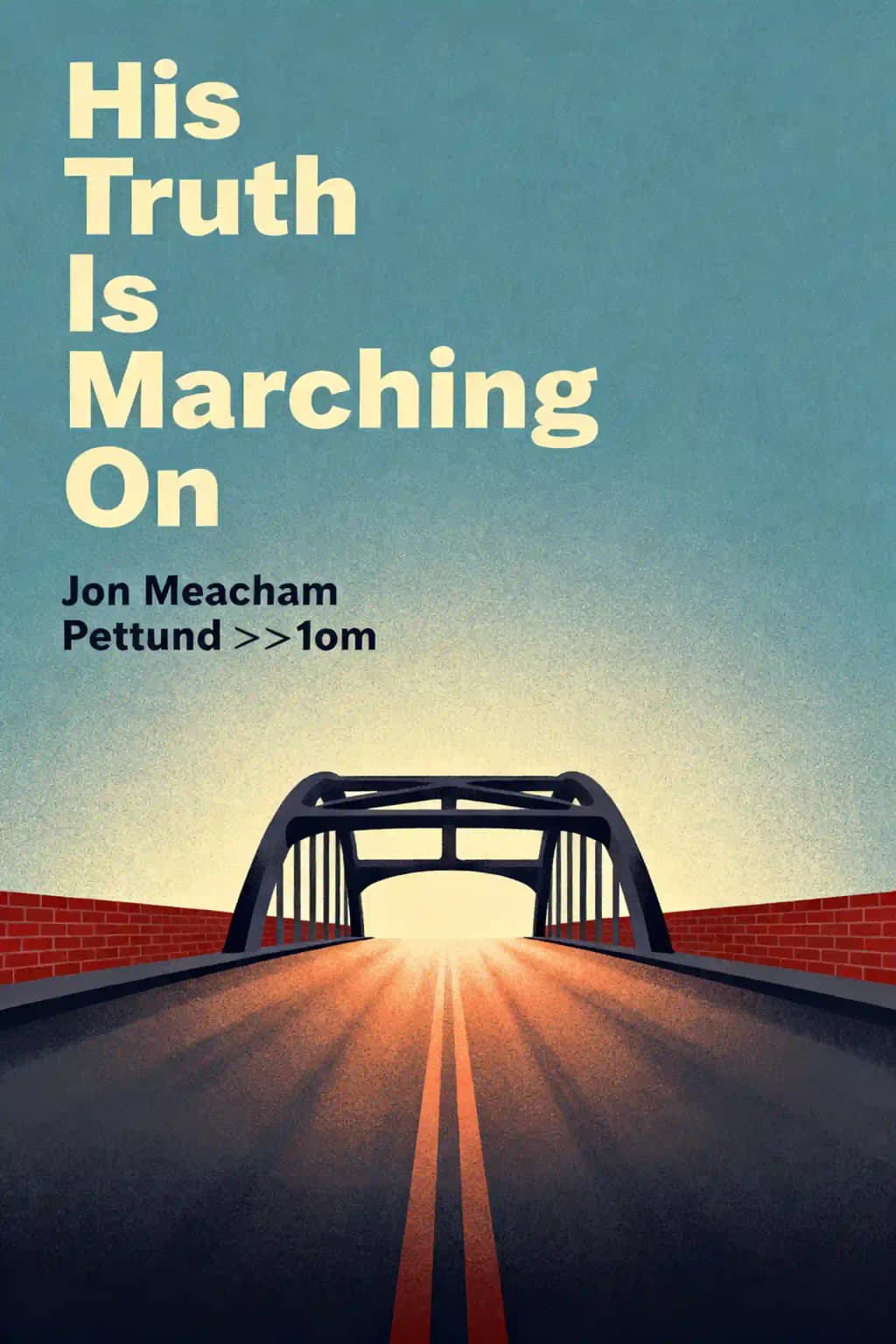
At the Edmund Pettus Bridge, John Lewis and Hosea Williams faced a wall of state troopers. When Williams asked if Lewis could swim, Lewis replied, "No," and Williams admitted, "A little." Lewis concluded, "We cannot jump. We're going to have to keep marching."
Major John Cloud ordered them to disperse: "This is an unlawful assembly. Your march is not conducive to the public safety." When Williams asked to speak with him, Cloud replied, "There is no word to be had."
At twenty-five years old, Lewis stood at a crescendo moment of his life. The scene was starkly clear: forces of good pitted against forces of evil, with marchers asking the nation to honor equality while the authorities, as Sheriff Clark's lapel pin declared, said "Never."
Cloud ordered, "Troopers, advance!" The wave of blue struck instantly. "The troopers and possemen swept forward as one, like a human wave, a blur of blue shirts and billy clubs and bullwhips," Lewis recalled. Charles Mauldin, a seventeen-year-old marcher, would never forget "the sound of the billy club hitting John's head...this sickening, harsh thwack."
Lewis, struck twice and suffering a fractured skull, felt everything dimming as he vomited. He heard screams, slurs, and horses' hooves, believing "I'm going to die here." Yet remarkably, he felt no fear-only peace. "I thought I saw death," he later recalled, "and I thought, 'It's OK, it's all right'-I am doing what I am supposed to do."
That evening, ABC interrupted the broadcast premiere of "Judgment at Nuremberg" to show footage of the assault. The Washington Post declared the news "will shock and alarm the whole nation." On March 15, 1965, President Johnson addressed Congress on voting rights, drawing deeply on religious themes. "I speak tonight for the dignity of man and the destiny of democracy," he began, framing Selma as a pivotal moment in history alongside Lexington, Concord, and Appomattox. He concluded with the powerful phrase, "And we shall overcome."
Lewis and King watched the address together in Selma, tears streaming down their faces. The march from Selma to Montgomery began on Sunday, March 21. Despite his injuries, Lewis walked the entire fifty-four-mile route. On August 6, Johnson invited Lewis and others to a private meeting before signing the Voting Rights Act. Hours later, Lewis stood in the Capitol as Johnson signed the bill, declaring they were striking away "the last major shackle of those fierce and ancient bonds."
Capítulo 9
This Country Don't Run on Love: The Movement Fractures
Lewis had foreseen the challenges that would follow voting rights victories. In a May 1965 New York Herald Tribune piece, he warned that without addressing jobs, housing, and police brutality, "I can only see many long, hot summers ahead." His prediction proved accurate when riots erupted in the Watts section of Los Angeles on August 11, 1965. President Johnson, bewildered by the violence, asked his aide Jack Valenti, "How is it possible? After all we've accomplished. How could it be?"
The concept of "Black Power" gained momentum as an alternative to nonviolence. By spring 1966, SNCC papers argued "we must cut ourselves off from white people" and form separate institutions. James Forman had declared during Selma, "If we can't sit at the table, let's knock the fuckin' legs off!"
Stokely Carmichael emerged as the voice of this new approach. While not explicitly advocating violence, he rejected turning the other cheek and dismissed coalitions with whites. Carmichael argued that nonviolent tactics had reached their limit. Speaking to a Harlem audience, he rejected King's approach: "This country don't run on love, Brothers, it's run on power and we ain't got none."
SNCC's frustration with Lewis came to a head at a conference in Kingston Springs, Tennessee in May 1966. Critics felt Lewis wasn't representing the organization but was instead making speeches and rushing to Washington whenever President Johnson called. Though initially reelected chairman, a second vote resulted in what Lewis called his "de-election."
The ideological tensions within the movement became publicly visible during James Meredith's march across Mississippi in June 1966. In Greenwood, Mississippi, Carmichael delivered his passionate "Black Power" speech after his twenty-seventh arrest: "The only way we gonna stop them white men from whuppin' us is to take over. We been saying freedom for six years and we ain't got nothin'. What we gonna start saying now is 'Black Power!'"
On July 22, 1966, Lewis packed his belongings at the SNCC offices in Atlanta, beginning what he considered his personal exile. "It hurt to leave my family, so many good brothers and sisters with whom I had shared so much. My ego was hurt as well. My feelings were hurt. I felt abandoned, cast out." Like biblical figures before him, Lewis entered a wilderness period, taking a job with the Field Foundation in New York City.
Capítulo 10
The Last Integrationist: Lewis's Enduring Legacy
Following the assassinations of King and Kennedy, Lewis shifted from direct action to electoral politics. After losing a congressional race in 1977, he won an Atlanta City Council seat in 1981 and later defeated Julian Bond for the U.S. House seat that would define his career.
In Congress, Lewis remained a principled activist, being arrested five times as a Representative-protesting apartheid, the Darfur genocide, and for immigration reform. He boycotted both George W. Bush's and Donald Trump's inaugurations on principle, yet worked with the Bushes on building the National Museum of African American History and Culture. After the Orlando nightclub massacre, he led a sit-in on the House floor demanding gun reform legislation, declaring, "We have been too quiet for too long."
Lewis preserved movement history through his award-winning graphic novel trilogy "March," inspired by the comic book about King he'd read as a teenager. During Trump's presidency, Lewis spoke passionately during impeachment proceedings, saying, "When you see something that is not right, not just, not fair, you have a moral obligation to say something, to do something."
Though Lewis had initially endorsed Hillary Clinton in the 2008 presidential race out of personal loyalty, he switched to Obama after witnessing the movement-like enthusiasm for his candidacy. "I want to be on the side of the people, on the side of the spirit of history," Lewis explained. When Obama returned to Selma as president in 2015, he celebrated the "hard-won progress" while acknowledging the work still to be done.
Lewis's vision of nonviolence and the Beloved Community remains powerfully relevant in an era of resurgent white nationalism. Despite persistent racial injustice in America, Lewis's life demonstrates that progress is possible through religiously inspired witness and action. As Lewis said shortly before his death regarding reparations: "We should find ways to make people a little more whole."
In his final days, Lewis would still become emotional when recounting the events on the bridge. "I don't want to die," he recalled thinking during the attack. "I wanted to live." Though he would sometimes cry when reliving that day, he found it "good for the soul." Lewis noted that he dreamed of the movement often-not nightmares of beatings, but dreams of marching, singing, and the music of the movement. "I don't relive the beatings in my dreams... Maybe in my mind the good forces are always at work." Even as he faced death from cancer in July 2020, Lewis maintained his belief that the dream of the Beloved Community could become more than just a dream.
Capítulo 11
Against the Rulers of the Darkness: A Call to Continue
Forty years after King's death, Lewis stood at the same Canterbury Pulpit in Washington National Cathedral where King had preached in 1968. Drawing on King's text from Revelation about "the Holy City, new Jerusalem," Lewis reminded his listeners that "the tabernacle of God is with men"-emphasizing human responsibility to create God's kingdom on earth. He renewed the vision of the Beloved Community: "not hateful, not violent, not uncaring... not separated, not polarized, not locked in struggle; an all-inclusive world society based on simple justice, the values, the dignity, and the worth of every human being."
Lewis reflected on how the movement had changed America for the better, joining emancipation and women's suffrage as brilliant chapters in the national story. He believed the truths he had intuited in Troy and learned in Nashville remained relevant in the twenty-first century: "We are one people. We are one house. We are one family... we have to find a way to live together."
In 2020, a frail Lewis wept at George Floyd's killing but maintained hope in the young protesters, believing they would "help redeem the soul of America." As Obama noted, Lewis showed how a "little dude" could "awaken a nation" through the power of sustained witness against injustice.
In this personal reflection near the end of his life, John Lewis recounted coming of age in segregated America and embracing the civil rights movement's message of unity and hope. He described his first arrest in Nashville sixty years earlier as a liberating experience that made him "a stronger and better person." Though America won the battles of the 1960s, Lewis argued that the war for justice continues as the nation faces renewed divisions and tribalism.
Lewis called for Americans to choose community over chaos once more, insisting that silence is not the answer to injustice. He reaffirmed his belief that America's moral compass comes from God, who gave the movement courage and the power to believe that "the Spirit of History behind us is stronger than the terror of hatred in front of us." The civil rights leader expressed faith that despite forces trying to divide Americans along racial lines, the nation can move forward as one community, concluding with unwavering optimism: "We've come too far, we've made too much progress as a people, to stand still or to slip back."