Capítulo 1
The Rise and Fall of Masculinity in Modern Society
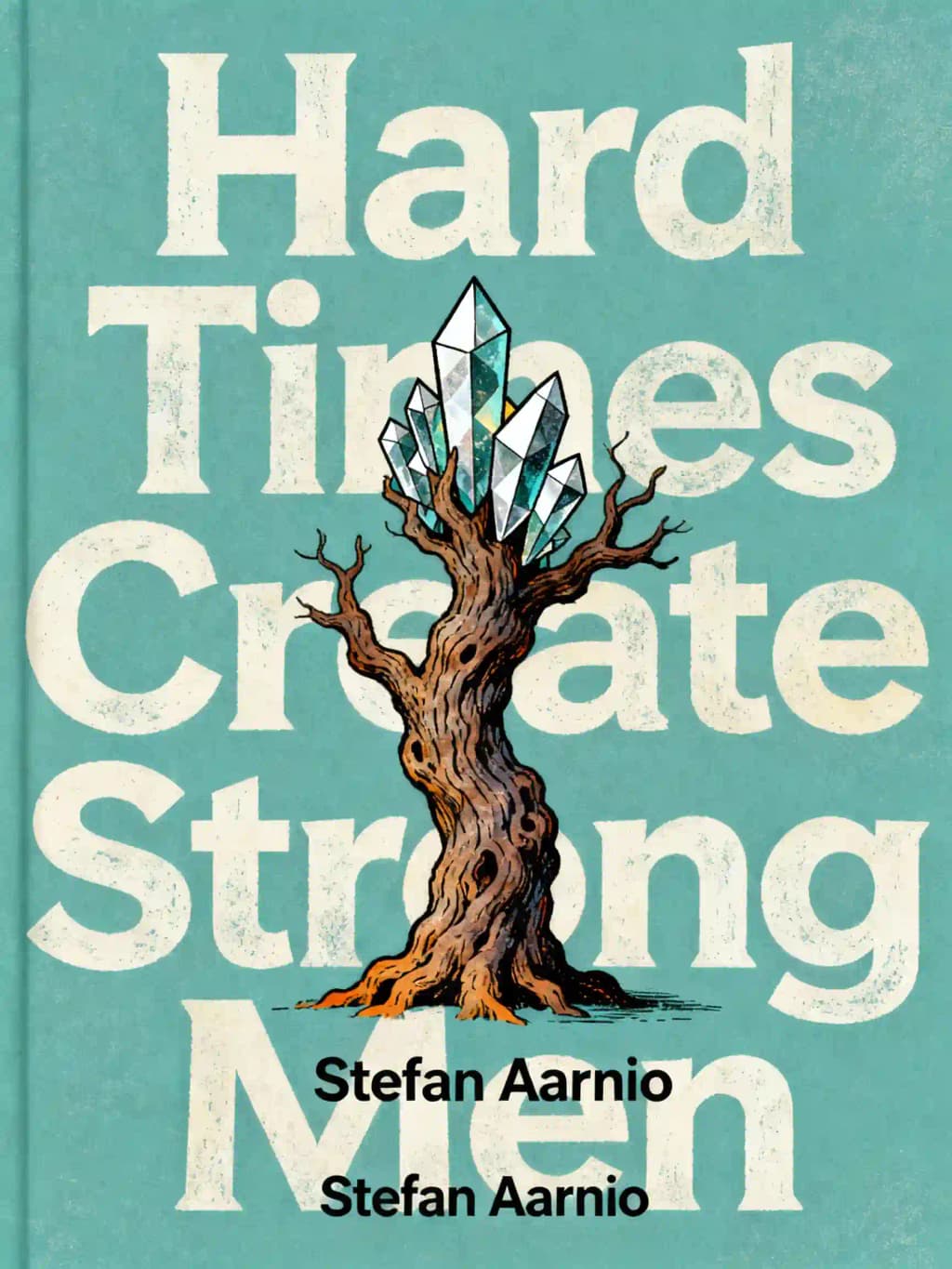
Hard Times Create Strong Men has become a cultural touchstone since its publication, finding its way into the libraries of everyone from Silicon Valley tech bros to military leaders. The book's provocative thesis has sparked fierce debates across political lines, with supporters praising its unflinching assessment of modern masculinity and critics condemning what they see as regressive gender politics. Despite the controversy-or perhaps because of it-the book has developed a cult following among young men searching for direction in an increasingly complex world. Stefan Aarnio, a real estate entrepreneur turned cultural commentator, wrote this book after noticing a pattern among his millennial employees: they seemed to lack the basic work ethic and masculine values he believed essential for success. What began as a blog post evolved into this raw, unfiltered "man bible" that has resonated deeply with men feeling adrift in today's society.
Capítulo 2
The Crisis of Modern Masculinity
What does it mean to be a man in today's world? This question haunts countless young men raised without father figures or clear paths to manhood. The traditional journey from boyhood to manhood has been systematically dismantled, leaving a generation of males confused about their purpose and identity. Unlike previous generations who had clear rites of passage and societal expectations, modern men often drift through their twenties and thirties without a clear sense of direction or achievement milestones.
Aarnio argues that Western society has created weak men with "weak bodies, weak minds, weak spirits" who lack responsibility. He points to his millennial employees as prime examples-young men offering emotional excuses for poor performance rather than taking ownership of their work. In one striking instance, he describes a 27-year-old employee who blamed his missed deadlines on "feeling overwhelmed" rather than addressing his poor time management. After confronting them with lectures on masculinity and implementing structured mentoring programs, he witnessed immediate improvement as they thanked him for teaching them "how to be a man"-something their fathers had failed to do.
This crisis stems from multiple interconnected sources: an educational system designed for compliance rather than strength, where physical education and competition are increasingly eliminated; universities promoting victimhood over responsibility, with safe spaces replacing challenging discourse; media messages encouraging men to "follow their dreams" without developing practical skills or work ethic; women attempting to feminize men through social pressure; absent father figures in over 40% of American households; an overly sensitive "Care Bear society" that prioritizes feelings over results; destructive feminism that demonizes traditional masculine virtues; and cultural forces systematically eradicating strong masculinity from public life.
The consequences are stark and measurable: unlike the "greatest generation" who endured the Depression and fought in WWII before building stable lives, millennials face declining prospects with lower wages (earning 20% less than their parents at the same age), decreased home ownership (down 8% from previous generations), falling marriage rates (delayed by an average of 5 years), and plummeting birth rates. Many return home like "boomerangs," unable to launch into independent adulthood, with over 52% of young adults now living with parents - the highest rate since the Great Depression.
This weakening of men threatens society's strength and resilience at fundamental levels. When hard times arrive-as they inevitably do in historical cycles-who will have the fortitude to face them? As Aarnio warns, "hard times are coming" on an eighty-year social cycle, similar to the pattern that brought the Great Depression and World War II. A society of weak men, lacking physical strength, emotional resilience, and practical skills, will be ill-prepared to handle the challenges ahead, whether economic downturns, social upheaval, or global conflicts.
Capítulo 3
A Man's Purpose Is His Work
"You are not a special and unique snowflake." This famous line from Fight Club captures a fundamental truth that modern men have lost: a man's purpose is found in his work, not in fantasies of exceptional destiny or following passions without discipline. This harsh reality stands in stark contrast to the modern self-help narrative that everyone is destined for extraordinary achievements simply by following their dreams.
Aarnio illustrates this through his father's failures-a man who avoided real work through entrepreneurial fantasy, leading to financial ruin and divorce. His father perpetually chased "get-rich-quick" schemes and business opportunities while neglecting stable employment, ultimately destroying his family's financial security. When his mother announced divorce, Aarnio witnessed his 6'2" father begging on his knees while his 5'4" mother towered over him in contempt. His mother, forced into the masculine breadwinner role, grew resentful of becoming mannish-cutting her hair short and developing a stocky build-while his father took on feminine household duties, creating a profound disruption in the family's natural dynamic.
Years later, when his father approached him at age 30 seeking work with an outdated resume highlighting being a "proud father," Aarnio confronted him: "No one cares that you have two great boys. That's irrelevant to work." He urged his father to take any job-even at McDonald's-rather than chase entrepreneurial fantasies. This painful interaction exemplified how personal identity must be grounded in productive work rather than familial roles or unrealized ambitions.
The industrial education system has destroyed traditional mentorship models where boys learned trades from men. Instead of practical skills and work ethic, boys now receive abstract education disconnected from real-world application. This creates men who don't understand that purpose comes through work, regardless of whether they enjoy it. Historical apprenticeship models provided not just technical skills but also character development and understanding of masculine responsibility.
The path to greatness requires balancing practical work with pursuing passions. Using the metaphor of two bricklayers-one who sees only labor, another who envisions building a cathedral-Aarnio demonstrates how meaning transforms work. While both perform identical tasks, the second bricklayer's vision elevates his labor to meaningful creation. A man must first secure basic income through necessary work before pursuing his passion during off-hours, creating a foundation of stability that enables greater achievements.
Becoming great requires obsession and persistence through the "grind." It means working for 10 years/10,000 hours to achieve mastery, a principle demonstrated by experts across fields from musicians to athletes to entrepreneurs. It means avoiding comfort traps (TV, junk food, drugs) that prevent greatness by providing temporary pleasure at the cost of long-term achievement. Most importantly, it means living with urgency-as if death were imminent-rather than postponing purpose indefinitely. This mindset transforms daily work from mere obligation into purposeful action toward mastery.
Success demands embracing the reality that meaningful work often begins with mundane tasks, performed consistently and with excellence, regardless of immediate enjoyment or recognition. The modern tendency to seek fulfillment before mastery reverses the natural order of achievement and satisfaction.
Capítulo 4
The Strength Paradox: Good Men vs. Nice Men
There's a critical distinction between being a "good man" and being a "nice man." Good men keep their word and complete their tasks reliably, whether they're soldiers, criminals, or businessmen-they have integrity regardless of their moral alignment. In contrast, "nice" etymologically means "stupid" or "ignorant" and represents weakness. This distinction manifests in everyday scenarios: a good man will deliver difficult news directly, while a nice man might avoid conflict by making excuses or lying.
True strength comes from being able to bend without breaking. The Spartans exemplify masculine strength-taking boys at age 7 from their mothers into brutal warrior training. These strong men fought to their deaths at Thermopylae, where 300 Spartans killed thousands of Persians before falling. But Sparta's rigid "death before dishonor" mentality ultimately led to their downfall. They couldn't adapt to changing warfare tactics, diplomatic necessities, or evolving social structures, which eventually rendered their military prowess obsolete.
A better model is Erwin Rommel, the Desert Fox-strong yet flexible. Unlike Hitler's "fight to the death" orders, Rommel would retreat strategically to fight another day. He used deception, like wooden fake tanks, and repurposed weapons creatively. His adaptability extended to treating prisoners of war humanely and earning respect from both allies and enemies. Both the Spartans and Hitler's forces were incredibly strong but lost through rigid thinking. Their inflexibility became their greatest weakness.
This balance extends to emotional strength as well. Most men receive no education about managing emotions, leading to repression and health problems like high blood pressure, anxiety, and depression. Stoic philosophy teaches feeling emotions without being ruled by them - acknowledging anger, fear, or grief while maintaining rational decision-making abilities. A strong man understands that humans make decisions based on emotions but justify them with logic, and uses this knowledge to better understand himself and others.
A truly strong man wields three types of capital with his mind: real capital (cash, credit, debt, investments, and tangible assets), social capital (network, tribe, brand, connections, reputation, and influence), and intellectual capital (inventions, intellectual property, specialized knowledge, skills, and expertise). He maintains a strong body through regular exercise, proper nutrition, and adequate rest-though physical strength matters less in our information age than in hunter-gatherer times, physical presence remains important for leadership and longevity. And he cultivates a strong spirit-connecting with the spiritual realm through meditation, reflection, or religious practice to access dimensions beyond our perceivable ones.
Kindness, mercy, generosity and abundance come from positions of power and strength, not weakness. As Al Capone said: "Don't mistake my kindness for weakness." True strength allows a man to be compassionate without compromising his principles, to show mercy without appearing weak, and to be generous while maintaining clear boundaries. This combination of strength and benevolence creates lasting respect and influence.
Capítulo 5
The Victim-Owner Spectrum: Attacking the Man-Boy Epidemic
Modern society has produced a generation of "man-boys"-hipster, degree-holding men who can't find meaningful work, complain about capitalism while consuming expensive products, and lean politically left. These men opt out of traditional masculine responsibilities: choosing pornography over relationships, welfare over earning, minimalism over achievement, and victimhood over responsibility.
This represents the victim mentality that plagues modern men. Using Dave Logan's five leadership levels, Aarnio contrasts victim thinking with owner mentality. The first two leadership levels ("life sucks" and "my life sucks") represent victim mentality, while level three ("I'm great and you're not") begins ownership thinking, though still self-centered. True leadership emerges at level four ("we're great") when leaders develop other leaders.
The concept of the "teenager" itself is a modern invention that has progressively extended childhood well into adulthood. Prior to post-WWII American prosperity, people were either children or adults, with no intermediate stage. This prosperity led to a deferral of adulthood that has worsened, culminating in the 1995 invention of "emerging adulthood"-a period between 18-29 where young people feel "in between" childhood and adulthood.
Just 100 years ago, people died in their 40s while today many remain childlike until 30. The idea of "finding yourself" is foolish; instead, one should define oneself through action and responsibility. Successful men make decisions quickly and change their minds slowly.
Video games provide a perfect escape for man-boys, offering instant problem-solving gratification without real-world consequences. The average gamer is around 30 years old and spends 6-18 hours weekly playing-potentially 25% of non-working time. This represents significant opportunity cost, with the author calculating that 72 monthly gaming hours at $20/hour equals $17,280 annually in lost potential.
Becoming a man requires owning all problems, making consistent choices, and developing an "unconquerable soul" that fights for a better life for oneself and one's tribe. Like the characters in Fight Club, many man-boys secretly crave authentic masculinity but don't know how to attain it.
Capítulo 6
What Women Really Want (And What Men Want Too)
What do women truly want? After searching through 5.9 billion Google results, the answer lies in a half-millennium-old story from Chaucer's Canterbury Tales. The Wife of Bath tells of a knight who must discover what women want to avoid execution. The answer? Women want "mastery over their men." Yet paradoxically, women desire strong men they cannot fully master.
Women want the tension of pursuing a powerful man's devotion while he remains dedicated to his purpose. As Chris Rock observes, "Men see something they want and say, 'What do I have to do to get me that?' Women see something they want and say, 'Who do I have to get to get me that?'" The attraction lies in the push-and-pull dynamic-women want mastery over the tribal leader, not a man they can simply walk over.
A man must never sacrifice his purpose for his woman, as this would debase him and force him into feminine energy. Sexual attraction stems from the collision of opposite forces-masculine and feminine energies-not from gender-neutral homogeneity. When men slip into feminine energy, it forces women into masculine roles they resent, eventually destroying attraction.
When selecting a life partner, men should examine a potential partner's family, particularly her relationship with her father which often predicts her future relationships with men. Children learn love patterns from their parents, whether healthy or dysfunctional.
Men struggle between "what they want" (attractive women) and "what they need" (stable, marriageable women). The viral "Universal Hot vs. Crazy Matrix" video maps women on two axes: hotness (0-10) and craziness (4-10, as "all women are at least a 4 crazy"). The matrix identifies several zones: the "no-go zone" (women below 5 in hotness), the "danger zone" (very hot but extremely crazy women), the "fun zone" (moderately hot and crazy), the "date zone" (very hot but too crazy for marriage), and the ideal "wife zone" (8-10 hot but only 5-7 crazy).
When reversed for women's perspective, the matrix becomes simpler with "cute" and "money" axes, showing women primarily choose between cute men with no money ("fun zone") and rich men regardless of looks ("husband zone"). This exchange is rational: "Women are exchanging their limited sexual and life-giving force for power, which in today's world is money."
Capítulo 7
The Destructive Forces Undermining Masculinity
Several powerful forces are systematically undermining masculinity and the traditional family structure in Western society. These include pornography, the welfare state, divorce laws, and the education system.
Pornography serves as a mass castration of men's divine masculine power. Prison systems use "pizza and porn nights" to sedate violent, hyper-masculine inmates-a revealing insight into pornography's pacifying effects. Men produce approximately 100 million sperm daily, with each ejaculation expending tremendous creative energy. The difference between a bull and an ox illustrates this concept perfectly. A bull-powerful, aggressive, dominant-becomes a docile, controllable ox when castrated. Similarly, pornography renders modern men docile through a daily "mini-castration," depleting their creative and actionable energy.
The welfare state has replaced men as providers, allowing women to leave marriages with fewer consequences than in the past. Divorce laws still heavily favor women despite women's economic empowerment, discouraging men from marriage. The author, at 31, questions risking his wealth and life's work on "the whim of a woman."
Since the 1950s, men have lost power in the Western world while women have gained it. This shift has marginalized fathers, resulting in fewer strong men and many fatherless families. The father role has been undermined by women taking on masculine work roles, the welfare state, divorce and family laws favoring women, and media portraying fathers as bumbling idiots.
The marginalization of fathers has created devastating statistics: 63% of child suicides, 90% of homeless children, 85% of children with behavior disorders, 80% of rapists with anger issues, and 71% of high school dropouts come from fatherless homes. Boys without fathers lack discipline and proper role models for sexuality and male virtues. Girls without fathers are more likely to become sexually active earlier, have teenage pregnancies, and struggle with stable relationships.
To rebuild society, we must restore the nuclear family with strong fathers, as the elimination of masculinity and discipline has weakened society and left the state to replace the father's role.
Capítulo 8
The Spiritual Dimension of Masculinity
Religion forms the foundation of civilization and provides man with access to infinite spiritual power. Without religion, humanity would degenerate into chaos, as organized faith systems provide the structure needed for societies to advance beyond primitive conditions. This pattern is evident throughout human history, from ancient Mesopotamian civilizations to modern societies, where religious frameworks have consistently preceded cultural advancement.
Religion serves as mankind's greatest invention-more important than cars, spaceships or computers-because it provides the foundational values necessary for civilization to develop. Without religion, man degrades into "robbing, raping, killing bands of cannibals." Throughout history, religious structures have mirrored political power: paganism with multiple gods matched decentralized city-states, monotheism emerged with empires, and totalitarian states replaced God with government worship. For example, ancient Greece's polytheistic system reflected its city-state structure, while Rome's eventual embrace of Christianity paralleled its imperial consolidation.
The spiritual realm offers infinite power that atheism rejects to its detriment. Napoleon Hill distinguishes between limited "synthetic intelligence" (logic, known facts) and unlimited "infinite intelligence" (divine creativity) accessible through faith. This infinite intelligence manifests through inspiration, intuition, and profound insights that transcend rational thought. Religious practice both civilizes societies and connects individuals to their creative potential through rituals, contemplation, and community.
As Western civilization has systematically replaced traditional values with new gods, society has weakened dramatically. The four new gods-money (fiat currency with no real value), government (collectivist philosophy), science (manipulated synthetic intelligence), and atheism (belief in nothing)-have replaced what truly matters: family values, freedom-based governance, infinite intelligence, and Judeo-Christian philosophy. This shift has led to increased social atomization, mental health issues, and moral relativism.
Written religion is mankind's greatest invention-the technology that prevents us from degrading into cannibalism. The Ten Commandments reveal the ten dark things humans naturally do when acting on emotions and urges. These commandments were created during hard times to civilize the beast into a coherent group and prevent men from becoming criminals, adulterers, and cannibals. Each commandment addresses specific human weaknesses: coveting, stealing, lying, and murder represent base impulses that must be controlled for society to function.
To connect with divine power, one must clear the mind of civilization's noise through prayer, meditation, or fasting-all triggering the same brain mechanics to reach a dreamlike state. These practices, found across different religious traditions, alter consciousness and facilitate spiritual connection. To find divine purpose, one must strip away distractions, addictions, and time-wasters that block connection to God. This might include reducing social media use, limiting entertainment consumption, or practicing regular periods of silence and solitude. Any religion is better than none (1 is infinitely greater than 0), as religion keeps man from darkness by providing moral framework, community support, and spiritual guidance. Historical examples show that societies maintaining strong religious traditions typically demonstrate greater stability, lower crime rates, and stronger family structures than those that abandon religious practice.
Capítulo 9
The Cycle of History: Hard Times Create Strong Men
History moves in cycles, with societies rising and falling based on the strength of their men and the hardness of their times. Hard times create strong men, strong men create good times, good times create weak men, and weak men create hard times-completing the cycle.
The world ultimately belongs to warrior cultures. Peace is unsustainable because there are always "have-nots" beyond the frontier who eventually become "barbarians at the gates"-strong men forged by hard times who violently take what they want from comfortable civilizations.
Societies are born from intolerance but die when they become too tolerant to function. All great empires rise through violence, killing, and slavery, only to grow complacent and vulnerable to hungrier, more aggressive cultures forged through hardship.
The author warns that the cycle of history shows that comfortable societies inevitably produce weak men who create hard times, making them vulnerable to invasion. Western society has become hostile toward men, particularly white Christian men who have lost majority status while media and government cater to minorities for political gain.
The current political climate has destroyed Western man's ability to identify problems and threats, disabling our tools of discernment and judgment. Questioning popular narratives leads to social suicide and character assassination. A man who questions gay marriage is labeled homophobic; one who questions childhood gender transitions is deemed ignorant; one who questions immigration policies is branded racist or xenophobic; one who questions women's roles is called sexist.
The author examines political power through the lens of primate behavior, contrasting chimpanzee (patriarchal) and bonobo (matriarchal) societies as models for human organization. He argues humans have historically lived like chimps in patriarchal societies but are now shifting toward a bonobo-style society where females dominate. This creates an inverse relationship-the more matriarchal a society becomes, the less patriarchal it is.
The fundamental question is whether war is the determining factor between patriarchal and matriarchal societies, and whether societies naturally cycle between these states. The author suggests that hard times require strong men who create patriarchal societies, which then produce good times that create weak men, allowing women to take power-until external threats or resource scarcity force a return to male dominance through violence.
As we face the potential beginning of hard times in the coming decades, the question remains: Will we have enough strong men to weather the storm? Or will our society's systematic weakening of masculinity leave us vulnerable to collapse from within or conquest from without? The choice to cultivate strength-physical, mental, emotional, and spiritual-may determine not just individual success but the very survival of Western civilization.