Capítulo 4
Escape to the Desert
When Charlie's insurance coverage runs out and her grandmother can no longer pay for treatment, she faces returning to her abusive mother. Instead, her friend Mikey arranges a bus ticket to Tucson, Arizona, where Charlie can stay in his apartment while he's away on tour. With her old ID, birth certificate, and $933 that she and Ellis had saved for dreams of Paris and London, Charlie embarks on a new life in the desert.
The journey takes nearly two days across six states, filled with "sadness and stale air." Charlie arrives in Tucson at night, finding her way to Mikey's purple guest house where his landlady Ariel has left a yellow bicycle. Though initially panicked at being truly alone, Charlie finds comfort in Mikey's space, sleeping in his peacoat despite the desert heat.
Charlie quickly establishes a routine-buying supplies at Circle K, food at the Food Conspiracy co-op, and creating a new "tender kit" with glass shards from a smashed bottle. Though she doesn't want to cut, having the kit makes her feel safer. She spends days sleeping and drawing, living on crackers and cheese, finding comfort in Mikey's casual possessions.
Through Darla at a record store called Swoon, Charlie finds a job washing dishes at True Grit, a vegetarian cafe owned by Julie. There she meets Riley, a charismatic but troubled musician who becomes central to her new life. Charlie also rents a small apartment with peeling paint and a claw-foot tub from an elderly landlord named Leonard. Despite its flaws, it feels like a sanctuary compared to where she's been.
The desert setting represents both opportunity and danger for Charlie-a place where she can reinvent herself, but also where she might lose herself in the vast emptiness. The heat and brightness contrast sharply with the gray Minnesota skies she left behind, symbolizing the stark differences between her old and new lives.
Capítulo 5
The Dangerous Dance of Love and Addiction
When Mikey returns briefly to Tucson, Charlie's carefully constructed world tilts on its axis. Her romantic feelings for him crash against the reality that he has a girlfriend named Bunny - a revelation that leaves Charlie feeling hollow and displaced. After impulsively kissing him outside True Grit one evening, the rejection burns deep, leaving her vulnerable and searching for connection in all the wrong places.
Enter Riley, the charismatic musician whose presence at True Grit draws Charlie like a moth to flame. His talent on the guitar and weathered charm mask a dangerous relationship with alcohol, though Charlie initially mistakes his dysfunction for depth. Their relationship evolves in the shadows, taking on ritualistic qualities that should serve as red flags: Riley's insistence on calling her his "nighttime visitor," the peculiar candy-fetching errands before their encounters, the way he keeps her separated from his daylight life.
Charlie finds herself seduced by the carefully curated details of Riley's world - his apartment becomes a sanctuary of sorts, with its meticulously alphabetized record collection, dog-eared books bearing cryptic margin notes, and that inviting velvet couch that seems to hold stories of its own. She spends countless nights on the street corner, letting his guitar melodies wash over her, each song drawing her deeper into his orbit.
The true nature of their relationship reveals itself gradually. Riley's "errands" are actually drug runs from his dealer Wendy, with Charlie serving as an unwitting mule. Their codependency deepens like quicksand - Charlie abandoning her photography, her friendships, her sense of self, while Riley's addiction consumes him like a slow-burning fire. The situation comes to a head when Julie discovers them in her office, her fury ignited not just by the act itself but by the predatory nature of their age difference, leading her to invoke the term "statutory rape" with devastating clarity.
Riley's descent becomes impossible to ignore - empty bottles multiply like breadcrumbs marking his path to destruction, his beloved guitar gathering dust in the corner, and most disturbing are the moments when his eyes glass over, looking through Charlie as if she's become invisible. Her desperate insistence that she can save him prompts Linus, a recovering alcoholic who's seen this story play out countless times, to deliver a stark warning: "If I had a dollar for every time I've heard that, I'd be a rich woman."
The parallel between Charlie's self-harm and Riley's alcoholism emerges with painful clarity - both are destructive rituals masquerading as relief. Charlie's cutting provides her with moments of feeling "warmer, and calmer," while Riley drinks to drown the ghosts of his failed music career and collapsed marriage. Together, they form a toxic symbiosis, each enabling the other's self-destruction while mistaking their mutual damage for love. Their relationship becomes a haunting metaphor for addiction itself - alluring, all-consuming, and ultimately devastating to everyone in its path.
Capítulo 6
Art as Salvation
Throughout her journey, Charlie's artistic talent serves as her lifeline. Even during her silent days at Creeley, she communicated through drawing. Her sketchbook contained comics about life on the street, and she treasured her grandmother's Land Camera, which she used to take black-and-white Polaroids of herself with Ellis, Mikey, and DannyBoy.
In Tucson, Charlie continues to draw, creating portraits of her neighbors-Hector, Manny, and his mother Karen-who are reverently pleased to see themselves through her eyes. When she visits a warehouse gallery with her leather portfolio, Tony Padilla-Ariel's friend-immediately accepts her drawings for his exhibition, impressed by their "proficiency" and "something odd."
Charlie's landlady Ariel, an artist whose walls are covered in dark paintings with tiny strips of light, invites Charlie to her art workshop, saying she has talent but needs to examine herself as a subject. After the traumatic discovery of Riley with Wendy, Charlie is taken to Felix Arneson's home in New Mexico to recover. Felix, another artist, tells her that while her drawings show skill, they lack emotion: "You need to give your skill an emotion."
Following Felix and Ariel's advice, Charlie begins drawing a comic about a girl with hidden scars. She works for days, losing track of time, telling her story through images since she struggles with spoken words. When she finishes, she feels a shift within herself-art has become her path to healing and self-expression.
This theme of art as salvation extends to other characters as well. Riley expresses himself through music, performing a song about Charlie called "Who Knew I'd Make Her So Blue" as his way of apologizing. Linus creates woven landscapes that transform the walls of True Grit. Even Louisa at Creeley poured her secrets into composition books that she later passed on to Charlie.
The novel suggests that creative expression-whether through drawing, music, or writing-provides a constructive outlet for pain that might otherwise be directed inward through self-harm or outward through destructive relationships.
Capítulo 7
The Community of Broken People
Throughout her journey, Charlie finds connection and healing through unlikely communities that form around shared trauma and understanding. At Creeley Treatment Center, despite their diverse backgrounds and initial resistance to therapy, the girls forge a profound support system based on their shared experiences of pain and self-destruction. When Louisa tells Charlie, "Little one, you're with your people," she acknowledges not just their common struggle with self-harm, but a deeper kinship born from understanding what drives someone to hurt themselves.
In Tucson, Charlie gradually builds a new community that becomes her chosen family. Her neighbors-Hector with his quiet wisdom, Manny's protective nature, and Karen's maternal warmth-create a safety net she never had before. Her coworkers at True Grit, especially Riley, show her that work can be more than just survival; it can be a path to belonging. When Blue follows Charlie from Creeley, it demonstrates how these connections transcend institutional boundaries. The night Charlie collapses after a severe cutting episode becomes a powerful testament to this community's strength-Hector and Manny working desperately to stop the bleeding, Leonard offering his medical expertise, while Linus and Tanner ultimately drive her to New Mexico for recovery.
Even in her darkest moments, when self-destruction feels like the only option, Charlie discovers she's surrounded by people who refuse to let her disappear. During her devastating phone call with Riley at his rehab facility-when she questions whether she was merely a "freak show" to him-she fights the overwhelming urge to harm herself by implementing Linus's practical advice about surviving difficult moments in five-minute intervals, then fifteen, then an hour.
The novel powerfully illustrates that healing isn't a solitary journey but a collective experience strengthened through relationships with others who understand our deepest wounds. This theme crystallizes when Blue, another survivor of trauma, declares that she and Charlie are family now-a moment of raw emotional honesty that acknowledges how chosen families can be stronger than biological ones. The revelation about Ellis's condition through Mikey-that she responds to Charlie's name with recognition-shows how these bonds persist even through severe trauma and separation.
Glasgow extends this community beyond the novel's pages to include readers themselves. In her moving Author's Note, she shares a personal memory of seeing a young woman on a bus whose self-harm scars mirrored her own, and her regret at not reaching out despite their shared experience. By writing this novel for "the cutters and the burners and the kids on the street," she creates a literary safe space for those struggling with self-harm-estimated to affect one in two hundred teenage girls-reminding them they're not alone in their pain or their healing journey.
Capítulo 8
Finding Voice After Silence
Charlie's journey from selective mutism to verbal expression serves as a powerful metaphor for her path toward healing and self-discovery. At Creeley, she initially retreats into complete silence, communicating solely through hastily scribbled notes and expressive drawings. She has "cut all her words out" because her "heart was too full of them" - a poignant reflection of how trauma can literally steal one's voice. Her first spoken sentence - "Nurse. Ava. Bought. Me. This. Underwear." - emerges painfully, each word distinct and separate, her voice scratchy from months of disuse, like a rusty hinge slowly beginning to move again.
The reclamation of her name marks a crucial turning point in Charlie's recovery. When she finally declares, "It's not Chuck, Isis. It's Charlie. Charlie Davis," she isn't just correcting someone - she's actively reclaiming her identity. This moment ripples through the rest of the novel, as Charlie gradually finds different channels for self-expression. Her artistic journey becomes particularly significant, evolving from simple sketches to increasingly complex drawings that capture emotions she can't yet verbalize.
The theme of voice manifests uniquely through other characters, creating a tapestry of different forms of expression. Riley, the musician, transforms his remorse into melody, composing and performing a song about Charlie that serves as both apology and acknowledgment. Louisa's voice echoes through time in her composition books - raw, honest accounts of her struggles with self-harm that later become a lifeline for Charlie. Even Casper's office turtle becomes a powerful symbol - endlessly paddling without forward motion, representing the frustration of having something to express but lacking the means to do so.
The novel explores how finding one's voice is fundamentally linked to healing. When Charlie discovers Louisa's composition books, the words about cutting and pain strike deep chords of recognition. This discovery leads her to follow Felix and Ariel's artistic advice: to use herself as subject matter. Charlie spends days crafting a comic about a girl with hidden scars, transforming her trauma into visual narrative. This artistic expression becomes a bridge between her silent world and verbal communication.
The evolution of Charlie's voice culminates in multiple forms of expression. Her artwork becomes more confident and revealing, her relationships deepen through newfound ability to communicate, and her decision to write to Ellis represents a final breakthrough. As she sits on the plane to New York, mentally composing her letter, Charlie isn't just finding her voice - she's choosing how to use it. This moment represents more than just the ability to speak; it symbolizes her reclamation of personal power and agency, marking her transition from silence to self-expression in all its forms.
Capítulo 9
The Courage to Begin Again
The novel concludes with Charlie accepting a job as Felix Arneson's assistant in New Mexico, drawn to the stillness of his desert home and eager to escape Riley's ghost. The position includes room, board, and a small salary, plus space where she can continue her creative work.
Before leaving Tucson, Charlie attends Luis Alvarez's benefit concert where Riley performs. His song about their relationship-"Who Knew I'd Make Her So Blue"-serves as an apology, his way of talking just like her comic is hers. After his set, Riley gives Charlie a note that reads: "Charlotte-I do remember, and I did. I do. Take care of yourself. Irwin David Baxter."
More significantly, Charlie reunites with Mikey, who delivers life-changing news: he visited Ellis in Sandpoint, Idaho, and confirms she's still present mentally despite her condition. When Mikey mentioned Charlie's name, Ellis's face lit up. This news fills Charlie with love and hope as she clutches Ellis's address.
As the novel ends, Charlie sits on a plane beside a friendly girl named Shelley, heading to New York before continuing to New Mexico. When Shelley shows her viral videos of Riley's performance from the night before, Charlie reads Riley's note and holds Mikey's note with Ellis's address. As the plane takes off, Charlie begins mentally composing a letter to Ellis, choosing her next "momentous" step forward.
This ending embodies the novel's central message-that healing is not a destination but a journey, one that requires the courage to begin again despite past traumas. Charlie's decision to write to Ellis represents her willingness to confront her guilt and grief rather than cutting it out. Her new job with Felix offers a fresh start where she can continue developing her artistic voice.
The novel doesn't promise a perfect recovery or a fairy-tale ending. Instead, it offers something more valuable-the hope that with each day, each small choice, we can move closer to becoming whole. As Charlie puts it when contemplating Felix's question about whether self-harm is about getting closer to God: "Fuck no." It's about surviving, about finding ways to live with pain rather than being consumed by it.
Capítulo 10
Healing Through Scars: The Lasting Impact
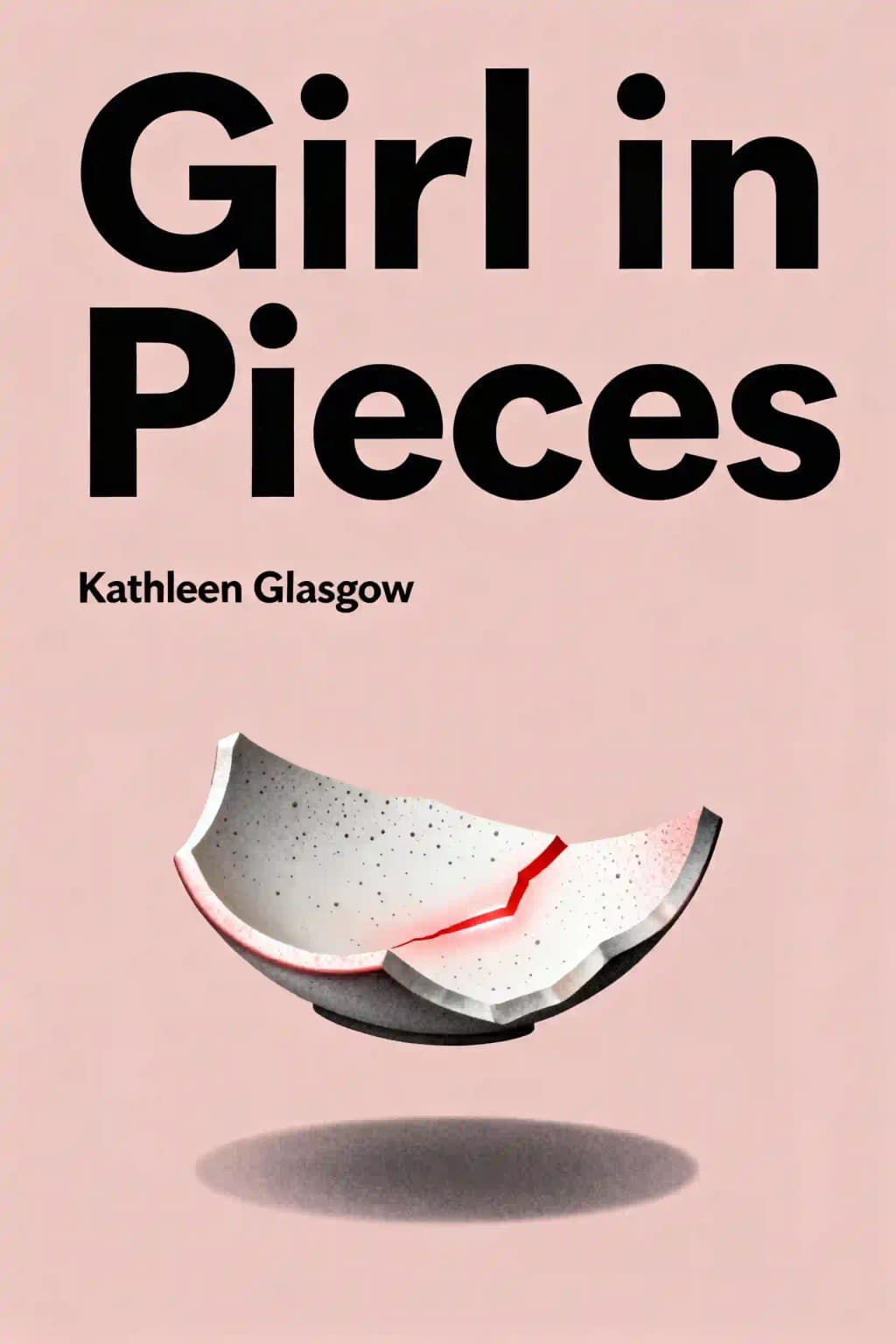
"Girl in Pieces" delivers a profound understanding of self-harm, dismantling common misconceptions that dismiss it as attention-seeking behavior. Instead, Glasgow's raw and honest portrayal reveals it as a complex coping mechanism born from deep emotional turmoil, depression, and mental illness. Through Charlie's narrative, readers witness how self-harm often serves as a desperate attempt to externalize internal pain - making the invisible visible through physical wounds.
The novel's impact resonates far beyond its literary merit through its comprehensive resources section. This practical addition provides vital contact information for crisis services, including 24-hour hotlines, shelter locations, and mental health resources. By including these lifelines, Glasgow transforms her work from a mere story into a potential lifesaving tool, creating a bridge between fiction and real-world support for readers who might recognize their own struggles in Charlie's journey.
Charlie's path to recovery illustrates the complex, non-linear nature of healing. She experiences moments of progress followed by devastating setbacks, periods of hope interrupted by relapses, and the constant challenge of maintaining forward momentum. Through these ups and downs, the novel portrays how recovery isn't about achieving perfection - it's about developing resilience and building a toolkit of healthy coping mechanisms. Charlie learns to replace self-destructive behaviors with art, honest communication, and self-compassion.
The story powerfully addresses the shame that often accompanies trauma and self-harm. When Louisa tells Charlie, "What we've done, no one will love us. Not in a normal way," she voices a fear common among trauma survivors. However, the community Charlie builds in Tucson - including Riley, Blue, and others - demonstrates how connection and acceptance are possible even with, and sometimes because of, our wounds. These relationships show that authentic healing often comes through allowing others to witness our vulnerability rather than hiding it.
The novel's most resonant message emerges through its exploration of transformation. Charlie's scars, both physical and emotional, become part of her story rather than its entirety. She learns that healing doesn't mean erasing the past but integrating it into a new narrative. Through art, friendship, and gradual self-acceptance, Charlie discovers that being broken doesn't mean being beyond repair - instead, it can be the foundation for building something new, like kintsugi, the Japanese art of repairing broken pottery with gold, making it more beautiful for having been broken.
"Girl in Pieces" ultimately stands as a testament to human resilience, suggesting that our worth isn't diminished by our wounds. The novel reminds us that everyone carries scars of some kind, and it's through acknowledging and accepting these marks that we find our way to authentic healing and genuine connection with others.