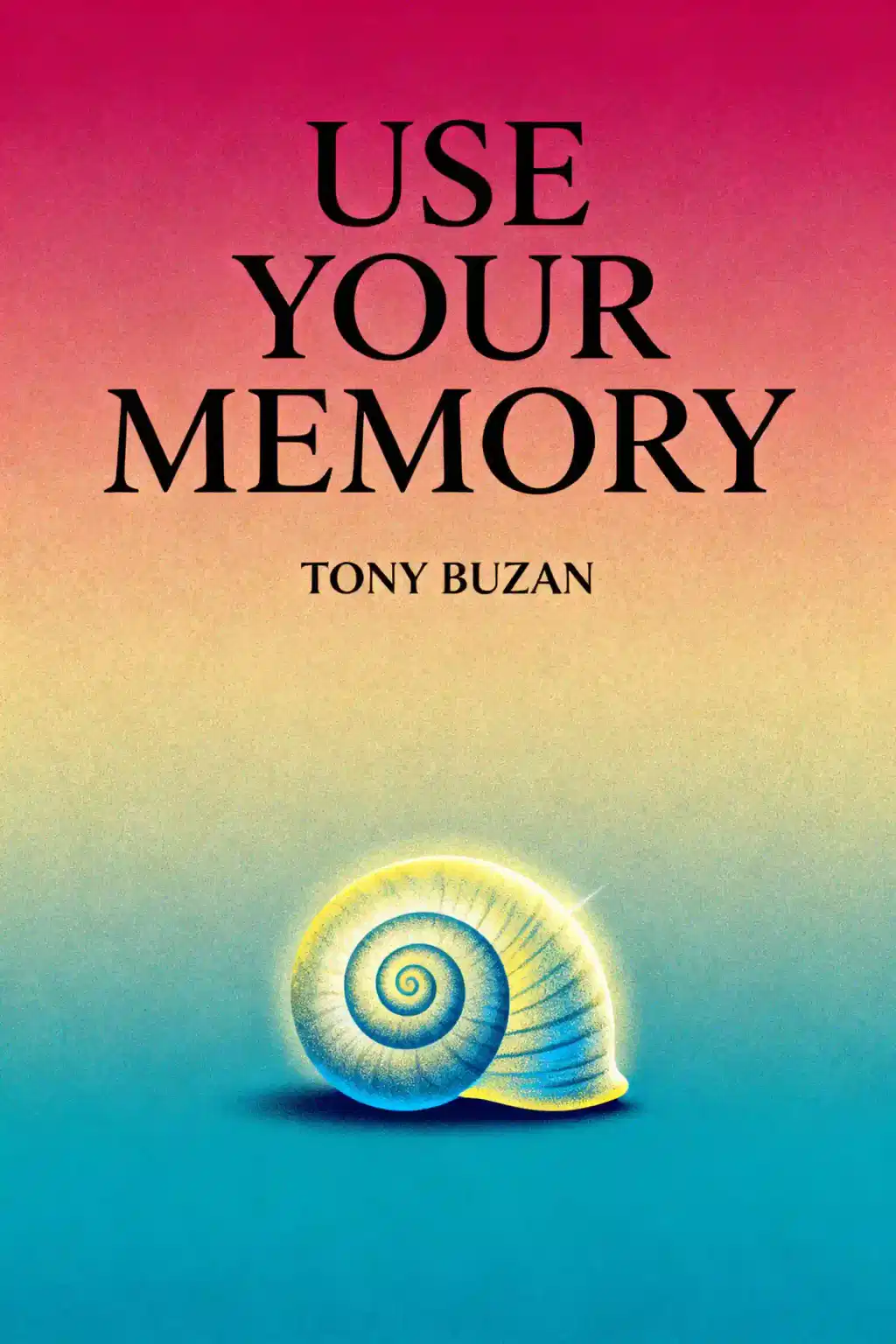
Use Your Memory by Tony Buzan Summary

Overview of Use Your Memory
Unlock your brain's hidden potential with Tony Buzan's revolutionary memory techniques. The mastermind behind Mind Mapping and World Memory Championships reveals methods embraced by Olympic athletes and corporations worldwide. Forget where you left your keys? This book ensures that never happens again.
- Combine imagery and association to unlock memory’s creative potential.
- Tony Buzan’s Mind Map method transforms linear notes into multidimensional memory tools.
- Train both brain hemispheres with mnemonics for deeper learning and faster recall.
- Construct a "Memory Palace" using spatial awareness to store infinite information.
- Replace rote repetition with story-based linking to retain complex data effortlessly.
- Convert abstract numbers into vivid shapes or rhymes for perfect numeric recall.
- Boost exam performance by encoding study material through multisensory mental journeys.
- Transform daily forgetfulness into creative flow with consistent memory system practice.
- Elevate IQ and concentration by treating memory training as cognitive workout.
- Master Buzan’s Roman Room technique to organize thoughts and accelerate innovation.
- Discover why traditional outlining fails compared to brain-compatible memory strategies.
- Apply the Alphabet Peg System to remember lists sequentially without notes.
About the Author of Use Your Memory
Tony Buzan (1942–2019), author of Use Your Memory: Dramatic New Techniques for Improving Your Memory, was a pioneering British educational consultant and memory improvement expert. A bestselling authority on cognitive enhancement, Buzan revolutionized learning strategies through his development of mind mapping—a visual thinking tool featured in his companion work The Mind Map Book. His books, including the BBC-published Use Your Head series, blend neuroscience with practical techniques for memory, speed reading, and creativity, reflecting his background in psychology and mathematics from the University of British Columbia.
As founder of the World Memory Championships and co-creator of the iMindMap software, Buzan shaped global educational practices, with his methods adopted by corporations and universities. A former editor for International Journal of Mensa, he authored over 80 books translated into 150 languages. Use Your Memory remains a cornerstone of his legacy, with his BBC series alone selling 3 million copies by 2003.
FAQs About Use Your Memory
What is Use Your Memory by Tony Buzan about?
Use Your Memory by Tony Buzan is a practical guide to unlocking your brain’s potential through proven techniques like mind mapping, visualization, and mnemonic strategies. The book explains how memory works, introduces neurobic exercises for brain training, and teaches methods to retain names, dates, and complex information. It blends neuroscience with creative learning approaches to boost recall and cognitive agility.
Who should read Use Your Memory?
This book is ideal for students, professionals, lifelong learners, or anyone seeking to improve memory retention. It’s particularly useful for those preparing for exams, learning new skills, or combating forgetfulness in daily life. Buzan’s techniques are accessible to beginners but also valuable for advanced learners.
Is Use Your Memory worth reading?
Yes—Buzan’s actionable strategies, like imagery-based mnemonics and brain-stimulating exercises, offer tangible improvements in recall. The book’s blend of science and practicality makes it a standout resource for memory enhancement, though those familiar with mnemonics may find some concepts repetitive.
What are the key memory techniques in Use Your Memory?
- Mind Mapping: Visual diagrams to organize information.
- Association: Linking new data to vivid mental images.
- The Journey Method: Storing memories in a mental “room” or route.
- Neurobic Exercises: Brain workouts to enhance cognitive flexibility.
How does Use Your Memory explain the brain’s role in recall?
Buzan breaks down short-term vs. long-term memory and highlights the brain’s reliance on imagery and spatial awareness. He emphasizes engaging both left (logic) and right (creativity) brain hemispheres for optimal retention, using techniques like colorful mind maps.
What is the “Seven Intelligences” framework in the book?
Buzan identifies seven intelligences: logical-mathematical, linguistic, spatial, bodily-kinesthetic, musical, interpersonal, and intrapersonal. He argues that nurturing these enhances memory and learning by leveraging diverse cognitive strengths.
Can Use Your Memory help with exam preparation?
Absolutely. The book provides strategies like chunking information, creating memory palaces, and using rhythmic repetition. These methods help students retain complex subjects efficiently, reducing cramming and improving long-term recall.
What criticism does Use Your Memory face?
Some critics note the techniques require consistent practice and may feel outdated compared to digital tools. However, the core principles remain relevant for analog memory training.
How does Use Your Memory compare to other memory books?
Unlike dense academic texts, Buzan’s guide prioritizes actionable steps over theory. It’s more visual than Moonwalking with Einstein and focuses on daily applications rather than competitive memorization.
What quotes from Use Your Memory are most impactful?
- “When you train your memory and imagination, you boost concentration, creativity, and IQ”.
- “Memory isn’t about trying harder—it’s about working smarter”.
How does Use Your Memory apply to professional settings?
Professionals can use Buzan’s methods to remember names, presentations, and workflows. Techniques like mind mapping aid in project planning, while association tricks enhance client interactions.
Why is Use Your Memory relevant in 2025?
With AI reliance growing, the book’s emphasis on human cognitive agility offers a counterbalance. Its strategies remain vital for critical thinking, adaptability, and maintaining mental sharpness in a tech-driven world.
Feel the book through the author's voice
Turn knowledge into engaging, example-rich insights
Capture key ideas in a flash for fast learning
Enjoy the book in a fun and engaging way
Key Themes in Use Your Memory
Quotes from Use Your Memory
Your memory isn't merely adequate-it may be virtually limitless.
We don't have one brain but two.
These elements aren't just memory aids-they're the natural language of your brain.
This simple technique is your first step toward memory mastery.
Characters in Use Your Memory
Quick Summary Mode - Read or listen to Use Your Memory Summary in 9 Minutes

Break down key ideas from Use Your Memory into bite-sized takeaways to understand how innovative teams create, collaborate, and grow.

Flash Card Mode - Top 9 Insights from Use Your Memory in a Nutshell

Distill Use Your Memory into rapid-fire memory cues that highlight key principles of candor, teamwork, and creative resilience.

Fun Mode - Use Your Memory Lessons Told Through 20-Min Stories

Experience Use Your Memory through vivid storytelling that turns innovation lessons into moments you'll remember and apply.
Personalize Mode - Read or listen to Use Your Memory Summary in 0 Minutes

Ask anything, pick the voice, and co-create insights that truly resonate with you.

From Columbia University alumni built in San Francisco
"Instead of endless scrolling, I just hit play on BeFreed. It saves me so much time."


"I never knew where to start with nonfiction—BeFreed’s book lists turned into podcasts gave me a clear path."


"Perfect balance between learning and entertainment. Finished ‘Thinking, Fast and Slow’ on my commute this week."
"Crazy how much I learned while walking the dog. BeFreed = small habits → big gains."
"Reading used to feel like a chore. Now it’s just part of my lifestyle."

"Feels effortless compared to reading. I’ve finished 6 books this month already."
"BeFreed turned my guilty doomscrolling into something that feels productive and inspiring."

"BeFreed turned my commute into learning time. 20-min podcasts are perfect for finishing books I never had time for."
"BeFreed replaced my podcast queue. Imagine Spotify for books — that’s it. 🙌"

"It is great for me to learn something from the book without reading it."
"The themed book list podcasts help me connect ideas across authors—like a guided audio journey."
"Makes me feel smarter every time before going to work"
From Columbia University alumni built in San Francisco
"Instead of endless scrolling, I just hit play on BeFreed. It saves me so much time."
"I never knew where to start with nonfiction—BeFreed’s book lists turned into podcasts gave me a clear path."
"Perfect balance between learning and entertainment. Finished ‘Thinking, Fast and Slow’ on my commute this week."
"Crazy how much I learned while walking the dog. BeFreed = small habits → big gains."
"Reading used to feel like a chore. Now it’s just part of my lifestyle."
"Feels effortless compared to reading. I’ve finished 6 books this month already."
"BeFreed turned my guilty doomscrolling into something that feels productive and inspiring."
"BeFreed turned my commute into learning time. 20-min podcasts are perfect for finishing books I never had time for."
"BeFreed replaced my podcast queue. Imagine Spotify for books — that’s it. 🙌"
"It is great for me to learn something from the book without reading it."
"The themed book list podcasts help me connect ideas across authors—like a guided audio journey."
"Makes me feel smarter every time before going to work"
"Instead of endless scrolling, I just hit play on BeFreed. It saves me so much time."
"I never knew where to start with nonfiction—BeFreed’s book lists turned into podcasts gave me a clear path."
"Perfect balance between learning and entertainment. Finished ‘Thinking, Fast and Slow’ on my commute this week."
"Crazy how much I learned while walking the dog. BeFreed = small habits → big gains."
"Reading used to feel like a chore. Now it’s just part of my lifestyle."
"Feels effortless compared to reading. I’ve finished 6 books this month already."
"BeFreed turned my guilty doomscrolling into something that feels productive and inspiring."
"BeFreed turned my commute into learning time. 20-min podcasts are perfect for finishing books I never had time for."
"BeFreed replaced my podcast queue. Imagine Spotify for books — that’s it. 🙌"
"It is great for me to learn something from the book without reading it."
"The themed book list podcasts help me connect ideas across authors—like a guided audio journey."
"Makes me feel smarter every time before going to work"
"Instead of endless scrolling, I just hit play on BeFreed. It saves me so much time."
"I never knew where to start with nonfiction—BeFreed’s book lists turned into podcasts gave me a clear path."
"Perfect balance between learning and entertainment. Finished ‘Thinking, Fast and Slow’ on my commute this week."
"Crazy how much I learned while walking the dog. BeFreed = small habits → big gains."
"Reading used to feel like a chore. Now it’s just part of my lifestyle."
"Feels effortless compared to reading. I’ve finished 6 books this month already."
"BeFreed turned my guilty doomscrolling into something that feels productive and inspiring."
"BeFreed turned my commute into learning time. 20-min podcasts are perfect for finishing books I never had time for."
"BeFreed replaced my podcast queue. Imagine Spotify for books — that’s it. 🙌"
"It is great for me to learn something from the book without reading it."
"The themed book list podcasts help me connect ideas across authors—like a guided audio journey."
"Makes me feel smarter every time before going to work"

Get the Use Your Memory summary as a free PDF or EPUB. Print it or read offline anytime.