Capítulo 4
Living in the Shadow of Past Glory: Natasha's Story
I was taken aback when Natasha, a portly Russian woman of about seventy, entered my office and immediately presented me with a photograph of herself as a young ballerina in an elegant arabesque pose. Though no longer slender, she moved with a dancer's grace as she settled into her seat. I found myself searching her coarsened features - perhaps weathered by Russian winters and alcohol - for traces of the beautiful young dancer in the photograph. Sensing my comparison, she turned her profile toward me and asked coyly, "Was I not lovely?" When I nodded, she proudly declared, "I was a prima ballerina at La Scala." Her immediate self-reference in the past tense revealed much about how she viewed herself now compared to her former glory.
When I questioned her use of past tense, she bristled at my "rude question" but admitted I might be right. Surprisingly, she claimed to have been happier in the forty years since she stopped dancing before age thirty. Yet she still introduced herself with this decades-old image, suggesting I would be uninterested in the present-day Natasha. She deflected by sharing a dream about me where she carried rifles - which she interpreted as penises from her previous psychoanalysis - but became defensive when I suggested a connection between the dream and her photograph.
Natasha explained she was experiencing a profound dissociation - feeling "lost outside of her life." Though visiting California with her husband Pavel and engaging in their usual activities, she felt insulated from experience, describing it as ostrannaya - not truly being present. This feeling began after visiting a ballet exhibition in Washington where she had searched for images of Sergei, her first husband and "the great love of her life." A brilliant dancer who had defected with her to Italy, Sergei abandoned her when gout ended her career at thirty. In response, she had slashed his face with a broken bottle before having a breakdown. After psychoanalysis, she rebuilt her life as a cello teacher, eventually marrying Pavel, one of her students.
Seeing a poster of Sergei at the exhibition but finding no mention of him had triggered her dissociation. Despite his cruel abandonment, she still idealized him, unable to imagine him as an old man. She feared searching for him online - afraid he might be dead, or worse, that reconnecting would rekindle unbearable passion. When I suggested her frozen-in-time image of their relationship was unrealistic, she refused to listen.
In our next session, Natasha arrived irritable, claiming my words about Sergei were "cruel" and that she'd slept poorly because of me. When I suggested this reflected the strength I saw in her, she paused, exhaled, and settled back in her chair, finally ready to listen. She described recurring nightmares of being alone in dangerous situations - lost in the Congo, hiding in deserted houses, unable to communicate her location. When asked to free-associate to "my life is in danger," she initially resisted but eventually admitted the obvious truth: at sixty-nine, her life was indeed in danger, with her "real life" - her dancing days with Sergei - far behind her.
I shared my own struggles with aging and mortality, explaining how the dimming of youthful passions can reveal previously overlooked wonders. Natasha softened, appreciating my personal disclosure, and recalled a dream about her deceased dog Baloo. I suggested the dream revealed her awareness of mortality - that she, like all living souls, walks the same final road. Though she protested that our conversation was "making things worse," I maintained that her symptoms of feeling removed from life were merely anesthesia against the pain of being mortal.
As our final session ended, she asked if she could contact me later with questions. "Of course," I replied, "but remember: I'm aging. So don't wait too long."
Capítulo 5
The Hidden Life: Alvin's Journey Through Isolation
At Molly's funeral - my long-term bookkeeper who had been both indispensable and infuriating - I was approached by a distinguished older man in a panama hat accompanied by a lovely woman. He introduced himself as Alvin Cross, a former therapy patient, with his wife Monica. Embarrassed by my inability to recall him, I arranged to meet for coffee later in the week, then hurried away, mortified by my memory lapse.
That evening, I searched through my old patient files, finding Alvin's thick folder from 1982. Reading my detailed notes, everything came rushing back. Alvin had sought me out after hearing my grand rounds presentation about psychotherapy with cancer patients. As a radiologist who wrote "death sentences" in his reports, he'd been deeply affected by my talk - and even more by his estranged brother Jason's recent death from lung cancer.
Alvin explained how he'd been the perfect older brother while Jason rebelled, eventually cutting off contact with the family after Alvin criticized his drug-using fiancee. Fifteen years later, Jason called from North Carolina asking Alvin to review his lung cancer scans. Alvin visited his dying brother, finding him emaciated yet defiantly smoking in a run-down shack. Despite trying to reconnect, the gap between them was too wide to bridge. Jason died weeks later, and Alvin's work examining scans now filled him with dread, constantly reminding him of his brother's death.
In our second session, I learned Alvin lived a strangely isolated life - successful professionally but with no intimate relationships, eating most meals alone, and maintaining only superficial connections with women despite frequent dates. He'd also begun having recurring nightmares about a black bird pursuing him in darkness - dreams he correctly interpreted as representing his newfound terror of death.
I felt moved by Alvin's trust as he revealed his nightly masturbation ritual - a coping mechanism developed after his parents' deaths when sleep became impossible. His cosmic embarrassment at sharing this secret revealed his fear of judgment, yet I saw it differently: his racing heart at bedtime connected to death anxiety, with sexual arousal serving as life's antagonist to death fears.
Though his nightmares subsided and work improved, I sensed we weren't finished. When I probed his isolation despite good social skills, resistance emerged. He insisted he simply preferred privacy, yet contradicted himself by acknowledging the comfort of our intimacy. Most revealing was his admission about women: "We go out, have dinner, sex is great...then sooner or later they come to my house. And then it ends." Something about his home drove potential partners away.
I couldn't stop questioning Alvin about his relationships despite knowing I was out of line. He finally revealed that women would stop seeing him after visiting his house. When I proposed holding our next session at his home, he initially resisted but eventually agreed after I pushed hard. At his house, I discovered extreme hoarding - stacks of books, newspapers, and other items covering nearly every surface with only narrow pathways visible. Despite my attempts to continue therapy, Alvin terminated our work together.
Years later, we reconnected at Molly's funeral, where I learned that following my referral, Molly had helped organize his home and managed his affairs for thirty years. This unexpected outcome taught me that therapy works in unpredictable ways - if I create a genuine caring environment, patients find help in ways I could never have imagined.
Capítulo 6
Fences of Time: Confronting Aging and Mortality
Rick Evans, a 77-year-old former CEO, proudly described his nine successful careers to me, emphasizing how he "reveres spontaneity" and refuses to be locked into any lifestyle. When I asked how he feels about his careers, he insisted he never failed but simply got "fidgety" after a while. His spontaneity, once his strength, has now become problematic at his retirement facility - when considering activities like fitness training or yoga classes, he becomes paralyzed by alternatives and ends up doing nothing.
When I suggested his resistance to schedules might connect to fears about aging and mortality, Rick dismissed this as "far-fetched," insisting he simply doesn't "do lines" because he's special. Though he claimed not to think about death, he shared two revealing dreams from the night before our session: one where he couldn't join either a youth baseball game or an age-appropriate activity because of a fence, and another where he struggled to clear a foggy mirror. The fence dream triggered his memory of the song "Don't Fence Me In," which had been playing in his mind recently.
Rick described his daily routine at the retirement community, including his tendency to avoid social activities and eat meals alone when possible. Despite his loneliness, he actively avoided forming connections with others at Fairlawn. His only significant relationship was with his banker son in London who called weekly. I pointed out the paradox that he complained of loneliness yet avoided relationships, suggesting his focus on activities rather than people might be part of his problem.
Rick resisted this interpretation, insisting on discussing his devotion to spontaneity. I proposed that his behavior wasn't truly spontaneous but rather driven by fear - specifically, fear of mortality that made him experience the retirement home as a prison. Though Rick denied this interpretation during our session, he later emailed to admit I was right, confessing he had deliberately withheld the first stanza of "Don't Fence Me In" which explicitly mentions jail.
His story illustrates how our defenses against mortality often manifest in unexpected ways - sometimes through behaviors that seem unrelated to death anxiety but actually serve to distract us from confronting our finite nature. Rick's insistence on spontaneity and resistance to structure was, in reality, a desperate attempt to deny the ultimate structure that confines us all - the limited time we have remaining.
Capítulo 7
The Healing Power of Witnessing Pain: Justine's Transformation
When I learned that Astrid, a therapist I had supervised and treated for over ten years, had suddenly died from a ruptured aneurism, I attended her "life celebration." Throughout the ceremony, I vacillated between feeling I knew the "real" Astrid better than anyone else present and realizing how much of her life remained unknown to me despite our years of therapeutic intimacy. The stories shared by family members, especially her young grandchild who described how Astrid would invite them to play games, made me question my privileged position in her life.
After the service, I was approached by Justine Casey, one of Astrid's nurses - a plain, frumpy woman with stringy yellow hair. Days later in my office, I noted her tight pinched face seemed too small for her large head. She revealed she'd recently been diagnosed with malignant melanoma with a 50% chance of recurrence. Her work as a surgical nurse was emotionally draining - she'd get close to patients like Astrid, work desperately to save them, only to watch them die later. "I'm just their escort through the valley of death," she explained.
Her personal life was equally barren: divorced twenty years ago, with one son she'd "written off" after his heroin addiction led to imprisonment for assault and theft. Though she had two close college friends she spoke with weekly, she hadn't told them about her cancer diagnosis. We agreed on three sessions, which felt "scorch-free" to me after being "scorched" by Astrid's death.
In our second session, Justine shared the nightmarish tale of her only child, James. She described herself as "clunky and awkward" with "no feminine guile" and "no female mentors" after losing her mother at nine. She'd married only because she got pregnant, escaping her abusive husband when James was three. Despite devoting herself entirely to James, he had severe behavioral, learning, and attention problems from birth. "I think he was born a sociopath," she explained, detailing years of treatments, medications, and interventions that failed. When he discovered heroin as a teenager, he stole from her and others until she disowned him. "I must have been a ghastly mother," she sobbed, consumed by shame.
In our final session, Justine brought a dream where she felt exposed and unprotected. This led to her confession: "I am dangerous. Venomous. I'm full of anger. Bad, angry thoughts about everyone circle through my mind. That's why I stay away from people."
I shared something Astrid had told me during our therapy - that a nurse had whispered "Show some class for your kids" to her when she was at her worst, words Astrid called "transformative." Justine froze, then admitted she had said those words, but not whispered them - she had hissed them in frustration and envy. "Astrid had everything," she explained, describing her resentment of Astrid's wealth, family, and support network. Yet despite her spiteful intentions, her words had profoundly helped Astrid.
I suggested a thought experiment: "Imagine a row of people you've helped... a very long line winding out of the office." Justine could see them - "both the living and the dead" - stretching into the distance. Though her anger remained, I offered to guide her through the process of examining and releasing it. As she left, I saw "pain and sadness in her eyes and perhaps pride as well," hoping she would call to continue our work.
Capítulo 8
Finding Voice: Sally's Journey to Authorship
A handsome, forthright woman named Sally arrived for a consultation, stating firmly: "I want this to be different from our last consultation. This time I want a complete overhaul. My sixtieth birthday is approaching, and I want to change my life." She was referring to our previous therapy six years earlier, when she had requested exactly four sessions to address her grief following her father's death.
Sally revealed her true calling was writing, not her lifelong career as a physics technician. She had won a prestigious literary prize at eighteen but published nothing since, considering the award "quite a curse" that made her feel like a fraud. For decades, she'd kept writing but sealed everything in a box, "as a tortoise lugs its shell," carrying it from dwelling to dwelling. Her earliest writings met a tragic fate when, at fourteen, she discovered her father had secretly taken her poems, prompting her to burn all her work in retaliation.
Over several months, we methodically prepared for Sally's transition to full-time writing. She addressed the irreversibility of leaving her rapidly evolving field, ensured a smooth handover at work, considered the loneliness of her husband's frequent absences, consulted financial advisors, and found the perfect writing space - a loft encircled by a massive California oak that offered the silence, solitude and natural surroundings she needed to create.
Then came the day Sally arrived carrying her heavy box, trembling with shears in hand. "Today's the day, I guess," she said, red-eyed and anxious. She feared being "sucked back" into dark chapters of her life contained in those pages, particularly a story about contemplating suicide at thirteen. With reassurance, she carefully cut the tape and opened the box. Tentatively reading a poem from 1980 that began "To want words/Is not hunger/But disease," she wept when I praised its stunning final lines.
Sally took the box home, spending weeks transferring everything to her computer. Each session became rich with vivid recollections about relationships. When she discovered sixty-six love poems written to "Austin," a brief passionate affair that ended badly, she considered burning them. I was horrified and asked her to read some aloud. With quavering voice, she shared passages I found lovely. She wept, calling them "fraudulent" and rooted in "a dung heap." I argued that transforming dung into beauty is artistic triumph, and that without errant passion and despair, most great art would never exist.
By revealing her shame about the affair and Austin's bondage rituals, something she'd never shared with anyone, she felt enormously liberated. That night she dreamed of clean laundry, signaling she had no more dirty secrets to wash. When she finally brought "the dreaded bus story," I discovered it was actually a new story she'd written about a kind bus driver helping a young girl. Rather than giving up hope for a better past, she'd written herself a new one. Her parting words touched me deeply: "It's not so hard if you've got a kind bus driver."
Capítulo 9
Pioneering the Art of Dying: Ellie's Final Journey
During a writing retreat in Hawaii, I received a shocking email from my patient Ellie announcing she had begun the process of voluntarily stopping eating and drinking to hasten her death from terminal cancer. Though I'd known she would die, I was stunned by this abrupt message.
Ellie had contacted me five months earlier, requesting help with living while facing terminal ovarian cancer. At 63, she was running out of effective chemotherapy options. When she arrived at my office, she appeared as a faded flower child - small in stature, disheveled, with loose clothing and no makeup, but with intensely gleaming brown eyes. Despite her medical situation, she insisted, "I don't want you to define me as a cancer patient." Her oncologist had recently told her she likely had less than a year to live. Surprisingly, she felt relief at finally getting a straight answer. As a professional science writer and editor, she articulated her experience with uncommon lucidity, describing how her limited time had changed her perspective on money. Having never married nor had children, she'd decided to "blow her savings" on a grand European tour with a friend, gambling that her doctor's timeline was accurate.
Ellie developed powerful mantras to face her mortality: "I'm alive now and that matters," "Life is temporary-always, for everyone," and "My work is to live until I die." Her most remarkable insight was becoming "a pioneer of dying" for friends and family, finding meaning by modeling how to die with dignity. This reminded me of a cancer patient forty years ago who decided to be "a model of how to die" for her children.
Despite her illness, Ellie found unexpected benefits - feeling like a "scarce commodity" to loved ones, experiencing greater confidence and gravitas, and following the cancer website advice to "enjoy every sandwich." She maintained her humor, noting how people complimented her appearance with the unspoken "considering you have cancer" and how she gave herself "extra credit" for ordinary kindnesses.
Reading her profound reflections - "My work is to love my body, all of it... this assemblage of atoms... that is failing at the one essential job of life, to stay alive" - I realized my own denial. While I believed I was fully present with her, I was unconsciously distancing myself with thoughts like "you're the afflicted one, not me." This protected me but created a barrier. I missed the opportunity for a deeper encounter with this great-souled woman, though perhaps this self-protection allowed me to do my work. Those who work with the terminally ill must hold these contradictions while continually working on ourselves.
Capítulo 10
Ancient Wisdom for Modern Suffering: The Stoic Path
Jarod entered my office to confess that he had been misleading both his live-in partner Marie and another woman, Alicia, about marriage plans. Marie had discovered incriminating emails during their couples therapy session with Dr. Patricia Johnson, whom I had recommended. Rather than immediately addressing this crisis, I focused on our therapeutic relationship, noting Jarod's reluctance to share anything that might "tarnish" my view of him. When pressed to imagine what image he wanted me to have of him, Jarod revealed his desire to be seen as "smart," "deep," and having "integrity" - someone "to be remembered."
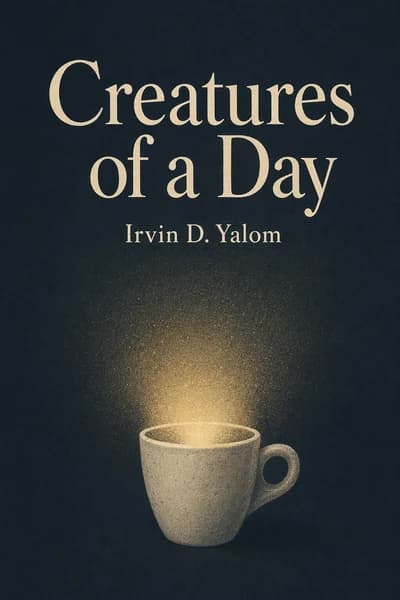
In our session, I shared passages from Marcus Aurelius's Meditations, particularly "All of us are creatures of a day; the rememberer and the remembered alike." Despite my hope that these would provide insight about Jarod's fixation on my image of him, he intellectualized and deflected. When finally addressing his situation with Marie, Jarod claimed not to know what he wanted, frustrating our progress. I ended feeling I'd made an amateurish error by becoming professorial rather than addressing his crisis directly.
After my disappointing session with Jarod, I prepared to meet with Andrew, a client who felt trapped in his unfulfilling job selling luxury goods. I'd recommended Marcus Aurelius to him because I thought they shared the predicament of being locked into unwanted careers. Worried I'd made another mistake, I was stunned when Andrew entered joyfully with a heavily bookmarked copy of The Meditations, declaring it had changed his life. The Stoic principle "Take away thy opinion, and then there is taken away the complaint" had transformed his perspective on work challenges and family conflicts.
At our next session, Jarod arrived with news that Marie had left him, leaving only a brief note saying she needed space. Rather than feeling liberated, he felt sad for both of them and deeply unsettled. Unable to stay in their apartment surrounded by reminders of Marie, he had retreated to a friend's cottage in Muir Beach for a three-day weekend, surprisingly taking "my Marcus" - The Meditations - with him. There, disconnected from technology, he spent time reading Marcus Aurelius and pondering my thought experiment about his need to exist in my mind. Through this retreat, he experienced a profound shift, recognizing his own hollowness and lack of self. The meditations that resonated most addressed virtue, self-respect, and finding truth within oneself rather than through others' opinions.
After Jarod left, I reflected on how both he and Andrew had found such different benefits from the same source of wisdom. Their unique journeys humbled me, highlighting the complexity of the human mind and the inadequacy of attempts to codify treatment approaches. For myself, approaching my eighty-second birthday with awareness of my own mortality, I found comfort in Marcus Aurelius's words about ending one's journey in contentment, "just as an olive falls off when it is ripe."
The most vital thing a therapist can offer is an authentic healing relationship from which patients draw what they need. The patients in these stories found benefit in ways I could never have anticipated: one sought a witness to his significance, another mended her fractured reality through authentic encounter, others learned to live in the present, found their voice, or discovered meaning in their final days. Each required a unique approach not found in any therapy manual. These stories emphasize the therapeutic relationship and heighten awareness of existential themes - death anxiety, meaning, aging, choice, and isolation - that affect far more patients than generally recognized.