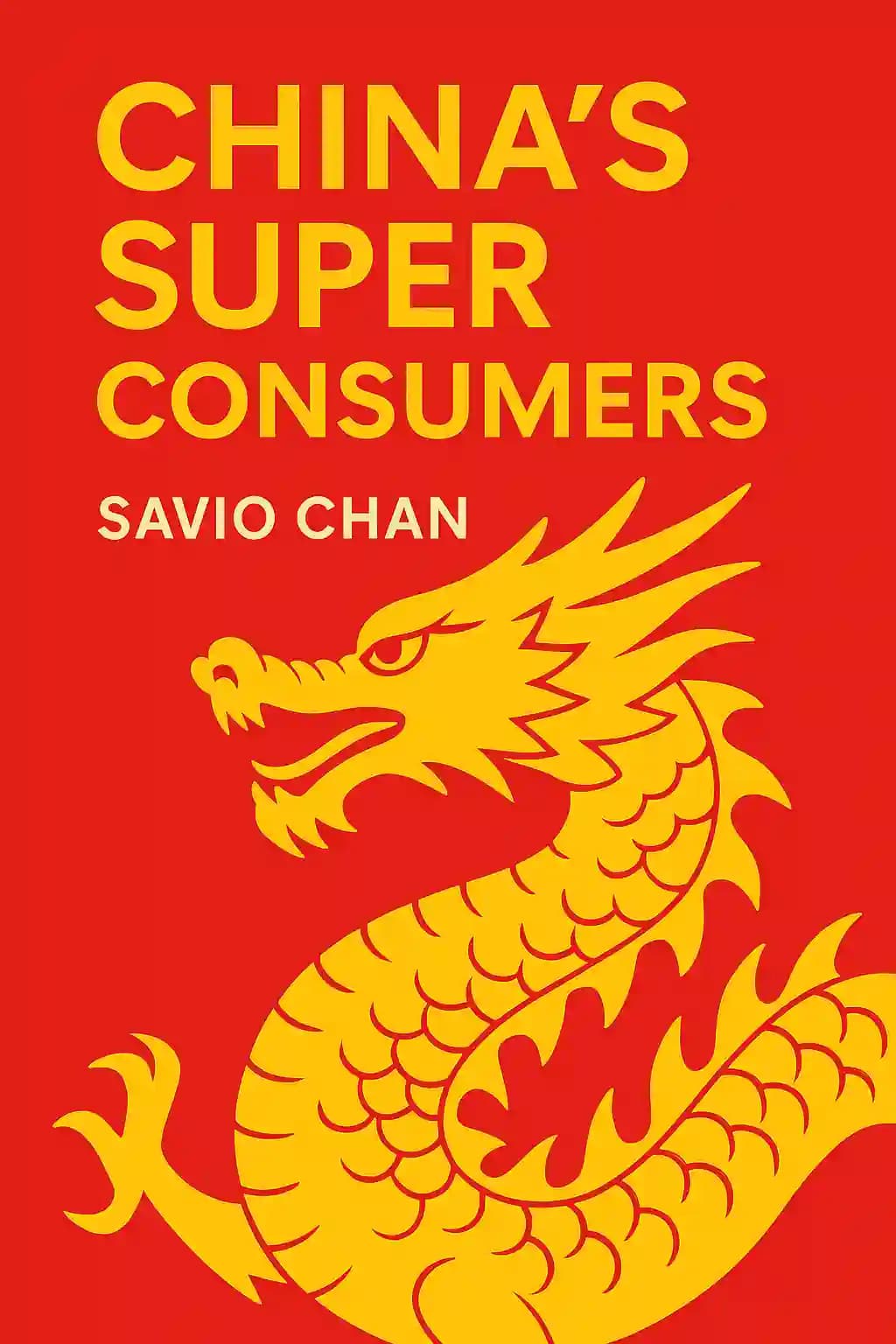
Discover how 1 billion Chinese consumers are reshaping global markets. China's Super Consumers reveals why Chinese shoppers now account for 25% of luxury purchases worldwide and how Alibaba created an e-commerce empire larger than America's entire population.
Savio S. Chan and Michael Zakkour, authors of China’s Super Consumers: What 1 Billion Customers Want and How to Sell It to Them, are renowned experts in Chinese consumer markets and global business strategy.
Chan, CEO of US China Partners Inc., leverages his decades of experience advising Fortune 500 companies on market-entry strategies and cross-cultural business practices in China. Zakkour, founder of 5 New Digital and former principal at Tompkins International, brings expertise in retail innovation and digital commerce, having guided over 250 companies in Asia-Pacific expansions. Their nonfiction work combines cultural analysis, case studies, and actionable frameworks to decode China’s consumer revolution, reflecting their firsthand experience shaping billion-dollar strategies for brands like Alibaba and Pizza Hut.
Both authors are frequent contributors to major media outlets, including BBC, CNN, and The Wall Street Journal, and Zakkour hosts the Digital Deep Dive podcast exploring retail’s digital transformation. Published by Wiley in 2014, China’s Super Consumers remains a cornerstone resource for multinational firms, cited by Asian Review of Books and featured in Asia Society discussions on global consumer trends.
China's Super Consumers by Savio S. Chan analyzes the transformative power of Chinese consumer behavior, focusing on luxury markets, cultural nuances, and strategies for global brands to succeed in China. The book delves into the rise of affluent middle-class shoppers, their preferences, and how companies like Louis Vuitton and Saks Fifth Avenue adapt to local tastes. Chan combines case studies with actionable frameworks for market entry and brand loyalty.
This book is essential for executives, marketers, and entrepreneurs targeting China’s luxury market, as well as investors seeking insights into Chinese consumer trends. It also benefits academics studying global business strategies or cross-cultural commerce. Chan’s practical advice caters to brands aiming to navigate China’s complex retail landscape, emphasizing cultural sensitivity and long-term relationship-building.
Yes—Chan’s firsthand experience advising Fortune 1000 companies and luxury brands provides rare insights into China’s consumer psyche. The blend of real-world examples (e.g., Brooks Brothers’ China strategy) and tactical frameworks makes it a actionable guide. However, readers seeking macroeconomic analysis may prefer supplemental data on broader market trends.
Chan emphasizes three pillars:
These strategies are illustrated through cases like Tourneau’s retail expansion and Montblanc’s localized marketing.
The book highlights how luxury brands like Roger Dubuis and Piaget tailor exclusivity to Chinese tastes—e.g., limited-edition products for festivals and VIP experiences for high-net-worth clients. Chan stresses the importance of “guanxi” (relationship-building) through personalized service and loyalty programs.
Some reviewers note the book focuses heavily on luxury sectors, offering less guidance for mass-market brands. Others suggest it could delve deeper into post-pandemic consumer shifts, like live-stream shopping’s dominance post-2020. Despite this, its frameworks remain foundational for market entry.
While both explore Asian luxury markets, Chan’s work is more tactical, offering step-by-step entry strategies, whereas Radha Chadha’s book provides historical context on luxury’s cultural evolution. China's Super Consumers uniquely integrates e-commerce tactics and case studies from Chan’s advisory work with Hudson’s Bay Company.
Chan details how super apps (WeChat, Alipay) and live-stream commerce drive purchasing decisions. He urges brands to adopt “social selling” via KOLs (key opinion leaders) and gamified loyalty programs, citing Louis Vuitton’s success with limited-edition digital collectibles.
The term refers to China’s affluent, brand-savvy shoppers who prioritize quality, exclusivity, and social status. These consumers often research products extensively online but finalize purchases in-store, blending digital and physical retail experiences.
With China’s luxury market projected to surpass $500B by 2025, Chan’s insights on Gen Z consumers and sustainability-driven purchases remain critical. Updated strategies for TikTok-like platforms (Douyin) and ESG-focused branding are now essential extensions of his original frameworks.
These lines encapsulate Chan’s emphasis on narrative-driven marketing and hyper-localization.
The book outlines a 4-phase approach:
Saks Fifth Avenue’s phased expansion exemplifies this model.
Sinta o livro através da voz do autor
Transforme conhecimento em insights envolventes e ricos em exemplos
Capture ideias-chave em um instante para aprendizado rápido
Aproveite o livro de uma forma divertida e envolvente
From feudalism to Fendi.
China increasingly sets standards for distribution, retail, digital marketing, and design.
Chinese social networks, or guanxi, profoundly influence consumer behavior.
Understanding these paradoxes requires abandoning Western assumptions.
Divida as ideias-chave de China's super consumers em pontos fáceis de entender para compreender como equipes inovadoras criam, colaboram e crescem.
Destile China's super consumers em dicas de memória rápidas que destacam os princípios-chave de franqueza, trabalho em equipe e resiliência criativa.

Experimente China's super consumers através de narrativas vívidas que transformam lições de inovação em momentos que você lembrará e aplicará.
Pergunte qualquer coisa, escolha a voz e co-crie insights que realmente ressoem com você.

Criado por ex-alunos da Universidade de Columbia em San Francisco
"Instead of endless scrolling, I just hit play on BeFreed. It saves me so much time."
"I never knew where to start with nonfiction—BeFreed’s book lists turned into podcasts gave me a clear path."
"Perfect balance between learning and entertainment. Finished ‘Thinking, Fast and Slow’ on my commute this week."
"Crazy how much I learned while walking the dog. BeFreed = small habits → big gains."
"Reading used to feel like a chore. Now it’s just part of my lifestyle."
"Feels effortless compared to reading. I’ve finished 6 books this month already."
"BeFreed turned my guilty doomscrolling into something that feels productive and inspiring."
"BeFreed turned my commute into learning time. 20-min podcasts are perfect for finishing books I never had time for."
"BeFreed replaced my podcast queue. Imagine Spotify for books — that’s it. 🙌"
"It is great for me to learn something from the book without reading it."
"The themed book list podcasts help me connect ideas across authors—like a guided audio journey."
"Makes me feel smarter every time before going to work"
Criado por ex-alunos da Universidade de Columbia em San Francisco

Obtenha o resumo de China's super consumers como PDF ou EPUB gratuito. Imprima ou leia offline a qualquer momento.
What happens when a nation of 1.4 billion people, suppressed from consumer desire for decades, suddenly gains purchasing power? In 2008, a critical piece of advice changed Apple's trajectory: partner with China Unicom immediately rather than waiting for China Mobile. This decision unlocked billions in revenue and positioned Apple to capture a market that would soon become the world's most influential. Yet just thirty years earlier, Chinese citizens wore identical gray clothing, used ration coupons for food, and needed government permits to buy televisions. This isn't just an economic story-it's a cultural earthquake that compressed a century of consumer evolution into three decades, creating a new breed of shopper who now shapes global markets from Paris to New York. To grasp China's consumer revolution, you need to understand what came before. For most of its 4,000-year history, China was self-sufficient, producing nearly 30% of global GDP during the Tang and Song dynasties. The Silk Road brought limited exchange, but China remained the "Middle Kingdom"-self-contained and inward-looking. This changed violently when Britain, facing unsustainable trade deficits from importing Chinese tea and silk, flooded China with opium from South Asian colonies. The resulting Opium Wars forced humiliating concessions, including foreign-controlled Treaty Ports that became instruments of exploitation. The Qing Dynasty collapsed in 1911, followed by decades of civil war, Japanese invasion, and finally Mao Zedong's Communist revolution in 1949.
