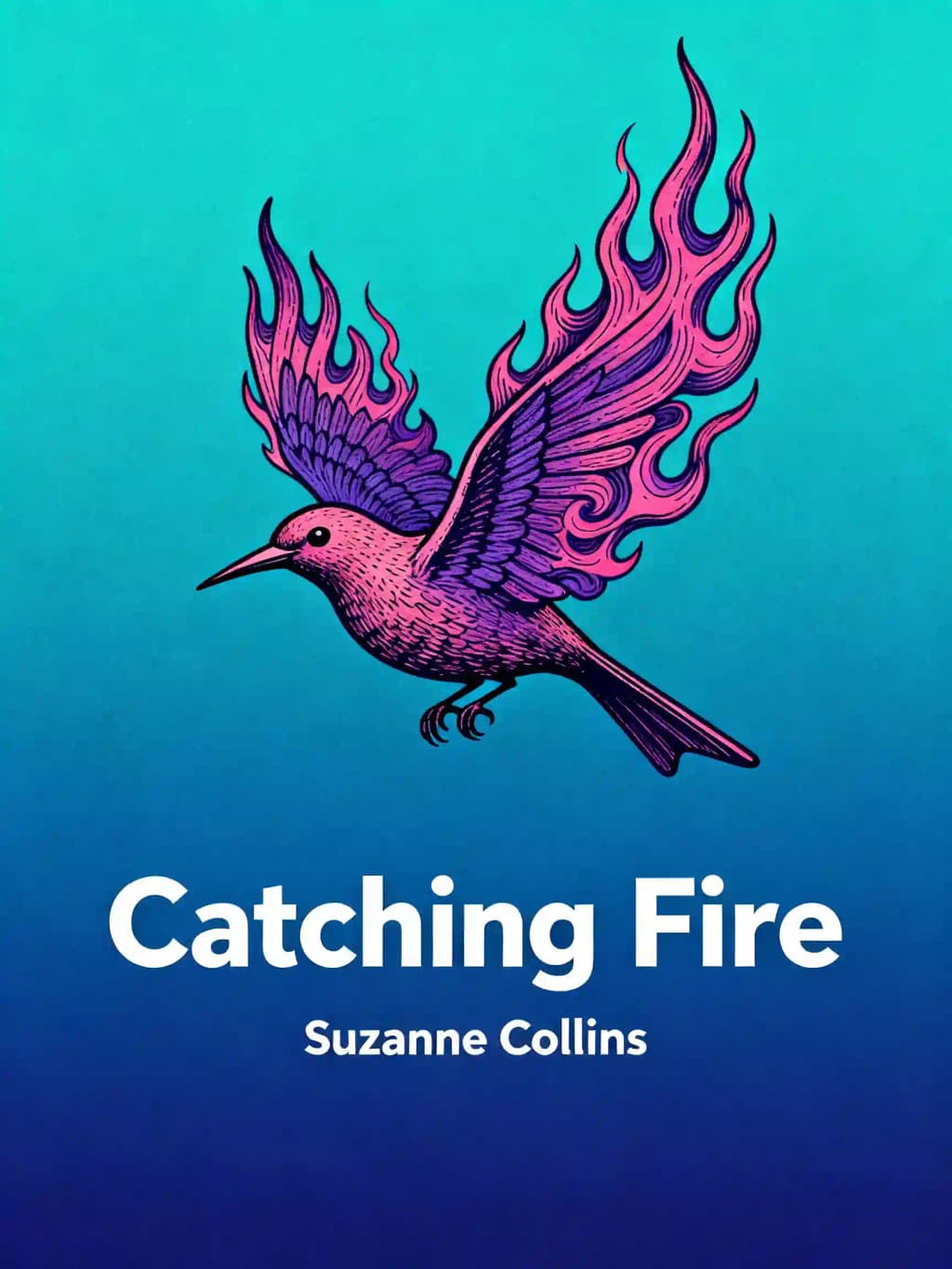
In "Catching Fire," Katniss faces deadlier stakes in a special Hunger Games edition. With over 10 million copies sold, this dystopian sequel sparked classroom debates on rebellion and government control. Jennifer Lawrence credits the series with defining her career. Ready to join the resistance?
Suzanne Collins, bestselling author of Catching Fire and a luminary in young adult dystopian fiction, was born in Hartford, Connecticut, in 1962.
A former television writer for Nickelodeon and PBS, Collins melds her expertise in suspenseful storytelling with themes of rebellion, oppression, and moral courage—a perspective shaped by her father’s military service and her academic background in theater and telecommunications.
Catching Fire, the second installment in her groundbreaking Hunger Games trilogy, explores loyalty, sacrifice, and societal inequality through the lens of protagonist Katniss Everdeen’s fight against a tyrannical regime. Collins’ earlier Underland Chronicles further cemented her reputation for crafting immersive, morally complex worlds.
Her work has been translated into over 50 languages, and The Hunger Games film adaptations grossed nearly $3 billion worldwide, solidifying the series as a cultural phenomenon.
Catching Fire follows Katniss Everdeen as she becomes the symbol of rebellion against the oppressive Capitol after surviving the Hunger Games. Forced into a lethal "Victors' Tour" and a deadly Quarter Quell arena, Katniss uncovers a growing resistance led by District 13. The story explores her struggle with political manipulation, alliances with past victors like Finnick Odair, and the escalating revolution.
Fans of dystopian fiction, YA audiences, and readers interested in themes of rebellion and authoritarianism will appreciate Catching Fire. It’s ideal for those who enjoy strong protagonists, political intrigue, and fast-paced survival narratives. The book also resonates with readers exploring topics like media influence and moral resilience.
Yes, Catching Fire expands the Hunger Games universe with deeper character development, higher stakes, and nuanced political commentary. It balances action with emotional depth, particularly in portraying Katniss’ PTSD and the rise of collective resistance. Critics praise its pacing and darker tone compared to the first book.
Key themes include survival under oppression, sacrifice for loved ones, and the power of symbols (like the Mockingjay). The book critiques authoritarian control, media manipulation, and the moral costs of rebellion. Interdependence—seen in Katniss and Peeta’s relationship—contrasts with individual resilience.
While the first book focuses on survival in the arena, Catching Fire escalates the political stakes, introducing a rebellion subplot and a more complex arena. Katniss evolves from a survivor to a revolutionary symbol, and the Capitol’s cruelty extends beyond the Games to systemic repression.
The Mockingjay represents defiance against the Capitol, embodying hope for the districts. Katniss’ role as the "Mockingjay" is weaponized by rebels to unify resistance. The symbol underscores themes of propaganda and the power of collective identity in overthrowing tyranny.
The 75th Hunger Games (Quarter Quell) forces past victors, including Katniss and Peeta, back into the arena. This twist exposes the Capitol’s ruthlessness and accelerates rebellion. The Games’ sabotage by rebels marks a turning point, revealing District 13’s survival and the organized resistance.
Finnick (a charismatic victor) and Johanna (a defiant ally) help Katniss survive the Quarter Quell. They reveal hidden rebel agendas, protect her in the arena, and later assist in destroying the Capitol’s force field. Their alliances highlight trust-building in oppressive systems.
The book depicts rebellion through covert alliances, propaganda (e.g., Mockingjay imagery), and District 13’s resurgence. Katniss’ public defiance sparks uprisings, while rebels orchestrate arena escapes. Themes include the ethics of revolution and the personal cost of becoming a symbol.
Yes, The Hunger Games: Catching Fire (2013) closely adapts the novel, emphasizing Katniss’ PTSD and the political tension. The film expands on her internal trauma while maintaining the plot’s key events, like the Quarter Quell and rebel rescue mission.
Some critics argue the pacing lags in early chapters, and the YA focus simplifies darker themes. Others note the love triangle’s prominence, though it underscores Katniss’ internal conflict. Despite this, the book is praised for escalating stakes and deeper worldbuilding.
The story ends with Katniss in District 13, Peeta captured, and the rebellion openly declared. It establishes her role as the Mockingjay, the Capitol’s brutality, and the moral ambiguity of war—setting the stage for the trilogy’s exploration of revolution’s costs.
Sinta o livro através da voz do autor
Transforme conhecimento em insights envolventes e ricos em exemplos
Capture ideias-chave em um instante para aprendizado rápido
Aproveite o livro de uma forma divertida e envolvente
"Remember who the real enemy is."
Some habits die hard, especially when they're tied to survival.
As the Victory Tour begins, I realize I've never truly left the arena.
The Games continue, only now all of Panem is watching.
Divida as ideias-chave de Catching Fire em pontos fáceis de entender para compreender como equipes inovadoras criam, colaboram e crescem.
Destile Catching Fire em dicas de memória rápidas que destacam os princípios-chave de franqueza, trabalho em equipe e resiliência criativa.

Experimente Catching Fire através de narrativas vívidas que transformam lições de inovação em momentos que você lembrará e aplicará.
Pergunte qualquer coisa, escolha a voz e co-crie insights que realmente ressoem com você.

Criado por ex-alunos da Universidade de Columbia em San Francisco
"Instead of endless scrolling, I just hit play on BeFreed. It saves me so much time."
"I never knew where to start with nonfiction—BeFreed’s book lists turned into podcasts gave me a clear path."
"Perfect balance between learning and entertainment. Finished ‘Thinking, Fast and Slow’ on my commute this week."
"Crazy how much I learned while walking the dog. BeFreed = small habits → big gains."
"Reading used to feel like a chore. Now it’s just part of my lifestyle."
"Feels effortless compared to reading. I’ve finished 6 books this month already."
"BeFreed turned my guilty doomscrolling into something that feels productive and inspiring."
"BeFreed turned my commute into learning time. 20-min podcasts are perfect for finishing books I never had time for."
"BeFreed replaced my podcast queue. Imagine Spotify for books — that’s it. 🙌"
"It is great for me to learn something from the book without reading it."
"The themed book list podcasts help me connect ideas across authors—like a guided audio journey."
"Makes me feel smarter every time before going to work"
Criado por ex-alunos da Universidade de Columbia em San Francisco

Obtenha o resumo de Catching Fire como PDF ou EPUB gratuito. Imprima ou leia offline a qualquer momento.
Victory should mean safety. After defying the Capitol with poisoned berries and walking out of the arena with Peeta, Katniss Everdeen expects her nightmare to end. Instead, she discovers something far more terrifying: her act of desperation has become a symbol of hope across Panem's oppressed districts. President Snow himself appears in her home, reeking of blood and roses, with a simple message-convince everyone the berries were about love, not defiance, or watch District 12 burn. The girl who volunteered to save her sister now carries the weight of an entire district on her shoulders. Every word she speaks, every gesture she makes during the mandatory Victory Tour, will determine whether people live or die. This isn't freedom. This is a different kind of arena, one where the stakes extend far beyond her own survival.