Capítulo 1
When Beasts Revolt: The Fable That Changed Political Discourse Forever
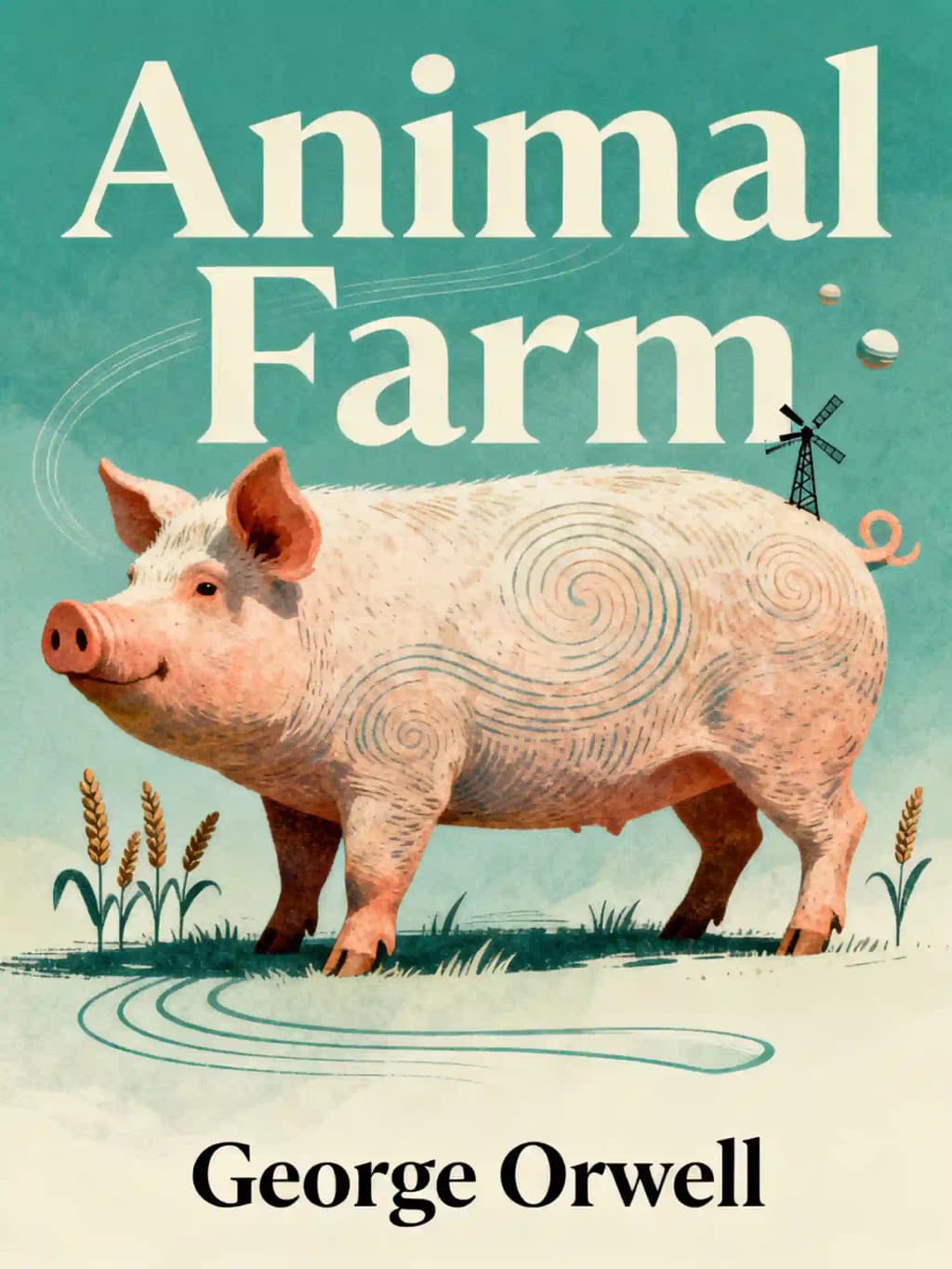
Animal Farm has transcended its status as a mere novel to become a cultural touchstone. This allegorical masterpiece by George Orwell, published in 1945, continues to resonate with readers worldwide, selling over 20 million copies and translated into more than 70 languages. Rejected by publishers during WWII for its criticism of Stalin (then a British ally), the book later became required reading in countless schools. Its influence extends beyond literature-Animal Farm's phrases like "some animals are more equal than others" have permeated political discourse, and its themes have inspired everything from Pink Floyd's album "Animals" to countless political cartoons. Even tech mogul Elon Musk has cited it as essential reading for understanding power dynamics. The book's genius lies in its deceptive simplicity: a barnyard tale that reveals profound truths about revolution, corruption, and the human condition.
Capítulo 2
The Spark of Revolution: Old Major's Dream
On a seemingly ordinary night at Manor Farm, an extraordinary gathering takes place. The farm animals, summoned by old Major, a venerable prize-winning boar, assemble in the big barn while their owner, the perpetually drunk Mr. Jones, sleeps off another night of excess. The animals arrive according to their distinct natures-the loyal dogs, the intelligent pigs, the hardworking horses Boxer and Clover, the cynical donkey Benjamin, the vain white mare Mollie, and others. Only Moses, the tame raven who tells tales of a paradise called Sugarcandy Mountain, is absent.
What unfolds is a moment of awakening. Old Major, nearing the end of his life, shares a vision that electrifies his audience. He articulates what many have felt but never expressed: that their lives under human rule are miserable and unnatural. "Man is the only creature that consumes without producing," he declares. "He does not give milk, he does not lay eggs, he is too weak to pull the plow, he cannot run fast enough to catch rabbits. Yet he is lord of all the animals."
The speech builds to a revolutionary crescendo as Major calls for Rebellion. He paints a picture of a future where animals control their own destinies, where the fruits of their labor benefit themselves rather than human masters. To solidify this vision, he establishes foundational principles: the unity of all animals against humans ("four legs good, two legs bad"), the rejection of human vices, and perhaps most importantly, the equality of all animals.
The emotional pinnacle comes when Major teaches them "Beasts of England," a stirring anthem that captures their longing for freedom. The song spreads like wildfire through the barn, the animals' voices rising in unison until Mr. Jones, awakened by the commotion, fires his shotgun into the darkness. The animals scatter back to their sleeping places, but something fundamental has changed. A seed has been planted that will soon grow into revolution.
This pivotal gathering establishes the central conflict and themes that will unfold throughout the narrative. It introduces us to the key characters whose actions and choices will drive the story forward. More importantly, it captures that magical, hopeful moment that precedes all revolutions-when oppression is first recognized, when solidarity is born, and when the possibility of a better world first seems within reach.
Capítulo 3
The Rebellion: From Manor Farm to Animal Farm
Revolution arrives not through careful planning but through desperate necessity. When the chronically drunk Mr. Jones neglects to feed the animals one day, their hunger drives them to break into the feed storage. Jones and his men respond with whips, but the starving animals' pent-up rage explodes. In a spontaneous uprising, they drive the humans from the property. The animals find themselves suddenly, unexpectedly free.
The euphoria of victory sweeps through the farm. The symbols of human oppression are systematically destroyed-bits, nose-rings, dog chains, castration knives-all thrown onto a bonfire. The farmhouse is preserved as a museum, though none will live there. Most significantly, the farm itself is renamed "Animal Farm," marking a complete break with the past.
The pigs, having secretly developed old Major's teachings into a system called "Animalism," emerge as natural leaders. Snowball and Napoleon stand out among them-Snowball, vivacious and inventive; Napoleon, quieter but more imposing. Alongside them is Squealer, a brilliant talker with "a way of skipping from side to side and whisking his tail" that somehow makes his words more persuasive. This triumvirate codifies Animalism into Seven Commandments painted on the barn wall:
1. Whatever goes upon two legs is an enemy.
2. Whatever goes upon four legs, or has wings, is a friend.
3. No animal shall wear clothes.
4. No animal shall sleep in a bed.
5. No animal shall drink alcohol.
6. No animal shall kill any other animal.
7. All animals are equal.
These principles represent the pure ideals of the revolution-before power and privilege have had a chance to corrupt them. The animals celebrate their victory with double rations and singing "Beasts of England" seven times through. Yet amid the celebration, a small but significant event occurs: when the cows are milked, Napoleon takes charge of the milk, which mysteriously disappears.
This early period of Animal Farm captures the heady optimism that follows successful revolutions. The animals experience genuine freedom for the first time, creating their own rules and determining their own destiny. Yet subtle signs of trouble already appear. The pigs' special treatment of the milk foreshadows the privilege they will increasingly claim for themselves. The Seven Commandments stand pristine on the wall, not yet twisted and reinterpreted to serve the powerful. The stage is set for the gradual corruption of revolutionary ideals that forms the heart of Orwell's allegory.
Capítulo 4
Labor and Literacy: The New Order Takes Shape
With humans gone, the animals face their first real test: can they manage the farm themselves? The harvest becomes a triumphant demonstration of their capabilities. Working together with unprecedented motivation, they complete it faster than Jones ever did. Without exploitative humans taking the fruits of their labor, they enjoy more food despite the challenges of using tools designed for human hands.
A clear hierarchy quickly emerges. The pigs, leveraging their intelligence, assume supervisory roles rather than performing physical labor. They justify this division by claiming their "brainwork" is essential to farm management. Meanwhile, Boxer the cart-horse becomes the farm's greatest asset. His tremendous strength and unwavering dedication, captured in his personal motto "I will work harder!" inspire all the animals. When challenges arise, Boxer's solution is always to redouble his efforts rather than question the system.
Not all animals contribute equally. Mollie, the vain white mare who loves sugar cubes and ribbons, frequently makes excuses to avoid work. The cat mysteriously disappears during working hours only to reappear at mealtimes with convincing explanations. Benjamin the donkey, cynical and long-lived, works steadily but offers only cryptic comments about the Rebellion, suggesting nothing ever really changes.
Sundays become days of ceremony and planning. The animals raise their green flag emblazoned with a hoof and horn, hold meetings to plan the week's work, and debate resolutions-though increasingly, only the pigs propose ideas. Snowball and Napoleon emerge as opposing forces, disagreeing on virtually everything. While Snowball organizes educational committees and programs to improve farm life, Napoleon focuses on secretly raising nine puppies away from public view.
Education becomes a priority but progresses unevenly. The pigs master reading and writing completely. The other animals achieve varying levels of literacy-dogs learn to read moderately well, Muriel the goat reads fairly well, while Boxer can only memorize the first four letters of the alphabet. For the simpler animals, Snowball reduces the Seven Commandments to the memorable slogan "Four legs good, two legs bad," which the sheep enthusiastically adopt.
A crucial moment occurs when the pigs appropriate all the farm's milk and windfall apples for themselves. When other animals notice this special treatment, Squealer explains that pigs, as "brainworkers," require these delicacies not from preference but necessity-to prevent Jones's return. This manipulation marks a significant step in the pigs' transformation from leaders to privileged rulers, using fear and supposed necessity to justify their growing inequality.
Capítulo 5
External Threats and Internal Heroes: The Battle of the Cowshed
News of Animal Farm's revolution spreads throughout the county, carried by Snowball and Napoleon's trained pigeons who visit neighboring farms to teach "Beasts of England" and share tales of the Rebellion. This missionary work creates a dual response: inspiration among other farm animals and alarm among human farmers.
The neighboring farms present contrasting threats. Foxwood, owned by the easygoing Mr. Pilkington, is large but neglected. Pinchfield, owned by the tough and shrewd Mr. Frederick, is smaller but well-run. These human farmers initially mock Animal Farm but grow increasingly concerned as revolutionary sentiment spreads among their own animals. They begin a propaganda campaign, spreading horrific rumors about cannibalism, torture, and sexual depravity at Animal Farm-yet these efforts backfire as "Beasts of England" continues to spread, becoming an anthem that secretly terrifies humans throughout the countryside.
By October, Mr. Jones gathers men from both neighboring farms for an attempt to recapture his property. What follows becomes the stuff of Animal Farm legend-the Battle of the Cowshed. Snowball, having studied an old book about Julius Caesar's campaigns, organizes a brilliant defense. The animals execute a tactical retreat, luring the humans into a trap before launching a coordinated counterattack. Boxer emerges as a fearsome warrior, striking terror with his powerful hooves. When he accidentally kills a stable-boy, we glimpse his gentle nature as he expresses remorse, though Snowball dismisses this with the cold logic that "war is war."
The victory transforms farm morale. They create military decorations-"Animal Hero, First Class" for Snowball and Boxer, and "Animal Hero, Second Class" posthumously for a sheep killed in battle. Jones's gun is salvaged and placed at the farm flagstaff, to be fired twice yearly commemorating the Rebellion and the Battle of the Cowshed.
This battle serves multiple purposes in the farm's development. It unites the animals against a common external threat, reinforcing their revolutionary identity. It creates heroes and martyrs central to their founding mythology. Most importantly, it provides a powerful narrative that the pigs will later manipulate to serve their own ends. The battle becomes not just a historical event but a malleable story that can be rewritten to suit those in power-a theme that grows increasingly important as the tale progresses.
Capítulo 6
Power Struggles: The Windmill Controversy
As winter approaches, the first cracks in Animal Farm's unity become visible. Mollie, never fully committed to the revolutionary cause, is caught fraternizing with humans from neighboring farms, accepting sugar and ribbons-luxuries she misses from the old regime. When confronted, she flees the farm entirely, later spotted pulling a human's cart with ribbons in her mane. Her departure represents the first defection from the revolutionary project.
The central conflict emerges between Snowball and Napoleon, whose leadership styles and visions for the farm increasingly diverge. Their disagreements play out during Sunday meetings where farm policies are debated. Napoleon cultivates support between meetings, particularly among the sheep, who disruptively bleat "Four legs good, two legs bad" during Snowball's speeches.
The windmill becomes the focal point of their power struggle. Snowball envisions it as a transformative project that would provide electrical power to heat stalls and run labor-saving devices, potentially reducing the work week. He spends hours developing detailed plans using books salvaged from the farmhouse. Napoleon opposes the project, arguing that food production should take priority. The farm divides into factions supporting each leader.
During the crucial vote, Snowball delivers an impassioned speech that seems to sway the majority. Just as victory appears within his grasp, Napoleon makes his move. He emits a strange high-pitched whimper, summoning nine enormous dogs-the puppies he had secretly raised and trained. These fierce animals charge Snowball, who barely escapes with his life, fleeing the farm forever.
This coup marks a fundamental shift in Animal Farm's governance. Napoleon immediately abolishes the Sunday debates, announcing that a special committee of pigs will make all decisions privately. When some animals timidly protest, the dogs growl menacingly, establishing that Napoleon's rule now rests on force rather than consent. Squealer, the propaganda minister, explains that Napoleon has taken on leadership as a "sacrifice" to protect them from Snowball's "criminal" ideas.
In a final twist that demonstrates Napoleon's cynical opportunism, three weeks later he announces that the windmill will be built after all-presenting Snowball's idea as his own without explanation. This episode reveals how power operates: through force when necessary, through manipulation of information, and through the elimination of alternatives. The animals' revolution has produced not the equality they sought but a new form of tyranny.
Capítulo 7
Rewriting History: From Idealism to Exploitation
The windmill project transforms Animal Farm into a perpetual construction site. The animals work like slaves throughout the year, but do so willingly, believing they labor for themselves rather than humans. Napoleon increases their workload to sixty hours weekly, then adds "voluntary" Sunday afternoons with punishment for absentees. Though the regular harvest suffers slightly from these demands, the animals accept the sacrifice for the greater good.
Building the windmill presents enormous technical challenges. Breaking stones into manageable pieces proves particularly difficult until they develop an ingenious solution-dragging boulders to the quarry edge and letting them shatter on impact below. Boxer becomes indispensable, straining himself relentlessly under his twin mottos "I will work harder" and "Napoleon is always right." His unquestioning loyalty and self-sacrifice exemplify both the nobility and tragedy of blind devotion to a cause.
Despite their labor, the animals maintain adequate food supplies. However, manufactured goods become increasingly scarce-oil, nails, string, and materials needed for the windmill. Napoleon announces they must trade with neighboring farms, contradicting earlier principles against human contact. He arranges to sell hay and wheat through Mr. Whymper, a solicitor who serves as intermediary.
When animals express unease about breaking resolutions against trade and money, Squealer employs a tactic that becomes increasingly common-he convinces them no such resolution ever existed, blaming their memories on Snowball's lies. The past is not merely interpreted differently; it is actively rewritten.
This pattern repeats when the pigs move into the farmhouse, another apparent violation of early principles. When Clover questions the commandment against beds, she discovers it now reads "No animal shall sleep in a bed with sheets," with Squealer explaining they've merely removed the sheets. This manipulation of written rules reveals how revolutionary principles can be gradually corrupted while maintaining a facade of consistency.
Disaster strikes when a violent November storm destroys the half-built windmill. Napoleon immediately blames Snowball, claiming to find evidence of sabotage, and declares a death sentence on the exiled pig. The devastated animals are rallied to rebuild immediately, with Napoleon transforming their setback into motivation through the creation of an external enemy.
This period shows how idealism transforms into exploitation. The animals work harder than ever but receive diminishing benefits. Their revolutionary principles are systematically undermined while appearing to be maintained. Most insidiously, their very memory of the original principles is called into question, making resistance nearly impossible. Without a reliable shared history, the animals cannot effectively challenge the growing corruption of their revolution.
Capítulo 8
The Reign of Terror: Confessions and Executions
A bitter winter follows the windmill's destruction, with severe food shortages developing by January. To maintain appearances, Napoleon orchestrates an elaborate deception-having sheep casually mention increased rations within earshot of Whymper and filling storage bins with sand topped by remaining grain. This facade of prosperity becomes more important than the animals' actual welfare.
When Napoleon demands the hens surrender their eggs to fulfill a contract with Whymper, they stage a small rebellion by smashing their eggs rather than surrendering them. Napoleon's response is ruthless-he orders their rations stopped entirely. Nine hens die before the rest submit. This brutal suppression of dissent foreshadows the greater violence to come.
Snowball becomes the all-purpose scapegoat, blamed for every misfortune on the farm. Napoleon conducts "investigations" into Snowball's activities, claiming to smell his presence everywhere. Most significantly, Squealer rewrites the history of the Battle of the Cowshed, transforming Snowball from hero to villain. Though Boxer questions this narrative, remembering Snowball's wounds from the battle, he ultimately accepts Napoleon's version, revealing how even eyewitness memory yields to official history.
The culmination of this period comes in a shocking display of power. Napoleon orders four pigs to confess their collaboration with Snowball. After they confess, the dogs tear their throats out in full view of the horrified animals. This triggers a wave of forced confessions and executions, with animals admitting to various crimes allegedly inspired by Snowball before meeting the same bloody fate.
The remaining animals, huddled together in horror, struggle to reconcile these events with their revolutionary ideals. Clover, looking over the farm, silently mourns how far they've strayed from Major's vision. Though unable to articulate her thoughts clearly, she realizes they've reached a point where no one dares speak freely while fierce dogs roam everywhere and comrades are executed after forced confessions.
In her confusion and grief, Clover begins singing "Beasts of England," joined by others in a mournful rendition. Squealer arrives to announce that Napoleon has abolished the song as it's "no longer needed" since the Rebellion is complete. A new anthem by Minimus replaces it, but the animals find it lacks the power of their old revolutionary song.
This sequence represents the complete transformation of the revolution into tyranny. The original ideals are not merely corrupted but actively suppressed. The revolutionary anthem that inspired their liberation is banned. Violence replaces persuasion as the primary means of control. Most tragically, the animals themselves become complicit in their own oppression, unable to resist the combination of force, propaganda, and the rewriting of their shared history.
Capítulo 9
Betrayal and Sacrifice: Boxer's Fate
The rebuilt windmill is finally completed, but at tremendous cost. The animals work even harder than before, often hungry and always exhausted. Napoleon rarely appears in public, issuing commands through intermediaries while living in the heavily-guarded farmhouse. Despite these hardships, the animals maintain their pride in Animal Farm as the only one owned and operated by animals.
Boxer, the farm's most dedicated worker, suffers a split hoof that heals slowly. Despite his weakening condition, he refuses to rest, determined to see the windmill completed before his retirement. His motto changes from "I will work harder" to "Napoleon is always right," showing his complete submission to authority. One summer evening, while hauling stone, Boxer collapses between the shafts of his cart, unable to rise.
What follows is perhaps the most heartbreaking sequence in the narrative. Squealer announces Napoleon will send Boxer to a veterinary hospital in Willingdon. Days later, a van arrives to collect him, but Benjamin, who has read the writing on the van's side, frantically alerts everyone that it belongs to a horse slaughterer. The animals watch in horror as Boxer, realizing too late, attempts to kick his way out before being taken away forever.
Three days later, Squealer announces Boxer died in the hospital despite receiving excellent care. He claims Boxer's final words praised Napoleon and the farm. When questioned about the "Horse Slaughterer" sign on the van, Squealer explains it away as an old marking the veterinarian hadn't yet painted over. That evening, the pigs hold a banquet after purchasing whisky with the money from selling Boxer.
Boxer's fate represents the ultimate betrayal of revolutionary ideals. The animal who contributed most to the farm's success, who embodied the virtues of hard work and loyalty, is discarded once his usefulness ends. His body is literally converted into profit for the ruling class. Most disturbingly, his death is repackaged as a narrative that serves the regime-his supposed final words becoming propaganda rather than truth.
This episode reveals the complete moral bankruptcy of Napoleon's leadership. The original promise of Animal Farm-that animals would care for each other and share in the fruits of their labor-has been utterly abandoned. In its place stands a system as exploitative as the human regime it replaced, where loyalty is rewarded with betrayal and sacrifice with commodification.
Capítulo 10
Full Circle: When Pigs Walk Like Men
Years pass, and the farm changes dramatically. Most animals who remembered life before the Rebellion have died. Only Clover, Benjamin, Moses, and some pigs remain from those days. The farm has expanded and grown more prosperous with new buildings and equipment, including the completed windmill-though it's used for profitable corn milling rather than generating electricity as originally planned.
Despite the farm's increased wealth, the common animals remain poor and hungry while the pig and dog populations grow. Squealer justifies the pigs' privileged position by explaining their crucial administrative work with mysterious "files" and "reports" that the other animals cannot comprehend. Unable to remember if life was better before, the animals have only Squealer's manipulated statistics as reference.
Nevertheless, they maintain their pride in Animal Farm being the only animal-operated farm in England. Though their dreams of equality remain unfulfilled, they cling to Major's vision of a future animal republic, secretly remembering "Beasts of England" while consoling themselves that at least they work for themselves rather than humans.
The final transformation occurs when Squealer takes the sheep away for a week, claiming to teach them a new song in private. When they return, the animals witness a shocking sight-Squealer walking on his hind legs, followed by all the other pigs doing the same. Napoleon himself emerges carrying a whip. Before the stunned animals can protest, the sheep begin bleating "Four legs good, two legs BETTER!"
Clover asks Benjamin to read the Seven Commandments, which have been reduced to a single line: "ALL ANIMALS ARE EQUAL BUT SOME ANIMALS ARE MORE EQUAL THAN OTHERS." This final corruption of their founding principle represents the complete inversion of the revolutionary ideal.
The pigs begin carrying whips, wearing Mr. Jones's clothes, and reading newspapers. Napoleon invites neighboring farmers to tour the farm, and that evening the animals peer through the farmhouse window to see the pigs and humans dining together. Mr. Pilkington praises the pigs for making their animals work harder for less food than any in the county. After toasts to the farm's prosperity, Napoleon announces the name has been changed back to "The Manor Farm."
As the animals watch the celebration, they notice something strange happening to the pigs' faces. Looking from pig to man and man to pig, they can no longer tell which is which. The revolution has come full circle-the oppressed have become indistinguishable from the oppressors.
This devastating conclusion reveals Orwell's central insight: revolutions often replace one form of tyranny with another. The mechanisms of power-propaganda, violence, privilege-remain consistent even as those who wield them change. Without vigilance, transparency, and true equality, even the most idealistic movements can recreate the very systems they sought to overthrow.