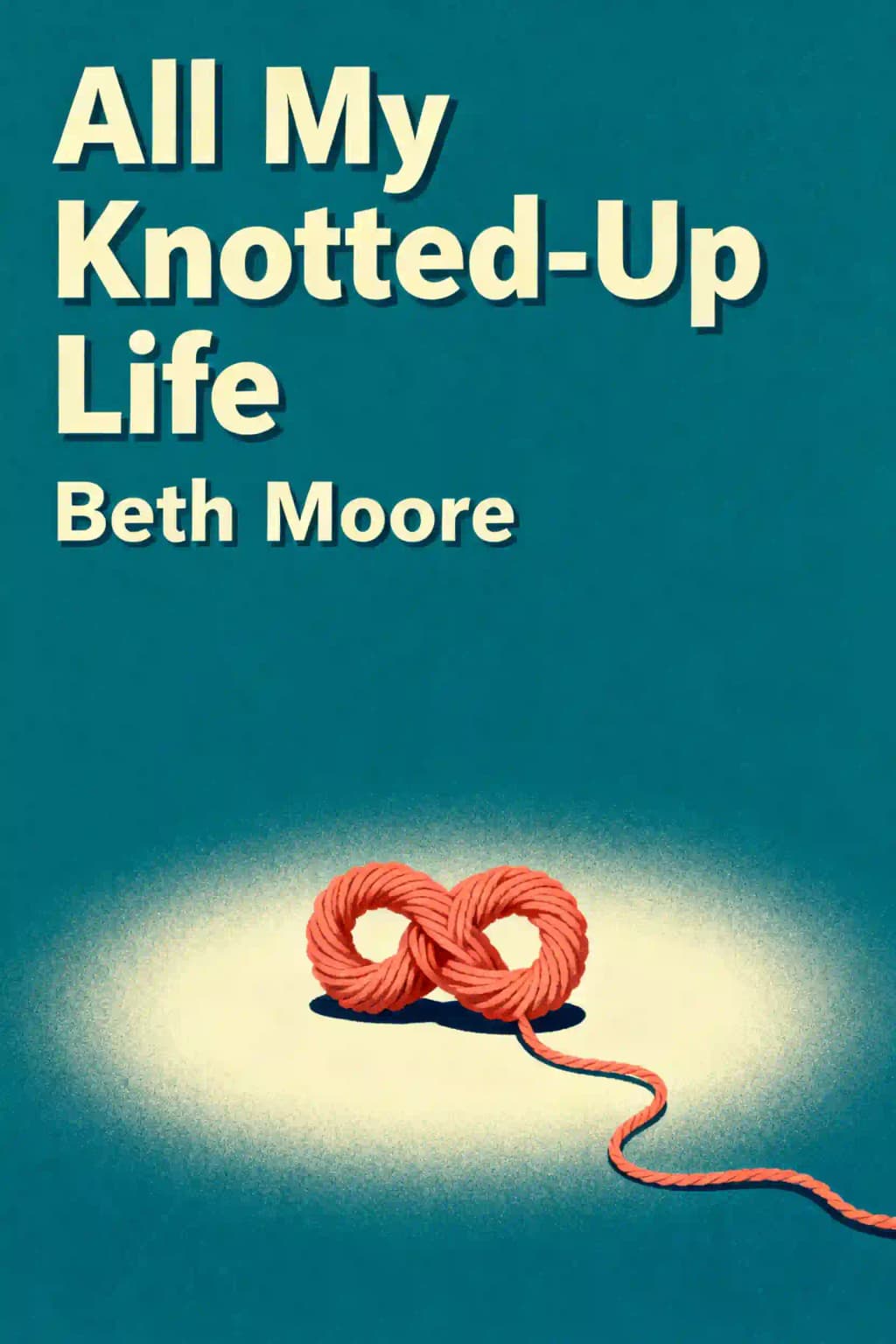
All My Knotted-Up Life
A Memoir
Visão geral de All My Knotted-Up Life
Beth Moore's raw memoir unravels her journey through sexual abuse, faith crises, and leaving the Southern Baptist Convention after criticizing Trump supporters. Like "The Glass Castle" but with spiritual grit, this story sparked crucial conversations about women's roles in American Christianity.

Temas principais em All My Knotted-Up Life
- childhood trauma recovery
- evangelical church culture
- denominational transition
- southern family dynamics
- spiritual resilience
Citações de All My Knotted-Up Life
River people have no business going to the sea.
Family is fierce and frightful-all zipped up inside the unknown together.
Fear was a core value in our family-we were 'tutored and tested on it'.
We know too much to truly know each other.
There are some things sitting in someone else's seat can't tell you-you'd have to sit in the same skin.
Personagens de All My Knotted-Up Life
- Beth MooreThe author and protagonist of the memoir
- Wayne GreenBeth's musical brother and Paul McCartney lookalike
- Sandra GreenBeth's eighteen-year-old sister
- NannyBeth's grandmother who lived with the family
- PappawBeth's one-eyed grandfather
Baixar resumo de All My Knotted-Up Life
Obtenha o resumo de All My Knotted-Up Life como PDF ou EPUB gratuito. Imprima ou leia offline a qualquer momento.
Perguntas Frequentes Sobre Este Livro
All My Knotted-Up Life chronicles Beth Moore’s journey through childhood sexual abuse, family dysfunction, and her spiritual evolution from Southern Baptist leadership to Anglicanism. It intertwines raw vulnerability with themes of resilience, forgiveness, and God’s faithfulness amid life’s complexities, framed through her marriage, ministry, and advocacy for abuse survivors.
This memoir resonates with Christians navigating faith crises, survivors of trauma, and readers seeking nuanced spiritual biographies. It appeals to those interested in women’s leadership in evangelical spaces, Anglican theology, or stories of personal redemption.
Yes—it’s praised for its unflinching honesty, lyrical prose, and exploration of human complexity. Moore balances trauma narratives with hope, offering insight into forgiveness, marital fidelity, and spiritual perseverance. Critics highlight its relevance for evangelicals reevaluating institutional loyalty.
Moore recounts her father’s abuse and its lifelong impact, avoiding graphic details while emphasizing her path to healing. She connects this trauma to her advocacy for survivors and critiques church cultures that silence victims, framing abuse as a catalyst for deeper reliance on faith.
Moore departed the SBC in 2021 over theological differences, including critiques of white supremacy, Trump-era politics, and restrictions on women’s teaching roles. She joined an Anglican church, finding harmony between liturgical traditions and evangelical theology.
Key themes include:
- Resilience through faith: Daily dependence on Scripture amid chaos.
- Nuanced humanity: Rejecting binary views of “good vs. evil” in people.
- Marital fidelity: Her 50-year marriage’s struggles and redemption.
- Institutional critique: Balancing love for the church with calls for reform.
Moore shifts from rigid evangelicalism to a sacramental Anglican faith, maintaining core beliefs while embracing liturgical practices. Her daily “manna” metaphor—relying on Scripture each morning—underscores a lifelong commitment to spiritual discipline despite doctrinal changes.
The memoir explores her parents’ tumultuous marriage, her grandmother’s stabilizing influence, and sibling dynamics. Moore reflects on generational trauma, forgiveness toward her abusive father, and how family shaped her ministry and self-perception.
Moore rejects simplistic forgiveness narratives, detailing her struggle to reconcile love for her father with his abuse. She emphasizes holding individuals accountable while recognizing their humanity—a tension mirroring her critique of evangelical institutions.
The “knot” symbolizes life’s intertwined pain and grace. Moore reframes chaos as evidence of God’s faithfulness, writing: “In all the letting go, he has held me fast”—a metaphor for finding purpose in life’s tangled moments.
Unlike her structured Biblical teachings, this memoir is introspective and literary. It reveals personal struggles behind her public ministry, offering fans a deeper understanding of her theology and advocacy origins.
Moore responds to backlash over her SBC exit, accusations of “liberalism,” and critiques of women teaching mixed audiences. She clarifies her orthodox beliefs while challenging sexism and abuse cover-ups in religious communities.