Capítulo 1
Wisdom's Daily Bread: Tolstoy's Spiritual Almanac
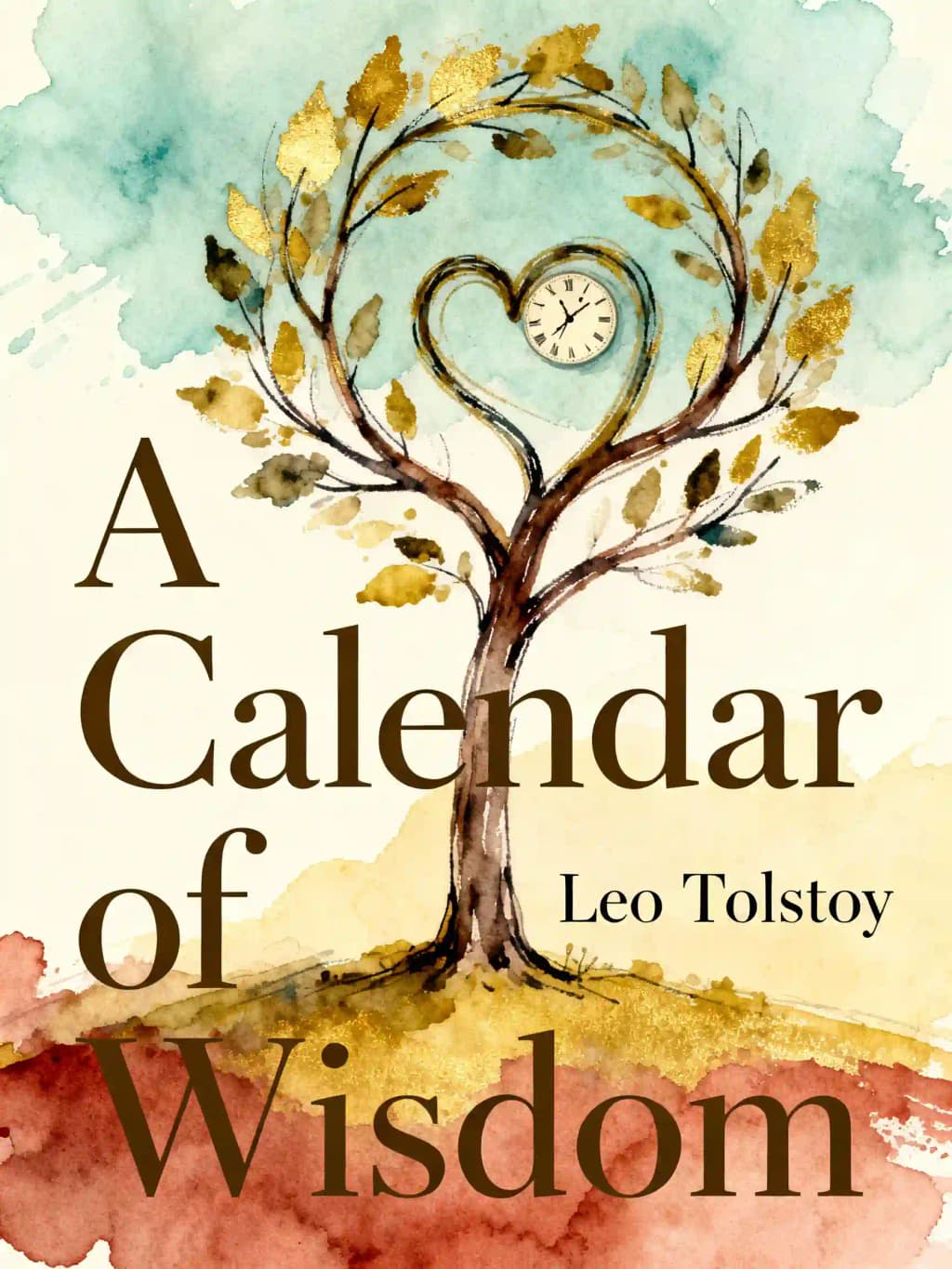
Have you ever wondered what book Leo Tolstoy himself turned to for daily inspiration? Surprisingly, it wasn't War and Peace or Anna Karenina, but his own final masterpiece-A Calendar of Wisdom. This remarkable collection, completed just before his death, represents Tolstoy's fifteen-year labor to distill humanity's greatest spiritual and philosophical insights into one accessible volume. Gandhi called it his constant companion, and many modern thought leaders from Brene Brown to Tim Ferriss have cited its profound influence on their thinking. What makes this book so powerful is its unique format: daily readings that build upon one another, creating a spiritual journey through the year that has transformed countless lives across generations.
Capítulo 2
The Essence of Spiritual Life: Beyond Material Existence
At the heart of Tolstoy's collection lies a fundamental distinction between our material and spiritual natures. While we often focus on our physical bodies, especially in youth, Tolstoy reminds us that our souls represent our essential selves. "True wisdom," he writes, "lies in caring for the soul rather than the body, subduing physical desires to spiritual needs." This principle manifests in daily choices, from how we spend our time to how we treat others and what we value most deeply.
This perspective transforms how we view life's greatest challenges, particularly death. As we shift from material to spiritual concerns, fear of death diminishes until it vanishes entirely for those living truly spiritual lives. Contemplating our mortality clarifies our conscience and true wishes. Tolstoy illustrates this with a powerful image: a condemned man won't worry about wealth or glory but might wish to comfort others, help the elderly, tend wounds, or fix a child's toy. Such moments of clarity reveal what truly matters - not our accumulated possessions or achievements, but our capacity for kindness and connection.
The spiritual realm cannot be explained through material means, yet it manifests in our daily choices - in moments of sacrifice, in acts of unconditional love, in the quiet satisfaction of helping others without recognition. People essentially divide into two groups: believers in the spiritual realm who are truly alive, and unbelievers concerned only with material pleasures who remain spiritually dead. This distinction becomes clear even to children and the wisest adults alike. Tolstoy notes how children often instinctively understand the difference between genuine kindness and superficial gestures, while great philosophers arrive at similar conclusions through careful contemplation.
Tolstoy draws from diverse traditions - Christian mysticism, Buddhist teachings, and ancient wisdom - to emphasize that our material life faces suffering and death that no effort can prevent, while our spiritual life is subject to neither. "Salvation," he writes, "lies only in transferring my conscious self from material to spiritual." Through love, we understand other beings and their attitudes toward themselves, creating the world as we know it. This understanding transcends mere intellectual knowledge; it's an experiential wisdom that comes from genuine connection with others. The essence of love of God is the soul's desire for its creator, for unity with higher light - a yearning that manifests in our drive for meaning, truth, and authentic connection with others.
In practical terms, this spiritual perspective transforms everyday experiences. A meal shared with friends becomes more than sustenance; it becomes communion. Work becomes not merely a means to earn money but an opportunity to serve others. Even suffering takes on new meaning when viewed through this lens, becoming an opportunity for growth and deeper understanding rather than merely something to be avoided.
Capítulo 3
The Practice of Love: Foundation of Human Existence
Kindness exists for the soul as health does for the body-unnoticed when present yet profoundly missed in its absence. Our happiness grows proportionally to the happiness we create for others, much like a garden that flourishes through consistent care and attention. "God's will," Tolstoy writes, "is for us to live happily while caring about others' lives." This isn't mere philosophical musing but a practical guide to living. True love manifests only through self-sacrifice and forgetting oneself for another's sake, whether in small daily acts or life-changing decisions. This foundational love brings life's blessings and rewards, creating a ripple effect that transforms both the giver and receiver. Nothing beautifies life more than perpetual kindness, which acts like a light illuminating the darkest corners of human experience.
Love solves all contradictions of human life and gives the greatest bliss, working like a master key that unlocks life's most complex challenges. It destroys death by giving life meaning beyond our physical existence, gives meaning to senseless things by providing purpose and context, and transforms unhappiness into happiness through connection and understanding. As fire purifies everything material, love purifies everything spiritual, burning away doubt, fear, and selfishness. The less love a person has, the more they suffer, much like a plant withering without water. If you're in difficulty, Tolstoy advises: "I will love everyone I meet in life." This isn't naive optimism but a practical approach to life's challenges. Follow this rule and everything will find its way-doubts and fears will vanish like morning mist in sunlight.
Real love transcends the boundaries of particular relationships, existing as a spiritual state of loving everyone unconditionally. To be loved, simply love others - this principle works like a natural law, as reliable as gravity. A holy person lives constantly aware of their attitude toward others, sensing and feeling all, and naturally drawing their attention in return. Without love, nothing brings lasting goodness, while every love-inspired action, however small-a kind word, a gentle gesture, a moment of patience-bears fruit. Religion, in its purest form, is love's highest expression. The more love you express, the more people love you, creating a virtuous cycle that makes it easier to love others-thus love becomes eternal, self-perpetuating and ever-expanding.
Love manifests God in humanity, serving as the bridge between the divine and human experience. Life's purpose is expressing love in all its forms-loving with self-sacrifice, loving everything and everyone, from the greatest to the smallest aspects of existence. We all recall moments, often from childhood, when we wanted to love universally-parents, siblings, even animals and plants-and make everyone happy, even through self-sacrifice. This pure, unconditional love represents our natural state before life's complications intervene. This feeling of love must be reclaimed as the essence of every person's life, not as an occasional emotion but as a constant state of being. Everything you do should be filled with love, transforming even the most mundane tasks into sacred acts of connection and purpose.
Capítulo 4
Freedom Through Truth: Breaking the Chains of Illusion
Freedom comes only through living in truth, which the intellect alone perceives. Wealth, glory and worldly rewards are like sweets that cause children to fight-mere empty shells to the wise. While children might quarrel over nuts and cookies, adults recognize their insignificance. The thinking person submits to fate rather than struggling against it as animals do. True freedom comes not through indulging passions or emotions but through the intellect.
The intellect liberates-the less intellectual life one has, the less free one is. A wise person lives according to desires that are attainable, making them truly free. As Diogenes told the Persian king, you cannot enslave truly free people-they prefer death to servitude. Freedom cannot be granted by others or achieved by seeking it directly; it comes as a consequence of seeking truth. Each person can only liberate themselves.
Only those who accept life's spiritual rather than material essence can be truly free. A contented slave is doubly enslaved in both body and soul. Peace through slavery becomes misfortune rather than blessing. True peace comes from respecting everyone's rights, while slavery negates rights and human dignity. We should sacrifice everything for peace, but even more to eliminate slavery. Changing your opinion when corrected shows greater freedom than stubborn error. The only real knowledge liberates us-everything else merely amuses. There's no middle path: either be enslaved to people or serve God.
At a certain level of self-awareness, a person understands something supernatural in himself. God exists because we exist. You can call the superior life that created us by any name, but it undoubtedly exists. God exists only for those who seek Him. Start looking: you'll find Him in you and yourself in Him. Seeking God is like pulling a net in water-heavy and full when pulling, yet empty when drawn out. When you seek God through intellect and actions, He exists in you, but as soon as you become satisfied that you've found Him, you've lost Him.
Capítulo 5
The Moral Life: Cultivating Goodness Through Daily Practice
All events in individual lives and societies originate in thought. To understand people and societies, we must examine the thoughts behind their actions rather than merely observing events. Knowing what not to think about may be even more crucial than knowing what to think about. Our thoughts, depending on their nature, can significantly influence our lives. A thought seems free, but humans possess something stronger that can guide thoughts. To change things within yourself or others, change the thoughts that created those events, not the events themselves.
Self-improvement requires both inner work and interaction with others. Three temptations plague humanity: sexual desire, pride, and greed-the source of all human misfortunes. The solution is self-improvement. As Christ said, strive for perfection, not to equal God but to move closer to goodness. Pure perfection exists only in God, and life consists of drawing nearer to Him. Nothing is more harmful than improving only your material side, while nothing is more beneficial than improving your soul.
Your spirit must constantly assert itself against your body's exertions. When you stop working on your spirit, your body gains complete power. Clarify what isn't clear; persist with difficult tasks. We suffer from our vices and struggle with them because we're imperfect, but this struggle is our salvation. Good actions require effort, and repeated effort makes them habitual. Never reject anything that helps achieve good or prevents evil.
Life's meaning reveals itself to those ready to accept it. The most important philosophical question is "What should I do?" If a person knows what they should do, they'll understand everything they need to know. Every bird knows where to build her nest-she knows her purpose. Why does man, supposedly the wisest creature, not know his purpose when even birds do? The universal meaning of life may be difficult to grasp, but what you should do as an individual is simple enough to explain even to children.
Capítulo 6
The Wisdom of Humility: Strength in Gentleness
People instinctively blame others quickly, assuming they would never commit similar transgressions themselves. This self-righteous tendency appears in workplace conflicts, family disputes, and even traffic incidents. In any dispute, both parties typically share some measure of blame, and genuine resolution only emerges when at least one person has the courage to acknowledge their part in the conflict. The ancient wisdom "Judge not, that ye be not judged" carries profound psychological truth. When we cease our habit of blame, we experience a profound emotional liberation comparable to what an alcoholic feels upon breaking free from addiction - a lifting of a heavy burden we didn't realize we were carrying.
The relationship between self-opinion and stability follows a paradoxical pattern: the higher one elevates their self-image, the more precarious their position becomes; conversely, those with modest self-esteem often stand on firmer ground. True strength manifests like water - flowing around obstacles rather than confronting them directly, adapting effortlessly to containers of any shape, embodying both gentleness and immense power. Through honest self-analysis, we discover our relative insignificance in the vast universe - this humbling realization marks the first crucial lesson of wisdom. Humility doesn't diminish our capabilities but enhances them; acknowledging our limitations actually expands our power. Like water naturally flowing to valleys rather than remaining on mountaintops, authentic virtue naturally gravitates toward the humble rather than those constantly seeking elevation. The key lies in accurately assessing our potential - neither diminishing nor inflating it.
The humble person discovers unique pleasures inaccessible to those consumed by pride and self-interest. These include deeper connections with others, genuine inner peace, and the ability to learn from any situation. Lasting peace between individuals requires mutual humility - the willingness to face false accusations without defensive reactions and maintain readiness for any outcome. Christ's invitation to the weary, promising rest through meekness, illustrates this principle perfectly. Pride acts as a protective shield for other sins, preventing healing by concealing and justifying wrongdoing. Paradoxically, understanding and acknowledging our own faults often contributes more positively to personal growth than good deeds that might inflate our ego.
The practice of judging oneself strictly while extending gentleness to others creates an environment where enmity cannot thrive. Humiliation, when accepted with genuine humility, loses its sting - the spiritual benefits that follow invariably outweigh the temporary discomfort. Those who attempt to force circumstances often become enslaved by them, while those who learn to flow with circumstances gain mastery over them. This mirrors water's nature - nothing appears more yielding, yet it ultimately overcomes the hardest obstacles. The principle that weakness can defeat strength, and tenderness can overcome rigidity, represents a universal law that few fully grasp or implement.
True humility manifests when one forgets themselves entirely, achieving a state of unity with the divine. The paradox of humility reveals itself in practice: those appearing weakest often gain victory over the strongest through patience and adaptability. Humility and silence provide strategic advantages in numerous situations, though few recognize or utilize these tools effectively. While genuine humility remains rare, its power is undeniable - the more humble one becomes, the greater their freedom and strength grows, enabling them to navigate life's challenges with grace and wisdom.
Capítulo 7
Living in the Present: The Power of Now
You make decisions in the present, which exists out of time-that tiny moment where past and future meet. In the present, you're always free to choose. The most important time is now, when you have power over yourself. The most important person is the one you're with, and the most important thing is to love them. Only by using every minute will we know we're eternal. Don't prepare to live-live now. The present reveals the divine nature of life.
We suffer from the past and spoil our future by neglecting the present. The future offers only dreams; the present alone truly exists. In the present we understand eternity. Use your body today; tomorrow it may break. There is no past or future-only the present. Live in and for the present. If your present is good, it's good forever. When suffering from loss or future fears, direct your thoughts to this moment-your anguish will disappear, replaced by freedom and happiness.
Life is constant movement, so goodness isn't a state but a direction-not serving yourself but God. Some seek goodness in power, science, or dissipation, but those close to goodness understand it's when all people share it. Happiness is what one wishes for oneself; goodness is what one wishes for oneself and others. Happiness comes through struggle; goodness through humility. Real goodness is serving God without choosing recipients. Good deeds never disappear even if forgotten. There's only one way to happiness: doing good and sharing it with others.
The past no longer exists; the future hasn't yet come; only the present exists. Only in the present can the divine nature of the free human soul manifest. As Jesus said, "Walk while ye have the light, lest darkness come upon you." Our habits strengthen through exercise-to be a good walker, walk; to be a strong runner, run. The same applies to your soul: when you become angry, you not only perform evil but create an evil habit, increasing your potential for further evil. If you want to do good, do it now-time passes, and the chance may not come again.
Capítulo 8
The Conscience: God's Voice Within
Conscience is the understanding of the divine beginning within us. It makes us similar to God and is humanity's greatest advantage. Without conscience, nothing would raise us above animals, and we would move from one lie to another. Your life's purpose isn't to follow the majority but to live according to the inner law you understand. Never act against conscience or truth-these are God's rules, and it's better to submit to them.
Conscience makes no mistakes. It wants not the fulfillment of our animal self but its denial or sacrifice. A Christian who doesn't know where he goes or what God gives him doesn't know his life's real purpose. As self-interest diminishes, anxieties disappear, bringing quiet, firm joy with good spiritual disposition and clear conscience. Every good deed kindles this joy. The egoist feels lonely amid threatening events, desires sunk in self-concern. A kind person lives in a world of beneficent events matching his goodness. Someone living only for bodily concerns may become lost in sensual life, while the soul always finds truth and its way. Conscience's voice stands out above other wishes, always demanding something seemingly useless but actually beautiful and good, achievable only through effort.
Your conscience is God's voice speaking within you. Two beings exist within you: one blind and sensual, another seeing and spiritual. Conscience is like a compass pointing toward goodness at one end and evil at the other. We feel its pull when straying from goodness. God gave us both collective and individual consciousness; with these two wings, we fly closer to God and truth. Conscience is heaven's deathless voice, our guide to goodness, making us resemble God. Youth should heed conscience as their highest authority, even when it leads to different conclusions than others reach. Fear all that your conscience rejects.
Life is understanding the holy spirit within ourselves, confined within limits. Conscience is the only clear, final truth. Everything around us-earth, trees, sky, our bodies and thoughts-exists by chance in this temporary world created by our senses. Though I may die, the world continues. Death changes but doesn't destroy me, transforming me into another being separate from this world. Our life is our limited understanding of the eternal, limitless spirit unconstrained by time and space. Human conscience is divine conscience.
Capítulo 9
Death and Immortality: The Soul's Journey
The fear of death comes from understanding one's sins. The more spiritual a life one leads, the less one fears death. For a spiritual person, death merely frees the spirit from the body. Such a person knows their essence cannot be destroyed. Only those who don't truly live fear death. If death is like permanent sleep as Socrates suggested, we know this state holds nothing terrible. If death transfers us to a better life, it becomes a blessing. We should prepare for death by living well, for a good life removes fear of death.
Death changes but doesn't destroy life. The future is merely an illusion from our present state. What matters isn't life's length but its depth-taking your soul out of time, as sublime acts do. Jesus didn't explain eternity but his influence brought people to it. Faith in eternity comes through life, not meditation. When someone close disappears into death's abyss, look within it. Your fear of death measures your understanding of life. The less you fear death, the more you possess freedom, tranquility and joy.
Life can be viewed as death, and death as awakening. We were dead before birth and return to that state at death. Life is temporary, death merely a transition to another state. Even if mistaken about the soul's eternity, such belief brings calmness and satisfaction that no one can take away. Asking what happens after death poses the wrong question-when we die, we leave time behind entirely.
People believe in eternal life because they believe life's beginning is spiritual and therefore eternal. Our soul bears the sign of eternity. Our greatest desire is to live forever, yet once freed from the body, we won't wish to return-like a child not wanting to return to the womb or a freed prisoner to prison. One fears death only until understanding they were never born but always existed and will always exist. Life isn't a wave but eternal movement manifested temporarily as a wave. Those who believe life neither begins with birth nor ends with death find living well easier.
Capítulo 10
The Universal Wisdom: One Truth in Many Forms
The world's greatest changes happen slowly and gradually, not through eruptions and revolutions. The same applies to spiritual life. Great thoughts are living things that grow like trees, not clouds. Significant things happen inconspicuously. Life should birth the soul-the highest alchemy justifying our earthly presence, our calling and virtue. Our life is unceasing wonder, growth, and development. True perfection comes invisibly-if you notice your progress, you're likely moving backward.
All faiths share the same foundation. Despite appearances of trade, wars, science and arts, people's only real concern is understanding the moral law by which they live. When asked for a single word to follow throughout life, a wise man answered "shu"-meaning don't do to others what you wouldn't want done to yourself. Behave so you can tell everyone, "Behave as I do." The true unchanging law directing us and forbidding wrong is the intellect of a superior being. Remember reciprocity in conflicts-do unto others as you would have them do unto you.
There can be only one true religion for all mankind, despite different faiths and religious books. We can believe in something without fully understanding or explaining it. Whether Muslim, Christian, Jewish, or Catholic, respect people of different religions. If you can communicate without indignation, you've achieved peace. All religions seek love, making the world a place of love-why emphasize differences between churches? Don't fear religious questioning; study different faiths intellectually.
The past doesn't exist. The future hasn't begun. The present is an infinitely small point where the nonexistent past meets the imminent future. At this timeless point exists a person's real life. Time doesn't pass-we move. Time affects the body, but the spirit's life has no meaning in past or future, only in the present. Divine spirit is eternal, existing outside time. Limitless time and space are divided into small parts for limited beings. The soul is put into our body to understand date and time, contemplating this as "nature." Time doesn't exist-there is only a small, infinite present where our life occurs. Therefore, concentrate all spiritual force on this present.