BeFreed
    Categories>Psychology>Time Blindness: Solving Chronic Lateness and the Planning Fallacy

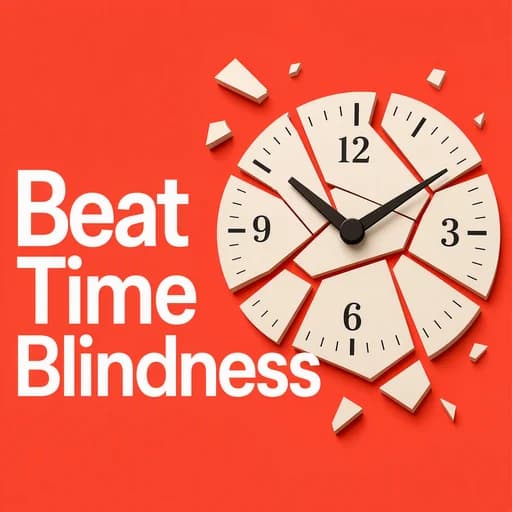
    Time Blindness: Solving Chronic Lateness and the Planning Fallacy

    12 min
    |
    |
    Aug 20, 2026
    • Psychology
    • Self-Growth
    • Productivity

    Explore time blindness and chronic lateness with Dr. Dan Boynton. Learn how the planning fallacy and invisible minutes impact executive functioning and punctuality.

    Time Blindness: Solving Chronic Lateness and the Planning Fallacy
    0:00 / 0:00
    Choose how it's told

    One episode. Many ways to hear it.

    Same ideas from Time Blindness: Solving Chronic Lateness and the Planning Fallacy. Pick the voice, depth, and pace that fits you. Switch anytime.

    Transcript & chapters

    Chapter 1

    The Optimism Delusion and the Hidden Costs of Being Late

    If you have ever found yourself standing in your entryway, one shoe on, staring at a set of keys that seem to have vanished into a parallel dimension while the clock mocks you, then you know that chronic lateness isn't a personality trait—it's a physiological heist. You probably tell yourself that you're just "bad with time" or that you just need to "try harder" tomorrow, but the reality is much more interesting and much less about your moral character. Dr. Dan Boynton, a psychologist who specializes in these executive functioning hurdles, points out that this struggle often stems from something called time blindness. It is a distortion of the senses where your brain essentially edits reality to make life look smoother and faster than it actually is. You aren't lazy; you’re an undercover optimist who is losing a war against "invisible minutes". These are the tiny, overlooked slices of time—the three minutes it takes to find your wallet, the four minutes spent waiting for the elevator, the ninety seconds to double-check that the stove is off—that aggregate into a catastrophe. Most people who struggle with punctuality suffer from what behavioral psychology calls the planning fallacy, which is our internal tendency to underestimate how long a task will take even when we have a history of it taking much longer. You assume the drive to work takes twenty minutes because once, on a Sunday morning in 2022, it actually did. You ignore the fact that on a Tuesday at 8:45 a.m., it’s a forty-minute crawl through the circles of hell. This episode matters because your reputation is currently being drafted by people who don't see your good intentions—they only see the empty chair. We are going to dismantle the mechanics of why you get stuck in the "transition zone" between being ready and actually moving, and more importantly, how to stop negotiating with a clock that isn't interested in your excuses. Here is where it gets interesting: we're starting with the realization that your brain is lying to you about the length of a minute.
    Chapter 2

    Identifying the Psychological Traps of Start and Switch Delays

    To fix the "leaving the house" problem, you have to understand that your lateness usually happens in specific, predictable stages. Dr. Dan Boynton categorizes these as Start Delay and Switch Delay. Start Delay is that paralyzing moment where you know you should begin getting ready, but the task feels like a monolithic mountain, so you check your phone "for just a second." Switch Delay is even more insidious—it's the struggle to transition from one state of being to another. Think about the last time you were fully dressed, bag packed, standing by the door, and you suddenly decided that right now was the perfect time to reorganize your junk drawer or respond to a non-urgent email. This is what Jenny, writing on the psychology of lateness, calls the "just one more thing" effect. You believe you have time for one small task, but in a morning's fragile ecosystem, these "small" tasks are invasive species that destroy the entire schedule. This behavior is often a form of emotional avoidance; you might be unconsciously delaying your departure because you’re dreading a stressful meeting or a difficult coworker. Your brain invents these last-minute errands as a way to stay in the safety of your home just a few minutes longer. The problem is that while you're "just" checking your messages, you're falling into an execution gap. This is the space between receiving a reminder—like a phone notification—and actually converting that into the physical act of walking out the door. Most people rely on passive notifications that appear and disappear, but if you're in the middle of a "Switch Delay" episode, those notifications are easily tuned out. You need to recognize that your brain’s tendency to squeeze in "one more thing" is actually a sophisticated defense mechanism designed to keep you from the discomfort of the transition. Congrats, you've turned your morning into a negotiation with a terrorist, and that terrorist is your own desire for comfort.

    Keep learning with this episode

    Take the ideas from this episode into a guided learning experience in BeFreed.

    Chapter 3

    The Mathematics of Travel and the Myth of the Google Maps Estimate

    One of the most common mistakes you're likely making is treating a GPS estimate as a divine commandment. When Google Maps says it takes twenty-two minutes to reach your destination, your brain hears "I should leave in twenty-two minutes." This is a mathematical error of the highest order. As Ellen Hendriksen, Ph.D., notes, you have to account for transition activities—the mundane, stealthy tasks like finding parking, walking from the lot to the building, or even the sudden realization that your child needs to use the bathroom the second you turn the key in the ignition. These are the "invisible minutes" that Ellen Hendriksen warns about. To counter this, you need to apply a buffer of 25 to 50 percent to every estimate you make. If the GPS says twenty minutes, you treat it as thirty. This isn't being pessimistic; it's being a realist in a world full of red lights and slow elevators. You should also rethink your semantics: instead of saying "I have to be there at 5:00," you should tell yourself "The curtain goes up at 5:00" or "The meeting begins at 5:00". There is a massive difference between being in the vicinity of a building and being in your seat with a pen in your hand. If you aim to arrive precisely on time, you are giving yourself a one-minute window of success; if you arrive at 5:01, you have failed. By aiming to be ten minutes early, you expand your margin of error to a ten-minute window, which drastically reduces the cortisol spike that comes with rushing. Being early isn't a waste of time—it's a luxury. It’s the only time in your day where you are in total control, allowing you to check those "just one more thing" emails in the lobby instead of at your kitchen counter while your keys are missing.

    Chapter 4

    Closing the Loop with a Professional Shutdown Ritual

    The chaos of your morning often starts the night before, specifically in how you leave your workspace. If you finish work mid-thought, your brain refuses to drop the task. This is known as the Zeigarnik effect—the tendency for unfinished tasks to intrude on your attention until they are either finished or captured in a way your brain trusts. This "attention residue" follows you home, making you distracted while you're trying to prep for the next day. To stop this, you need a formal shutdown ritual. Cal Newport, a computer science professor, popularized a five-minute routine that involves reviewing your day, checking tomorrow's calendar, and capturing any loose ends into a trusted system. The final, most important step is actually saying the phrase "shutdown complete" out loud. It sounds ridiculous, but it acts as a verbal anchor that signals to your brain that it is safe to stop worrying about work. Similarly, you can use the "2-Minute Note Hack": before you stop working, write down exactly where you got to, what is unresolved, and what the precise next step is. Vague notes like "continue project" are useless because they force "tomorrow-you" to make a decision, which is where the delay starts. A specific next step like "Update slide 6 with Q3 figures" allows you to hit the ground running. By closing these mental loops, you prevent work anxiety from bleeding into your evening, which is the time you should be using to "transfer your biggest morning headaches to the night before". If you aren't doing a shutdown ritual, you aren't actually leaving work; you're just carrying the office into your kitchen in a state of high-tensile stress.

    Keep learning with this episode

    Take the ideas from this episode into a guided learning experience in BeFreed.

    Chapter 5

    Designing a Frictionless Exit and the Departure Window

    If you struggle with the transition from preparing to leaving, you need to stop viewing "leaving" as a single event and start seeing it as a sequence of mechanical steps. You need a "leaving script" or a pre-departure checklist. This means ensuring all tasks—dressing, packing the bag, finding the keys—are completed before the departure window opens. The biggest trap is thinking you can "just do everything else faster" to make up for a late start. Hurrying doesn't actually save that much time; it just makes you more likely to forget your phone or trip over the cat. Instead, use environmental fixes: place your keys, phone, and wallet in the exact same spot every single night. This removes the "search and rescue" mission from your morning timeline. You should also consider the "Last 5 Minutes Problem," which is the execution gap where you see a reminder but fail to act because you're finishing an email. Passive notifications fail here because they don't demand action. You need an alarm that interrupts you—something that stays on the screen until you physically dismiss it. This forces the "now" to happen. When that alarm goes off, the rule is simple: no more "one more thing." You resist the urge to check the news or send that one last Slack message. By treating your departure time as a hard deadline rather than a suggestion, you stop the internal negotiation. You have to realize that your morning is a fragile ecosystem, and the moment you introduce a "quick" five-minute task, you've essentially invited a wrecking ball into the room.

    Chapter 6

    Combatting Time Blindness with Environmental Anchors

    For those with ADHD traits or chronic executive functioning challenges, "time blindness" is a tendency to underestimate how quickly time passes during focused activity, especially common with ADHD but it also shows up for anyone doing deep work or context-heavy tasks. You might look at the clock and see it's 8:00, then get absorbed in a task and feel like two minutes have passed, only to find it's actually 8:20. This is why standard reminders often fail; they inform you of the time, but they don't help you feel the time. To combat this, you need to transition from notifications to alarms. A notification is a suggestion; an alarm is an interruption. Use persistent alarms that require an active response to clear, forcing you to break your hyper-focus and acknowledge the transition. Dr. Boynton suggests that chronic lateness is a systems problem, not a character flaw, so you need to build systems that don't rely on your memory or your "willpower". One such system is the "Morning Startup," a mirror to the shutdown ritual, where you spend three minutes reviewing your calendar and picking your most important task before you even touch your phone. In fact, one of the most effective rules you can implement is "no phone until you leave the apartment". The phone is the primary delivery mechanism for the "one more thing" trap and the Start Delay. By removing the digital friction, you're left with the physical reality of the tasks at hand. You aren't "bad with time"—you’re just currently unequipped to handle the way your brain distorts it. Providing yourself with external, interrupting cues is how you outsource your executive function to a system that doesn't get distracted by headlines or emails.

    Keep learning with this episode

    Take the ideas from this episode into a guided learning experience in BeFreed.

    Chapter 7

    The Practical Playbook for the Chronic Lateness Cure

    Let's turn these insights into a concrete plan you can start tonight. First, tonight before you finish work, perform a five-minute shutdown ritual: review what you did, check tomorrow’s schedule, capture loose ends, and say "shutdown complete". Then, use the 2-Minute Note Hack to write down your precise next step for tomorrow morning so you don't waste ten minutes "deciding" what to do when you sit down. Second, prep your environment: lay out your clothes, pack your bag, and put your keys in their designated "launchpad" by the door. This is about removing the "invisible minutes" of searching and deciding. Third, when you plan your commute, take the GPS estimate and add a 50 percent buffer for "transition activities" like parking and walking. If you need to be in your seat at 9:00, and the drive is 20 minutes, your "leave by" time isn't 8:40—it's 8:30. Fourth, set a persistent alarm for your departure time, not just a notification. When it goes off, you must follow the "Jacques the Shrimp" rule: resist the urge to do "one more thing". No checking the email, no wiping the counter, no "just one quick text." Finally, try to arrive ten minutes early on purpose just once this week. Observe how it feels to be the person sitting calmly in the lobby rather than the person sprinting down the sidewalk sweating. Notice the difference in how people look at you when you’re already there. You’ll realize that the "reputation" you thought was permanent was actually just a collection of bad habits that you've now started to replace with a better pattern.

    Chapter 8

    Final Reflections on Becoming the Person Who Is Already There

    As we wrap this up, I want you to take a second to reflect on the "identity" you've built around your lateness. You might have spent years telling yourself that you're just "not a morning person" or that you’re "naturally chaotic," but those stories are just programming that keeps you stuck in the same loop. The reality is that you don't need a personality transplant or perfect mornings; you just need a better system. Chronic lateness is often just a series of "invisible minutes" and "Switch Delays" that you haven't yet learned to manage. When you start leaving space for things to go wrong—when you build in that 10-minute buffer—you aren't just being "on time," you are giving yourself the gift of calm. Think about the French saying: "While you keep a man waiting, he reflects on your shortcomings". Turning this around isn't just about being professional; it's about respecting yourself enough to not live in a constant state of frantic apology. You now have the tools to recognize the "one more thing" trap and the "Start Delay" before they take over your morning. You have the shutdown ritual to keep work from following you home and the 2-minute note to make your mornings effortless. The next time you feel the urge to squeeze in one last task before heading out the door, remember the "execution gap" and the "invisible minutes." Just for tomorrow, try being the person who arrives before the meeting starts. Notice the silence, notice the lack of guilt, and notice how much easier life becomes when you stop negotiating with the clock. Thank you for spending this time with me and for being willing to look at your habits with a bit more curiosity and a lot less shame. Apply just one of these rules tomorrow—perhaps the "no phone until I leave" rule—and see how the morning shifts.

    ★★★★★

    You made it to the end of Time Blindness: Solving Chronic Lateness and the Planning Fallacy

    “23 days in and I have used it every single day. It is part of my daily habit now.”

    jayallen

    Best quote from Time Blindness: Solving Chronic Lateness and the Planning Fallacy

    “

    Chronic lateness isn't a personality trait—it's a physiological heist where your brain essentially edits reality to make life look smoother and faster than it actually is.

    ”
    K

    Generated by Kendric

    Input question

    How to cure chronic lateness, focusing on the transition from preparing to leaving. Address the psychological and practical hurdles of 'struggling to start moving' and getting distracted by last-minute tasks even when ready. Include habits for better travel time estimation and ensuring all tasks (dressing, packing) are completed before the departure window.

    Host voices
    Lenaplay
    Knowledge sources
    Why Can’t I Be On Time?: ADHD, Time Blindness, and the “Leaving the House” Problem (Why Can’t I Just...) | Dr. Dan Boynton | Practical Psychology Books
    link
    https://drdanboynton.com/books/why-can-t-i-be-on-time-adhd-time-blindness-and-the-leaving-the-house
    The 2-Minute Note Hack That Stops Work Following You Home
    link
    https://empowerprocess.com/career/the-2-minute-note-hack/
    Shutdown Ritual: Newport's 5-Min End-of-Day Routine (2026) | HabitBox Blog
    link
    https://habitbox.app/blog/shutdown-ritual
    How to Stop Being Late | Psychology Today
    link
    https://www.psychologytoday.com/us/blog/how-to-be-yourself/202109/how-to-stop-being-late
    The Hidden Psychology Behind Chronic Lateness | by Jenny | Mar, 2026 | Medium
    link
    https://medium.com/@vivianx131/the-hidden-psychology-behind-chronic-lateness-99d00a197804
    The Last 5 Minutes Problem: Why Notifications Fail | OnTimer
    link
    https://www.ontimer.app/last-5-minutes-problem

    Frequently Asked Questions

    Time blindness is a distortion of the senses where the brain edits reality to make life appear smoother and faster than it truly is. According to psychologist Dr. Dan Boynton, this executive functioning hurdle means you aren't lazy, but rather an undercover optimist losing a war against time. This physiological heist causes individuals to overlook the small moments that aggregate into a scheduling catastrophe, leading to persistent struggles with punctuality.

    The planning fallacy is a concept in behavioral psychology describing our internal tendency to underestimate how long a task will take, even when history suggests otherwise. For example, you might assume a commute takes twenty minutes based on a single ideal experience, ignoring daily realities like traffic. This cognitive bias leads to chronic lateness because the brain relies on best-case scenarios rather than accurate, lived data.

    Invisible minutes are the tiny, overlooked slices of time that occur during daily transitions, such as searching for keys, waiting for an elevator, or checking the stove. While they seem insignificant individually, these minutes aggregate into a larger time deficit. Dr. Dan Boynton highlights that failing to account for these small gaps is a key reason why people with executive functioning hurdles find themselves consistently behind schedule.

    From Columbia University alumni | built in San Francisco

    BeFreed Brings Together A Global Community Of Curious Minds

    4.7

    avg rating

    7.84k+ App Rating

    BeFreed Community

    Seriously I haven’t even explored this app fully yet but from using it the last few days I am so impressed... BeFreed is on a different level from any other learning app I have used. This makes it ultra engaging and can actually improve your concentration which is great for all the doom scrollers!

    @ladyInfinity

    I bought BeFreed exactly 23 days ago, and I have used it every single day since. It has completely embedded itself into my daily workflow and learning habit.

    @jayallen

    The truth is, the app has exceeded all my expectations. I can ask it to generate audio on any topic, whatever it may be, and the result is impressive. My professional field is a specialization in psychotherapy and it is multidisciplinary; however, the answers are very accurate.

    @Raguipa

    What I appreciate most is how much it's reduced my scrolling – I'm spending less time searching and more time absorbing information. The combination of full audiobooks, podcasts, the learning plans are brilliant.

    @colonyofcreatorsNGO

    I have been a PhotoReading Accelerated Learning Instructor for the past 24 years... books and reading and learning are my thing, and BeFreed has done a great job in providing an innovative approach to disseminating and delivering information in an easy to consume way.

    @BeFreed user

    It is not just a book summary app, I have used the 'fun reading' option and it's a much better summary and way to grasp ideas the traditional way, that alone is worth this deal.

    @austinakon

    I love this app. Used it for several days and I cannot stop listening. Such a great way to start.

    @jcrules328

    I really like the program; I have already tested it for around one month, and I feel that it's an amazing gem. It works so well because I can use BeFreed to create my own topics, and the voice is so good with unlimited choice of narrations.

    @DanielCZ

    Seriously I haven’t even explored this app fully yet but from using it the last few days I am so impressed... BeFreed is on a different level from any other learning app I have used. This makes it ultra engaging and can actually improve your concentration which is great for all the doom scrollers!

    @ladyInfinity

    I bought BeFreed exactly 23 days ago, and I have used it every single day since. It has completely embedded itself into my daily workflow and learning habit.
    @jayallen

    The truth is, the app has exceeded all my expectations. I can ask it to generate audio on any topic, whatever it may be, and the result is impressive. My professional field is a specialization in psychotherapy and it is multidisciplinary; however, the answers are very accurate.

    @Raguipa

    What I appreciate most is how much it's reduced my scrolling – I'm spending less time searching and more time absorbing information. The combination of full audiobooks, podcasts, the learning plans are brilliant.

    @colonyofcreatorsNGO

    I have been a PhotoReading Accelerated Learning Instructor for the past 24 years... books and reading and learning are my thing, and BeFreed has done a great job in providing an innovative approach to disseminating and delivering information in an easy to consume way.

    @BeFreed user

    It is not just a book summary app, I have used the 'fun reading' option and it's a much better summary and way to grasp ideas the traditional way, that alone is worth this deal.

    @austinakon

    I love this app. Used it for several days and I cannot stop listening. Such a great way to start.

    @jcrules328

    I really like the program; I have already tested it for around one month, and I feel that it's an amazing gem. It works so well because I can use BeFreed to create my own topics, and the voice is so good with unlimited choice of narrations.

    @DanielCZ

    I love the fact that I can get useful, condensed, information and ideas in a 8 - 15 minute podcast style audio. I'm not a general fan of podcasts because of all the fluff, but this cuts through all that.

    @BeFreed user

    I am finishing up my doctorate, and have to read a lot of unfamiliar material... With BeFreed, you simply enter a prompt, and the app finds source material for you and generates an audio podcast. I find the process in BeFreed to be more streamlined than NotebookLM.

    @Brad

    I often search YouTube for something to listen to whilst making breakfast, when I'm out walking, commuting, etc, and BeFreed has provided an even more targeted approach, without the adverts and the fluff!

    @BeFreed user

    The absolute best part about this platform is its versatility. There is literally no subject that is off-topic. It handles whatever you throw at it... It is rare to find an learning tool with zero limitations that actually delivers on its promises.

    @jayallen

    BeFreed is fantastic. The user-friendly design means I spend less time navigating and more time learning. The mix of audiobooks, podcasts, and learning plans is a genius combo that has completely changed my daily routine.

    @BeFreed user

    At the start I needed a while to understand how to create podcasts in italian language and boom! It is so great! I can ask to explain every argument and it does so well and so smartly!

    @matteo77

    BeFreed has become my daily app for audio books tools... What I like the most is the way you put your text and come with an audio that you can listen on the go.

    @kotanzu1

    I love the fact that I can get useful, condensed, information and ideas in a 8 - 15 minute podcast style audio. I'm not a general fan of podcasts because of all the fluff, but this cuts through all that.

    @BeFreed user

    I am finishing up my doctorate, and have to read a lot of unfamiliar material... With BeFreed, you simply enter a prompt, and the app finds source material for you and generates an audio podcast. I find the process in BeFreed to be more streamlined than NotebookLM.

    @Brad

    I often search YouTube for something to listen to whilst making breakfast, when I'm out walking, commuting, etc, and BeFreed has provided an even more targeted approach, without the adverts and the fluff!

    @BeFreed user

    The absolute best part about this platform is its versatility. There is literally no subject that is off-topic. It handles whatever you throw at it... It is rare to find an learning tool with zero limitations that actually delivers on its promises.

    @jayallen

    BeFreed is fantastic. The user-friendly design means I spend less time navigating and more time learning. The mix of audiobooks, podcasts, and learning plans is a genius combo that has completely changed my daily routine.

    @BeFreed user

    At the start I needed a while to understand how to create podcasts in italian language and boom! It is so great! I can ask to explain every argument and it does so well and so smartly!

    @matteo77

    BeFreed has become my daily app for audio books tools... What I like the most is the way you put your text and come with an audio that you can listen on the go.

    @kotanzu1

    See more on how BeFreed is discussed
    129.7K19.5K
    55.2K19.2K
    154.2K10827355
    48.1K2.5K
    81.2K6.6K
    82.3K1.8K
    Start your learning journey, now
    BeFreed app
    BeFreed

    Learn Anything, Personalized

    DiscordLinkedIn
    Featured book summaries
    Crucial ConversationsThe Perfect MarriageInto the WildNever Split the DifferenceAttachedGood to GreatSay Nothing
    Trending categories
    Self HelpCommunication SkillRelationshipMindfulnessPhilosophyInspirationProductivity
    Celebrities' reading list
    Elon MuskCharlie KirkBill GatesSteve JobsAndrew HubermanJoe RoganJordan Peterson
    Award winning collection
    Pulitzer PrizeNational Book AwardGoodreads Choice AwardsNobel Prize in LiteratureNew York TimesCaldecott MedalNebula Award
    Featured Topics
    ManagementAmerican HistoryWarTradingStoicismAnxietySex
    Best books by Year
    2025 Best Non Fiction Books2024 Best Non Fiction Books2023 Best Non Fiction Books
    Featured authors
    Chimamanda Ngozi AdichieGeorge OrwellO. J. SimpsonBarbara O'NeillWinston ChurchillCharlie Kirk
    BeFreed vs other apps
    BeFreed vs. Other Book Summary AppsBeFreed vs. ElevenReaderBeFreed vs. ReadwiseBeFreed vs. Anki
    Learning tools
    Knowledge VisualizerAI Podcast Generator
    Information
    About Usarrow
    Pricingarrow
    FAQarrow
    Blogarrow
    Careerarrow
    Partnershipsarrow
    Ambassador Programarrow
    Directoryarrow
    BeFreed
    Try now
    © 2026 BeFreed
    Term of UsePrivacy Policy
    BeFreed

    Learn Anything, Personalized

    DiscordLinkedIn
    Featured book summaries
    Crucial ConversationsThe Perfect MarriageInto the WildNever Split the DifferenceAttachedGood to GreatSay Nothing
    Trending categories
    Self HelpCommunication SkillRelationshipMindfulnessPhilosophyInspirationProductivity
    Celebrities' reading list
    Elon MuskCharlie KirkBill GatesSteve JobsAndrew HubermanJoe RoganJordan Peterson
    Award winning collection
    Pulitzer PrizeNational Book AwardGoodreads Choice AwardsNobel Prize in LiteratureNew York TimesCaldecott MedalNebula Award
    Featured Topics
    ManagementAmerican HistoryWarTradingStoicismAnxietySex
    Best books by Year
    2025 Best Non Fiction Books2024 Best Non Fiction Books2023 Best Non Fiction Books
    Learning tools
    Knowledge VisualizerAI Podcast Generator
    Featured authors
    Chimamanda Ngozi AdichieGeorge OrwellO. J. SimpsonBarbara O'NeillWinston ChurchillCharlie Kirk
    BeFreed vs other apps
    BeFreed vs. Other Book Summary AppsBeFreed vs. ElevenReaderBeFreed vs. ReadwiseBeFreed vs. Anki
    Information
    About Usarrow
    Pricingarrow
    FAQarrow
    Blogarrow
    Careerarrow
    Partnershipsarrow
    Ambassador Programarrow
    Directoryarrow
    BeFreed
    Try now
    © 2026 BeFreed
    Term of UsePrivacy Policy

    More like this

    The Psychology of Chronic Lateness book cover
    Chronic Lateness Psychology: Root Causes and Real Fixes - ReachLinkRevenge Bedtime ProcrastinationAlways Late? How To Be On Time — For RealA Late Person's Guide to Being on Time - The Cut
    9 sources
    The Psychology of Chronic Lateness
    Struggling to be on time isn't a character flaw. Discover the neuroscience of time blindness and practical shifts to close the intention-behavior gap.
    1103 min
    The Transition Zone: Ending Chronic Lateness book cover
    Chronic Lateness Psychology: Root Causes and Real Fixes - ReachLinkHow to Stop the ADHD Task Avalanche Before You Leave the ...The 'Did I Forget Something?' Feeling: What It Is and How to Fix It - CheckYourListTop 9 Micro Routines to Simplify Busy Weeknights Without Stress | Blog
    6 sources
    The Transition Zone: Ending Chronic Lateness
    Struggling to leave the house even when you're ready? Learn to manage the 'task avalanche' and build a launchpad that gets you out the door on time.
    866 min
    Time Management as Conscious Choice book cover
    [url_d03702a8:c0000] Time management p1-1[url_d03702a8:c0001] Time management p1-1[url_d03702a8:c0005] Time management p1-1
    6 sources
    Time Management as Conscious Choice
    Stop letting the day happen to you. Discover how conscious control and understanding your brain’s hurdles can turn a frazzled schedule into freedom.
    13 min
    Master Your Time: Science-Backed Productivity Secrets book cover
    source 1source 2source 315 Essential Time Management Techniques For Peak Productivity
    6 sources
    Master Your Time: Science-Backed Productivity Secrets
    Discover why traditional time management fails and learn proven strategies from psychology and productivity research to align your daily hours with what truly matters most.
    10 min
    Time Management: Reclaiming Your Day book cover
    [url_d03702a8:c0000] Time management - Wikipedia p1-1[url_d03702a8:c0001] Time management - Wikipedia p1-1[url_d03702a8:c0005] Time management - Wikipedia p1-1
    3 sources
    Time Management: Reclaiming Your Day
    Feeling behind before your day even starts? Learn to shift from being overwhelmed to taking conscious control of your time for a more balanced life.
    14 min
    ADHD time management and the wall of task paralysis book cover
    Thriving with Adult ADHDOrder from ChaosYou Mean I'm Not Lazy, Stupid or Crazy?!How to ADHD
    22 sources
    ADHD time management and the wall of task paralysis
    Struggling with task initiation isn't a lack of willpower. Learn how to use external scaffolding to manage time blindness and beat procrastination.
    23 min
    Master Your Time: From Chaos to Intentional Living book cover
    Time Management: 10 Strategies for Better Time ManagementPrinciples of Effective Time Management for Balance, Well-being, and Successsource 3source 4
    6 sources
    Master Your Time: From Chaos to Intentional Living
    Discover research-backed strategies to escape the urgency trap and focus on what truly matters. Learn practical techniques for deep work, defeating procrastination, and aligning your daily choices with your deepest values.
    9 min
    Time Management: The Art of Conscious Control book cover
    [url_d03702a8:c0000] Time management - Wikipedia p1-1[url_d03702a8:c0001] Time management - Wikipedia p1-1
    2 sources
    Time Management: The Art of Conscious Control
    When your to-do list feels like a whirlwind, staying busy isn't enough. Learn to reclaim your day through conscious choices that lead to true balance.
    12 min